Updated Jun 1, 2026 by Duolingo
What can I help with?
AI-powered answers with citations from the library.
What can I help with?
AI-powered answers with citations from the library.
Financial
Published by Duolingo
Duolingo reported robust Q3 2025 performance, with revenue climbing 41 % YoY to $271.7 million and daily active users expanding 36 % to 50.5 million. Paid‑subscriber growth of 34 % brought the total to 11.5 million, representing a 9.0 % penetration of the last‑12‑month active user base. Adjusted EBITDA reached $80 million, a 29.5 % margin, bolstered by a one‑time tax benefit and operating leverage that offset rising artificial‑intelligence expenses. Management projects fiscal‑year bookings of 33 % YoY and revenue growth near 38 %, targeting an adjusted EBITDA margin of 29.0 %. The company explains that its core operating metrics—MAUs, DAUs, paid subscribers, and subscription/total bookings—are derived from an internally developed analytics platform that has not undergone third‑party validation. Methodological updates can affect year‑to‑year comparability, and Duolingo cautions that other industry peers may calculate these figures differently, potentially limiting direct comparisons. Free‑cash‑flow reconciliation shows a shift in definition from Q1 2025 onward. For the quarter ended September 30, FCF rose from $51.2 million (26.6 % of revenue) in 2024 to $77.4 million (28.5 %) in 2025, driven by higher operating cash and increased capital expenditures. A one‑time $222.7 million tax benefit from releasing a valuation allowance is noted, and FCF excludes discretionary cash uses. Overall, Duolingo demonstrates strong top‑line momentum and improving profitability while acknowledging methodological caveats that may affect metric comparability across the industry.
our mission is to develop the best education in the world and make it universally available. o. DUOLINGO Q3 / FY 2025 2
Q3 Highlights User Metrics Q3 2024 Q3 2025 Daily Active Users 37.2M 50.5M 36% YoY Monthly Active Users 113.1M 135.3M 20% YoY Paid Subscribers 8.6M 11.5M at period end 34% YoY Paid Subscriber Penetration 8.5% 9.0% as % of LTM MAUs Financial Metrics Q3 2024 Q3 2025 Revenue 192.6M 271.7M 41% YoY Total Bookings 211.5M 281.9M 33% YoY Net Income (1) 23.4M 292.2M Adjusted EBITDA 47.5M 80.0M 24.7% margin 29.5% margin (1) During the three months ended September 30, 2025, the Company released the valuation allowance previously recorded against its federal and state deferred tax assets, resulting in a one-time income-tax benefit, net of a return-to-provision adjustment, in the period of $222.7 million. DUOLINGO Q3 / FY 2025 3
Dear shareholders, 2025 is shaping up to be another standout year for us. Through the first nine months, DAUs and revenue are both up 40% or more compared to the same period last year, and we continue to expand profitability. In Q3, we crossed an important milestone: more than 50 million people now use Duolingo every day. We also saw chess become our fastest-growing subject, had our biggest brand moment in Asia by partnering with Luckin Coffee, and launched a LinkedIn integration so learners can showcase their Duolingo Score. coffee 123 0123 x Over 26,000 Luckin stores in Asia partnered with us, selling more than 10 million Duolingo-branded drinks in two weeks. DAUs grew 36% year over year in Q3, even on top of an exceptional Q3 last year. Growth was slightly slower than Q2 in part because we posted less “unhinged” content on our English-speaking social media accounts as we listened to community feedback and prioritized building long-term brand sentiment. We recently started posting more unhinged content, and while impressions haven’t yet reached peak volume, we’ve seen a significant increase in them. We also modestly increased marketing spend to help drive momentum, particularly in the US. These actions support near-term user growth, but long-term gains will come from making our product even more engaging and effective. Taking the long view One of our five operating principles is “take the long view.” The opportunity ahead of us is to teach billions of people, and while we’ve made incredible progress, we know we’re early in our journey.
m gains will come from making our product even more engaging and effective. Taking the long view One of our five operating principles is “take the long view.” The opportunity ahead of us is to teach billions of people, and while we’ve made incredible progress, we know we’re early in our journey. We focus on three core areas as we look to continuously improve our product: monetization, user growth, and teaching better across all our subjects. Each impacts our financial results on a different timeline. Monetization improvements, such as getting more users to subscribe, show up immediately. User growth improvements take longer to show up in our finances, since it takes time for people to subscribe. And teaching improvements take the longest, since they take time to improve user growth, which in turn takes time to improve monetization. DUOLINGO Q3 / FY 2025 4
One of the most important parts of my job is balancing among these three core areas, both in terms of relative investment and navigating tradeoffs between them. For example, changes that boost subscriptions may have a negative impact on free user growth, so we have to determine what tradeoff makes sense. In Q3 we decided to shift the balance towards longer-term initiatives. In particular, we’re investing proportionally more in teaching better, and we’re prioritizing user growth over monetization in the A/B tests that get launched. This shift is reflected in our full-year guidance. We’re doing this now because we want to keep growing users for a long time, and because of our increasing conviction that AI can fundamentally change what’s possible in how we teach. If we develop an app that is more engaging than, and teaches as well as, a personal tutor across multiple subjects, we think we’ll become a much bigger business in the long-term. Looking ahead As for Q4, I’m excited about a number of product initiatives. We’ve introduced player-vs-player on our chess course, a new flashcards exercise for better word memorization, and a new guided Video Call format that should help increase Max adoption. Q4 also brings two of our biggest annual events: Year in Review and our New Year’s Promotion. Both are high-impact events with global reach that we believe will set us up for a strong finish to the year. Take the long view, Luis von Ahn CEO and Co-Founder DUOLINGO Q3 / FY 2025 5
Summary of Financial and Key Operating Metrics (in millions) Q3 2024 Q3 2025 YoY User Metrics Monthly active users (MAUs) 113.1 135.3 20% Daily active users (DAUs) 37.2 50.5 36% Paid subscribers (period end) 8.6 11.5 34% Operating Metrics Subscription bookings 176.3 240.3 36% Total bookings 211.5 281.9 33% GAAP Financial Measures Revenues 192.6 271.7 41% Subscription revenues 157.6 229.5 46% Gross profit 140.4 196.9 40% Gross margin (%) 72.9% 72.5% ~(40) bps Net income (1) 23.4 292.2 >100% Net cash from operating activities 56.3 84.2 50% Non-GAAP Financial Measures (2) Adjusted EBITDA 47.5 80.0 68% Adjusted EBITDA margin 24.7% 29.5% ~5 pts Free cash flow (3) 51.2 77.4 51% Free cash flow margin (3) 26.6% 28.5% ~2 pts (1) During the three months ended September 30, 2025, the Company released the valuation allowance previously recorded against its federal and state deferred tax assets, resulting in a one-time income-tax benefit, net of a return-to-provision adjustment, in the period of $222.7 million. (2) Please refer to the Appendix at the end of this letter for a reconciliation of non-GAAP financial measures to the most directly comparable GAAP financial measure. (3) The prior period has been recast to conform to current period presentation. Amounts reported in millions are computed based on the amounts in thousands. As a result, the sum of the components reported in millions may not equal the total amount reported in millions due to rounding. In addition, percentages presented are calculated from the underlying numbers in thousands and may not add to their respective totals due to rounding.
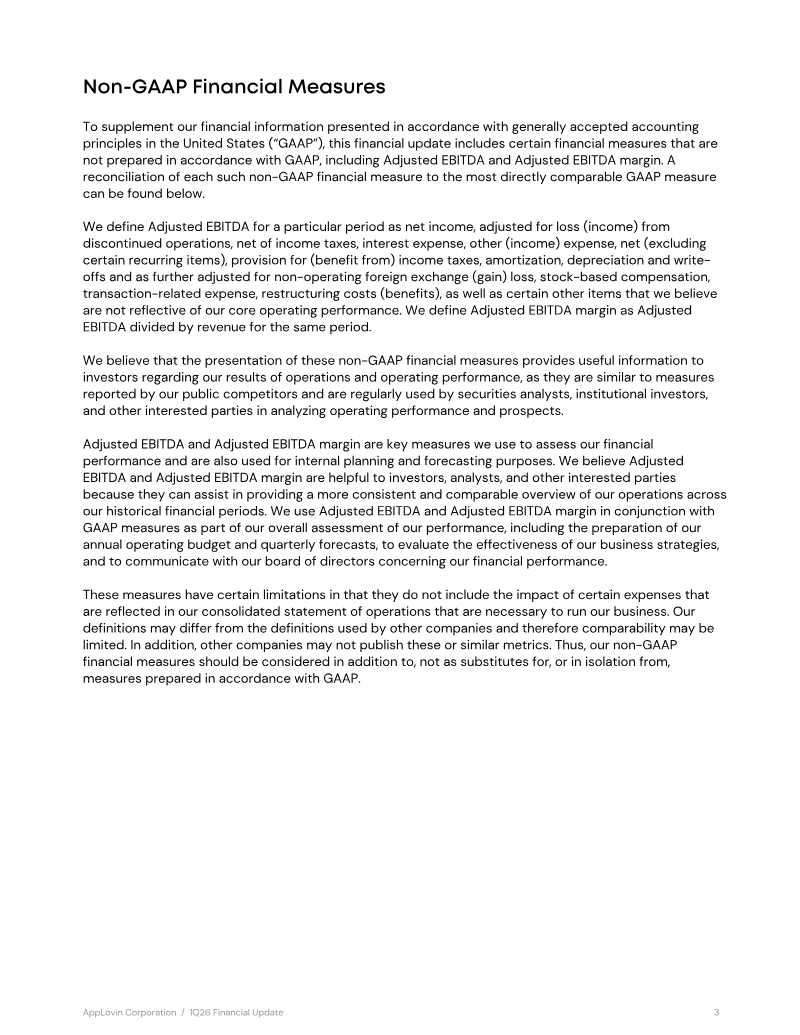
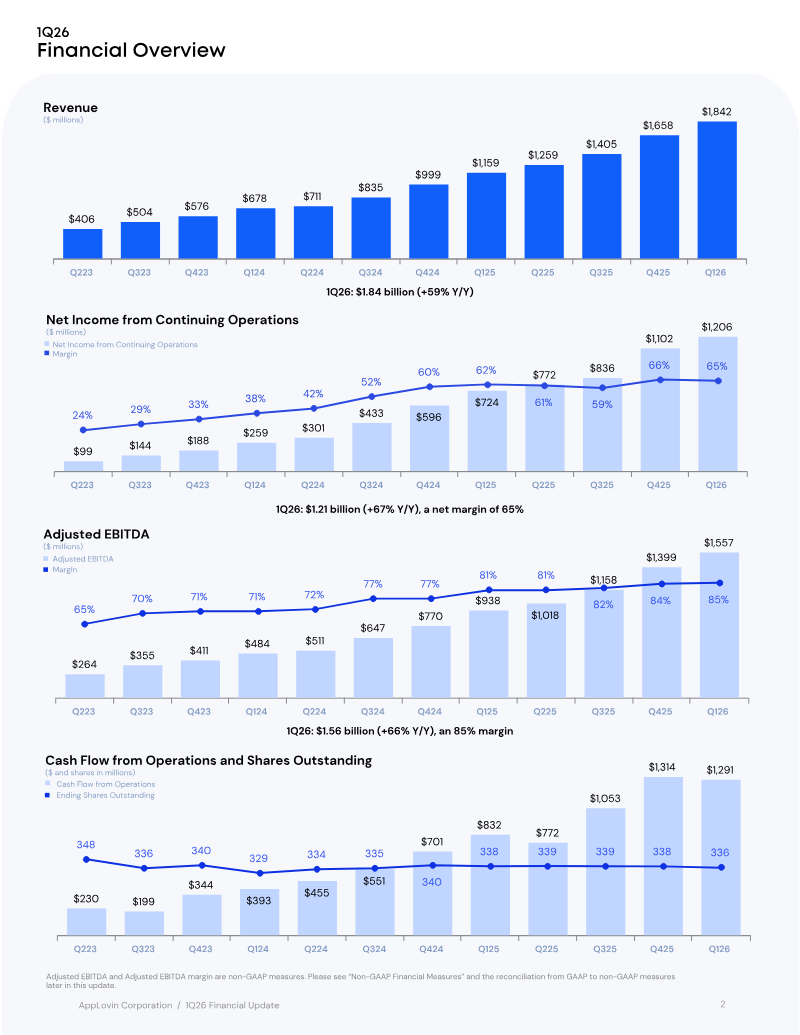
AppLovin’s Q1 2026 financial update reports a revenue of $1.842 billion, up 59% year‑over‑year, and net income from continuing operations of $1.206 billion, a 66% increase to a net margin of 65%. Adjusted EBITDA reached $1.557 billion, an 85% margin, reflecting a 66% rise from the prior year. Cash flow from operations matched Adjusted EBITDA at $1.556 billion, underscoring strong operating liquidity. Shares outstanding averaged 1.053 million, with diluted earnings per share of $3.56. The company’s balance sheet shows cash and equivalents at $2.759 billion, up from $2.487 billion, and total assets of $7.708 billion versus $7.260 billion a year earlier. Long‑term debt remained stable at $3.514 billion, while equity rose to $2.363 billion from $2.135 billion. Operating expenses grew modestly, with research and development increasing to $94 million from $56 million, while sales and marketing rose slightly to $60.8 million. Methodologically, the update presents both GAAP and non‑GAAP measures; Adjusted EBITDA is defined by excluding items such as stock‑based compensation, restructuring costs, and goodwill impairment. The reconciliation table shows cumulative Adjusted EBITDA margins climbing from 65% in Q1 2025 to 85% in Q1 2026, driven by revenue growth and controlled cost expansion. The update covers the United States market for Q1 2026, with data drawn from audited financial statements and internal reconciliations.
The 2026 State of Gaming analysis demonstrates a shifting landscape in which mobile gaming remains the largest driver of downloads—approximately 50 billion in 2025—but its growth rate is slowing. Revenue, however, continues to climb as monetization models mature and lifetime value deepens, especially within hybrid‑casual titles that now generate the most incremental income. In contrast, PC and console platforms experience record revenue growth, with Steam’s premium segment up 32 % and blockbuster releases such as Battlefield 6 capturing significant market share from incumbents. Shooter downloads on these platforms have plateaued, suggesting new titles are primarily cannibalizing existing audiences rather than expanding the category. Genre‑specific dynamics reveal that strategy games are the only mobile genre to grow in downloads, driven by 4X titles from Eastern developers. Action and shooter games dominate PC/console gains, while hyper‑casual remains the largest download engine but shows a notable lift in time spent, particularly in Tier 2 markets. Casual titles face declining day‑7 retention, indicating a stickiness challenge that could erode long‑term player value. Live‑ops and acquisition strategies have evolved toward retention‑focused events, multi‑tier season passes, and expedition‑style rewards. These mechanisms now represent the most reliable revenue drivers across competitive genres such as RPG, action, and simulation. Advertising spend remains concentrated on social channels—YouTube, Facebook/Instagram—and high‑attention formats like video, playable, and rewarded ads. Battlefield 6’s pre‑launch spend surpassed Call of Duty titles, leveraging Facebook, Reddit, and desktop display, while its post‑launch strategy pivoted to YouTube with cinematic, celebrity‑hook creatives. Geographically, the U.S. market shows a skew toward lifestyle and puzzle categories despite lower IAP shares, whereas casino titles exhibit higher spend‑to‑revenue efficiency. Overall, the industry is moving from acquisition toward deeper monetization per user, with indie shooters and simulation titles gaining traction amid intense competition in the shooter segment.
Hybrid monetization can increase revenue without eroding player retention by treating advertisements as an integral part of the game’s design system. Three core ad formats—interstitials, rewarded video (RV), and banners—are positioned strategically through careful gating on level progression, playtime, or cooldown periods. Optimal triggers and placement reduce player frustration while maximizing eCPM, ensuring that monetization flows naturally with gameplay. Rewarded video is most effective when offered during high‑stakes moments such as revives, boosters, or time‑limited rewards. Leveraging scarcity and urgency in these contexts drives conversions while preserving the core experience. Consistent visual cues, a clear distinction between coin rewards and RV value, and optional “No Ads” bundles further balance monetization with player comfort. Selling “No Ads” bundles requires thoughtful presentation. Bundles should appear side‑by‑side with regular items, use distinct visual cues and anchoring to convey high value, and be gated behind a minimum purchase tier to protect payer retention. Segmenting ad exposure—capping impressions, applying cooldowns, and filtering out disruptive creatives—maintains a positive user experience while sustaining revenue. Overall, the strategy blends ad formats with gameplay mechanics, employs scarcity and urgency for rewarded video, and offers high‑value “No Ads” options. This approach delivers robust monetization across diverse segments while safeguarding long‑term player engagement and retention.
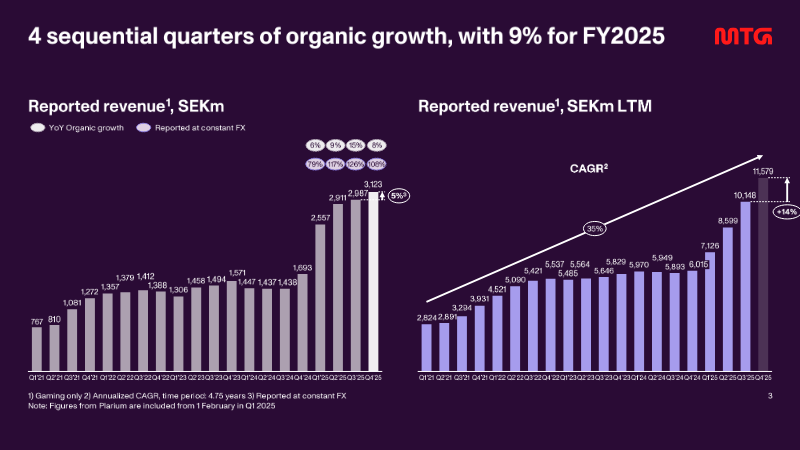
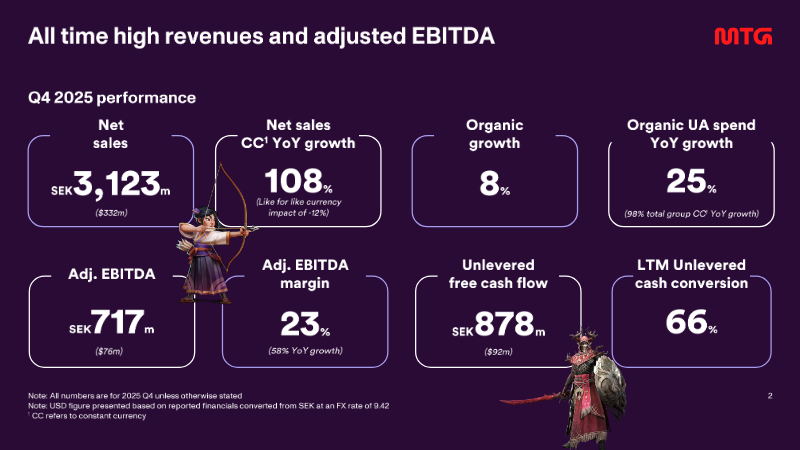
The interim filing presents the fourth‑quarter 2025 financial results for a midcore‑casual gaming group, emphasizing a record‑setting revenue run and the successful execution of a transformation agenda that includes the integration of the Plarium acquisition and the rollout of a new district structure in early 2026. Revenue reached SEK 3,123 million, reflecting 108 % organic growth year‑on‑year and a 25 % increase on a constant‑currency basis, while adjusted EBITDA rose to SEK 717 million, delivering a 23 % margin that matches the full‑year figure. Unlevered free cash flow amounted to SEK 878 million, with a cash‑conversion rate of 66 % and a leverage ratio of five times EBITDA, underscoring robust liquidity and disciplined capital management. User‑acquisition spending accelerated, representing 38 % of quarterly revenue—up from 37 % in the prior quarter—and grew 76 % on a reported basis, driven by heightened investment in original studios, new casual titles, and the racing franchise. The direct‑to‑consumer channel expanded by 600 basis points to 32 % of total revenue, reflecting a strategic shift toward higher‑margin in‑app purchases. Across the fiscal year, the company posted a 9 % organic revenue increase, with word‑games, racing, and RAID franchises delivering the strongest quarter‑end performance. Operating cash flow for the quarter stood at SEK 840 million, while adjusted net income was SEK 1,390 million, translating to an adjusted EPS of SEK 11.33. The financial outcomes exceed guidance and position the firm to meet its medium‑term outlook, with a pre‑IPO study for PlaySimple concluded and the midcore transformation progressing as planned.