1 free read left. Create a free account for unlimited reading + AI research.
Create free account
Bill Walsh | Don't Make Enemies (Philosophy Friday #9)
Key insights
7 takeaways- 01Maintain professional distance from toxic individuals rather than engaging in retaliatory behavior, as these issues typically resolve themselves without active intervention.
- 02Avoid forced political maneuvering to maintain personal credibility, as authenticity is essential for effective leadership.
- 03Treat the gaming industry as an infinite game focused on innovation rather than a zero-sum competition, as collaboration consistently yields superior results compared to aggressive rivalry.
- 04Focus on unique value propositions and shared learning rather than creating common enemies, which often serves as a distraction from core product excellence.
- 05Use personal frustrations as diagnostic signals to identify and address systemic workplace issues rather than viewing them as personal vendettas.
- 06Ensure communication is objective, clear, and concise to minimize the workplace drama that frequently stems from miscommunication.
- 07Prioritize long-term organizational objectives over interpersonal conflict to prevent the significant resource drain caused by harboring professional enemies.
Ask AI about this video
Transcript
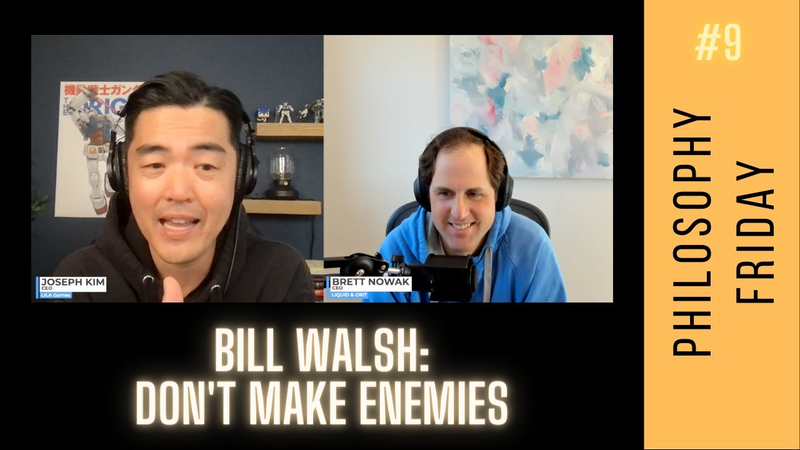
philosophy friday everybody hello and welcome your host today as usual myself joseph kim and brett novak and today we are going to discuss a philosophy from bill walsh which he calls make friends not enemies and this is from the book the score takes care of itself but let me actually dive right in and read from the book enemies take up your time energy and attention commodities too valuable to squander frivolously that's why i instructed everyone in our organization players staff and all others to do everything possible to get along with people who interacted with us even when it might appear they were treating us unfairly we simply couldn't afford to waste resources fighting needless fights whether with fans media vendors sponsors
other teams or anyone else including squabbles among ourselves you can quickly find yourself doing nothing but chasing so-called enemies okay brad one of the issues i've been thinking about recently is some anger i personally feel when i think about you know something someone says which is clearly intended as a slight or being screwed over by someone or a mean tweet well okay maybe not a mean tweet because i don't use twitter that much but anyway i and you know i'm usually pretty good about not holding in any anger it's something i can't say it was true for all of my career because i think early on i did tend to hold in anger i did tend to like make more enemies and for me today i can't really even think of anyone who i consider an enemy and so like
the approach for me these days is generally to just disengage from people who who i think are either wasting my time or where there's been some mistreatment or where i think there's a lack of character for example but it's kind of like what my yoga teacher tells me when i'm doing a yoga session you know let go of whatever doesn't serve you but anyway just wanted to talk about this topic today but also get your cake in terms of how you think about anger enemies in this and you know kind of what we read from bill walsh yeah i think it's a super interesting question and i i think i struggled with this as well particularly when i was younger and when i was working at larger companies i struggled with this a ton also because when i transitioned from being a professional hockey player i think i was somewhat trained to just be a little bit overly aggressive and i had to some somewhat detrain that when i joined
a company although zynga was pretty aggressive so it allowed me to sort of stay in that state really really was until after i left zynga that i really had to de-train this but i ultimately didn't really mastered enough i mean i listed a few people that i couldn't stand in my last company the dev lead who just has meetings all day like his calendar was just nine to six like meetings and he got paid so much the hr person who was a total backstabber like you tell them one thing and then they were just totally like not even basically lying to your face the boss who threw under the bus the marketing head who had no concept of ltv and when you brought it up they were pissed at you for it and uh the head of sales who always got pissed at you like if you didn't check in every second with this person so dude those are actual people that i can remember really having problems with it that's not just like such just like
random thoughts those are those are actual people i'm like oh you know but ultimately i try to live by the creed if you seek revenge you should dig two graves because i have found that when you try to get back at people that you ultimately get back at yourself and right so i do try to let things go but i would say that sometimes when you let things go to too much you can you can piss people off as well so a lot of unpack here and i think it's an interesting point because i also don't feel like you want to totally let go of your emotions too much you know as we've talked about before i'm a big believer in the emotional alert system of your brain and you have to be cognizant of why you're getting those emotions and what really is causing it and what to do about it so right now i really like that the quote you mentioned about the two graves i absolutely think that's true especially when i think about my younger self and myself
when i was you know much earlier in my career i definitely felt a lot more personally right like i would personalize a lot of issues a lot more than i do today whereas you know like there's a lot of things people might say about me i'm just like whatever and so for me a lot of that stuff just doesn't matter and i think one thing that kind of helped me in terms of of like just depersonalizing and letting go is just like this saying about hey let's just agree to disagree and i i think that right because because then um that that just allows us to help depersonalize stuff and because i don't think we're talking a lot about like intra company dynamics right now but within a company i don't think if there is now this kind of harkens back to our last talk about decision making but i think if there's a good decision-making structure within a company there shouldn't be
a reason to have hostility and conflict in a company now there should be a way in which there there should be disagreements there should be some level of conflict but not that should be like where people are taking things personally and wasting time on unnecessary anger and resentment but when i think about the ways in which people can approach this concept of enemies i kind of think of it is is three different ways and and so like the first would be okay like maybe somebody hurt you in some way somebody said something about you the first part is you kind of let go and disengage and i would bucket myself into that camp where it's just like okay you know these people are whatever maybe they're saying something or they actually did something bad to me and it's like all right well i'm just gonna disengage the second which is what sounds like bill walsh's um
is supporting is to let go but also to engage basically trying to flip enemies into friends and the third would be to actually to not let go but to actually fight back right so and i think this is one aspect where i would differ from bill walsh's philosophy and that i for me personally i can see that there could be some benefit if you could flip an enemy into a friend but i generally don't spend time doing that and maybe i can also go back and read from from bill walsh where he says hostile relationships are toxic cultivate good relationships i cautioned be available avoid making enemies don't close off communications i taught those in the organization that it was necessary to initiate communication after a conflict even if the other person had
misunderstood you or wrongfully ridiculed you and to understand that regardless of the cause of the animosity negative relationships have ongoing negative consequences i felt that positive or at least non-adversarial relationships were a tangible and significant organizational asset i worked hard at following my own advice about having no enemies and that paid handsome dividends so brett my question to you is more on the part about this kind of second model this continuous communications after conflict so in the book bill walsh then also talks about a specific example where he turned an adversarial relationship between him and howard cosell where a comment he made pissed off howard kosov then he reached out to him flipped him from being an enemy to being a supporter of bill walsh so my question to you brett would be how do you think about this second aspect regarding enemies
you know that's a tough one i in my experience and i'm thinking back to being a product manager it has benefited me to talk to someone after we've gotten into a disagreement and i wouldn't call this person probably uh i wouldn't call this person an enemy in fact this person was my boss and now he's a great friend of mine but being the the actually the conflict that we had brought us a lot closer because it showed that we could have a very serious disagreement and we could get pretty heated and then go out and have you know lunch the next day and those moments were actually what i thought that brought us the closest together and so i do think that you can use that to your advantage and i haven't not not into advantage i don't think it's the right way but to your benefit and i have done that in the past where i've i've basically used a moment where it was pretty intense and and then been the one to bridge the gap very quickly afterwards and then fostered an even stronger
relationship afterwards in this case it was with my boss so it was very beneficial i think the counter to that is that if you generally dislike somebody which i have definitely just like a lot of people particularly people i worked with and i think what i dislike that's really hard because particularly for me i'm extremely transparent as my wife says kind of like what you see is what you get and she means that in in a compliment complimentary way but because i'm so transparent it's very hard for me to play the air quotes game and i tried man like i was in the last company and it was my goal for the quarter to play the game meaning to be political to go meet the people i didn't like and ultimately it backfired because i just couldn't i couldn't really convince them that i actually didn't like them because that was just ultimately just too transparent
you know like they could just pick they could just pick up on it right and ultimately then they banded together and you know we're like so i think you have to be careful about about being fake about it and i think that it's okay to avoid people and particularly if you have the control to do it i think when you're in a company it's a lot harder but we were just talking about this before we jump on the podcast jk i'm like the leader of not having meetings with people to the point where people will get they'll be like what is wrong with this guy you know they just wanted they'll want to jump on a call or whatever i'd be like no no no no and it's not and we'll get into this later it's not personal it's just that i don't i don't know about fos i'm careful not to waste time just to foster relationships and i know people will say well yeah but you never know what's going to help you that's true but at the same time i kind of know what i can create with that hour or half an hour that uh that meeting might take up
and so i err on the side very often of going with the known then this like theoretically unknown you know so yeah and i i think to your point about playing the game versus not playing the game like for me i've never really been good at playing the game and i think at this point in my career a lot of what i think about is just man life is so short so i just don't for me it seems like such a waste of time to try and engage with enemies to try to flip them on the off chance that something you know beneficial could happen later but i do think that to your point though like maybe situationally you should think about in terms of the first few buckets whether you let go and disengage or let go and then try to let go of like a slight or something bad that someone's done to you and then try to engage and flip to being a friend probably would be situation like in your case if it was your boss i mean that's a pretty
important relationship at a company so it probably makes sense to invest some time in in that you would think you would think i wouldn't get so angry at my boss that would be not true you would think that that would think this is my boss don't get angry at him but my boss is who i got angry at the most yeah sorry i interrupted but no but yeah so i i can't see an argument where you could say that maybe you shouldn't completely disengage for certain relationships it probably does makes like you know situationally or strategically to think about maybe there are certain relationships you should try to use and flip turning an enemy into a friend um but then let's consider the third option which is fighting back i generally don't fight back i usually just like ignore like whatever has happened it's like it's just again because i'm i'm more oriented on time i'm just like [ __ ] it whatever
i'm moving on i'm i'm gonna look forward but i do remember early in my career i used to work at cisco systems the the networking and internet router company not the food company and the ceo of cisco at the time was a guy by the name of john chambers who is actually in silicon valley considered to be one of the great ceos like one incredible ceos but he actually had the opposite perspective on enemies so i thought we could talk about this so i distinctly remember i still remember to this day all hands meeting where john talked about a company that was doing something to cisco and he talked about you know what if a company comes after us if they hit us we're gonna go back and we're gonna hit them back 10 times harder and you know and even speaking to our own industry in gaming i will say some very successful ceos and companies
do take a very i guess we could call it enemies focused approach to competitors into perceived slights or actual attacks right and i mean i can't say with a hundred percent confidence but for example this is well known so everybody in the industry should know but word on the street is that apple is one of these companies that really treats companies and people as a friend or enemy right where it's kind of a lot of the word on the street is they that they do have a blacklist of people and you can get blackballed based upon if you say anything negative about apple right and we also see the pulsing and action between apple and facebook which can really only be described as a beef or a grudge between the companies i mean let's just be real that there's a beef there for sure we also see this war between epic and
apple and so i guess you know can we make the argument that rather than not having enemies the policy for some companies maybe should be to not only fight back but to try and attack back and really engage with enemies or not i mean brett what do you think should should you always have a no enemies policy or given apple and other companies that do engage with enemies that are very successful are there cases in which we can make an argument that you should actually engage you should actually fight back against enemies i think this is a great point and i i think what what i read when you when you wrote this story about it is that what john chambers is doing is basically creating a common enemy to bring his team together and also to build clout as a leader and
i think that's an incredibly effective tool to do and this is probably a bad example but we've kind of seen trump do that pretty successfully as a president where he would bash things like the news or obama or whatever it was and he would build clout with his own group because of it and i know you know trump isn't the most uh you know whatever you want to think of trump obviously but he um he did did have an ability to bring to like garner a group of people to follow him but there's other examples of this as well in my last company that the old ceo did that and it's um it's a it's in in this case what you were talking about with john chambers is an effective tool to bring every other yeah let's let's go get this enemy right we're going to band together i think the more valuable component of that is bringing your team together the less valuable component of that is really you know getting back at the other company because often like we said it can be at the expense of your own company so you
have to be careful about that um i i the other example of that is 37 signals which is a great company they they have uh that's the blog they have a blog called 37 signals and they created base camp and they have a lot of really interesting writings that influence some of my early thoughts on entrepreneurship as well and they talk a lot about that right like get the big guys or create some type of enemy to rally against and also i think in terms of product management makes you have a product positioning right like if for example liquid and grit like we we sort of think of like the the research people who come in from like finance is somewhat of our enemy right like they wear suits and they talk in fancy writing and it's very like all their stuff is like branded really like hyper i don't know financy right and whereas me like our product position has always been like we're gamers we
came from gaming we're building this for gamers so we've been unapologetic about not explaining what a collection feature is or what missions are what battle passes are we wear i wear hoodies you go to our website like you have pictures of me and like from gaming or fish or the guy who built our brand was the same guy who built farmville's brand right so that helps too with the product process as well i think or like you know creating a mission it's like you almost understand yourself by understanding your enemies in a way so i i do think it's kind of a really great way to um to rally the team uh this is going a little long but my last point about it is maybe we can talk about it separately is that i think we're a little quick though to to create enemies like without really doing it and probably the best example of this for me has been my somewhat evolution in negotiations so i i negotiate a fair amount of contracts
and i think in the beginning i think what i was very much like most people were like negotiations win or lose right like i'm going to get what i want and they're going to get not get what they want and i my like my first bullet on my notes whenever i have to negotiate something now is to see the other person as your partner and like it's unbelievable how much of a difference that makes just having that one bullet and so i do think that we're not really talking about it here but i think we're kind of quick to create like enemies that may not be enemies and that that's something you definitely want to be careful of like you know like apple maybe not might not even know what the heck epic is you know and then fx like we you know and all of a sudden now apple is fighting epic and it's like maybe maybe i mean maybe they knew who epic you know was but it baby wasn't on their radar and now they have an enemy right so it's like you got to be kind of careful about it yeah i think that's a really great point that you make in terms of the insight
around the nuance between enemies on a personal level probably not good but strategically at the corporate level to your point like helping you know galvanize your team creating that condiment common enemy helping to establish like you know um helping bring people together and potentially you know create a common goal or opponent for the company to some degree could be strategically useful and i do remember bill walsh in his book the score takes care of itself he also did mention at times strategically talking about you know a team that they're going to be you know playing against and then talking specifically about some slight that came from that team or some you know kind of like uh locker room board bulletin board material and things things like that so i definitely think that that's an interesting point but to your to your
point one that should probably be thought about carefully and maybe the the other thing we could talk about is just kind of further expanding upon your your thoughts around competition and whether you know to your point about when you're negotiating with somebody are they a partner are they a competitor and that kind of reminds me of something that gary vaynerchuk the entrepreneur social media guy talks about when he talks about there's kind of two kinds of people in how those two kinds of people think about success or competition and he says that one kind of person tries to achieve success by let's say building the biggest building in in a city and the other kind of person tries to achieve success by tearing down everyone else's buildings so that their building is is the tallest and i i think that uh you know for me i definitely feel like there are a lot of that second type of
person just in life but also you know i think in the gaming industry we're a little fortunate to have a greater mix of both the first type and the second type but it also reminds me about the book by james carse and also popularized by simon sinek you know finite versus infinite games and the way that you should be thinking about success and competition and so in your experience you know maybe maybe you could talk about i don't know if you have any other examples but like for you when you think about other companies doing research or things like that i mean how are you thinking about them competitively well i mean well just one thing that came up when you were talking about that i don't know if this is exactly answering your question it's going off my notes a little bit but adam grant who is a uh harvard professor maybe he's at penn now but he's written
a few books in is adam grant well known do you know adam grant jk i don't know no okay he's he's kind of uh anyways he he wrote a book on being successful and it's about how giving can make you extremely successful like like the top people are very giving and i i definitely think of i think that way as well in terms of my business and so i try to be that as much as i can that type of one person i think in gaming we're super blessed to be basically all almost all type one because it's just so much unexpected things happen and help grow the industry that's hard not to think of it as expansive as opposed to a contractual uh or you know like basically like a zero-sum game but i think yeah and we're fortunate we're all somewhat like that but you have to be careful because when you interact with somebody if you're very giving and they're and
they're sort of a zero sum they can they can kind of take advantage of you you're giving you're giving nature but in gaming it certainly benefited us some people i think in general been pretty giving in terms of how we build our relationships with businesses and that's been very fruitful for us i mean for example like we don't have a marketing team we don't have a sales team we don't have anybody except for me doing all of that and we've managed to grow very nicely over the years and partly because we sort of give as much as we can that we can kind of afford to give and then the community gives back to us so yeah i don't think i answered your question at all but it just came up while you were speaking well i mean yeah i think one one thing that has influenced my thinking when it comes to competition is basically so i mentioned finite versus infinite games and to your point i do think that the games industry is
very expansive that there are so many ways of making money and creating new opportunities that you really don't have to be zero-sum and uh so so that's like one way i think about competition and the other way i think about competition is heavily influenced from peter thiel um and you know he's i think we've talked about his book zero to one quite a lot but he's famous for uh you know speaking on the topic of competition and basically suggesting that competition is for losers and what he means by that is that you know if you think about the you know economist definition of competition then really your that kind of perspective you're competing away any you know any additional margin you can have and so like if everyone is just doing the same thing then there's perfect competition and
like you know that's all you have and so what he highly recommends is then more of the zero to one like you know not everybody needs to go after the same problem space like the same specific market and there are so many other opportunities to like create other markets and just speaking for myself in terms of the shooter market right it's like there doesn't have to be only battle royale games that are all similar there could be other types of shooter games and so for that reason i i believe that in terms of the industry we can be more helpful for each other by collaborating and being more partners in viewing competition as in in a collaborative sense as well because i do think there is infinite opportunity and that gaming is like the if i remember as a entertainment medium is one of the least expensive right it's
it's um from the perspective of the user like there should be many more games like we have so much more opportunities so like for example one thing that i did recently just like a month ago is i arranged a shooter dinner in la where we brought together all the shooter guys and we all just hung out at dinner together it was so fun and you know talking about um shooter games and things like that and i think there was so many lessons learned and that kind of goes back to this notion of i don't know if we've talked about it before but tribes meaning that when you look at all the great artists from you know in like i don't know i'm not an art guy but like the renaissance period people have talked about how like a lot of the great artists hung out together and shared best practices and it's not like they were they were competing as artists but they were also collaborative in terms of sharing stuff and they all became and so all the great artists a lot of them came from the same cities and things like that so i think that
from that perspective i do think that um viewing competition in the right way and not creating enemies in terms of from a competitive perspective is is probably better i don't know if you have any yeah i i i would i would agree with that and i think you have to be careful about it i i go back and forth with it but i i do think that this the point that i want to highlight is this ex expansive mindset that you're talking about is so incredibly valuable and i think that's been a big theme of mine in the last few years particularly as it applies to my life and in entrepreneurship where if you really push yourself to think about alternatives to things you can create a lot of value and i'll get more specific with that i think in terms of enemies for example one way we often create enemies is we make a huge assumption about the why the other person is taking an action right and i think that's
if you start thinking expansively like well yeah that's one reason why that person may have done something right that's one reason why jk might have said that if you start thinking expansive you can start getting you start getting creative like well another reason might be because he was having a bad day or something happened here or he meant this or he meant that and when you start being expansive about it it kind of deflates the situation and it does make you really want to figure out hey did the person really mean this because well if they did then of course they may be an enemy but so often it is not the case right yeah and i and and that's just with the enemy but i think in terms of business i have found that the most value i've created for myself has been to spend time thinking about alternative solution right for example the way that i run my company we've talked about this a bunch but that's created a lot of value for me right i've basically thought about
well do we need to have meetings or do we need to have in-person stuff the same goes for competition right like when you stop and question these assumptions in life and then think of alternatives you generally and particularly things that are uh assumed to be right those can those things like don't don't share information with your competitor right like that's a assumed to be right thing that we all generally accept when you go and and take that known thing supposedly known thing and question it and think of an alternative solution for it you can create them so much value for yourself like this this shooter dinner you're talking about right you've taken a known concept which is don't interact with your competitors you've thought about it you've flipped it and you've created a lot of value for yourself right and so it's like when people are like well like when you hear people say well that's the
way it is you know or like that's life like i don't know for whatever reason i just my whole life people when they say that to me it's like it's like a visceral reaction for me to be like [ __ ] you like it's not gonna be that way for me you know like well you're gonna have to do this nope nope gonna nope you know and it's created a lot of value for me um and i think uh i don't know i just want to harp on this because i just think it's like kind of what unlocks entrepreneurship it unlocks great game design innovation great companies well organized operational systems like it's just like when people start questioning what is assumed to be right there's so much value in that yeah and just to kind of touch upon what you're what you were calling kind of an expansive mindset in terms of trying to understand the rationale for why you know maybe somebody slided you or said something i also do think that a
lot of that also comes down to communication so even within my company there might be a couple people who are upset at each other and it was actually just a miscommunication right and so when they sit down and talk it's like oh okay yeah total miscommunication and but people can like hold in anger and be like oh that [ __ ] god damn it but and then and then they but and then they don't talk right because it's like a lot of people don't want to say hey you know actually when you said this or i think you're trying to do this let's just talk it out it requires the level of maturity most people don't have and even like you know and even me as an old guy now you know sometimes it's hard for me to have those kind of conversations too you know let's just be real we're all human beings right so i i do think that that's important um so what you're calling expansive mindset making sure it wasn't just a miscommunication making sure you
understand the intent because to your point you could be making enemies when actually it's based on nothing yeah i want to jump in here jk and usually this is your role in the podcast video cast whatever recording but i'm gonna be the hater here i think that that crap is way too accepted in work culture meaning like when somebody gets angry and then comes to the boss and be like hey i was angry at this person i think that i do this in my company i kind of get angry at that person for getting angry at someone else for communication because it's we kind of have a saying it's like put smiley face i don't know what the saying is exactly in our in our operating but it's like put smiley faces in your comments because people just assume negative thoughts when someone when they read what other people say
and i get mad at people when they make that mistake not that not the people who didn't put the smiley face although i do say like hey this is a good example of why you should put a smiley face and stuff but it's when someone's like they said this in the comment and you know i'm like yo no no no no like we don't like that shit's not go go to some other company that [ __ ] wants to listen to that [ __ ] you know what i mean like yeah i'm pretty sure that that person isn't trying to you know blow up your battleship okay they're just trying to like get their job done and i don't want to i don't want you you know don't come to me with that [ __ ] and i personally feel like when i was at other companies it was way too more accepted to like hr get involved it's like no this [ __ ] like that person they were just saying something to make more money for the company don't [ __ ] get all upset about it you know i mean and like it's just like
and i i honestly think and this is kind of like i honestly think that people in hr kind of facilitate it because it justifies having hr people it's like it justifies having somebody like who costs a lot of money to like get these disagreements sorted out but yeah i tell you my culture is like oh [ __ ] like both people are in trouble because it's like yo you're making a big assumption here and the other person like put a smiley face in your sentence next time dude you know like so anyways they don't get a lot of sympathy and liquid and grit for that [ __ ] let's just put it that way we do not spend time on that i think we talked about this before not to go too too far afield in terms of topical focus but when we talked about remote work and i i remember saying that even even more than remote work like i prefer on-site but there's on-site remote and then there's the two office situation and i think that and i i call the two office situation the worst but i noticed
that the reason why i don't like to office there's a lot of reasons but one of the main things that happens is that between the two offices emails get fired back and forth and always happens right people misinterpret emails and because and you don't know those guys from that because you're not there in person and you're not able to have the more full context but almost every time i've noticed that when you have that two office situation unless you're doing like what you're doing uh brett with like the whether it's the smiley faces or something else inevitably some email gets misinterpreted someone gets pissed off every single time right and so i do think that it would be best for people to like clear up that communication so you don't make an unnecessary enemy and so maybe that's a point is that
if you don't clear up your communication i do think you will be making a lot of unnecessary enemies yeah but the blame is on both sides because even the way you're saying that you're you're applying the blame is on the communicator side and i think it's on both sides yeah i brought up a brief company number one point in our company philosophy is speak your mind show your work and be nice that's the bold sentence and then it says liquid and grid is collaborative company we all manage edit and prove and comment each other's works to create great products which is one of our goals we must have lots of iteration editors if you see something that can be improved comment on it when you do be nice when in doubt add a smiley face we all know how written communication can be misconstrued remember we're all trying our best smiley face okay and it's yeah i mean that's number that's like that's our number one bullet in our cup like when you've on board that's number one and so i completely agree but i think my point is in leader calling out the leaders i think that this is just like
it's it's too tolerated you know what i mean it's like it's almost as if one thing i've learned through through the therapy which i love is like when you really peel back the onion it's a weird thing in life but you kind of realize that people are doing things because they like it and this is one example where i would say they like it like people love drama a lot of people love drama and so it just brings up a lot of attention something to talk about something to complain about whatever and this is one thing where you have to be careful of people who just like this stuff you know but they won't admit it they don't know consciously that they like it but subconsciously it's like really it seems like he could have avoided all this you know what i mean like it's start peeling back the onion and that stuff you just gotta nip in the bud or get rid of those people right i i don't know i don't know about everybody but i agree with you i do think that there is a certain personality type which is like a drama seeker so yeah
it's like get rid of that [ __ ] that's not what i mean in business yeah i mean we i think this is the one of the things that we i noted i don't know if i was supposed to talk on the last time but the last bullet but i think that unfortunately business is an objective action like being in business and being great at business is is not it should be basically objective and not emotional and it should almost be not compassionate and not empathetic in many instances and that is necessary for businesses to succeed over the long run i think in most in a lot of cases and so that goes counter to being nice and always being friends with everybody and i mentioned this before the podcast started i watched bill walsh's football life and his kids talked about how he would let people go as saying was
i'll let people go a year before their it's like a year before you think you should let someone go is when you should let them go and he let go a lot of great players on the niners that really never talk to him again because he let them go because he knew it was the right thing for the organization to maintain a successful organization and it was very hard for him and his kids even said like it was like the hardest things that he had to do and that's where that enemy and being in business or being competitive or being a coach or whatever you're being conflict with each other and it's it's not necessarily possible to be always a friend of everybody and also be very successful that's my belief and that's i'm a you know i'm a big fan of bill belichick and bill belichick's really like he this is his way i mean he'll let people go that are are the best in in the league at certain things right if he thinks it's not best for the team and yeah it's just um or that he loves
right or that the the team loves and it's um it's also it's also difficult because it's a balance because you do create a lot of value by having this loyalty and this uh camaraderie and things like that for a business but you have to kind of balance those two yeah and that's how you can create enemies yeah i i totally agree with that i it is uh maybe we can talk about this in a different podcast in the future but that balance between you know what we call it you know the jim harbaugh philosophy of winning with character and cruelty but then balancing the cruelty versus success versus not making enemies and things like that but maybe the next thing for us to talk about because as i think about my earlier career i wanted to speak to the concept around enemies and time and focus and this is something maybe for someone in our audience who may be a younger version of me what i wish i would have heard
is just really understanding the time and the effort and just the ways that happens when you make enemies and hating others it just wastes so much valuable time and just to quote bill walsh again in his book he puts it this way the reality of the situation is that regardless of the reason behind an extremely adversarial relationship such a relationship can have negative consequences conversely by minimizing the forces working against you you do away with resultant distractions and free your mind and conserve your energy to focus on your work and this is also as as a as a student of stoicism as well i know the stoics have a very similar philosophy which i wanted to quote as well since we are philosophy friday here but from epictetus in from discourses he said the beautiful and good person neither fights with anyone nor
as much as they are able permits others to fight this is the meaning of getting an education learning what is your own affair and what is not if a person carries themselves so where is there any room for fighting and maybe just one more from seneca on anger how much better to heal than seek revenge from injury vengeance wastes a lot of time and exposes you to many more injuries than the first that sparked it anger always outlasts hurt best to take the opposite course would anyone think it normal to return a kick to a mule or a bite to a dog what do you think brett yeah i mean it's so hard because i think my passion when i was younger also helped me be successful yeah and i think that my bosses used to see that it was sort of like yeah brett pissed off a few people but man does
that guy care man does he really want this company to do well right and i think that is how i like to operate and i think when you do it genuinely and you go and apologize very quickly that's always been the best mode for me because it's the most genuine to who i am and i think that i also i i saw other pms try to be too passive and it just also was it just made them be sort of mediocre in a way because they couldn't really push things through they were afraid to get people upset and i think you need to strategically upset people really i mean yeah when you're making a big bet and you think this thing is going to make the company 10 like it's okay to burn a couple bridges and get after it and then after it's done apologize and money talks you know what i mean it's like and the other thing i would add to that is it's not just for the fights because
the fights are to this at this point in in our culture much rarer i think i think it's so much less accepted to be in a fight now i mean our just our culture is generally going softer and that's you know what i mean if that's good or bad or whatever but it just feels that way i actually think where you can save the most time is be very careful about the niceties that you do as well because it's the niceties that can suck up a ton of your time and you know oh hey could you jump in a meeting oh hey could you come over here and help me here and help me that and help me this and then all of a sudden you're not doing your job and you're not getting the stuff done that you know you need to get done and you don't have to say no in a mean way but i feel like there's more value to be gained by saying no to some of the niceties and there is to be like avoiding the fights just because the fights aren't that frequent anymore those yeah these days are probably gone you know but the nice days are here and
i see that a lot um i see that a lot you know in my own household my wife you know works at a big company and it's like she's in meetings all day long she doesn't want to offend anybody but then she's got all this work to do right so it's like i i think you got to be you got to be uh strategic about how many meetings you say yes to and how many things you say yes to because you got to get your sh you got to get your really important stuff done you know and that that's probably created more value for me in my life than avoiding fights yeah and i i mean i think it goes back to when we when you think about you know in terms of enemies let go and disengage versus let go and try to flip to a friend i to your point like i don't think like if it's gonna mean compromising on your principles or your character or what will lead a company to success i completely agree you just can't do it in that case you either just have to disengage or hopefully to the point i made earlier there is a decision-making structure within the company such that even if there are
disagreements there's a clear path towards moving towards a decision and moving the company forward and yeah i would say that i i'd like the other point just to kind of harken back to your point about on a personal level i you know i think the nuance here is that on a personal level i think generally it doesn't make sense to have any enemies just if nothing else just disengage and on a company level that's something i hadn't thought about a lot but i do think it can strategically make sense to your point maybe you should have some enemies maybe that will be um you know strategically it could be advantageous to have some enemies at a company level yeah and don't be and and i think probably better but is like at least internally is be okay with pissing people off every once in a while maybe not make an enemy and i've always found too
this goes back to what jaco said extreme ownership is like i've always found be quick to apologize and don't apologize with a long like explanation or excuse or whatever it's just like the short and i'm sorry that i did this and just leave it at that don't don't go on you know because so many apologies it's like well you know i'm sorry but uh you know uh you did it it's like okay bro like nobody's feeling better after that apology sorry oh yeah i'm sorry that i did that thing but you did sorry to that thing um but i you know was working late it was like 50 excuses and you're like by the end of it you're like that was just a waste of time you know what i found is it's like a one sentence like i'm sorry that i did this thing and i've learned through extreme ownership
to be genuine with that because if you if you do really adopt the extreme ownership mentality you and you start really peeling back that onion which is a theme in my life again through two years of working with a psychiatrist which i highly recommend just is when you really start peeling things back man you can you you definitely can find something you did wrong like don't tell me don't don't call me up and tell me that you you can't find something that you could have done better in that situation right like even in the examples of bill walsh right like that example he gave she randomly called out some guys on some broadcast because they said something about him like bill bill bro [Laughter] like like come on bro like you shouldn't be calling people out because they did one thing on a broadcast with like 20 bosses and 20 different reasons right like i mean the example we don't have to go into it but bill walsh was definitely at fault there some fault the other guy had some fault too but
if you're honest with yourself analyze the situation find something that you did wrong and you know there's something and then apologize and don't go into it and just be like hey i'm sorry that thing happened right sorry that i did that thing and you know the if they want to apologize great a lot of times they do they'll just open up if they don't then you've you've no longer have the enemy and you can move on you know so that that's that mode has worked well that it only took me like 40 years to figure that one out all right everybody so for all of the younger folks please do bear this in mind and as my yoga teacher has said let go of whatever does not serve you you know any final thoughts or otherwise i think we're done yeah the only other thing i would say is that someone is not necessarily an enemy but maybe an object that's an enemy one
thing that created a lot of valley for me at synga and other places is like when i hated something or maybe somebody i would i would be like well if i hate that person or that thing i bet a lot of other people do and i would fix it i mean this is generally i didn't have control over the people as much but when i did have control over people i would get rid of those people right and it was amazing how many people would come out of the woodwork and be like yo bro thank goodness you fixed that man like i would get so much value for fixing those things so don't like squash it you know what i mean like make sure you understand it don't just like ignore your feelings get to the root cause of it and then take an action based off of that root cause and not what's like showing on the surface which is just this raw emotion right yeah maybe the the last point i would make especially for like the younger folks who take things more personally and or who's like oh this guy screwed me over or whatever is that usually if somebody is really
bad or evil or lacking character you don't need to take revenge life will take revenge for for you so like you you could just relax don't worry about other people what other people get whether you know other people's outcomes just focus on yourself and just maximizing the outcome for yourself in your company don't worry about other people and more often than not yeah i mean there's karma in life i believe and even though you may not see it on the surface there's something usually where you know life is taking care of itself so don't feel like you need to be the distributor of justice yeah find someone you know the other one the last thing is like find somebody who's your like sage and i had uh someone like this at zynga like yo bro this happened whatever like they'd be like no bro i mean like that doesn't sound like that's what happened it sounds like this happened
and you shouldn't probably do that thing you were thinking about doing it i'm like yeah man you're right you know if you're like me for sure get that sounding board you know what i mean yeah let off your chest and then move forward all right well everybody that's it for this week end of philosophy friday and we will catch you all next time bye everybody [Music] [Music] you
Summary
Professional success relies on the strategic management of interpersonal conflict and the preservation of organizational energy. By adopting a philosophy that prioritizes emotional intelligence and long-term objectives, leaders can avoid the significant resource drain associated with harboring professional enemies. While some high-stakes relationships may benefit from proactive reconciliation or conversion into alliances, the most effective approach often involves detachment from toxic individuals to maintain focus on core business goals. Authenticity remains paramount, as forced political maneuvering frequently undermines the very credibility it seeks to build.
In the context of the gaming industry, which functions as an infinite game defined by innovation rather than zero-sum competition, collaboration often yields superior results compared to aggressive rivalry. Although creating a common enemy can occasionally galvanize internal teams or clarify brand identity, this tactic carries the risk of unnecessary distraction. Instead, companies achieve greater growth by emphasizing unique value propositions and fostering shared learning. Viewing competitors as potential partners rather than adversaries allows organizations to dedicate their efforts to product excellence rather than destructive industry friction.
Ultimately, maintaining an expansive mindset is essential for navigating the complexities of professional life. Miscommunication frequently serves as the primary driver of workplace drama, necessitating a commitment to objective, clear, and concise interaction. While leaders must occasionally make difficult or unpopular decisions, they should distinguish between productive friction and personal vendettas. By utilizing personal frustrations as diagnostic signals to address systemic issues and relying on trusted mentorship to maintain perspective, professionals can ensure that their energy is directed toward high-impact outcomes. Poor behavior from others is best managed through professional distance, as such issues typically resolve themselves without the need for retaliatory engagement.