Updated Mar 17, 2026 by BGZ Berliner Gesellschaft für internationale Zusammenarbeit mbH
What can I help with?
AI-powered answers with citations from the library.
What can I help with?
AI-powered answers with citations from the library.
Report · November 1, 2020
Published by BGZ Berliner Gesellschaft für internationale Zusammenarbeit mbH
The Game Incubation Landscape in Europe Appraisal of the Game Incubation Landscape of the BSR in the European Context Pedro Santoro Zambon has been commissioned by BGZ Berliner Gesellschaft für internationale Zusammenarbeit mbH in the context of the BGI project to appraise different incubation approaches in Europe to provide a comparative view for the BGI incubation pilot results.
The Game Incubation Landscape in Europe Appraisal of the Game Incubation Landscape of the BSR in the European Context Pedro Santoro Zambon, Ph.D 1A1 1011001018 1001010 S 0100 T DE bgi D
Pedro Santoro Zambon has been commissioned by BGZ Berliner Gesellschaft für internationale Zusammenarbeit mbH in the context of the BGI project to appraise different incubation approaches in Europe to provide a comparative view for the BGI incubation pilot results. He is also the manager of São Paulo's Digital Games cluster and Coordinator of GamesBR project, a hub of knowledge about the Brazilian digital games industry, market intelligence consultant for the games industry, providing services to policy makers and civil society institutions, such as Abragames (Brazilian Association of Digital Game Developers). He is also a civil society representative at the National Council for Cultural Policies 2019/2022 and a mentor at the Finnish incubator Living Game Intelligence Network (LGIN) which had been piloted during the BGI project. Editor BGZ Berliner Gesellschaft für internationale Zusammenarbeit mbH (DE) Author Pedro Santoro Zambon, Ph.D Pictures Title page: ©iStock.com-bedya Title page bottom: © iStock.com/arcoss cc This work is licensed under the Creative Commons Attribution-NonCommercial-ShareAlike 4.0 International License excluding its photographs.
Content 1. CATEGORISATION OF DIFFERENT APPROACHES TO GAME INCUBATION IN EUROPE ..4 2. GAME INCUBATION IN EUROPE: CASE STUDIES .......................................................9 a) Dutch Game Garden – Utrecht, Netherlands .............................................................................................10 b) GameBCN – Barcelona, Spain.......................................................................................................................13 c) Cnam-Enjmin – Angoulême, France ............................................................................................................15 d) Carbon – Bucharest, Romania ...................................................................................................................... 17 e) GameFounders – Taliin, Estonia .................................................................................................................. 19 f) Game Habitat – Malmo, Sweden .................................................................................................................21 g) ACHIEVERS Hub – Kiev, Ukraine .................................................................................................................. 23 h) Stugan – Vessmanstorp, Sweden.................................................................................................................25 3. DISCUSSING INCUBATION AS AN APPROPRIATE APPROACH TO FOSTER ENTREPRENEURIAL SPIRIT IN GAME DEVELOPERS ....................................................... 27 4. ANNEX I - GAME INCUBATION / ACCELERATION IN THE BALTIC SEA REGION ..........31
.................................................25 3. DISCUSSING INCUBATION AS AN APPROPRIATE APPROACH TO FOSTER ENTREPRENEURIAL SPIRIT IN GAME DEVELOPERS ....................................................... 27 4. ANNEX I - GAME INCUBATION / ACCELERATION IN THE BALTIC SEA REGION ..........31 5. REFERENCES ....................................................................................................... 39
1. Categorisation of Different Approaches to Game Incubation in Europe It is constantly stated in the academic literature that, both in the market and in academia, there is no consolidated concept that defines clear distinctions between incubation and acceleration (HAUSBERG; KORRECK, 2018; MIAN; LAMINE; FAYOLLE, 2016; PAUWELS et al., 2016). Both are described as programmes focused on the development of promising companies, increasing their chances of survival. An incubation programme can be broadly characterised as “the way in which an incubation entity provides support to start-ups to improve the probability of survival of the portfolio companies and accelerate their development” (Pauwels et al., 2016, p. 2). The literature converges on four main models: (1) business innovation centers, with a focus on regional economic development; (2) university incubators to facilitate the commercialisation of technologies; (3) research incubators incorporated into research institutes to enhance research results; and (4) indep endent incubators, focused on the selection and support of high potential ventures (Pauwels et al., 2016) . However, these definitions cannot be directly applied to the game industry context. Based on these four models, we narrowed the scope to three main objectives: regional economic development; facilitate spin-off companies from universities; and select and support high potential ventures. With these perspectives, the following models were described:
ed to the game industry context. Based on these four models, we narrowed the scope to three main objectives: regional economic development; facilitate spin-off companies from universities; and select and support high potential ventures. With these perspectives, the following models were described: (1) Regional ecosystem development: a programme focused on developing the game industry in a specific territory; (2) Students and Alumni Support: a programme aimed at supporting students and alumni from a specific university or group of universities in a certain region; (3) Investment scouting: a programme focused on scouting and developing start-ups with high potential for investment It is important to highlight the fact that some programmes can overlap two concurrent objectives. The GameFounders of Estonia, for example, was implemented with support from the local government in order to encourage the emergence of the industry in the region. At the same time, associated with a private investment fund, the programme looked for potential start-ups. In this example, GameFounders is a programme that seeks regional ecosystem development, while carrying out an investment scouting. Also, it is clear that each different local ecosystem has their own peculiarities, which reflects in the format and model of incubation program mes.
VENTSPILS HIGH TECHNOLOGY PARK ERHVERVSAKADEMI DANIA TECHNOLOGY PARK This model scheme illustrates “how to run” an incubation programme for game development companies, drafted in form of a manual for business support providers and intermediaries working with Dania University of Applied Sciences Kaunas Science and Technology Park Ventspils High Technology Park für internationale Zusammenarbeit mbH Title page: © iStock.com-bedya, 1.
The manual summarises all the findings, lessons learnt and conclusions from the work on internationalisation, ideas for cooperation and recommendations to the different actors in game business. für internationale Zusammenarbeit mbH Hamburg Institute of International Economics für internationale Zusammenarbeit mbH Title page: © iStock.com-bedya, EXECUTIVE SUMMARY .4 1.
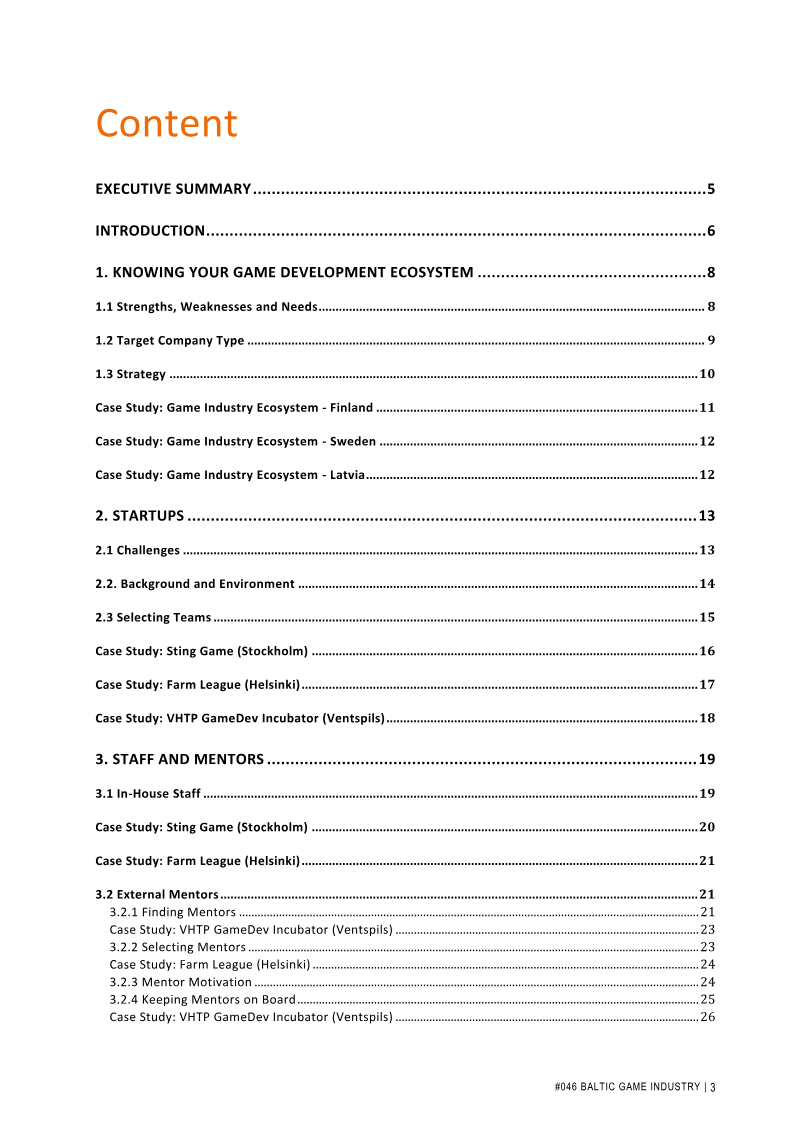
The guideline provides hands-on support regarding the whole process of set-up and maintenance of a mentor system (search for mentors, get in contact, motivate them to get engaged, integrate them in the programme, monitor their work and give feedback, promote their engagement, keep them on board, support further Metropolia University of Applied Sciences Swedish Games Industry (Association of Swedish Game Developers) – Dataspelsbranschen Ventspils High Technology Park für internationale Zusammenar...
The 2024 overview of Finland’s game sector presents a comprehensive assessment of an industry that remains a global technology leader while confronting a tightening financing environment. Employment reached roughly 4,300 individuals, equivalent to about 3,800 full‑time positions, underscoring the sector’s significance within the national economy. However, a pronounced drop in private risk capital and publisher backing has pushed many studios toward B2B subcontracting, co‑development agreements, and an expanding reliance on European Union and national public R&D programmes, especially after recent reductions in regional funding streams. Talent depth continues to drive innovation, with Finnish teams at the forefront of AI‑assisted development, proprietary engines, and cloud‑gaming solutions. Persistent shortages of senior developers and specialists in Unreal Engine, together with increasing regulatory complexity and geopolitical uncertainty, pose constraints on future growth. New public R&D instruments and targeted regional SME support aim to mitigate these pressures and sustain the ecosystem’s dynamism. Geographically, the industry is anchored by a network of regional hubs, notably Jyväskylä’s EXPA, which serves as a northern innovation cluster. The ecosystem is highly diversified, ranging from global powerhouses such as Supercell—employing over 800 staff and delivering seven worldwide hit titles—to agile indie studios like Snowhound, which hosts more than 120 employees from over twenty nationalities, and niche ventures such as Soihtu DTx, which secured a $4.2 million seed round for a clinically validated mental‑health game. Across the board, firms are expanding into cross‑platform and co‑development projects, exemplified by collaborations between Ubisoft RedLynx and Zaibatsu Interactive, reflecting a broader trend toward collaborative, multi‑disciplinary production.