1 free read left. Create a free account for unlimited reading + AI research.
Create free account
Asset Reuse - Working Smarter, Not Harder - Extra Credits
Key insights
6 takeaways- 01Asset reuse is a strategic design tool that allows studios to shift finite resources away from redundant technical labor and toward core gameplay, narrative depth, and world-building.
- 02Successful implementations like Fallout: New Vegas and The Legend of Zelda: Majora’s Mask demonstrate that reusing assets can facilitate superior role-playing depth and unique narrative experiences.
- 03The Yakuza series utilizes recurring map assets to treat the environment as a foundational character, allowing for incremental increases in detail over time.
- 04While low-effort 'asset flips' exist, they are a misuse of the practice rather than a failure of the concept, which is essential for the sustainability of indie studios and budget-constrained projects.
- 05Reusing existing assets can enable rapid production cycles, such as the 16-month development timeline achieved for Dragon Age 2.
- 06Modern asset reuse is a pragmatic evolution from the industry's historical 'slash-and-burn' mentality, which was previously necessitated by rapid hardware shifts that rendered old assets incompatible.
Ask AI about this video
Transcript
You've all heard the old maxim, work smarter, not harder, right? It's good advice, and most game developers have found that reusing assets is a heck of a lot smarter than redoing everything each game. But if that's the case, why is asset reuse so often met with a negative response? Want to learn how you can help support indie devs hit hard by the pandemic? Then stick around after the episode to learn about our indie game megaphone initiative. It doesn't always make sense to scrap every asset your team has ever created when starting a new project. For instance, spoiler alert, we don't redraw every frame of me at this lectern for each episode. Because if we did that, our artists wouldn't have the bandwidth to tackle any new art. Every episode would just be this the whole time. Fun. But for a long while in the game industry, this slash and burn mentality was kind of how games were made. Back in the olden days, there often wasn't really any alternative to redoing most everything every time you made a game. And that's because technology improved
so fast. NES sprites couldn't just be touched up for the SNES, and much less when the PlayStation and Nintendo 64 paved the way for real 3D models. And it wasn't just art, either. Studios also had a tendency to follow this model and rewrite their core engine every game, even when they didn't have to. The misconception here is people viewing asset reuse as laziness or simply being cheap. But in truth, it's usually neither. When done right, it's just smart design. And there's more to it than just reducing production costs. It can actually benefit players as well. Every game has a finite amount of time and money that can be put into it. And oftentimes, asset reuse can free up developers to focus more resources on things that are core to the game's experience it's trying to deliver. I mean, would you rather have every single in-game rock or tree be brand new, or a few more levels when that game ships? Because sometimes, things like that are the trade-off. A great example of asset reuse done right in this way is the ever fantabulous Fallout: New Vegas. New Vegas is generally considered one of the best Fallout games based on the strength
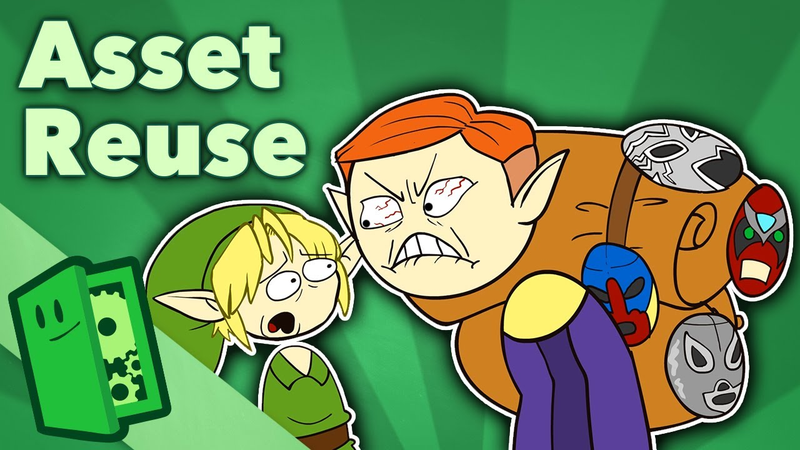
of its narrative and role-playing aspects, which was only possible in its production cycle because of the time they saved using Fallout 3 assets. Had they spent all the game's budget on redoing every mailbox and doorway, there would have certainly been less meaningful game content. And that is what distinguishes smart asset use from simple laziness. Making sure the overall experience surrounding those old assets feels new and fresh. For instance, remember Symphony of the Night's upside down castle? It took some serious design chops to make that castle work both right side up and upside down. And the upside down castle doesn't feel like you're just retreading all of the old rooms. It feels like a unique place of its own. Another positive example is Majora's Mask. While it did reuse a ton of Ocarina of Time's assets and mechanics, Nintendo used those assets and mechanics to tell an original story in a new setting. Heck, even the Yakuza series reuses the same relatively small Kamurocho map every game. There are some changes each time, such as an empty lot becoming the Millennium Tower, but Kamurocho remains familiar enough to become a character in its own right. One
map designed well was enough to carry an entire game franchise, so the team could focus on filling that small map with even more details and even more reasons to make it worth coming back to. Now, of course, there are cases where pre-made assets are just cobbled together to pump out something on the cheap without much regard for quality. And this can even happen in the AAA industry. Uh uh oh, hi there, Metal Gear Survive. Um didn't see you there. Be with you in a second. And while it's understandable how these instances could sour some people on other games that have reused assets, in these examples of lazy asset flips, the actual reuse of old assets is usually just one of many of the game's problems. For instance, if the mechanics are rotten, custom art isn't going to save it. Asset reuse itself is a powerful tool for game development, and not using it due to a few bad actors would kind of be akin to banning all carpenters from using hammers because one goober sometime used one to smash a hole in your wall. Also, the time and money required for top-tier production values these days can mean it's financially
unfeasible for most game studios, especially indies, to throw enough money at each game to make every aspect of it totally new. And even if the studio did have the luxury to recreate everything for their next game, if that game was set in a similar style or world as the previous one, that would just be a colossal waste of valuable time. They could be finding new things to do with those assets instead. And we're not just talking about sequels here. When treated with care, studios can leverage their existing assets for spin-offs and entirely new games. Captain Toad's Treasure Tracker was not only much cheaper and faster to make than the game it spun off from, but it sold at a lower price point as well. Heck, even Hearthstone, back when it was, you know, young and innocent, reused art assets from the old World of Warcraft TCG, which allowed them to focus more on gameplay on a tight initial budget. We're now in a day and age where assets from last generation's consoles can more easily be used in modern games with a minimal amount of reworking. I mean, just imagine how many cool things could be done with the vast library of assets most companies have built up. Sam still
remembers playing a mission in GTA 4 that took place entirely inside a dilapidated, fully rendered motel. And the whole time he kept thinking, "You could make a Silent Hill out of this." In addition, for teams given super aggressive ship deadlines, which of course is a problem in its own right, asset reuse can be a saving grace for the studio. For instance, when EA gave BioWare a measly 16 months to make Dragon Age 2 immediately following the breakout success of Dragon Age 1, the crunch they had to endure would have been worse had they not been able to make smart reuse of the first Dragon Age's assets. So, as long as it's not done just to make shovelware, and it's used for the betterment of games and their developers, asset reuse means less time has to be spent on redoing old things, so more time can be spent on the new, innovative aspects of our games. But what do you all think? Can asset reuse in the current gaming climate be harnessed for the forces of creativity and innovative design? Or do you think that the good ship asset flip has not only set sail, but is running straight into the harbor? Let us know in the comment section below and keep the
conversation going. Just please, no reposts unless you innovate them. Indie developers have traditionally used shows like GDC, E3, and other gaming conventions to showcase their games, make deals, and get people excited for their titles. But now with the cancellation of these events to preserve public safety during the pandemic, many of them have been hit particularly hard. So, we here at Extra Credits are putting out the call to devs affected by these cancellations to send us info on the games they were planning to show. And we've just begun setting up a list of these games with short descriptions and links to help raise awareness in hopes more eyeballs find them during this tough time. So, if you're interested in helping Indies get the word out, or if you're an Indie dev who's been affected and would like to add your game, we encourage you to check out the Indie Game Megaphone list at the link below. Legendary thanks to Orioles 1, Kyle Murgatroyd, Gunnar Clovis, Dominic Valenciana, Casey Musgraves, and Ahmed Ziad Turk.
Summary
The practice of asset reuse in game development is often unfairly stigmatized as laziness or cost-cutting, when it is, in fact, a strategic design tool that allows developers to prioritize innovation and depth. Historically, the industry operated under a slash-and-burn mentality, largely due to rapid technological shifts that rendered old assets incompatible with new hardware. However, in the modern era, reusing assets is a pragmatic approach that enables studios to allocate finite time and financial resources toward core gameplay mechanics, narrative expansion, and world-building rather than redundant technical labor.
Effective asset reuse is characterized by the ability to create a fresh, immersive experience despite using existing components. Notable examples include Fallout: New Vegas, which leveraged Fallout 3 assets to focus on superior role-playing depth, and The Legend of Zelda: Majora’s Mask, which utilized Ocarina of Time’s engine to deliver a unique narrative. Similarly, the Yakuza series treats its recurring map as a foundational character, allowing for increased environmental detail over time. When executed with intent, this practice can facilitate spin-offs like Captain Toad: Treasure Tracker or help studios navigate aggressive production timelines, such as the 16-month development cycle of Dragon Age 2.
While the industry occasionally sees low-effort "asset flips" that prioritize speed over quality, these instances represent a misuse of the tool rather than a failure of the concept itself. By repurposing existing libraries, developers can avoid the colossal waste of recreating functional assets, ultimately fostering a more sustainable development environment. This approach is particularly vital for indie studios and projects operating under tight budgets, as it shifts the focus from technical overhead to creative iteration and player experience.
























Comments