
Country Reports·Updated Mar 17, 2026 by Maliyo Games
What can I help with?
AI-powered answers with citations from the library.
What can I help with?
AI-powered answers with citations from the library.
Report · January 1, 2025
Published by Maliyo Games
The African games industry is undergoing a period of rapid expansion, with total revenues projected to surpass $1 billion in 2024. This growth is primarily fueled by a mobile-first market that accounts for nearly 90% of the sector’s revenue, driven by a young, tech-savvy population and increasing smartphone penetration. While South Africa remains the most lucrative individual market, Nigeria has demonstrated the most significant momentum, with mobile revenues increasing fivefold since 2019. On a global scale, the Middle East and Africa region has emerged as a growth leader, maintaining an 8.9% year-on-year increase despite the historical dominance of North American and Asian markets. The developer ecosystem has matured significantly, expanding from a handful of entities to approximately 250 studios by 2024. West Africa has emerged as the primary regional hub, experiencing a nearly fivefold increase in the number of active studios over the past year. Development is characterized by a youthful, male-majority demographic that favors the Unity engine to create entertainment-focused content for mobile platforms. High-profile international partnerships with brands like Microsoft Xbox, Disney, and Gameloft, alongside the success of global titles like Candy Crush and PUBG Mobile within the region, signal increasing integration into the global gaming economy. Despite these advancements, the industry faces substantial structural and financial hurdles. Infrastructure remains a critical concern, as developers struggle with unstable power and high-speed internet access. Furthermore, a significant performance gap exists in funding and institutional support; only 3% of developers receive government funding, and over half of the continent's developers currently earn no income from their work. This has led to a trend of conservative, small-scale investment. To transition from early-stage prototyping to commercial acceleration, the sector requires a collaborative model focused on building talent pipelines, implementing rebate programs, and establishing localized payment methods to unlock the continent's full economic potential.
# TABLE OF CONTENTS - 01. Welcome Note 4 - 02. Introduction 6 - 03. The Games Industry 9 - 04. 2024: A Great Year for the African Games Industry 18 - 05. The State of the Industry 26 - 06. Headlines: News from 2024 41 - 07. The Africa Game Developer Survey 43 - 08. Africa Game Studio Directory 59 - 09. Final Word 61 - 10. Credits 64
# FOREWORD The African games industry is surging forward, fuelled by a vibrant community and an unwavering spirit of innovation. This year has witnessed remarkable milestones, from record participation in industry events to groundbreaking collaborations such as the Disney Iwájú Rising Chef game. Despite challenges such as limited funding and access to international markets, the industry's momentum is undeniable. New voices are emerging alongside established veterans, creating a dynamic ecosystem supported by talent programmes, community meetups, and regional conferences. To further accelerate this growth, we need data. Data that validates our progress showcases our potential and empowers stakeholders to make informed decisions. The Africa Games Industry Report serves this crucial purpose, crystallising the industry's achievements, challenges, and opportunities into a single, comprehensive resource. This report is a testament to the collective effort of documenting and archiving the African games industry's journey, not just for today's creators but for generations to come. A special thanks to the dedicated team at Maliyo Games for their tireless work in bringing this report to life, going above and beyond to contribute to the growth of our vibrant ecosystem. We invite you to explore this report, gain valuable insights, and join us in shaping the future of African game development. Hugo Obi Founder & CEO, Maliyo Games Image Credits: Maliyo Games Office, Lagos, Nigeria
# ABOUT THIS REPORT The Africa Games Industry Report is an in-depth exploration of Afric games ecosystem, providing essential data, insights, and narratives fro across the continent. Now in its second edition, this report continues be a benchmark resource for understanding the trajectory of Afric games industry, from emerging studios to the evolving developme landscape for mobile, console, and PC games. With the industry's growth driven by increased mobile access, a risi tech-savvy youth, and a unique cultural footprint, the report highligh how African game studios are transforming local stories into glob cultural products. This year, we’ve expanded our focus to include additional indust benchmarks, as well as private and public sector initiatives, to highlig the growing influence of the games industry across the contine Alongside these updates, the report presents case studies, and region analyses, offering a full view of Africa’s role within the global gam industry. It a must-read for developers, policymakers, investors, a educators who seek to understand or participate in this emerging Afric sector. Image Credits: Disney Iwájù Rising Chef (Maliyo Games)
# WHO THIS REPORT IS FOR AND HOW TO READ IT This report serves a diverse group of stakeholders related to the African gaming industry. Each section is colour-coded to help you quickly find the information most relevant to you. However, we do encourage you to explore other sections for a more holistic view of the continental games ecosystem. Here’s how each audience group can navigate the report: # GAMEDEVELOPERS AND STUDIOS (GREENLABEL) This report is a resource for game developers, indie studios, and creative teams seeking to expand their reach in Africa. You’ll find industry benchmarks, emerging trends, and cultural insights into African player preferences and market dynamics. Use the green-coded sections to explore local success stories, funding opportunities, and strategies for integrating African cultural narratives into games. # POLICY MAKERS (YELLOW LABEL) For government officials, NGOs, and development agencies, the report’s yellow-labelled sections address regulatory needs, digital access challenges, and the economic potential of the African games sector. These insights can support policy initiatives that encourage industry growth, improve digital literacy, and tackle youth unemployment through gaming. # INVESTORS (PINK LABEL) Investors seeking to understand Africa’s high-growth potential with the games industry will find actionable insights within the pink-labelled sections. Explore market revenue projections, fintech advancements, and investment trends shaping the industry. Data-driven analyses of opportunities in mobile gaming and regional growth patterns are also included.
tial with the games industry will find actionable insights within the pink-labelled sections. Explore market revenue projections, fintech advancements, and investment trends shaping the industry. Data-driven analyses of opportunities in mobile gaming and regional growth patterns are also included. # GENERAL PUBLIC (BROWN LABEL) Gamers, enthusiasts, and curious readers can explore the brownlabelled sections for an engaging overview of Africa’s games culture. Discover popular game genres, community trends, and cultural impact as the industry continues to grow. Following the color-coded labels to access audience-focused content or dive deeper into additional sections for a comprehensive look at Africa’s gaming sector and its exciting trajectory.
# THE GLOBAL GAMES INDUSTRY The global gaming industry is experiencing remarkable growth, driven by new technologies and shifting player interests. In 2024, the industry's revenue is expected to exceed \ 187$ billion, backed by a player base of over 3.42 billion worldwide. Mobile gaming continues to dominate, generating around \ 92$ billion in revenue, supported by the widespread adoption of smartphones, particularly in emerging markets. Console gaming also remains strong, projected to reach approximately \ 51$ billion, with a loyal fan base drawn to high-quality, premium offerings. PC gaming, known for its versatility and cross-platform reach, retains a significant share, appealing to a diverse player base. Millions of viewers are tuning in to watch their favourite games played by experts, generating substantial revenue through sponsorships, adverts, and event ticket sales. In addition, technologies such as virtual reality (VR) and cloud gaming are expanding access and delivering new immersive experiences, opening up exciting opportunities for both players and developers. Collectively, these trends highlight gaming’s evolution into a dominant global entertainment medium, with diverse platforms attracting a broad range of players and driving innovation across the industry. Source(s): - Newzoo Global Games Market Report 2024 https://newzoo.com/resources/trendreports/newzoos-global-games-market-report-2024-free-version
The African video games industry represents a rapidly expanding mobile-first frontier, characterized by a player population that surged from 77 million in 2015 to 186 million in 2021. With annual revenues projected to surpass $1 billion by 2024, the continent is positioning itself to replicate the success of other emerging markets like Brazil and India. Growth is currently concentrated in regional hubs across South Africa, Nigeria, Ghana, and Kenya, where a young demographic is increasingly integrating local cultural themes into digital entertainment. This evolution is supported by a complex value chain where mobile gaming accounts for the vast majority of engagement, mirroring global trends where mobile platforms generate over $92 billion in annual revenue. Despite this potential, the ecosystem remains in a nascent stage, with 63% of studios operating for five years or less and 59% of developers never having secured external investment. While high-profile deals such as Carry1st’s $27 million funding round and GBarena’s $15 million acquisition of Galactech signal growing investor confidence, the broader market is still dominated by hobbyists. Only 36% of developers currently earn a living from their work, and over half of those rely exclusively on domestic revenue. Technical development is heavily centralized around the Unity engine, which is utilized by 64% of the market, reflecting the industry's focus on accessible mobile content. Significant structural barriers continue to impede the transition from a hobbyist community to a professionalized global competitor. Infrastructure deficits are the primary concern, with 60% of industry participants citing poor power supply and high internet costs as critical obstacles. Furthermore, government support is nearly non-existent, currently reaching only 3% of the sector. To achieve sustainable maturity, the industry requires a coordinated effort to stabilize infrastructure, formalize talent pipelines, and attract informed investors who understand the unique dynamics of the African market. Addressing these catalysts is essential for transforming local creative potential into a robust, revenue-generating economic sector.
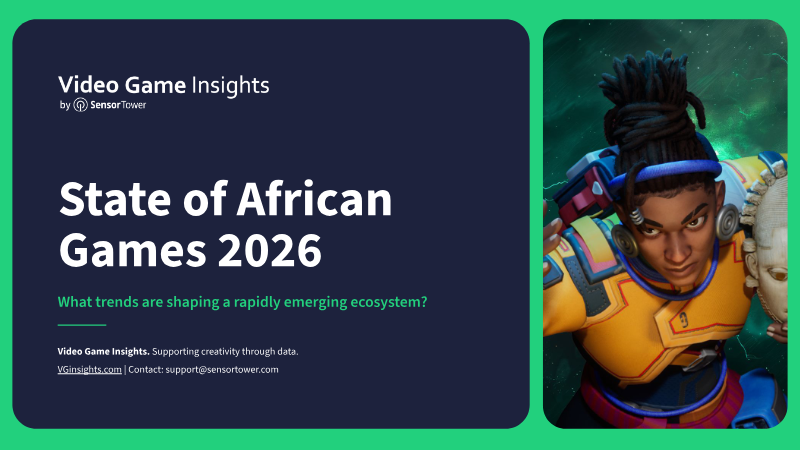
The analysis delivers a data‑driven overview of African‑developed video games, concentrating on performance across global platforms—primarily Steam, with supplemental PlayStation and Xbox data—from 2015 through 2025. Its central thesis is that the continent’s game‑development ecosystem is emerging rapidly yet remains highly concentrated, especially in South Africa, and is transitioning from volume‑driven growth to a focus on higher‑quality, strategically positioned titles. South Africa accounts for the overwhelming share of both developers and commercial success, supplying all titles in the top‑ten sales list and driving the continent’s 2 % share of Steam unit sales—higher than the Middle East and comparable to Oceania. Releases peaked in 2023 with 23 Steam titles before falling to 11 in 2025, suggesting a shift toward longer development cycles. Genre analysis reveals a mismatch: simulation games achieve the highest median sales (≈372 k units), followed by adventure and RPGs, while action titles dominate the release count. Pricing follows global indie norms, with most games priced between $5.99 and $19.99; premium pricing above $21.99 appears in only a small fraction of titles. Unity is the leading engine (≈18 % of releases), Unreal accounts for about 7 %, and the remaining 73 % use a diverse set of smaller tools, reflecting a decentralized technical landscape. Methodologically, the study relies on Video Game Insights estimations for games launched after 1 January 2015, employing internal sales‑estimation algorithms that convert review counts and apply the Boxleiter method to infer unit sales and revenue. The scope encompasses all major platforms, covers the entire African continent, and isolates trends in genre, pricing, engine choice, and geographic distribution. Conclusions point to a transitional phase where success will depend less on release volume and more on distinctive cultural content, genre diversification, and broader support structures beyond South Africa. If these dynamics persist, the African game‑development sector is poised to evolve from an emerging participant to a recognized creative force within the global industry.
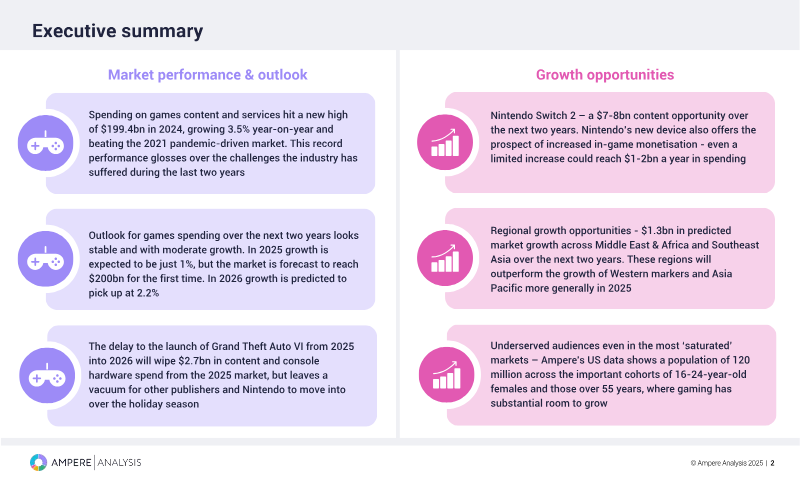
The global games content and services market reached a record $199.4 billion in 2024, a 3.5% year-on-year increase that surpassed pandemic-era peaks. Despite this financial milestone, the industry faces significant structural challenges, including widespread layoffs, studio closures, and a shift toward de-risking strategies. Growth is expected to slow to 0.9% in 2025, largely due to the delay of Grand Theft Auto VI into 2026, which is projected to remove $2.7 billion from the 2025 console market. However, the industry is forecast to surpass the $200 billion threshold for the first time in 2025, with growth accelerating to 2.2% in 2026. Key growth opportunities center on new hardware and emerging markets. The anticipated launch of the Nintendo Switch 2 in 2025 represents a $7-8 billion content opportunity, with significant potential for increased in-game monetization. Geographically, the Middle East, Africa, and Southeast Asia are expected to outperform Western markets, with the Middle East and Africa projected to grow by 6.3% in 2025. Additionally, significant headroom exists in mature markets like the U.S. by targeting underserved cohorts, specifically females aged 16-24 and adults over 55. The industry is navigating a transition in monetization and platform dynamics. In-game spending accounts for 77% of total revenue, while physical media is expected to dwindle to just 2% of the market by 2026. To combat escalating AAA development costs, publishers are increasingly utilizing remakes, remasters, and transmedia franchise strategies. While mobile gaming remains the largest segment at 58% market share, PC gaming showed the strongest growth in 2024 at 5.7%. The analysis utilizes proprietary market modeling, financial KPIs, and quantitative consumer research across global regions to provide a comprehensive outlook through 2026.
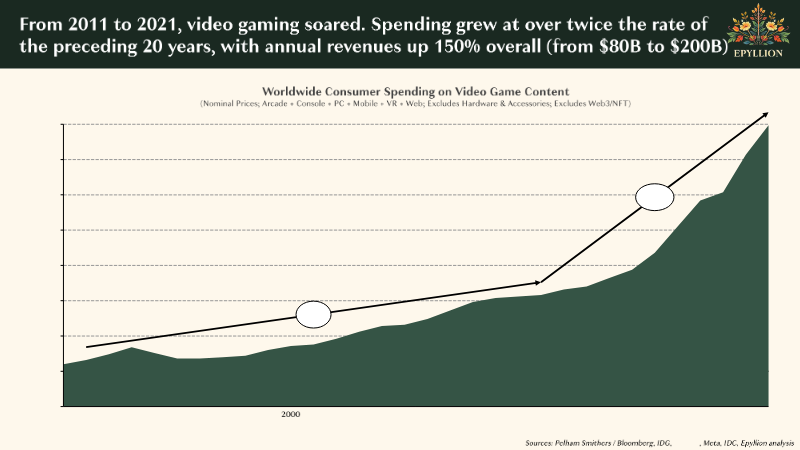
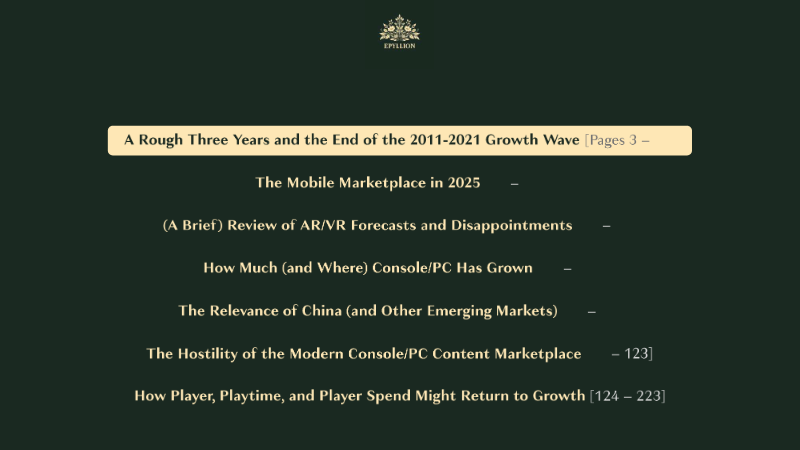
The global video game industry has transitioned from a decade of rapid expansion into a period of contraction and market maturation. Following the 2011–2021 growth wave, the sector now faces a "zero-sum" environment characterized by stagnant player spending, plummeting stock values, and a collapse in venture capital. This downturn has triggered an unprecedented wave of studio closures and mass layoffs as publishers move away from risky new ventures to focus on aggressive multiplatform strategies for established franchises. While the industry maintains a higher net headcount than in 2022, the current climate is defined by an oversupply of content competing for limited consumer hours, with the top ten titles capturing 60% of all sales. Market dominance is increasingly concentrated in "Black Hole" titles and User-Generated Content (UGC) platforms like Roblox and Fortnite. These ecosystems leverage deep social integration and digital entitlements to create a "lock-in" effect that makes it difficult for new live-service titles to gain traction. While the PC ecosystem is gaining momentum over traditional consoles due to its larger libraries and native social tools like Discord, the handheld market is poised for a shift with the impending launch of the "Switch 2" and Valve’s expansion of SteamOS. Furthermore, the rise of high-quality AAA titles from China and localized media in emerging markets is successfully challenging Western dominance by prioritizing domestic cultural themes and lower hardware specifications. Future growth is expected to be driven by technological innovation and regulatory shifts rather than traditional software sales. Generative AI is being deployed to create autonomous virtual agents and lower development costs, while major publishers are aggressively pursuing programmatic in-game advertising to offset decades of price deflation. Simultaneously, the deregulation of mobile app stores is expected to improve developer margins by 10–20%, enabling new cloud-native experiences and third-party storefronts. By 2030, nearly one billion mobile devices will be capable of running high-fidelity console-spec games, positioning emerging regional markets as the primary engine for the industry’s next economic cycle.