RuneStorm
Company
2 documents in the library are about RuneStorm, from writers such as Games Industry Africa and Sensor Tower. Each has a summary and key insights with the page they come from.
Connections
Each row is a game or company named alongside RuneStorm, each column a document, oldest first. A mark means that document names it. Select a row to see those documents.
Documents about RuneStorm
State of African Games 2026
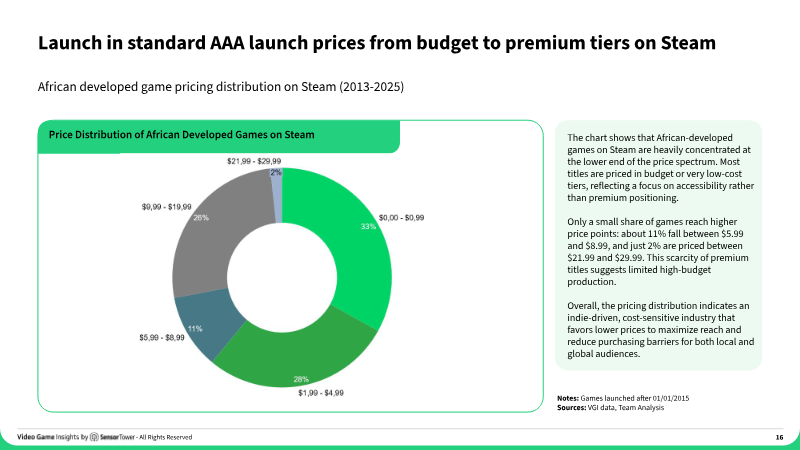
The State of African Games 2026 report from Video Game Insights (Sensor Tower) offers a data-driven snapshot of how African-developed games perform on Steam, PlayStation and Xbox.
- South Africa dominates the African game development sector, accounting for all top-ten selling titles and contributing to a 2% share of global Steam unit sales.
- The industry is shifting from volume-driven growth to longer development cycles, evidenced by a decline in annual Steam releases from a peak of 23 in 2023 to 11 in 2025.
- There is a significant genre mismatch in the market, as action titles dominate release volume while simulation games achieve the highest median sales at approximately 372,000 units.

The Great Divide
This 2020 opinion and analysis piece from Games Industry Africa challenges the perception of Africa as a single, uniform entity and examines why the continent's most commercially and critically recognized games originate overwhelmingly from South Africa.
- The African game development industry is highly fragmented, with the majority of commercially successful titles originating from South Africa and North Africa due to better access to technical infrastructure and international financing pipelines.
- South Africa’s industry maturity is driven by an established community ecosystem, such as Make Games South Africa, and a history of development dating back to the 1996 release of 'Toxic Bunny' by Celestial.
- North Africa’s development scene was historically bolstered by Ubisoft Casablanca, which operated from 1998 to 2016 and trained 300 graduates, creating a talent pool that eventually formed independent local studios.