Vungle
Technology3 documents
Documents
Report16 pages
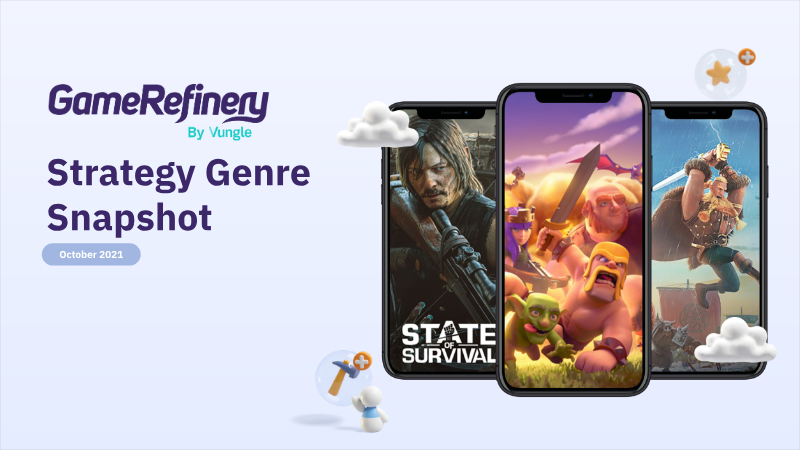
Strategy Genre Snapshot: October 2021
The strategy genre represents a cornerstone of the mobile gaming market, accounting for approximately 17% of total revenue on the US iOS platform as of October 2021. Analysis reveals that the genre is heavily dominated by the 4X strategy subgenre, which comprises 20 of the top 25 grossing strategy titles. While the market is characterized by aging hits and high competition, recent success has been driven by genre-blending, where developers integrate mechanics from other categories—such as merge, match-3, or RPG elements—to broaden player appeal.
Key market leaders include State of Survival, which became the top-grossing 4X title following a massive year-long collaboration with The Walking Dead, and Supercell, which remains the primary outlier succeeding with non-4X strategy titles like Clash of Clans. In contrast, the MOBA subgenre continues to face sustainability challenges in the US; despite a strong launch, League of Legends: Wild Rift struggled to maintain a position in the top 200 grossing charts, leaving the long-term viability of newer entries like Pokémon UNITE uncertain.
The core appeal of the genre is rooted in long-term power progression, complex live operations, and deep social integration. Data indicates that successful titles leverage permanent boosts, recurring event loops, and competitive guild mechanics to drive engagement. According to a survey of over 7,000 mobile gamers in English-speaking Western markets, the primary motivational drivers for strategy players are strategic planning, resource optimization, and social competition. These findings suggest that while the 4X subgenre remains the revenue leader, the path to growth lies in sophisticated monetization through battle passes and the continuous expansion of social and competitive features.
- As of October 2021, the strategy genre accounts for 17% of total mobile revenue on the US iOS platform, with 4X titles occupying 20 of the top 25 grossing spots.
- Genre-blending is the primary growth strategy, with developers integrating merge, match-3, and RPG mechanics to broaden appeal beyond traditional 4X gameplay.
- State of Survival leads the 4X market following a year-long collaboration with The Walking Dead, while Supercell remains the primary outlier succeeding with non-4X titles like Clash of Clans.
- The MOBA subgenre faces significant sustainability challenges in the US, as evidenced by League of Legends: Wild Rift failing to maintain a top 200 grossing position.
- Strategy players are primarily motivated by strategic planning, resource optimization, and social competition, according to a survey of over 7,000 mobile gamers in Western markets.
VungleOct 2021
Report22 pages
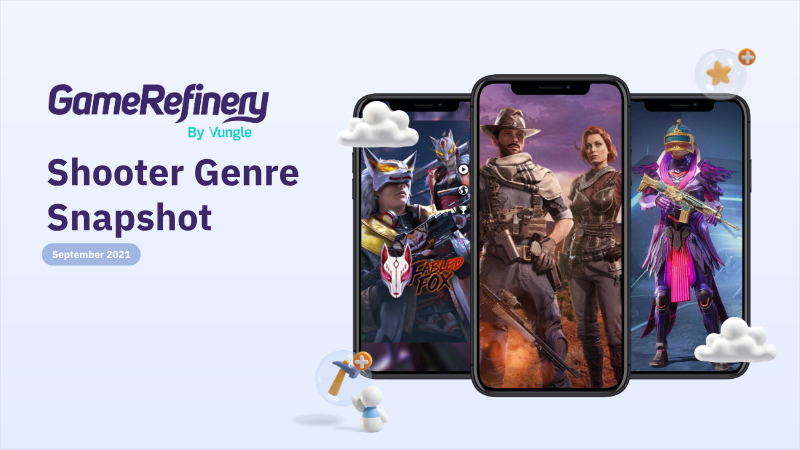
Shooter Genre Snapshot: September 2021
The mobile shooter genre currently occupies a significant position in the US iOS market, ranking as the sixth-largest genre and accounting for approximately 6% of total market revenue. The landscape is characterized by high market concentration, with over 84% of revenue generated by the "Big Three" titles: Call of Duty: Mobile, PUBG Mobile, and Garena Free Fire. The removal of Fortnite from the App Store in August 2020 served as a major catalyst for market consolidation, allowing these remaining leaders to capture significant additional market share. Garena Free Fire has demonstrated the most aggressive growth, more than doubling its revenue over the past year to reach parity with its primary competitors.
Despite the genre's financial success, the market has entered a period of stagnation regarding new entrants. No new shooter games released within the last two years have successfully broken into the top 200 grossing charts, and only one title, Bullet Echo, has entered the top 500 since May 2020. This lack of new competition is expected to be challenged soon, as several high-profile titles—including mobile adaptations of Valorant, Apex Legends, and Battlefield—are currently in development. These upcoming releases aim to leverage established intellectual properties to disrupt the current hierarchy.
Successful shooter titles rely on a consistent, high-frequency content cadence to maintain engagement and monetization. Core monetization strategies center on cosmetic economies, utilizing Battle Pass systems and limited-time gacha mechanics. Player motivation analysis indicates that the genre is driven primarily by mastery, competition, and excitement, with top games utilizing social features like guilds and collection systems to deepen player retention. Future growth in the sector will likely depend on whether new titles can successfully implement these proven engagement loops while introducing enough differentiation to attract players from the established incumbents.
- The US mobile shooter market is highly concentrated, with Call of Duty: Mobile, PUBG Mobile, and Garena Free Fire generating over 84% of total genre revenue.
- Garena Free Fire has achieved significant market growth, more than doubling its revenue over the past year to reach parity with its primary competitors.
- The mobile shooter genre currently ranks as the sixth-largest in the US iOS market, accounting for approximately 6% of total market revenue.
- Market entry for new titles has stalled, as no shooter released in the last two years has reached the top 200 grossing charts, and only one has entered the top 500 since May 2020.
- The removal of Fortnite from the App Store in August 2020 acted as a catalyst for market consolidation, allowing the remaining top-tier titles to capture increased market share.
GameRefineryJan 2021

Report24 pages
In-Game Events Snapshot
The snapshot presents a comprehensive overview of in‑game event strategies across the global mobile gaming market, focusing on seasonal and promotional collaboration events. It establishes that 90 % of the top‑grossing 100 mobile titles deploy seasonal events, while 40 % of US iOS top‑100 games feature brand collaborations. These events are highlighted as key drivers for player re‑engagement, new user acquisition, and revenue spikes, with examples such as Sky: Children of the Light’s Kizuna AI partnership and Genshin Impact’s Lantern Rite event, which each generated multi‑million daily revenue surges.
The report details the taxonomy of events—UI changes, limited‑time offers, playable content, and special bundles—and identifies profitable revenue streams: time‑limited skins, character drops, themed currency, and gacha mechanics. Seasonal calendars list major holidays (Christmas, Lunar New Year, Halloween) and region‑specific observances (Double Five in China, Sakura season in Japan), underscoring the importance of cultural relevance.
Geographic scope covers North America, China, and Japan, with data on event adoption rates: 51 % of Chinese top‑100 games and 62 % of Japanese top‑100 games use promotional collaborations, compared to 42 % in the US. Methodology relies on GameRefinery’s SaaS platform, aggregating revenue and event data from thousands of titles.
Key conclusions emphasize that events remain a differentiator for high‑performing games, offering scalable monetization and cross‑brand synergy. The snapshot recommends that developers evaluate event fit against audience demographics, content alignment, and potential for brand partnership to maximize engagement and revenue.
- Seasonal events are a standard industry practice, utilized by 90% of the top-grossing 100 mobile games to drive player re-engagement and revenue spikes.
- Brand collaborations are a significant growth lever, appearing in 62% of top-100 games in Japan, 51% in China, and 42% in the US.
- High-profile collaborations, such as Sky: Children of the Light’s Kizuna AI partnership and Genshin Impact’s Lantern Rite, have demonstrated the ability to generate multi-million dollar daily revenue surges.
- Successful event monetization relies on a mix of time-limited skins, character drops, themed currency, and gacha mechanics.
- Event strategies must prioritize cultural relevance, with top-performing titles aligning content with region-specific observances like China’s Double Five or Japan’s Sakura season.
GameRefineryJan 2021