
Journal of the Philosophy of Games
Open-access peer-reviewed journal on the philosophy of games and play, published by the University of Oslo.
Documents
Chess and the Cultivation of Attention: Remarks on a Media Theory of Games
Chess serves as a primary case study for a broader media theory of games, illustrating how ludic environments cultivate specific forms of human attention.
- Games function as cognitive training environments that teach players to transform overwhelming complexity into structured, manageable problems.
- Expertise in complex games is driven by refined situational awareness and holistic pattern recognition rather than brute-force calculation.
- Optimal performance relies on a two-stage cognitive cycle: the intuitive perception of environmental imbalances followed by deliberate, analytical reflection.
Embodied and Enactive Imagination in VR
Virtual reality engagement transcends the traditional binary debate between fictionalism, which views virtual entities as mere mental representations, and realism, which treats them as direct perceptions.
- VR immersion is driven by 'Embodied and Enactive Imagination,' where users interact with virtual environments through active, motor-driven anticipation rather than passive observation.
- Users do not suspend disbelief but instead engage with 'virtual affordances,' which are the genuine possibilities for action presented within the digital architecture.
- Players leverage existing bodily habits to master virtual spaces, allowing them to adapt to non-human avatars and integrate technical anomalies or glitches into their gameplay.
Chess is Still a Game
Chess occupies a central position in the philosophy of play, serving as a critical test case for Bernard Suits’ influential definition of a game.
- Chess remains a definitive example of a game under Bernard Suits’ philosophical framework, despite arguments that its checkmate condition can be achieved independently of its rules.
- The distinction between the formal mechanics of chess and the broader institution surrounding it confirms that the game satisfies the requirement of a prelusory goal.
- Achieving a checkmate position outside the context of play does not invalidate the game's status, as the definition of gameplay relies on the voluntary acceptance of constitutive rules.

Is Fun a Matter of Grammar?
The concept of fun is frequently misidentified as a specific psychological state, such as the flow state, within academic and game design discourse.
- Fun should be categorized as a linguistic marker for habitual, repeatable activities rather than a specific psychological state like flow.
- The term 'fun' functions as a grammatical descriptor for generic actions that transcend specific moments in time, distinguishing it from localized experiences like pleasure or enjoyment.
- Game engagement is more accurately understood through the linguistic framing of activities rather than the pursuit of elusive internal phenomenological states.
Video Game Fictions: A Dual-Work View
Video games function as dual-layered fictional entities, comprising both a fixed design framework and a unique, resolved narrative.
- Video games function as dual-layered entities consisting of a fixed design framework (the developer's structure) and a unique, resolved narrative (the player's playthrough).
- Player agency acts as a directorial force that resolves the inherent incompleteness of a game's design, transforming abstract possibilities into a singular, concrete experience.
- The game itself serves as a stable 'possibility structure' or structural prop, while the individual playthrough constitutes a distinct, realized work of fiction.
Digital Games, Image-Consciousness and Superreality
Digital games represent a distinct phenomenological category of experience that transcends the traditional binary of perception and imagination.
- Digital games create a unique 'superreality' that functions as an experiential bridge, blending lifelike perception with non-physical, fantastical possibilities.
- Gaming constitutes a distinct form of 'image-consciousness' that transcends the traditional binary of sensory input and mental imagination.
- The high level of interactivity in digital games fosters deeper psychological investment and cognitive engagement than passive media.
The Value of Value Capture: Using Gamification to Address Addiction and Sequential Choice Problems
This analysis examines the philosophical implications of gamification, specifically challenging the prevailing critique that the phenomenon of value capture—the replacement of complex, nuanced real-world values with simplified, quantified metrics—is inherently detrimental.
- Gamification can effectively mitigate addiction by using 'value capture' to simplify complex, long-term behavioral challenges into manageable, quantified milestones.
- Quantified metrics act as 'useful fictions' that help individuals overcome weakness of will by replacing nuanced, difficult choices with clear, resolute policies.
- The strategy leverages 'alethically wrong' values—beliefs that are technically inaccurate—to achieve 'practically right' outcomes for the user.
Ludic Unreliability and Deceptive Game Design
Deceptive game design functions as a deliberate, transgressive practice that intentionally misguides players regarding the implied designer’s intentions to elicit specific aesthetic or emotional responses.
- Ludic unreliability is a deliberate design strategy where game signals diverge from actual functionality to provoke meta-reflexive and critical player engagement.
- Deceptive design is categorized into covert practices, such as hidden difficulty adjustments or 'coyote time,' which smooth the player experience, and overt practices that rely on the eventual revelation of the deception.
- Titles including Undertale, Metal Gear Solid 2, and Dark Souls utilize overt deception to disrupt player expectations and force a re-evaluation of established mechanics and narrative reliability.
Videogame Cognitivism
Videogame cognitivism establishes a philosophical framework asserting that interactive digital media serve as legitimate sources of cognitive success, including knowledge, true beliefs, and conceptual understanding.
- Videogame cognitivism posits that interactive media are legitimate sources of knowledge, true beliefs, and conceptual understanding by functioning as a branch of aesthetic cognitivism.
- To be considered epistemically valuable, game insights must satisfy a referential constraint linking content to real-world phenomena and a content requirement derived from the game's structural properties.
- Neocognitivism serves as the most robust defense of the medium, arguing that games act as ethical sandboxes that allow players to refine conceptual frameworks and navigate complex moral dilemmas.
The Typology of Representations in Computer Games
Computer games function as complex representational systems that require a rigorous analytical framework to decode how digital content connects to real-world targets.
- Game representations can be analyzed using Charles Sanders Peirce’s trichotomy of symbolic (social convention), iconic (structural similarity), and indexical (causal link) signs.
- The framework replaces subjective visual similarity with structural similarity, allowing for the precise modeling of game elements as virtual systems rather than just visual assets.
- Representational content in games can exist independently of developer intent, meaning games may inadvertently contain culturally loaded or offensive imagery regardless of the creator's consciousness.
Ghosts of the Present Past: Spectrality in the Video Game Object
Video games operate as complex environments where fictional narratives and digital materiality exist in a state of perpetual tension.
- Spectral elements in video games, such as ghosts, save-states, and player traces, function as essential bridges between narrative diegesis and underlying programmed architecture.
- Digital ghosts act as dual-natured objects that simultaneously mask the game engine's technical reality and expose its mechanical constraints to the player.
- The integration of Kantor’s bio-object theory reveals that spectral imprints force a performative interaction where player agency is constantly negotiated against pre-determined algorithms.
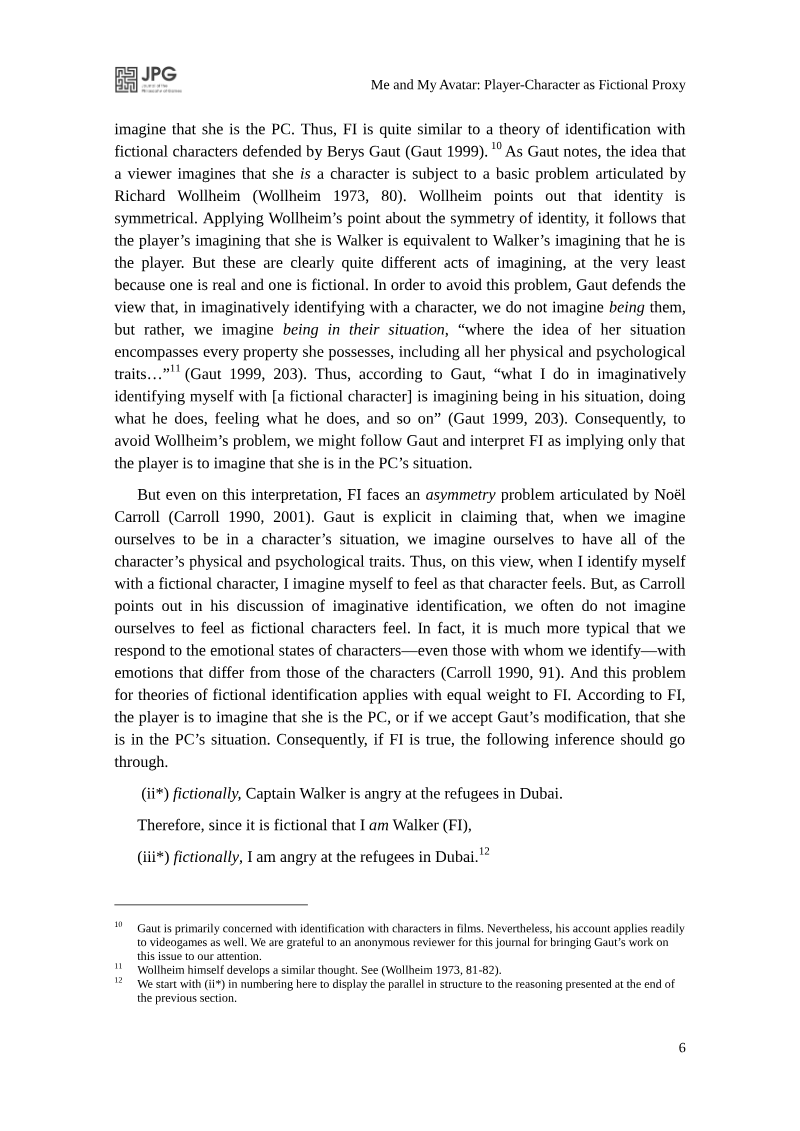
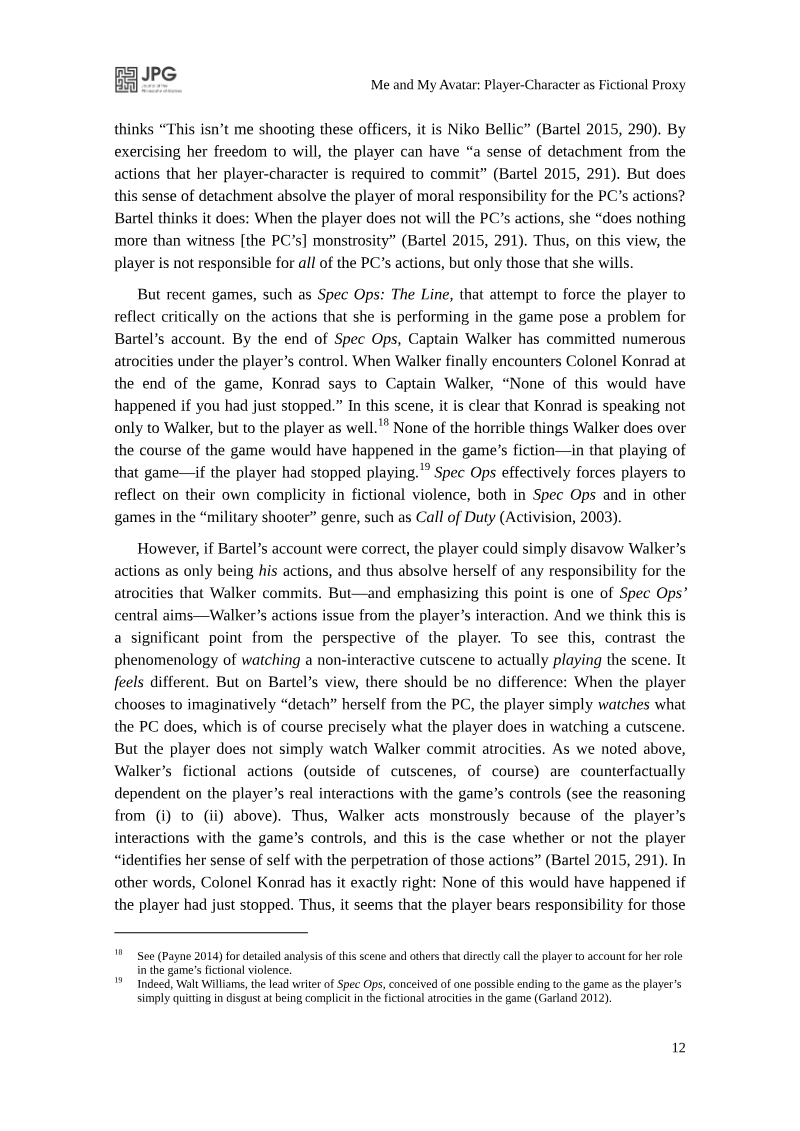
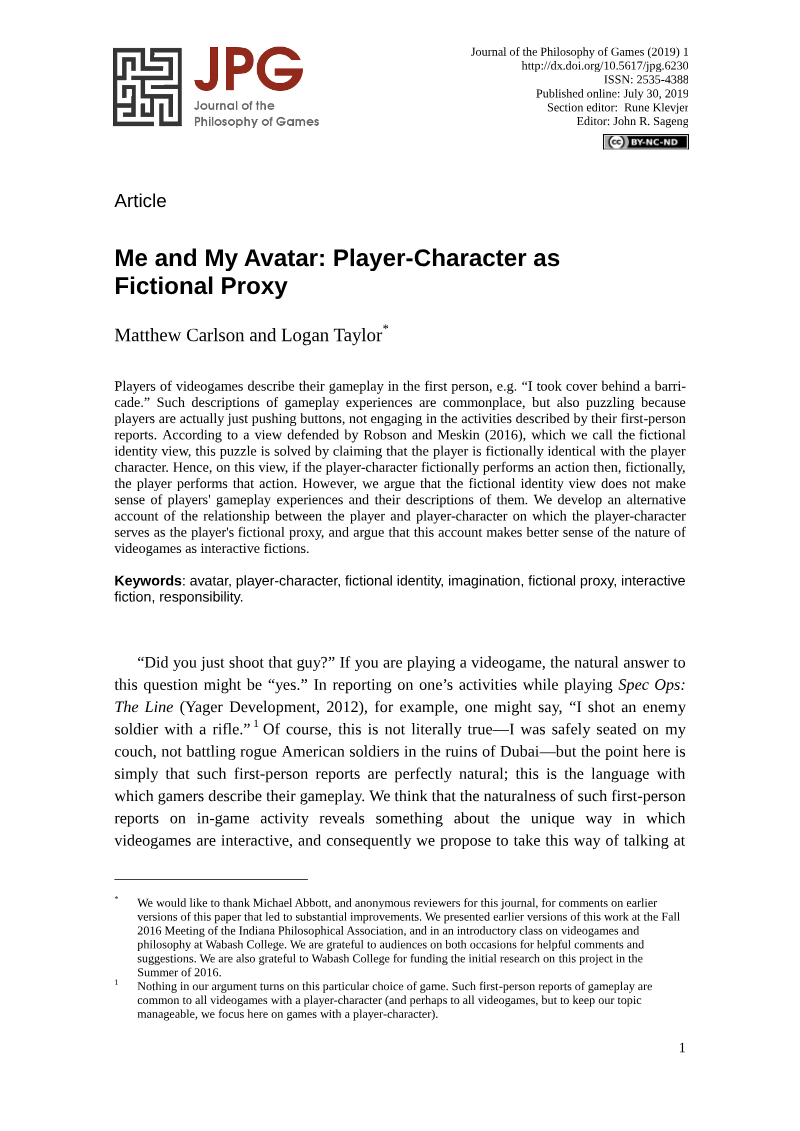
Me and My Avatar: Player-Character as Fictional Proxy
The relationship between players and their in-game avatars is best understood not as a state of fictional identity, but as a dynamic of fictional proxy.
- The 'fictional proxy' model defines the avatar as an artificial person whose actions are authorized by the player, rather than an extension of the player's own identity.
- Players maintain a distinct mental life separate from their avatars, making the theory of total psychological identification with characters philosophically untenable.
- Moral accountability in gaming is grounded in causal interaction, meaning players are responsible for actions initiated via controller input but not for non-interactive sequences like cutscenes.
Do you work at Journal of the Philosophy of Games? Get a free report of how these documents are read and cited here.