Digital Sun, the developer behind the successful 2D roguelite Moonlighter, has pivoted to the 3D strategy genre with its upcoming title Cataclismo. This shift represents a strategic move to target the core PC audience on Steam, where deep strategy and sandbox games offer a competitive advantage over the saturated market of 2D action and roguelite titles. Since its announcement in May 2023, Cataclismo has secured over 60,000 Steam wishlists, driven largely by a successful Steam Next Fest demo and coverage from major PC gaming media outlets.
The developer’s strategy emphasizes the continued importance of Steam Next Fest for discovery, despite industry concerns regarding event overcrowding. Additionally, Digital Sun utilized Kickstarter to raise €68,500, viewing the platform primarily as a marketing tool to engage existing fans rather than a sole funding source. Data indicates a highly international interest in the title, led by the United States (22.4%) and China (12.7%).
Broader industry sentiment reflects a challenging environment for indie developers in late 2023. A survey of approximately 60 studios reveals that 70% have frozen hiring and believe securing funding for future projects will be significantly more difficult. While 60% of respondents agree that the market is oversaturated with new releases, there is a cautious optimism that conditions will improve within the next 12 to 24 months. Consequently, over 43% of surveyed studios are currently adapting their scope or operations to mitigate market risks.
The scope of this analysis covers the global PC and console market, with specific focus on Steam data, crowdfunding trends, and developer sentiment during the 2023 calendar year. Findings are based on internal Steam wishlist data, Kickstarter results, and a third-party survey of indie game studios.
The success of the indie survival horror title Crow Country serves as a primary case study for modern game discovery and niche market penetration. Developed by SFB Games, the title reached 50,000 units sold across Steam (64%), PlayStation 5 (28%), and Xbox Series (8%) shortly after its May 2024 launch. The game’s performance highlights the efficacy of "vibes-based" marketing and the enduring appeal of 1990s-era aesthetic nostalgia. Key tactical successes included launching a demo simultaneously with the game’s announcement and leveraging horror-centric showcases to build a wishlist balance of over 210,000.
Broader industry data from Sony’s Business Segment meeting reveals significant shifts in console ecosystem dynamics. While the PlayStation 4 still accounts for 50% of active consoles, it represents only 37% of total gameplay hours. Furthermore, PlayStation 5 software spend is up 26% compared to the previous generation, driven primarily by a 176% increase in add-on content and DLC, while full-game purchases have declined by 12%. This data underscores a transition toward Games-as-a-Service (GaaS) models. Sony’s current strategy involves a bifurcated approach: releasing live-service titles simultaneously on PC and console while maintaining timed console exclusivity for single-player narrative titles to drive hardware adoption.
Market conditions in early 2024 show volatility, with Circana reporting a 43% year-over-year decline in U.S. console hardware spending for April. Despite these headwinds, specific segments show resilience; for instance, the top 10 major franchises accounted for 51% of all PlayStation Store revenue in FY2023. Additional industry developments include Discord refocusing on its core gaming audience, Meta preparing a cost-reduced Quest 3S, and Fortnite adjusting its creator payout formulas to prioritize player acquisition and re-engagement over pure retention.
The Steam marketplace has experienced a significant surge in total volume, with monthly releases increasing by 73% between January 2021 and January 2024. However, this growth is primarily driven by smaller-scale projects rather than high-profile titles. Analysis of "significant" games—defined by follower counts and launch-week review activity—suggests that the competitive landscape for major releases is relatively stable. While the number of games launching with over 1,000 followers reached an all-time peak in May 2024, the cohort of games with over 10,000 followers remains consistent at approximately 15 to 20 debuts per month.
Despite the increase in high-interest titles, actual player engagement as measured by first-week review counts has remained flat or slightly declined. This discrepancy indicates a potential dip in conversion rates from wishlists to sales. Market growth on Steam appears to be concentrated in two specific areas: robust back-catalog sales supported by DLC and discounting, and a small number of massive outliers like Palworld or Helldivers 2 that capture a disproportionate share of total revenue and attention.
The broader industry landscape in mid-2024 highlights the dominance of expansion content and social gaming. The Elden Ring: Shadow of the Erdtree DLC significantly boosted both streaming viewership and base game sales, while indie "masocore" and co-op titles like Chained Together demonstrated the power of viral, influencer-driven discovery. While hardware revenue in the United States saw a 40% year-over-year decline in May 2024, the PC market remains resilient, particularly for titles that leverage online co-op mechanics, which account for 36% of units sold despite representing only 6% of total releases.
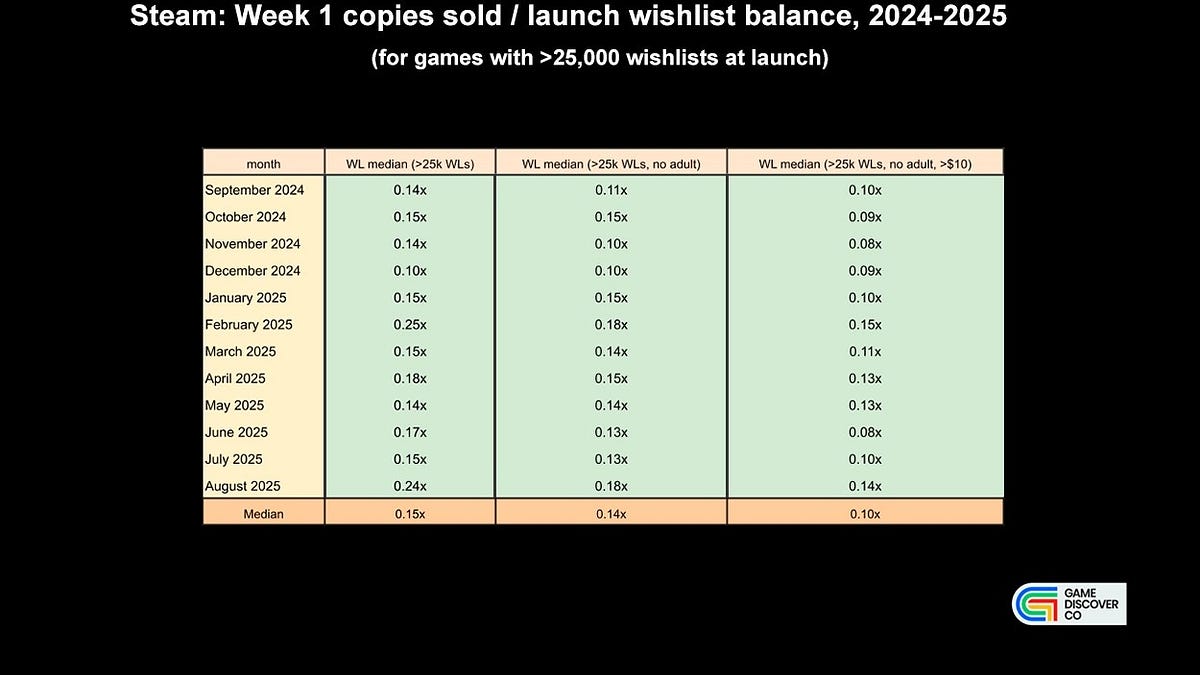
This analysis examines whether Steam conversion rates—the ability to turn pre-release interest into first-week sales—are declining over time. By tracking the median conversion of games with significant pre-launch traction from early 2022 through early 2024, data suggests a moderate downward trend. The median conversion rate has dipped approximately 15%, moving from just over 0.15 to roughly 0.125. This indicates that while pre-release wishlists remain a vital metric, it is becoming slightly more difficult to extract the same level of financial return from them compared to two years ago.
The research highlights significant volatility in performance regardless of broader trends. Even within the same month, high-performing outliers can convert at nine times the median rate, while underperformers may achieve only a fraction of the average. Seasonal trends suggest that the first quarter of the year often sees stronger conversion, though this may be influenced by the specific types of games choosing to launch during that window. Despite the slight dip in median rates, the total volume of "Hype" or wishlist interest across the platform has increased, largely driven by a small number of massive blockbuster releases.
A secondary investigation into downloadable content (DLC) using the game Besiege as a case study reveals that add-ons serve as critical tools for yield improvement. While DLC typically sees lower wishlist and review rates than base games, it significantly boosts overall revenue by allowing developers to sell higher-priced bundles and deluxe editions. Successful DLC strategies include using in-game wishlist buttons and leveraging Steam’s curated marketing messages for existing owners. Ultimately, while the market is increasingly crowded with high-quality older titles, the data concludes that there is no catastrophic collapse in Steam's ecosystem, though developers must work harder to convert interest into sales.
Analysis of recent market performance reveals that Senua’s Saga: Hellblade II has seen a more niche reception on Steam than initial projections suggested. Despite high visual fidelity and its status as a major first-party Xbox title, the game peaked at approximately 3,900 concurrent users (CCU) on Steam. This underperformance relative to expectations is attributed to its linear, single-playthrough nature and its positioning as an "arthouse" experience rather than a mainstream blockbuster. Early forecasts suggest roughly 100,000 sales in its first week on Steam, while Game Pass downloads are estimated at under one million.
The broader PC market shows varied success for indie and mid-tier titles. Esports Godfather and Rooftops & Alleys: The Parkour Game have emerged as notable successes, with the former leveraging a strong Chinese player base and the latter filling a market gap for dedicated parkour simulations. Conversely, titles like Crown Wars: The Black Prince and Synergy have struggled to convert high follower counts into active players, highlighting the volatility of Steam wishlists as a success predictor. In the VR space, Five Nights at Freddy's: Help Wanted 2 continues to lead the 2024 Meta Quest charts by rating volume.
Looking ahead to late May 2024, high-interest debuts include The Rogue Prince of Persia and the viral horror title Panicore. Long-gestating projects like Nine Sols and Selaco also show strong pre-launch momentum. On consoles, the market remains dominated by established hits and specific third-party successes like Little Kitty, Big City and Animal Well on the Nintendo Switch eShop. Data for these findings is derived from proprietary GameDiscoverCo tracking tools, Steam CCU figures, and storefront ranking analysis across PlayStation, Xbox, and Epic Games Store.
Market analysis of mid-May 2024 game releases indicates a period of high-performing PC ports and mixed results for established strategy franchises. The primary focus is the upcoming launch of Senua’s Saga: Hellblade II, which is projected to have a moderate debut on Steam with an estimated peak of 5,000 to 15,000 concurrent users. Despite high production values, its follower count of 22,000 suggests it may lack the broad mainstream appeal of other major titles, such as Ghost of Tsushima, which entered the PC market with over 70,000 followers.
The current Steam charts are dominated by the PC release of Ghost of Tsushima, which exceeded expectations by surpassing 60,000 concurrent users, making it one of the most successful PlayStation-to-PC conversions. In contrast, Homeworld 3 and Men of War II achieved respectable initial player counts but suffered from mixed user reviews. These negative sentiments are attributed to high fan expectations and technical issues, which may hinder long-term sales. Smaller titles like the roguelike Gatekeeper and the visually distinct Mullet Madjack are showing strong early momentum through positive word-of-mouth and high review scores.
On consoles, the Nintendo Switch is seeing significant success from independent titles Little Kitty, Big City and Animal Well, both of which are overperforming in the United States eShop charts. The PlayStation and Xbox markets remain led by established hits like MLB The Show 24 and Sea of Thieves, while the VR segment is currently topped by Five Nights at Freddy's: Help Wanted 2, which saw a massive debut on Meta Quest.
The analysis utilizes proprietary data from GameDiscoverCo, including Steam follower counts, concurrent user peaks, and regional console store rankings. The scope covers major PC and console platforms across North America and global Steam markets during the third week of May 2024.
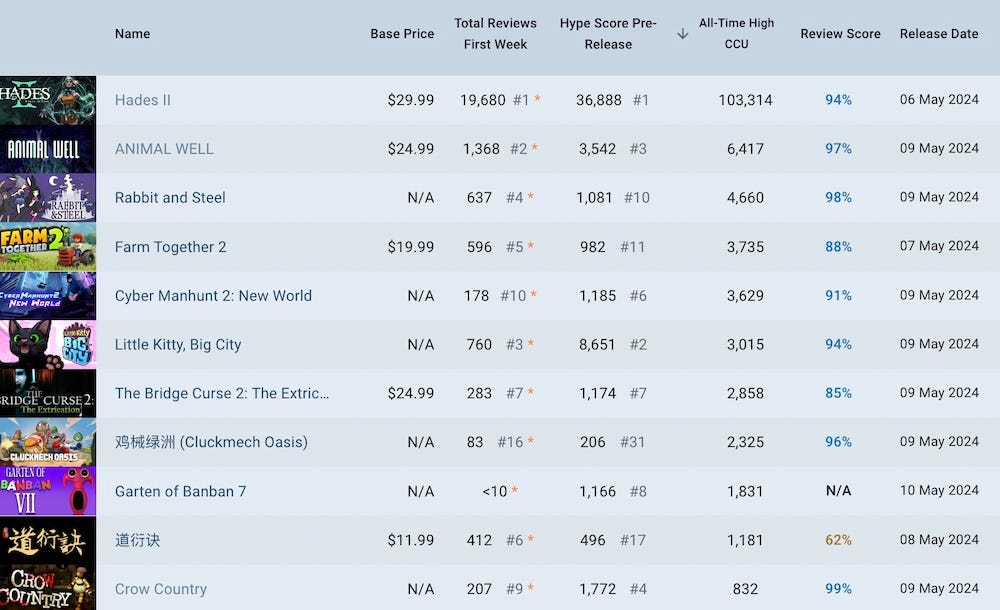
The analysis provides a comprehensive overview of the global video game market during a high-performing week for independent debuts in May 2024. By synthesizing data from Steam, PlayStation, Xbox, Nintendo Switch, and the Epic Games Store, the findings highlight a significant surge in indie success, characterized by ten titles achieving over 1,000 concurrent users (CCU) on Steam within their first week.
The primary thesis centers on the exceptional performance of Hades II, which dominated the market with over 103,500 peak CCU and nearly 20,000 positive reviews. Other notable indie breakouts include Animal Well, which leveraged viral interest and influencer backing to reach 6,400 CCU, and Rabbit and Steel, a solo-developed title that found a niche by blending bullet-hell mechanics with MMO-style raiding. The data suggests that high-quality, polished indie titles are currently capable of competing with major releases, provided they offer unique gameplay loops or established franchise loyalty, as seen with Farm Together 2.
Geographically, the scope extends to the Chinese market, where titles like Cyber Manhunt 2 and The Bridge Curse 2 showed strong performance driven almost exclusively by local players. On consoles, the findings note the continued dominance of Sea of Thieves on PlayStation and the steady performance of Another Crab’s Treasure across multiple platforms, including the Nintendo Switch.
Looking forward, the analysis identifies Homeworld 3 and the PC port of Ghost of Tsushima as the primary drivers of market momentum for the following week. Methodology relies on proprietary GameDiscoverCo tracking tools, SteamDB metrics, and public store charts to estimate sales and player engagement. The conclusion suggests a healthy, diverse ecosystem where both high-budget ports and innovative indie projects can find significant commercial traction simultaneously.
Analysis of Steam market data from 2024 reveals that core performance metrics for PC games have remained remarkably consistent since 2021, despite a significant increase in the volume of new releases. The findings are based on a survey of over 100 games launched since 2020, focusing on the relationship between pre-launch wishlists and subsequent sales performance, as well as long-term revenue trends.
The median conversion ratio from launch wishlists to first-week sales stands at 0.2x, identical to the figure recorded three years prior. While this multiplier varies significantly across titles—ranging from 0.07x for games with prior platform exclusivity to over 1.0x for viral hits—the broader market average remains stable. Data suggests that games with over 100,000 wishlists often see higher conversion rates, while titles with very low wishlist counts can easily outperform the median through organic discovery.
Long-tail revenue patterns also show high stability. The median gross revenue at the end of a game's first year is 3.16x its first-week earnings, a negligible increase from the 3.05x reported in 2021. Furthermore, the median multiplier for total revenue at the end of year two remains exactly 4.2x the first week's revenue. These figures suggest that while the market is more crowded, the fundamental way games earn money over time on Steam has not shifted significantly.
The primary challenge for modern developers is not a decline in conversion or long-tail efficiency, but rather the sheer intensity of competition. As more titles vie for a market that is growing at a slower pace than the supply of new games, the difficulty lies in achieving the initial visibility required to reach these median benchmarks. Consequently, while the ratios for financial planning remain reliable, the return on investment for many projects is under pressure due to the rising costs of development and the difficulty of standing out in a saturated ecosystem.
The primary focus of this analysis is the mechanics of game discovery and sales conversion on Steam, specifically examining how the co-op shooter Jump Ship secured nearly 300,000 wishlists within two months of its reveal. By interviewing the founders of Keepsake Games, the text identifies that a combination of high-quality IGN preview coverage, authentic gameplay trailers, and a clear "Sea of Thieves in space" hook drove massive organic interest. A significant finding is the impact of algorithmic amplification; the game gained over 35,000 wishlists in a single day by appearing on the Steam FPS tag page during a platform-wide festival, even without an official demo or release.
The scope of the discussion extends to broader industry trends in mid-2024, covering PC and console segments with a particular emphasis on Steam data. Utilizing a Gamalytic study of approximately 700 games released after September 2023, the analysis evaluates the efficacy of Steam launch discounts. The data suggests that while a 10-15% discount is a common psychological tool to drive early conversion, its impact on long-term sales and Steam’s internal discovery algorithms is often overstated. The findings indicate that conversion rates for games with no discount are often comparable to those with modest discounts, suggesting that the "type" of game and its existing hype are more critical factors than the initial price reduction.
Additional industry insights include a summary of declining U.S. console hardware sales for May 2024, with PlayStation 5 and Xbox units seeing significant year-over-year revenue drops. The analysis also touches on regional challenges, such as Steam’s recent IP blocking in Vietnam due to regulatory non-compliance, and the shifting landscape of game marketing as traditional events like E3 are replaced by digital showcases like Summer Game Fest. The tone remains analytical, cautioning developers that while high initial "hype" is beneficial, it necessitates rigorous expectation management to satisfy a demanding player base.
The Planet Crafter, a space survival title developed by the six-person French studio Miju Games, serves as a primary case study for achieving significant commercial success on Steam. After launching in Early Access in 2022, the game reached one million units sold following its 1.0 release in April 2024. Analysis of the game’s trajectory reveals that 32% of its total sales occurred in the two months following the full release, outperforming median industry expectations for 1.0 launches by over 50%.
Key performance metrics indicate that the addition of online co-op was a major catalyst for growth, doubling the game’s all-time high concurrent user count from 14,000 to 28,000. The title maintains an "Overwhelmingly Positive" rating with a high median playtime of over 18 hours, suggesting strong value-to-price perception. Geographically, the United States leads consumption at 29%, followed by Germany and China. Marketing success was driven by organic influencer interest and a €200,000 paid streamer budget rather than traditional press coverage.
Broader market analysis suggests a divergence between declining console sales and a growing PC segment. While traditional European and U.S. retail trackers show year-on-year declines, Steam’s gross platform revenue for May 2024 is estimated at $1.075 billion, a 14% increase over the previous year. This growth is attributed to rising spend in emerging markets and the strong performance of back-catalog titles, which may be offsetting stagnation in new AAA console releases. The findings suggest that small teams can achieve "big game" results by focusing on core gameplay loops, long-term Early Access updates, and the strategic implementation of multiplayer features.
Aggro Crab’s soulslike title, Another Crab’s Treasure, achieved significant commercial success by selling 250,000 units within its first month of release. Launched in April 2024, the game’s sales distribution is approximately 60% on Steam, 20% on PlayStation 5, and 20% on Nintendo Switch. While specific Xbox Game Pass download figures were not disclosed, estimates suggest the title has reached nearly one million players across all platforms.
The game’s success is attributed to its unique positioning as a "goofy" alternative to the traditionally dark and serious soulslike genre. By combining bright, cartoonish aesthetics with deep combat mechanics and a surprisingly emotional narrative, the developers successfully appealed to both hardcore genre fans and newcomers. Marketing played a critical role, with the 11-person development team prioritizing self-reliance on social media. Viral content on TikTok and Twitter, specifically "shitposting" and clips of gruesome in-game execution animations, helped the title break through industry noise without relying solely on platform holders or traditional press.
Broader industry data indicates a shifting landscape for major platforms. Sony’s recent financial results highlight the growing importance of the PC market, with Helldivers 2 reaching 12 million sales and contributing to a rise in non-console software revenue. However, hardware sales for PlayStation 5, Xbox Series, and Nintendo Switch are experiencing year-over-year declines in key regions like the UK and Europe, suggesting a peak in the current console cycle. Additionally, Steam data reveals that player churn for new buy-to-play games has increased 1.6 times since 2019, underscoring the difficulty of maintaining long-term engagement in an increasingly crowded market.
This analysis examines the performance of recent video game releases and provides market forecasts for upcoming titles across Steam, PlayStation, Xbox, and Nintendo Switch. Covering the mid-to-late April 2024 period, the data highlights a trend where high-profile launches are achieving significant initial scale but facing immediate scrutiny regarding technical optimization and gameplay balance.
The primary focus is the Early Access launch of No Rest for the Wicked, which achieved a peak of 34,000 concurrent users on Steam, marking the highest-CCU paid launch since the previous month. Despite this commercial success, the title received mixed reviews due to performance issues on high-end hardware and player disagreements over core mechanics like weapon durability. Other notable performances include the continued success of Balatro on the Nintendo Switch eShop and the strong debut of Grounded on non-Xbox platforms. Conversely, titles like Harold Halibut and The Crew Motorfest saw more muted or complicated receptions due to limited interactivity and storefront controversies, respectively.
Looking ahead, the industry anticipates a major release window led by Manor Lords, which has secured over 311,000 Steam followers. Other significant upcoming titles include Rotwood, Eiyuden Chronicle: Hundred Heroes, and the Steam release of Dead Island 2. The findings suggest that while the market remains crowded, titles with strong genre-blending elements or established developer pedigrees continue to capture significant consumer interest. Data is derived from proprietary Hype charts, Steam concurrent user counts, and digital storefront rankings across major consoles.