Esports Charts
Research186 documents
Documents
Article
Fastest-Growing Esports Games of 2025
The global esports landscape underwent a significant transformation in 2025, characterized by the successful integration of new competitive titles and the strategic revitalization of established legacy franchises. The industry’s growth was driven by a combination of high-profile PC and console launches, such as the debut of Marvel Rivals, and the expansion of mobile gaming ecosystems. By leveraging existing player bases and transitioning standalone modes into independent competitive titles, developers successfully captured increased audience engagement, signaling a shift toward more diverse and accessible esports content.
Data from the 2025 fiscal year highlights Honor of Kings as the primary leader in viewership expansion, recording the highest year-over-year growth in total hours watched among the top twenty esports titles. This surge was bolstered by the professionalization of its major competitive events, which solidified its dominance in the mobile sector. Simultaneously, niche titles like Identity V demonstrated the viability of community-driven esports, particularly within the Japanese market, where clear, readable competitive formats fostered substantial audience retention. Legacy titles, including Clash Royale and Clash of Clans, also experienced notable viewership resurgences, proving that long-standing franchises can maintain relevance through consistent ecosystem updates.
These trends underscore a broader industry evolution where geographic reach and platform accessibility are becoming the primary determinants of competitive success. As the sector moves into 2026, the focus remains on sustaining this momentum through regional league development and the continued analysis of viewership milestones. The current trajectory suggests that while established giants like League of Legends and Counter-Strike remain foundational, the rapid ascent of mobile-first titles and specialized niche games is fundamentally reshaping the hierarchy of global esports viewership.
- Honor of Kings achieved the highest year-over-year growth in total hours watched among the top twenty esports titles in 2025, cementing its leadership in the mobile sector.
- The 2025 esports landscape was defined by a shift toward mobile-first titles and the revitalization of legacy franchises like Clash Royale and Clash of Clans through consistent ecosystem updates.
- New competitive titles, most notably Marvel Rivals, successfully integrated into the market by leveraging existing player bases and transitioning standalone modes into independent esports.
- Niche titles such as Identity V demonstrated that community-driven esports with readable competitive formats can achieve significant audience retention, particularly within the Japanese market.
- Geographic reach and platform accessibility have become the primary determinants of competitive success, challenging the traditional hierarchy dominated by foundational titles like League of Legends and Counter-Strike.
+1
Esports ChartsDec 2025
Article
Top Counter-Strike 2 Tournaments and Viewership Stats of 2025
Counter-Strike 2 achieved unprecedented global viewership in 2025, solidifying its position as a dominant force in the competitive esports landscape. This growth was primarily catalyzed by Valve’s strategic implementation of new tournament regulations and the expansion of the Major format to include 32 teams. These structural adjustments fostered a more robust competitive ecosystem, allowing the game to thrive despite the removal of certain betting sponsors and significant shifts in industry oversight.
The BLAST.tv Austin Major stands as the definitive highlight of the year, establishing a new historical benchmark for the franchise with 1.79 million peak concurrent viewers and a total of 76.11 million hours watched. Beyond the Major circuit, the broader tournament ecosystem demonstrated remarkable strength, with events such as IEM Katowice setting new records for non-Major competitions. Regional engagement also reached new heights, exemplified by IEM Melbourne, which became the most popular esports event in Australian history by attracting 1.24 million peak viewers. This surge in interest was further bolstered by high-stakes narratives, such as Team Vitality’s pursuit of the Intel Grand Slam.
These developments reflect a maturing industry that successfully balances regulatory compliance with high-production entertainment. By leveraging comprehensive data tracking for team performance and player metrics, stakeholders can observe a clear trend toward increased professionalization and global fan engagement. As the competitive scene moves into 2026, the data suggests that the combination of expanded tournament formats and compelling player storylines will remain the primary drivers of viewership growth across international markets.
- The 2025 BLAST.tv Austin Major set a franchise record with 1.79 million peak concurrent viewers and 76.11 million total hours watched.
- Valve’s expansion of the Major format to 32 teams and new tournament regulations successfully drove global viewership growth despite the loss of certain betting sponsors.
- IEM Melbourne became the most popular esports event in Australian history, reaching 1.24 million peak concurrent viewers.
- Non-Major competitions showed significant strength in 2025, with IEM Katowice establishing new viewership records for the category.
- High-stakes professional narratives, such as Team Vitality’s pursuit of the Intel Grand Slam, served as a primary catalyst for increased fan engagement.
+2
Esports ChartsDec 2025

Article
Global Esports Map 2025: The Biggest Tournaments by Game and Region
The global esports landscape in 2026 reflects a mature and highly diversified ecosystem, characterized by the sustained dominance of established PC titles alongside the rapid ascent of mobile gaming. The primary objective of this analysis is to map the industry’s trajectory by tracking major tournaments, organizational structures, and audience engagement metrics across key international markets. By synthesizing viewership data from the first quarter of 2026, the industry demonstrates a robust capacity for cross-regional appeal, with significant event activity spanning Asia, Europe, the Middle East, and North America.
Viewership data underscores the immense scale of modern competitive gaming, as evidenced by the 2025 tournament cycle. League of Legends remains a cornerstone of the industry, achieving a peak viewership of 6.7 million for its World Championship. Simultaneously, the mobile sector has solidified its position as a primary driver of growth, with Mobile Legends: Bang Bang’s MPL Indonesia Season 15 attracting over 4 million peak viewers. These figures highlight a shift in consumption patterns where mobile-first titles are increasingly rivaling traditional PC-based esports in terms of global reach and fan engagement.
Professional analytics play a critical role in navigating this complex environment, providing the necessary infrastructure for stakeholders to monitor performance and compare tournament success. As the industry continues to professionalize, the reliance on granular data metrics—such as platform-specific statistics and comparative tournament analysis—has become essential for organizations and sponsors alike. This analytical framework confirms that while the esports market is geographically fragmented, it is unified by a consistent demand for high-level competition and data-driven insights that facilitate strategic decision-making across the global gaming sector.
- League of Legends remains the industry leader, with its 2025 World Championship reaching a peak viewership of 6.7 million.
- Mobile gaming has become a primary growth driver, exemplified by Mobile Legends: Bang Bang’s MPL Indonesia Season 15 attracting over 4 million peak viewers.
- Mobile-first esports titles are now directly rivaling traditional PC-based games in terms of global reach and fan engagement metrics.
- The 2026 esports ecosystem is characterized by a mature, diversified landscape with significant tournament activity across Asia, Europe, the Middle East, and North America.
- Professional stakeholders are increasingly reliant on granular, platform-specific data metrics to monitor tournament performance and guide strategic decision-making.
+1
Esports ChartsNov 2025
Article
Esports Charts Nominated for Esports Supporting Platform of the Year
Esports Charts has secured a nomination for the Esports Supporting Platform of the Year at the 2025 Esports Awards, underscoring its role as a critical infrastructure provider within the competitive gaming landscape. This recognition highlights the platform’s ongoing influence in delivering comprehensive viewership analytics, tournament data, and performance tracking for global esports organizations. By providing essential metrics that shape industry standards, the platform serves as a vital resource for stakeholders navigating the complexities of the digital gaming market.
The nomination reflects the platform’s sustained commitment to transparency and data-driven insights across the international esports ecosystem. As a previous recipient of the Esports Coverage Platform of the Year award in 2023, the platform continues to evolve its analytical tools to meet the increasing demands of the professional gaming sector. This latest acknowledgment in a newly established category specifically honors software solutions that offer indispensable utility to the broader industry.
The winner of this accolade will be determined through a public voting process concluding on November 12, 2025, with the final results announced on November 19. This nomination serves as a testament to the platform's established reputation for accuracy and its continued expansion of services designed to support the growth and professionalization of esports on a global scale. Through its consistent delivery of high-fidelity data, the platform remains a cornerstone for organizations seeking to quantify audience engagement and tournament success.
- Esports Charts has been nominated for the 2025 Esports Awards in the newly established 'Esports Supporting Platform of the Year' category.
- The winner of the award will be determined by a public vote ending on November 12, 2025, with the final results announced on November 19, 2025.
- The platform previously received the 'Esports Coverage Platform of the Year' award in 2023.
- Esports Charts provides industry-standard viewership analytics, tournament data, and performance tracking for global esports organizations.
- The nomination recognizes the platform's role as critical infrastructure for stakeholders to quantify audience engagement and tournament success within the digital gaming market.
Esports ChartsOct 2025
Article
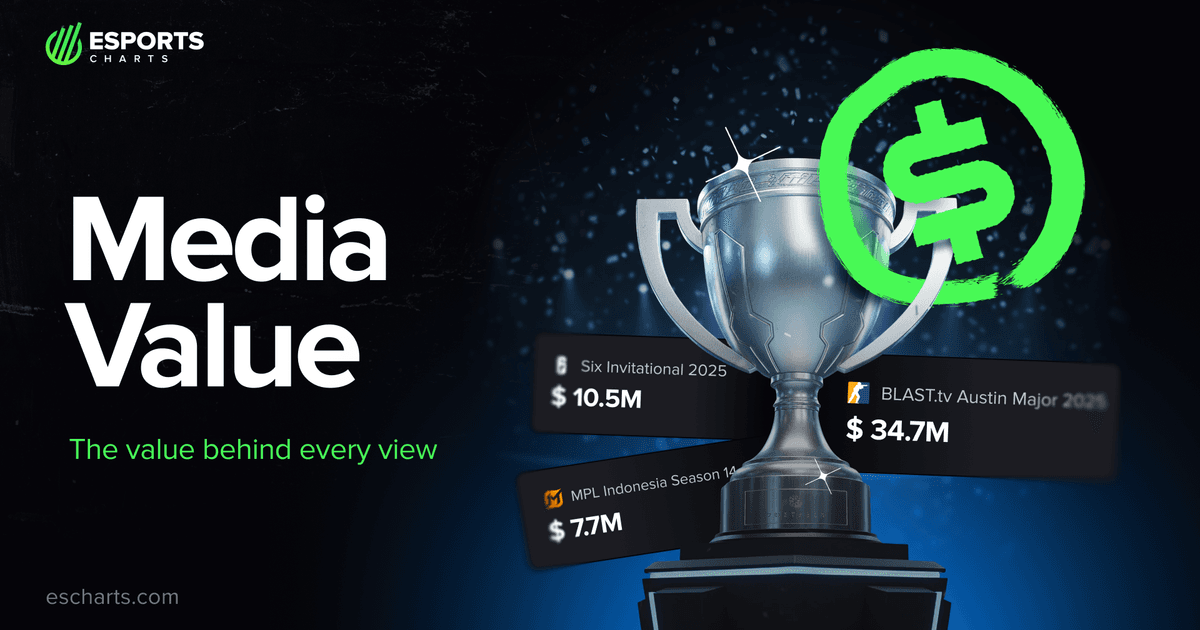
Esports Charts Introduces Media Value Metric
The introduction of a standardized Media Value metric provides a critical framework for quantifying the marketing impact of esports sponsorships. By establishing a benchmark based on the market cost of a standardized one-percent on-screen banner, this tool enables stakeholders to evaluate the commercial potential of tournament broadcasts with greater precision. The methodology incorporates regional and language-specific cost-per-mille adjustments, allowing for consistent comparisons across diverse global markets. While this metric serves as a robust baseline for broadcast inventory, it remains a focused analytical instrument that does not encompass the entirety of sponsorship activations, such as on-site physical placements or influencer-led marketing campaigns.
This analytical capability is integrated into a broader suite of professional tools designed to support data-driven decision-making within the esports industry. Through the Esports Charts PRO subscription service, priced at twenty-nine dollars and ninety-nine cents per month, users gain access to comprehensive performance metrics, including detailed tournament comparisons and platform-specific viewership data. These resources are intended to assist organizations in navigating the complexities of the digital gaming landscape by providing actionable insights into team performance and audience engagement.
The scope of these analytical offerings covers the global esports ecosystem, providing a centralized platform for stakeholders to assess the value of broadcast assets. By bridging the gap between raw viewership numbers and tangible financial valuation, these tools facilitate more informed investment strategies. The platform effectively standardizes how commercial entities approach sponsorship evaluation, offering a scalable solution for teams, organizers, and brands seeking to optimize their presence within the competitive gaming sector.
- Esports Charts has launched a standardized Media Value metric to quantify the marketing impact of esports sponsorships by benchmarking them against the market cost of a one-percent on-screen banner.
- The new valuation methodology utilizes regional and language-specific cost-per-mille adjustments to ensure consistent financial comparisons across diverse global broadcast markets.
- The Media Value metric is exclusively designed for broadcast inventory and does not account for other sponsorship activations like physical on-site placements or influencer-led campaigns.
- Professional access to these analytical tools and performance metrics is available through the Esports Charts PRO subscription service, priced at $29.99 per month.
- The platform provides centralized data, including tournament comparisons and platform-specific viewership, to assist stakeholders in moving from raw viewership numbers to tangible financial valuation.
+1
Esports ChartsSept 2025
Article
Esports Viewership Results 2021
The global esports landscape in 2021 was defined by the overwhelming dominance of League of Legends, which solidified its position as the industry’s premier title. The World Championship served as the year’s definitive viewership milestone, drawing record-breaking audiences that underscored the continued commercial and cultural relevance of established PC-based competitive gaming. Alongside these traditional pillars, the industry experienced a pivotal shift toward mobile platforms, with titles such as Mobile Legends: Bang Bang and PUBG Mobile emerging as primary drivers of audience expansion and engagement.
Professional organizations played a critical role in these viewership successes, with teams like Team Liquid, DWG KIA, NAVI, and Team Spirit acting as central figures in driving fan interest across their respective disciplines. These entities functioned as the primary conduits for audience retention, consistently attracting large-scale viewership during high-stakes tournament cycles. This period marked a transition where mobile esports began to rival the reach of legacy titles, signaling a broader diversification of the competitive gaming ecosystem.
Operating as an independent analytical authority, the industry infrastructure relies on sophisticated data tracking to quantify these trends. By providing granular insights into tournament performance, team-specific engagement, and regional growth patterns, analytical platforms facilitate strategic decision-making for stakeholders. These services, ranging from subscription-based dashboards to specialized consulting, remain essential for navigating the complexities of the global esports market. The 2021 data reflects a maturing industry that successfully balanced the stability of established PC titles with the rapid, high-growth trajectory of the mobile gaming sector.
- League of Legends remained the industry’s premier title in 2021, with its World Championship serving as the year's definitive viewership milestone.
- Mobile esports, led by titles such as Mobile Legends: Bang Bang and PUBG Mobile, emerged as primary drivers of audience expansion and began to rival the reach of legacy PC titles.
- Professional organizations including Team Liquid, DWG KIA, NAVI, and Team Spirit acted as the central conduits for audience retention and fan engagement during high-stakes tournaments.
- The 2021 esports landscape was characterized by a maturing ecosystem that successfully balanced the stability of established PC-based competitive gaming with the rapid growth of the mobile sector.
- Strategic decision-making for industry stakeholders is increasingly reliant on granular data tracking, including tournament performance metrics, team-specific engagement, and regional growth patterns.
+1
Esports ChartsFeb 2022