DDM
Investment12 documents
Documents
Report1 pages
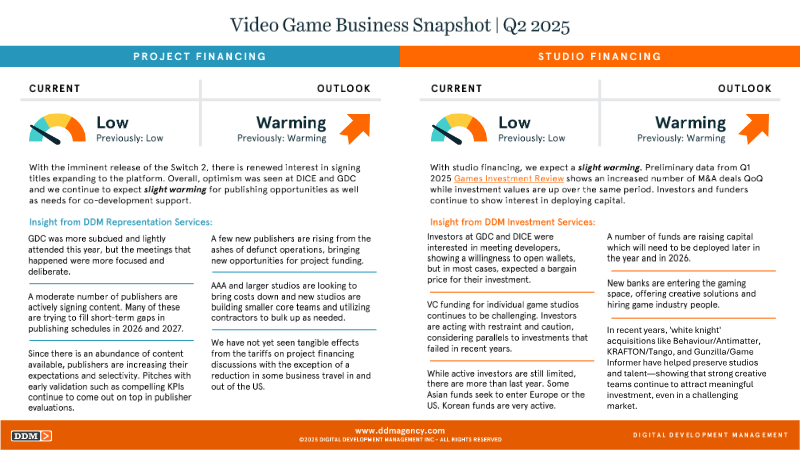
Video Game Business Snapshot: Q2 2025
The second quarter of 2025 highlights a strategic shift in the video game industry’s mergers and acquisitions landscape, characterized by a rise in rescue-style investments often referred to as white knight acquisitions. These transactions involve established global entities stepping in to acquire studios or media outlets that might otherwise face closure or significant downsizing. Notable examples include KRAFTON’s acquisition of Tango Gameworks, Behaviour Interactive’s absorption of Antimatter, and Gunzilla Games’ involvement with Game Informer. These moves suggest that despite broader economic volatility and a contraction in traditional venture capital, high-quality creative talent and established intellectual properties remain highly valuable assets for diversified gaming conglomerates.
The current market environment reflects a transition where strategic preservation is prioritized over speculative growth. Large-scale publishers are increasingly focused on securing proven development teams to bolster their long-term pipelines, viewing these acquisitions as opportunities to integrate specialized expertise at a time when independent sustainability is difficult. This trend underscores a broader industry sentiment that while the capital market remains challenging, the underlying value of experienced human capital continues to drive significant deal flow. These developments indicate that the industry is moving toward a more consolidated but stable structure, where the survival of key creative hubs is facilitated by the strategic interests of larger market players.
- Q2 2025 is defined by a surge in 'white knight' acquisitions, where major conglomerates are purchasing studios facing closure or downsizing to preserve creative talent and intellectual property.
- Notable rescue acquisitions this quarter include KRAFTON’s purchase of Tango Gameworks, Behaviour Interactive’s absorption of Antimatter, and Gunzilla Games’ involvement with Game Informer.
- The industry is shifting away from speculative growth toward strategic preservation, as large publishers prioritize securing proven development teams to stabilize long-term production pipelines.
- Despite a contraction in traditional venture capital and broader economic volatility, experienced human capital remains a high-value asset driving deal flow.
- The current market environment is trending toward a more consolidated industry structure, where the survival of independent creative hubs is increasingly dependent on the strategic interests of larger market players.
+1
DDMJun 2025
Financial11 pages
Game Developers Investment Report: March 2025
The report provides a comprehensive analysis of investment and merger‑and‑acquisition activity within the global video‑game development sector for the calendar year 2024, positioning the data as a benchmark for industry stakeholders seeking insight into capital flows and strategic trends. By focusing exclusively on developer‑centric deals—excluding hardware, middleware and ancillary software—the study highlights the accelerating scale of financing and consolidation in the games ecosystem.
In 2024, developers attracted $4.4 billion across 580 investments, representing 57 % of total industry capital and a 84 % increase in value over 2023. The surge was driven largely by a $1.5 billion infusion from Disney into Epic Games, which alone accounted for 34 % of developer investment value. Console and PC studios captured the largest share of investment volume (42 %), followed by mobile (31 %) and mass‑community games (12 %). Smaller studios dominate the investor base, with 90 % employing fewer than 50 staff, and the bulk of capital originated from Europe, North America and Asia, which together accounted for 96 % of total value.
M&A activity mirrored the investment boom, with developers involved in $6.4 billion of transactions across 91 deals, or 65 % of total industry M&A value. Excluding Microsoft’s $68.7 billion acquisition of Activision Blizzard, developer M&A volume fell 8 % in value but rose 23 % in deal count, underscoring a shift toward strategic purchases of distressed assets. Console/PC remained the dominant segment (50 % of M&A volume), while acquirers favored studios of 21‑250 employees, primarily in the same three regions.
Methodologically, the analysis counts only closed transactions, treating SPAC proceeds as the investment amount rather than post‑transaction valuations, and relies on a proprietary database maintained for over a decade. The dataset spans 17 years of historical activity, ensuring consistency and comparability across periods while deliberately filtering out announced but unclosed deals to present a clear picture of actual capital deployment.
- In 2024, game developers secured $4.4 billion across 580 investments, marking an 84% increase in value compared to 2023.
- Disney’s $1.5 billion investment in Epic Games was the primary driver of 2024 capital, accounting for 34% of the total developer investment value.
- Developer-focused M&A activity reached $6.4 billion across 91 deals, representing 65% of the total industry M&A value for the year.
- Excluding the Microsoft-Activision Blizzard deal, developer M&A deal count rose by 23% while total value fell by 8%, signaling a strategic shift toward acquiring distressed assets.
- Console and PC studios remain the primary focus for capital, capturing 42% of investment volume and 50% of M&A volume.
DDMMar 2025
Financial11 pages
Game Developers Investment Report
The current landscape of game development investment reflects a period of cautious recalibration following several years of aggressive expansion. Financial activity within the sector is increasingly concentrated on established studios with proven intellectual properties or technical infrastructures that mitigate risk for venture capitalists and private equity firms. While seed-stage funding remains accessible for innovative startups, mid-market developers face a more rigorous due diligence process as investors prioritize sustainable profitability and long-term player retention over rapid user acquisition.
Strategic shifts in the industry indicate a growing preference for cross-platform capabilities and the integration of live-service models. Data suggests that investment flows are heavily directed toward developers capable of maintaining high engagement through consistent content updates and community management. Geographically, while North America and Europe continue to lead in total deal volume, there is a notable uptick in capital allocation toward emerging markets in Southeast Asia and Latin America, driven by rising smartphone penetration and a burgeoning middle-class gaming demographic.
Methodological analysis of recent transactions reveals that the average deal size has stabilized, though the time required to close funding rounds has lengthened significantly. Investors are placing greater emphasis on the scalability of proprietary engines and the potential for transmedia expansion, such as adapting game franchises into film or television. Overall, the industry is transitioning toward a more disciplined investment environment where technical excellence and operational efficiency are the primary catalysts for securing capital in a competitive global market.
- Investors are prioritizing established studios with proven intellectual property and technical infrastructure, shifting focus away from rapid user acquisition toward sustainable profitability and long-term player retention.
- Funding for mid-market developers has become significantly more difficult to secure due to rigorous due diligence requirements, though seed-stage capital remains accessible for innovative startups.
- Capital allocation is increasingly favoring developers who utilize live-service models and cross-platform capabilities to maintain high player engagement through consistent content updates.
- While North America and Europe maintain the highest total deal volume, investment is expanding into Southeast Asia and Latin America, fueled by rising smartphone penetration and a growing middle-class demographic.
- Funding rounds are taking significantly longer to close, even as average deal sizes have stabilized across the industry.
+1
DDMMar 2025
Financial17 pages
Games Investment Review: Q4 2024 Executive Summary Report
The Games Investment Review provides a comprehensive analysis of financial activity within the global video game industry, focusing on the second quarter (Q2) and first half (H1) of 2024. The primary thesis indicates a period of stabilization and recovery in investment volume, even as total deal values fluctuate due to a lack of massive, outlier acquisitions. The scope is global, covering North America, Europe, and Asia across segments including Console/PC, Mobile, Blockchain, and Tech/Other. Data is derived from a proprietary database of over 725 deals spanning 17 years, utilizing medians to provide a more accurate picture of typical market activity.
Key findings for Q2 2024 show that investments reached $3.08 billion across 222 transactions, marking the highest investment volume in nearly two years. This growth was heavily influenced by GameStop’s $2.1 billion post-IPO equity raise. Conversely, M&A activity saw a decline, totaling $845 million across 40 transactions, a 59% drop in value from the previous quarter. Notably, Q2 2024 broke a five-year streak of quarterly public debuts, recording zero IPOs. However, the fundraising environment for venture capital showed signs of easing, with $21.9$ billion raised across 38 new funds, dominated by four major firms accounting for 74% of that capital.
The H1 2024 overview reveals that while total deal value reached $8.1 billion, a 15% decrease from an adjusted H2 2023, investment volume rose by 26%. Blockchain remains a significant sector, representing 37% of H1 2024 investment volume. Developer-focused investments also saw a 90% increase in value compared to the previous half-year, largely driven by Disney’s $1.5 billion investment in Epic Games. The analysis concludes that while the industry is moving away from the era of "colossal" acquisitions, the high frequency of smaller investments suggests a healthy, active ecosystem for early-stage companies and specialized technology.
- The gaming industry is shifting toward a high-frequency ecosystem of smaller investments, moving away from the era of colossal M&A deals.
- Total investment volume reached $3.08 billion across 222 transactions in Q2 2024, the highest volume recorded in nearly two years.
- M&A activity dropped significantly in Q2 2024, totaling $845 million across 40 transactions, representing a 59% decline in value from the previous quarter.
- H1 2024 saw a 26% increase in investment volume despite a 15% decrease in total deal value compared to H2 2023.
- Blockchain remains a dominant sector, accounting for 37% of all investment volume during the first half of 2024.
+1
DDMFeb 2025
Report17 pages
Console/PC Games Investment Report September 2024
The analysis presents a comprehensive review of investment and merger‑and‑acquisition activity within the console and PC video‑game sector for the 2023 fiscal year, positioning 2023 as an outlier driven primarily by Microsoft’s $68.7 billion acquisition of Activision Blizzard. Total deal value reached $69.5 billion across 200 transactions, a 612 % increase in value yet a 25 % decline in transaction count compared with 2022, and twice the combined value of the preceding five‑year period (2018‑2022). Investment volume fell to $627.8 million across 161 deals, while M&A volume surged to $68.8 billion in 39 deals, accounting for more than 99 % of North American M&A value. IPO activity contracted sharply, with six offerings generating $46 million in market capitalisation, down 85 % from the prior year.
Geographically, North America and Europe dominated private investment, contributing $184.7 million (29 % of volume) and $358.8 million (57 % of volume) respectively, while Australia and New Zealand saw limited activity aside from a government grant program. Investors favored micro‑studios (median six employees), whereas acquirers targeted slightly larger teams (median 39 employees). Blockchain‑related deals comprised 15 % of investment value but only 13 % of transaction count, highlighted by Mythic Protocol’s $6.5 million seed round.
Methodologically, the review counts only closed transactions, excluding announced deals, and treats SPAC proceeds as the investment amount rather than post‑transaction valuation. Data are drawn from a proprietary, sixteen‑year‑old database that tracks Western‑focused game‑industry deals across development, publishing, and technology, ensuring consistency and comparability across quarters. The findings underscore a market concentrated around a few mega‑deals, with modest activity elsewhere and a clear shift toward larger, strategic acquisitions.
- The 2023 fiscal year saw total deal value reach $69.5 billion, a 612% increase driven almost entirely by Microsoft’s $68.7 billion acquisition of Activision Blizzard.
- While total deal value surged, the actual number of transactions fell by 25% compared to 2022, and investment volume dropped to $627.8 million across 161 deals.
- M&A activity dominated the market with $68.8 billion across 39 deals, accounting for more than 99% of North American M&A value.
- IPO activity contracted significantly in 2023, with only six offerings generating $46 million in market capitalization, an 85% decline from the previous year.
- Private investment was concentrated in Europe and North America, which contributed 57% ($358.8 million) and 29% ($184.7 million) of investment volume, respectively.
+2
DDMSept 2024
Financial17 pages
Console/PC Games Investment Report 2024
Investment activity within the console and PC gaming sectors throughout 2023 reveals a strategic focus on early-stage developers, artificial intelligence integration, and blockchain-enabled platforms. Venture capital firms and strategic corporate investors prioritized studios capable of delivering high-fidelity experiences or innovative user-generated content tools. Andreessen Horowitz emerged as a leading contributor, deploying $82 million across various rounds, highlighted by a $55 million Series A investment in The Believer Company. This trend underscores a broader industry movement toward backing unproven but high-potential studios during their foundational stages.
The funding landscape also highlights the significant role of strategic industry players like KRAFTON and specialized funds such as Makers Fund. KRAFTON’s involvement included a notable $30.7 million post-IPO equity injection into People Can Fly, while Makers Fund distributed $22.5 million across multiple early-stage ventures including Noodle Cat Games and World Makers. These investments suggest a dual interest in established mid-tier developers and lean, agile startups focusing on niche PC markets.
Blockchain and Web3 gaming remained a resilient segment for capital allocation, particularly through investors like Merit Circle and Polygon. These firms concentrated on seed-stage rounds for developers such as Farcana, which secured $10 million, and Delabs Games. The data indicates that while the broader market faced economic headwinds, specialized sectors involving AI-driven development and decentralized gaming infrastructure continued to attract tens of millions of dollars in capital. Overall, the 2023 investment cycle was defined by a preference for Series A and Seed rounds, signaling a long-term bet on the next generation of console and PC intellectual property.
- Investment activity in 2023 prioritized early-stage developers, with a clear strategic focus on Series A and Seed rounds to secure the next generation of console and PC intellectual property.
- Andreessen Horowitz led the market in capital deployment, investing $82 million across various rounds, including a $55 million Series A investment in The Believer Company.
- Strategic corporate investors and specialized funds remained active, with KRAFTON injecting $30.7 million into People Can Fly and Makers Fund distributing $22.5 million across startups like Noodle Cat Games and World Makers.
- Blockchain and Web3 gaming proved resilient despite economic headwinds, with firms like Merit Circle and Polygon backing seed-stage developers such as Farcana, which raised $10 million.
- Investors concentrated capital on studios capable of delivering high-fidelity experiences, innovative user-generated content tools, and AI-driven development workflows.
+3
DDMSept 2024
Report1 pages
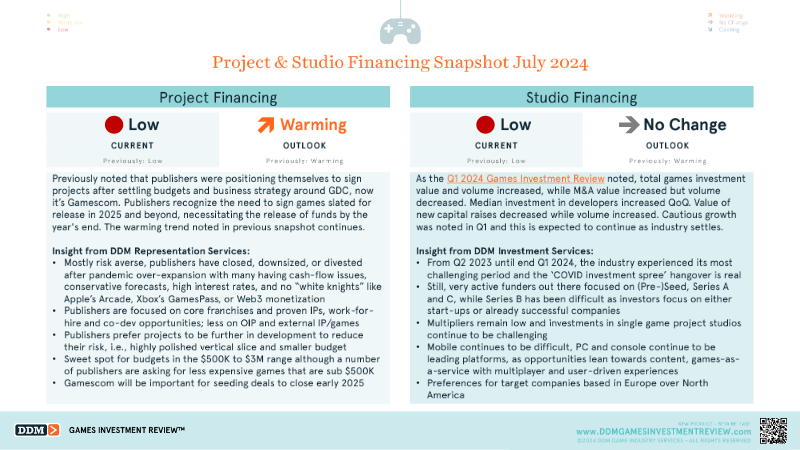
Project & Studio Financing Snapshot July 2024
The snapshot evaluates financing conditions for game projects and development studios as of mid‑2024, highlighting a persistently constrained capital environment while noting modest signs of warming in project funding. Publishers remain risk‑averse after pandemic‑driven over‑expansion, with many having reduced staff, divested assets, and facing cash‑flow pressures compounded by high interest rates and the absence of large platform backers. Consequently, they prioritize core franchises, proven IP and work‑for‑hire arrangements, demanding projects that are further along in development, feature polished vertical slices, and fall within a budget sweet spot of roughly $500 k to $3 million, though an emerging demand for sub‑$500 k titles is evident. The upcoming Gamescom event is expected to catalyze deal flow for releases slated for 2025 and beyond.
Studio financing remains low with no change in outlook, reflecting cautious growth after a volatile Q1 2024 period in which total investment value and volume rose, M&A value increased while deal count fell, and median developer investment grew quarter‑over‑quarter. New capital raises saw a decline in total value but an increase in deal count, underscoring a shift toward smaller, more frequent funding rounds. Investors continue to focus on early‑stage (pre‑seed, Series A) and later‑stage (Series C) opportunities, while Series B financing proves scarce as capital gravitates toward either nascent start‑ups or already successful entities.
Geographically, funders exhibit a preference for European‑based studios over North American counterparts, and platform trends show mobile projects facing heightened difficulty, whereas PC and console titles dominate, especially those built around games‑as‑a‑service, multiplayer, and user‑generated content models. Overall, the financing landscape is characterized by conservative publisher behavior, modest but steady studio investment, and a strategic emphasis on later‑stage, lower‑risk projects as the industry settles post‑pandemic.
- Publishers are prioritizing low-risk projects with budgets between $500k and $3 million, though there is an emerging demand for titles under $500k.
- Investment is heavily skewed toward early-stage (pre-seed/Series A) and late-stage (Series C) rounds, leaving Series B financing scarce.
- Funding trends show a shift toward smaller, more frequent capital raises, evidenced by a decline in total new capital value despite an increase in deal count.
- PC and console titles—specifically those featuring games-as-a-service, multiplayer, or user-generated content—are currently prioritized over mobile projects.
- Investors are showing a geographic preference for European-based studios over North American counterparts.
+1
DDMJul 2024

Report15 pages
Mobile Games Annual Investment Report
The mobile gaming investment landscape in 2023 was characterized by a strong concentration of capital within early-stage ventures, with a significant emphasis on blockchain integration and infrastructure. Venture capital activity was led by prominent firms such as Andreessen Horowitz, which deployed 63 million dollars across eight investments, including a notable 33 million dollar seed round for Proof of Play. This trend highlights a strategic pivot toward developers who combine traditional mobile gameplay with decentralized technologies and infrastructure solutions.
Investment patterns reveal a diverse range of sub-sectors receiving capital, including social gaming, AI-driven development, and fantasy sports. For instance, Lumikai focused heavily on the Indian market and social platforms, leading a 22 million dollar round for Eloelo. Meanwhile, firms like BITKRAFT Ventures and Animoca Brands continued to bridge the gap between mobile and web3, funding projects like Redemption Games and Upland. While early-stage seed and Series A rounds dominated the volume of transactions, late-stage funding remained selective, as evidenced by Animoca Brands’ 11.9 million dollar raise.
Geographically and operationally, the sector shows a global distribution of capital, targeting both established publishers and niche studios. Total round values for top investors ranged from approximately 15 million to over 60 million dollars, signaling a cautious but steady flow of capital into the mobile ecosystem. The data suggests that while the broader gaming market faced economic headwinds, investors remained committed to high-growth areas such as blockchain-enabled rewards platforms, mid-core mobile development, and innovative monetization models through digital ownership.
- Venture capital in 2023 prioritized early-stage mobile gaming ventures, specifically those integrating blockchain technology and decentralized infrastructure.
- Andreessen Horowitz led investment activity by deploying 63 million dollars across eight deals, including a 33 million dollar seed round for Proof of Play.
- Investment focus remained diverse, spanning social gaming, AI-driven development, and fantasy sports, exemplified by Lumikai’s 22 million dollar investment in Eloelo.
- Firms such as BITKRAFT Ventures and Animoca Brands actively funded projects like Redemption Games and Upland to bridge the gap between traditional mobile gaming and Web3.
- While early-stage seed and Series A rounds dominated transaction volume, late-stage funding remained highly selective, highlighted by Animoca Brands’ 11.9 million dollar raise.
+1
DDMJun 2024
Financial17 pages
Games Investment Review: Q2 2024 Executive Summary Report
The review aims to deliver a data‑driven snapshot of capital activity in the video‑game sector, quantifying investment, merger‑and‑acquisition (M&A) and fund‑raising trends for the second quarter of 2024 and placing them in a half‑year context. By tracking only transactions that have officially closed, the analysis avoids speculative figures and provides a consistent baseline that has been applied for more than a decade across Western‑focused development, publishing and technology deals.
In Q2 2024, total investment reached $3.0 billion across 222 deals, a 32 percent rise in value and a 21 percent increase in deal count over the previous quarter, marking the highest investment volume since Q3 2022. Combined investment and M&A activity summed to $3.8 billion in 262 transactions, representing an 11 percent dip in value but a 16 percent lift in volume. M&A activity contracted sharply to $845 million in 40 deals, down 59 percent in value, while no IPOs occurred, ending a five‑year streak of at least one public listing per quarter. New fund announcements totaled $21.9 billion across 38 funds, a 48 percent jump, with four flagship funds—General Catalyst, ICONiQ Capital, Norwest Venture Partners and Kleiner Perkins—accounting for 74 percent of the capital raised.
Segment analysis shows Tech/Other categories captured 83 percent of investment value, while Console/PC led in deal volume at 33 percent. Blockchain‑related funding rose to $416 million in Q2, driven by regulatory approvals for crypto ETFs, and undisclosed deals comprised 40 percent of the quarter’s activity. In the first half of 2024, investments surged to $5.2 billion across
- Q2 2024 investment reached $3.0 billion across 222 deals, marking the highest investment volume in the sector since Q3 2022.
- New fund announcements surged 48% to $21.9 billion, with General Catalyst, ICONiQ Capital, Norwest Venture Partners, and Kleiner Perkins accounting for 74% of that total.
- M&A activity contracted significantly to $845 million across 40 deals, a 59% decline in value compared to the previous quarter.
- The quarter saw no IPOs, ending a five-year streak of at least one public listing per quarter.
- Tech and 'Other' categories dominated the market, capturing 83% of total investment value, while Console/PC games led in deal volume at 33%.
+1
DDMMar 2024
Financial26 pages
Games Investment Review Q4 2023 Executive Summary Report
The analysis evaluates global capital flows into the video‑games ecosystem throughout 2023, with a focus on the fourth quarter, to gauge how mega‑transactions and shifting investor priorities are reshaping the market. The central thesis is that headline‑grabbing acquisitions mask a broader contraction in deal activity, prompting a more disciplined allocation of funds as the sector confronts macro‑economic pressures and tighter regulatory environments, particularly in China.
Overall M&A volume fell 22 % year‑on‑year, yet Q4 recorded a record $70.8 bn in total deal value, 98 % of which derived from Microsoft’s $68.7 bn purchase of Activision Blizzard. Excluding that outlier, annual M&A would have amounted to just $11.4 bn, an 80 % decline. Private‑equity and venture investment also weakened, with Q4 investment volume dropping to $936.6 m—the first sub‑$1 bn quarter since 2018—and the number of deals falling 21 %. IPO activity remained flat at three offerings, though market‑cap surged 257 % to $112 m. AI‑related funding accounted for 28 % of undisclosed deals, totaling $319 m across 61 transactions, while blockchain financing collapsed 72 % in value to $1.4 bn despite a modest revival after the SEC approved spot‑bitcoin ETFs.
Geographically, Europe dominated the quarter with roughly $308 m across 20 deals, Asia trailed, and the remainder of the world contributed about 12 % of undisclosed volume. Sovereign wealth funds entered the arena more prominently, exemplified by Saudi Arabia’s $4.9 bn acquisition of Scopely and a $265 m stake in e‑sports firm VSPO. The outlook for 2024 anticipates continued headwinds and stricter Chinese regulation, but forecasts a stabilization of investment and IPO activity in the second half of the year as valuations soften and strategic capital deployment becomes the norm.
- Annual M&A volume fell 22% year-on-year, with Q4 deal value reaching $70.8 billion only due to Microsoft’s $68.7 billion acquisition of Activision Blizzard; excluding this, annual M&A activity declined by 80%.
- Private equity and venture investment hit a five-year low in Q4, dropping below $1 billion for the first time since 2018 with a 21% decrease in deal volume.
- AI-focused funding emerged as a significant driver, accounting for 28% of undisclosed deals with $319 million invested across 61 transactions.
- Blockchain-related financing experienced a sharp contraction, with total value collapsing 72% to $1.4 billion for the year.
- Sovereign wealth funds are playing an increasingly prominent role in the sector, highlighted by Saudi Arabia’s $4.9 billion acquisition of Scopely and a $265 million stake in VSPO.
+1
DDMDec 2023
Financial43 pages
Games Investment Review: Q3 2023
The third quarter of 2023 was marked by a concentration of high‑value capital flows toward established developers and strategic acquisitions, underscoring a period of consolidation and selective growth within the global games industry. The most prominent developer investments were Embracer Group’s $184.6 million post‑IPO infusion into a console and PC studio and Candivore’s $100 million mid‑stage funding round for a mobile title, reflecting confidence in mature, platform‑agnostic projects. Sovereign‑wealth activity peaked with the Public Investment Fund of Saudi Arabia completing a $4.9 billion purchase of Scopely, the largest M&A transaction of the quarter, signaling continued appetite for large‑scale mobile publishers.
Microsoft’s $68.7 billion acquisition of Activision Blizzard, cleared after the divestiture of cloud‑gaming rights to Ubisoft, dominated the corporate landscape. A concurrent leak revealed an ambitious roadmap that includes a prospective Nintendo acquisition, a 2028 “cloud‑hybrid” Xbox, a 2 terabyte all‑digital console, and an Xbox‑exclusive Elder Scrolls VI, illustrating a strategic pivot toward integrated hardware‑software ecosystems. Console dynamics shifted markedly, with the Xbox Series S now accounting for three‑quarters of installations compared with the Series X’s one‑quarter share, indicating consumer preference for lower‑cost, high‑performance devices.
Across the sector, AI integration accelerated, with the majority of studios adopting generative tools to streamline content creation and operational workflows. Despite a persistent “crypto‑winter,” blockchain gaming retained modest interest, though investment volumes remained limited. Overall, the quarter’s activity highlights a dual trend of deepening consolidation among major players and a technology‑driven push toward AI‑enhanced, cost‑effective hardware solutions, setting the stage for the industry’s strategic direction through 2024.
- Microsoft finalized its $68.7 billion acquisition of Activision Blizzard following the divestiture of cloud-gaming rights to Ubisoft.
- The Public Investment Fund of Saudi Arabia completed a $4.9 billion purchase of mobile publisher Scopely, marking the quarter's largest M&A transaction.
- Leaked internal documents revealed Microsoft’s long-term roadmap, including a 2028 'cloud-hybrid' console, a 2TB all-digital Xbox, and potential interest in acquiring Nintendo.
- Consumer preference for lower-cost hardware is evident in the Xbox ecosystem, where the Series S now accounts for 75% of total installations compared to 25% for the Series X.
- Major developer investments included a $184.6 million infusion into an Embracer Group console and PC studio and a $100 million mid-stage funding round for mobile developer Candivore.
+1
DDMSept 2023
Financial40 pages
Games Investment Review: Q2 2023
In the second quarter of 2023, the games industry attracted $425.7 million in capital across 92 completed transactions, marking a modest rise from the previous quarter. The influx of funding underscores a continued appetite for growth within the sector, despite broader market volatility, and suggests that investors remain confident in the commercial prospects of interactive entertainment.
The analysis focuses exclusively on deals that have reached closing, deliberately omitting announced but unfinalized transactions. This approach, applied consistently for fourteen years, aims to capture actual money deployed rather than projected activity. For special‑purpose acquisition companies, the reported figures represent the amount of capital raised in the transaction, not the post‑deal enterprise valuation, which distinguishes the data set from many alternative sources that may inflate quarterly totals by including speculative valuations.
By adhering to this stringent methodology, the review provides a more dependable benchmark for stakeholders monitoring genuine investment and acquisition trends in the games sector. The resulting figures, while sometimes divergent from other reports, offer a clearer picture of real financial commitment and enable more accurate forecasting of industry dynamics. Overall, the quarter’s investment performance signals steady, if measured, confidence in the sector’s capacity to generate returns and sustain expansion.
- The games industry secured $425.7 million in capital across 92 completed transactions during Q2 2023.
- Investment activity in Q2 2023 showed a modest increase compared to the previous quarter, indicating continued investor appetite for the sector.
- This data set exclusively tracks finalized transactions, excluding announced but unclosed deals to provide a benchmark of actual capital deployed.
- For special-purpose acquisition companies, the reported figures reflect only the capital raised rather than post-deal enterprise valuations.
- The consistent methodology used for this report has been applied for fourteen years to ensure accurate tracking of genuine financial commitment in the games industry.
+1
DDMJun 2023