Anzu
Technology6 documents
Documents
Report23 pages
Gaming the Future: How to Make an Impact With Younger Generations
Gaming has become the dominant entertainment medium for younger generations, with 80 % of under‑18s actively gaming and Gen Z allocating up to 22 % of free time to play. The study, combining first‑party data from SuperAwesome and Anzu with social listening, qualitative research, quantitative surveys, syndicated data, brand lift studies and parent‑tracking panels, covers the UK, France, Germany, the United States and global markets from 2023‑24. A sample of 30 000 children, teens and young adults (ages 4‑24) plus parent responses informs the analysis.
Key findings show that gaming captures more attention than social media for Gen Z, with 55 % of under‑18s reporting a strong affinity for branded in‑game experiences. Younger gamers are highly receptive to ads, with 75 % of Gen Z players in the UK and US saying in‑game ads improve their experience, compared to 34 % of older adults. In‑game advertising drives higher brand recall (+7 pts) and purchase intent (+9 pts) for audiences under 34, and generates a “halo effect” that boosts brand affinity by up to 86 % among under‑18s. Parents report that children influence household spending, with 86 % saying their child’s opinions matter in purchases and 82 % prioritising items for children.
The report recommends a multi‑platform, contextual approach that respects emerging data‑protection regulations and Age Appropriate Design Codes. It emphasizes early engagement before brand loyalties lock at age 16, contextual targeting over behavioural profiling, and rigorous creative vetting to avoid manipulative design. The analysis underscores gaming’s strategic importance for reaching Gen Alpha and Gen Z, offering measurable lift across awareness, consideration and purchase stages.
- Gaming has become the primary entertainment medium for younger demographics, with 80% of under-18s actively gaming and Gen Z dedicating up to 22% of their free time to play.
- In-game advertising significantly outperforms traditional metrics for younger audiences, driving an 86% boost in brand affinity among under-18s and increasing brand recall by 7 points and purchase intent by 9 points for those under 34.
- Younger gamers are notably more receptive to in-game ads than older adults, with 75% of Gen Z players in the UK and US reporting that ads improve their gaming experience compared to only 34% of older adults.
- Children exert substantial influence on household economics, as 86% of parents report that their child’s opinions impact household purchases and 82% prioritize spending on items for their children.
- Gaming captures more attention than social media among Gen Z, with 55% of under-18s expressing a strong affinity for branded in-game experiences.
+4
AnzuApr 2026
Report38 pages
From Data to Personas: The 2025 Guide to US Gaming Audiences
The modern gaming landscape in the United States has evolved into a diverse, cross-generational ecosystem that fundamentally challenges outdated stereotypes of the solitary, young male player. Current data indicates that today’s gaming population is characterized by middle-to-high-income individuals who prioritize quality, convenience, and social connectivity. Far from being sedentary, these consumers frequently integrate digital play with active, outdoor lifestyles, sports participation, and family-oriented activities. This shift reflects a broader demographic reality where gaming serves as a primary form of entertainment across all age groups and socioeconomic backgrounds.
Consumer behavior within this segment extends well beyond the digital realm, as gamers demonstrate significant purchasing power and a strong affinity for premium brands, casual dining, and higher education. Analysis reveals a consistent tendency for these audiences to over-index on online shopping and delivery services, favoring mainstream, value-oriented brands across the retail and fitness sectors. These habits suggest that gaming is not an isolated hobby but a central component of a lifestyle defined by convenience and digital-physical integration.
Segmentation reveals distinct behavioral patterns that allow for more nuanced marketing strategies. For instance, sports-oriented gamers gravitate toward fast-food and convenience-driven brands, whereas those who favor board, puzzle, and trivia games tend to be older, more education-focused, and financially prudent. By moving past monolithic industry tropes, advertisers can leverage these granular insights to execute more precise, data-driven campaigns. Ultimately, the gaming audience represents a highly active, diverse, and economically influential consumer base that requires sophisticated engagement strategies tailored to specific lifestyle personas rather than generalized assumptions.
- The US gaming population is characterized by middle-to-high-income individuals who integrate digital play into active, outdoor, and family-oriented lifestyles rather than operating as a sedentary, isolated demographic.
- Gamers demonstrate significant purchasing power with a strong affinity for premium brands, higher education, and convenience-based services like online shopping and delivery.
- Gaming has evolved into a cross-generational, mainstream form of entertainment that transcends traditional age and socioeconomic stereotypes.
- Consumer behavior within the gaming segment is highly segmented, with sports-oriented gamers favoring fast-food and convenience brands, while puzzle and trivia gamers skew older and more financially prudent.
- Effective marketing in 2025 requires moving away from monolithic industry tropes in favor of granular, data-driven strategies tailored to specific lifestyle personas.
+2
AnzuJan 2025

Report37 pages
Trends Report 2025
Intrinsic in-game advertising functions as a resilient, year-round engagement channel that maintains steady session volumes even during seasonal lulls in traditional media. While PC and console platforms offer superior immersion and average session lengths of 107 minutes, mobile gaming provides twenty-five times the impression scale and greater gender diversity. Market data reveals a significant strategic opportunity in the first quarter, particularly in North America, where advertising costs drop by over 25% despite high player activity. This period offers a cost-effective window for wellness and travel brands to reach an attentive audience at a lower entry point than the highly competitive fourth quarter.
The effectiveness of this medium is driven by high viewability rates reaching nearly 100% and attention metrics that consistently outperform traditional digital formats. Although the sports genre commands the highest playtime and premium pricing, racing and simulation categories represent efficient alternatives where high engagement intersects with lower costs. Regional performance varies significantly, with European markets offering peak value in the first and third quarters, while the Asia-Pacific region follows a distinct cycle driven by second-quarter demand and localized cultural events.
Beyond visibility, these advertisements generate substantial brand lift, including a 20-point increase in recall and a 6% conversion rate for physical foot traffic. While male players currently report higher brand favorability, female audiences demonstrate stronger purchase intent, suggesting a need for more nuanced targeting strategies. Overall campaign performance remains highly efficient, with conversion costs averaging 21% below established goals. To maximize these returns, advertisers must integrate gaming into their permanent media mix, while developers should align in-game events with high-demand periods and real-world sporting calendars to optimize revenue.
- In-game advertising delivers high efficiency, with conversion costs averaging 21% below established goals and brand recall increasing by 20 points.
- North American advertising costs drop by over 25% in the first quarter, providing a cost-effective window for brands to reach highly active players.
- Mobile gaming offers twenty-five times the impression scale of PC and console platforms, while PC and console environments provide deeper immersion with average session lengths of 107 minutes.
- Racing and simulation game categories serve as cost-efficient alternatives to the premium-priced sports genre while maintaining high engagement levels.
- In-game ads achieve nearly 100% viewability, consistently outperforming traditional digital media formats in attention metrics.
+1
AnzuJan 2025
Report38 pages
The 2025 Guide to US Gaming Audiences: From Data to Personas
The 2025 United States gaming landscape reflects a profound demographic shift, moving away from the outdated stereotype of the isolated young male toward a mainstream, diverse population nearly evenly split by gender. Modern gamers are characterized by high levels of education and financial stability, with a significant portion of the audience falling into middle-to-high income brackets ranging from $51,000 to over $250,000 in net worth. This population views gaming as a social and familial cornerstone rather than a solitary pursuit, possessing substantial purchasing power that prioritizes immediate lifestyle quality, premium groceries, and discretionary spending over long-term asset accumulation.
Physical activity and convenience define the daily habits of this audience, as they over-index in gym attendance and outdoor recreation. Consumer behavior remains nuanced across different genres; for instance, Action and Simulation players tend to be more tech-focused and affluent, whereas Casual and Arcade gamers often reside in multi-generational, value-conscious households. Despite these differences, a universal reliance on delivery services, mainstream fast-food brands, and budget-friendly fitness options persists across the entire segment. This suggests a consumer base that values efficiency and digital integration in their physical lives.
The market is further segmented into distinct personas ranging from tech-savvy "Young Lifestyle Explorers" to financially secure "Golden Fans" over the age of 70. High-value opportunities for precision targeting exist within specific niches, such as sports gamers who dominate the highest income tiers or board and trivia enthusiasts who exhibit practical, family-oriented spending patterns. Geographically concentrated in hubs like Iowa and Hawaii, these diverse audiences offer brands a sophisticated landscape of consumers who defy traditional tropes, presenting a high-value target for advertisers across nearly every life stage and socioeconomic category.
- The US gaming audience is now gender-balanced and financially stable, with significant segments earning between $51,000 and over $250,000 in net worth.
- Modern gamers prioritize immediate lifestyle quality and discretionary spending over long-term asset accumulation, frequently investing in premium groceries and convenience services.
- Gaming is primarily a social and familial activity rather than a solitary pursuit, with consumer habits heavily influenced by multi-generational household dynamics.
- Consumer behavior is genre-specific: Action and Simulation players are typically more tech-focused and affluent, while Casual and Arcade gamers are more value-conscious.
- The audience over-indexes in physical activity, including gym attendance and outdoor recreation, while maintaining a universal reliance on delivery services and mainstream fast-food brands.
+1
Anzu & SemcastingJan 2025

Report37 pages
The Intrinsic In-Game Advertising Key Trends Report H1 2025
Intrinsic in-game advertising (IIGA) has transitioned into a measurable, high-impact media channel that allows brands to reach premium gaming environments through buying approaches similar to traditional digital and broadcast media. The primary thesis of this analysis is that gaming offers a unique, year-round engagement opportunity that remains consistent even when traditional channels like television and social media experience seasonal dips. By integrating non-disruptive, native ads into gameplay, advertisers can achieve significant full-funnel impact, including a 20-point lift in ad recall and a 21% lower cost per acquisition (CPA) compared to standard goals.
The findings are based on aggregated internal data from 105 games and 333 direct advertisers, supplemented by third-party research from partners such as IAS, Lumen, and Comscore. The scope is global, with specific insights covering North America, Europe, LATAM, and APAC throughout the 2024 calendar year. While mobile currently offers 25 times the scale of impressions and greater audience diversity, PC and console platforms provide superior immersion, with significantly longer session lengths and higher total playtime per user.
Key data points highlight that IIGA outperforms traditional digital formats in attention, delivering 2,957 attentive seconds per thousand impressions—nearly triple the performance of Facebook Infeed. Regional trends indicate that while North America and Europe command the highest CPMs, emerging markets like APAC and LATAM offer cost-effective growth opportunities. Furthermore, genre-specific data reveals that sports and racing titles see engagement peaks tied to real-world competitions, while simulation games offer a steady, female-skewing audience. The report concludes that advertisers should move beyond seasonal buying habits to capitalize on gaming’s "always-on" nature, particularly during Q1 when CPMs are lower but engagement remains high.
- Intrinsic in-game advertising (IIGA) delivers 2,957 attentive seconds per thousand impressions, nearly triple the performance of Facebook Infeed.
- Adopting IIGA drives a 20-point lift in ad recall and a 21% lower cost per acquisition (CPA) compared to standard digital benchmarks.
- Mobile platforms provide 25 times the scale of impressions and greater audience diversity, while PC and console platforms offer superior immersion through longer session lengths.
- Advertisers can optimize budgets by shifting to an 'always-on' strategy, specifically targeting Q1 when CPMs are lower but engagement remains consistent.
- Sports and racing titles show engagement peaks aligned with real-world events, whereas simulation games provide a consistent, female-skewing audience.
+1
AnzuJan 2025
Report21 pages
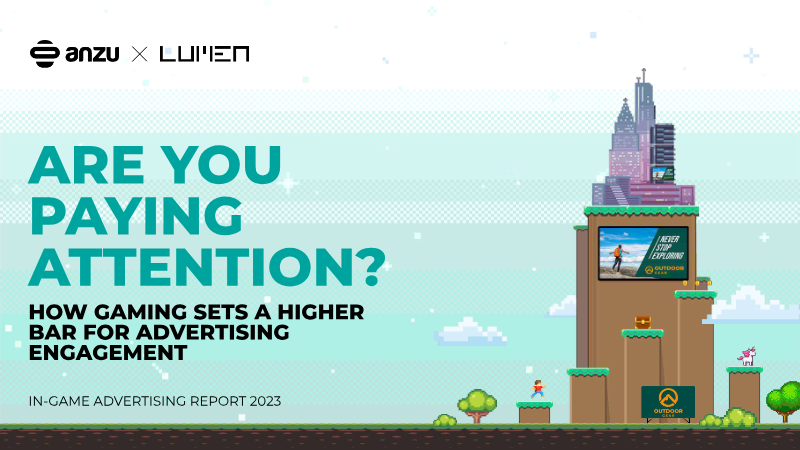
In-Game Advertising Report 2023
This analysis examines the efficacy of intrinsic in-game advertising as a high-engagement medium compared to traditional digital channels. Partnering with Lumen Research, the study utilizes eye-tracking technology and machine learning to analyze data from 25 specific brand campaigns and over 90 broader industry studies. The research focuses on global cross-platform environments, including mobile, PC, and console, comparing in-game performance against 42 standard digital advertising formats such as social media feeds and video platforms.
The findings indicate that gaming environments significantly outperform traditional digital media in viewability and attention. In-game ads achieved a 98% viewability rate, compared to a 78% average for other digital formats. Crucially, 85% of in-game impressions were actually viewed by players, surpassing the digital norm of 65%. In terms of duration, 80% of the studied in-game ads exceeded the critical two-second viewing threshold required for memory encoding, averaging 3.1 seconds of attention. This translates to 2,795 attentive seconds per 1,000 impressions, which is 22% higher than the average across all other digital formats and outperforms 76% of individual digital advertising categories, including most social media display and video.
The data concludes that high attention levels in gaming lead to measurable brand impact. Participants exposed to in-game ads showed a 9% point uplift in prompted brand awareness and a 7% point increase in purchase intent compared to control groups. For challenger brands, the impact was even more pronounced, with top campaigns seeing a 14% uplift in purchase intent. These results suggest that the immersive, "lean-forward" nature of gaming prevents the ad avoidance common in "distracted" media like TV or social scrolling, positioning in-game advertising as a superior tool for driving both brand recall and lower-funnel conversions.
- In-game advertising achieves a 98% viewability rate, significantly outperforming the 78% average observed across standard digital advertising formats.
- Gaming environments generate 2,795 attentive seconds per 1,000 impressions, representing a 22% higher attention level than the average for other digital media.
- 85% of in-game ad impressions are actively viewed by players, compared to a 65% norm for traditional digital channels.
- 80% of in-game ads surpass the two-second threshold required for memory encoding, with an average viewing duration of 3.1 seconds.
- Exposure to in-game ads results in a 9% point uplift in prompted brand awareness and a 7% point increase in purchase intent.
+1
AnzuJan 2023