
AnyKey
Advocacy organisation founded with ESL and Intel that researches diversity, inclusion and moderation in esports and gaming communities.
Documents


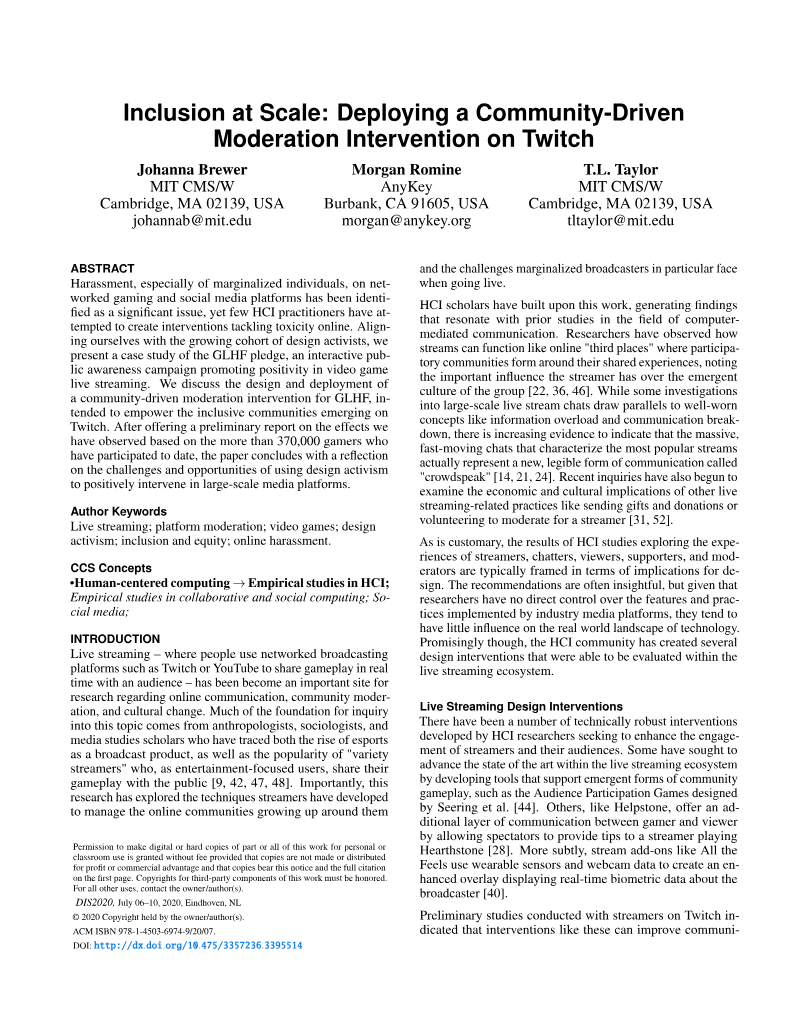
Inclusion at Scale: Deploying a Community-Driven Moderation Intervention on Twitch
The paper is an HCI case study by Johanna Brewer, Morgan Romine and T.L.
- The first GLHF pledge version reached 204,778 signers in 73 days, and 94% of them completed the Twitch authentication needed to unlock the AnyKey badge.
- The authors report that a fixed expiration date for the badge was set as a safeguard against trolling, and that their fears of trolling were never realized during the 73-day campaign.
- Following the relaunch, 309 badge abuse reports were filed, with 25% resulting in a warning and 13% in a badge revocation.


Diversity & Inclusion in Collegiate Esports: Challenges, Opportunities, and Interventions
AnyKey, an advocacy group supporting diversity, inclusion and equity in competitive gaming, published this October 2019 report on diversity and inclusion in collegiate esports.
- The report states that 'ninety percent of power five schools' were involved in collegiate esports in 2018, a figure attributed to Riot Games' head of collegiate, Michael Sherman.
- Pew data cited in the report show that 83% of U.S. teen girls and 97% of teen boys play video games.
- The report says women hold a significant percentage of leadership roles in Tespa and in founding campus clubs, but their participation as players is not proportional to how often they game.


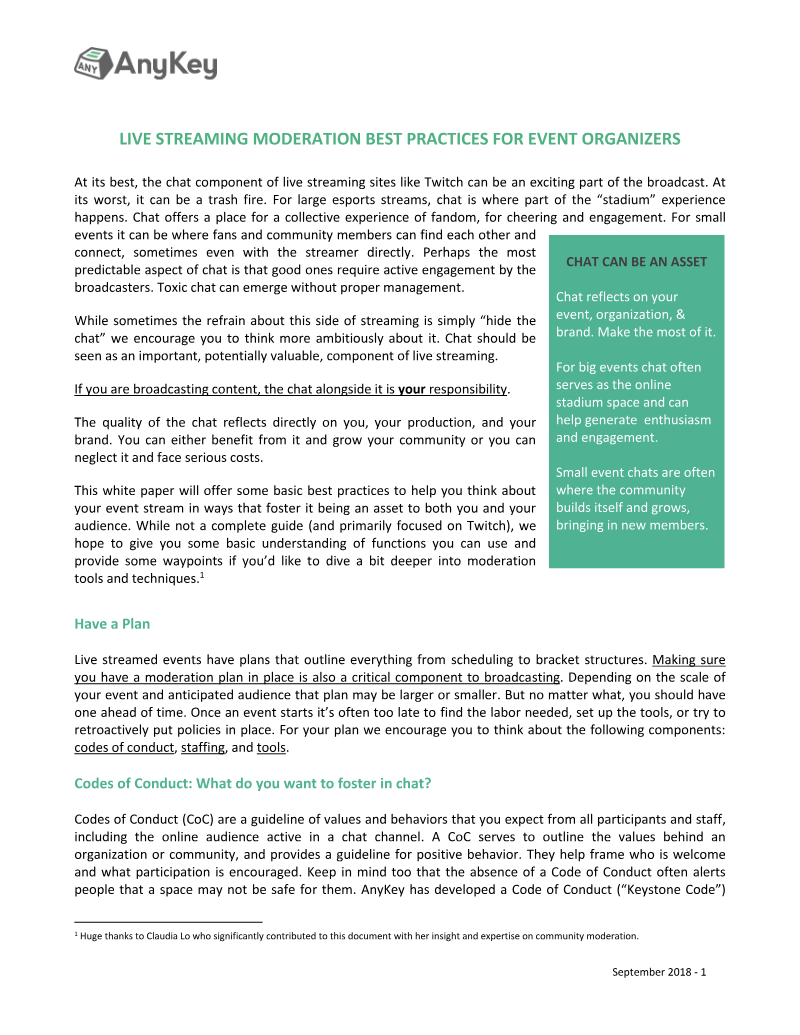
Live Streaming Moderation Best Practices for Event Organizers
AnyKey published this 2018 best-practices white paper for event organizers on moderating live stream chat, primarily focused on Twitch.
- The document states that a moderation plan should be in place before an event starts, because once it begins it is often too late to find labor, set up tools, or put policies in place.
- The paper says the absence of a Code of Conduct often signals to people that a space may not be safe for them, and recommends making the code public and visible in online spaces such as chat.
- Citing Twitch's 2017 research, the document says a chat rules tool requiring an "I agree" click has shown a "statistically significant reduction in timeouts and bans".


Report on the AnyKey Initiative: 2015-2017
AnyKey is an advocacy organization, formed in collaboration with Intel and the Electronic Sports League (ESL), that supports diverse participation in esports.
- AnyKey's GLHF pledge campaign, run with Intel, Twitch, and Oculus, drew 267,596 sign-ups. Participants who linked their Twitch account received a badge through the end of 2017.
- The Intel Challenge Women's CSGO Championship at IEM Katowice in 2016 had 8 teams, a $30k prize pool, and 55k stream viewers, with a reported 100%+ year-over-year increase.
- The affiliates program, launched in 2016, had grown to 24 members, including esports organizations, communities, and individual content creators.


Gender & Esports Tournaments: Best Practices Recommendations
The document is a best-practices guide titled "Gender & Esports Tournaments: Best Practices Recommendations," dated December 2017 and produced by AnyKey, an organization that says it drew it up after extensive conversation with experts, esports organizers, players, and other stakeholders.
- The guide states that all events, online and offline, should have a Code of Conduct and a mechanism for reporting and enforcement. It notes that Codes of Conduct without follow-up mechanisms remain simply symbolic.
- Citing Twitch, the guide says its "chat rules" tool, which requires participants to click an "I agree" button, has been shown to have a statistically significant reduction in timeouts and bans.
- The authors argue that legal ID alone is a flawed model for inclusive events and should not be the sole mechanism for gender identification in tournaments.


Diversity & Inclusion in Collegiate Esports
AnyKey Workshop 3, held in October 2016, produced a whitepaper on diversity and inclusion in collegiate esports.
- Women have participated in collegiate esports since its earliest days, and the document states that collegiate women run a sizable portion of TeSPA clubs.
- The document reports that the number of women participating in traditional collegiate sports has grown 600% in the forty-three years since Title IX was passed.
- The authors recommend supporting many ways to participate, including low-risk play days, viewing parties, and try-out-a-new-game nights, not only formal athletic programs.


Barriers to Inclusion and Retention: The Role of Community Management and Moderation
This whitepaper summarises an AnyKey workshop held in April 2016 on barriers to inclusion and retention in esports, focused on community management and moderation.
- As noted in the whitepaper for the September 2015 event, many organizations do not moderate their channels, which conveys the message that all speech ought to be allowed in the space.
- The authors argue that chat should not be written off, since it offers paths into participation, fandom expression and knowledge sharing.
- Chat is often under-moderated or not moderated at all, and attention is given only to coarse metrics rather than meaningful assessment of user experience.


Esports Event Participation: IEM San Jose
AnyKey conducted fieldwork at IEM San Jose on November 21 and 22, 2015, led by Dr. Taylor and three graduate students, to study esports fandom through questions of diversity and gender.
- Women attending were often experienced at other conventions and fan events, which the authors suggest prepares them for esports tournaments. Non-esports conventions may therefore be useful places to reach potential participants.
- The CSGO audience was on average 8% women, compared with 15% for League of Legends.
- Women reported feeling socially isolated as gamers, and this was most pronounced around CSGO, where women typically attended with a male boyfriend or husband.


Women in Esports Whitepaper
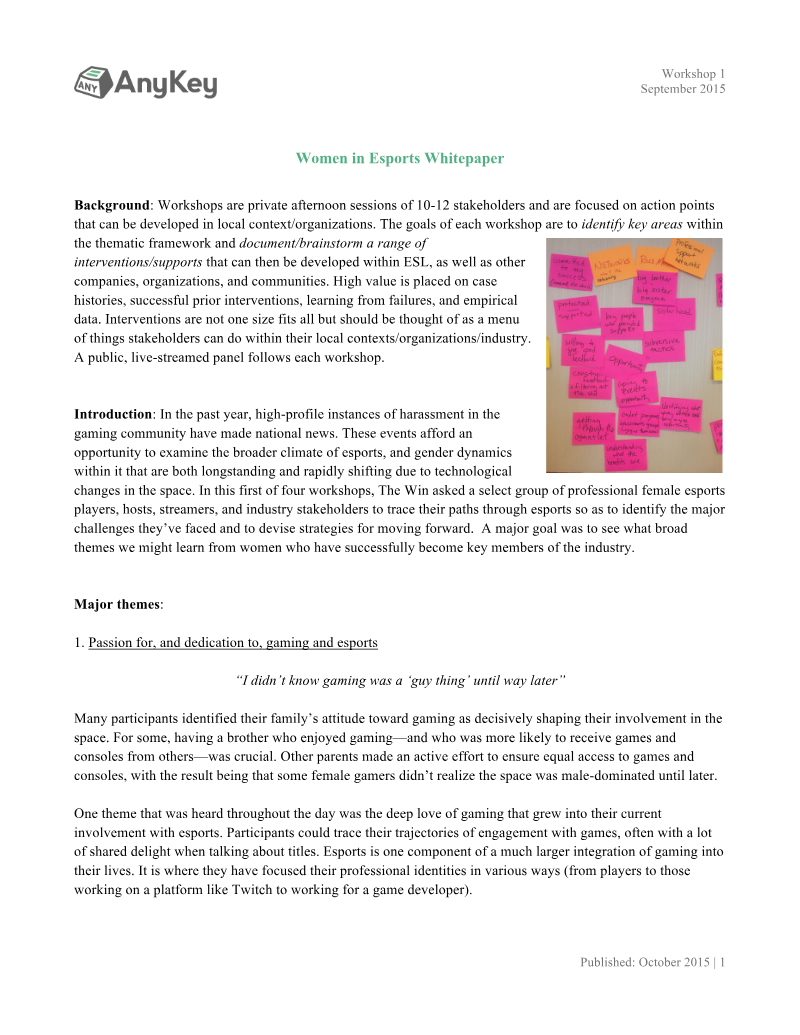
The AnyKey Workshop 1 whitepaper, titled "Women in Esports Whitepaper," was published in October 2015 and reports on a private workshop held in September 2015 as part of a series of four.
- The document notes that the frequency and volume of harassment in gaming is unusual compared with other professions, and that many organisations do not moderate their channels.
- Harassment was described as having a tangible toll, with participants reporting they could not respond for fear of professional retaliation and some withdrawing or leaving organisations.
- Many participants had been involved in the industry for over a decade, which the document presents as evidence of their dedication.
Do you work at AnyKey? Get a free report of how these documents are read and cited here.