Presentation43 pages
1Q FY2022 Presentation Material: October to December 2021
CyberAgent demonstrated significant financial growth during the first quarter of fiscal year 2022, with consolidated sales reaching 171 billion yen and operating profit increasing nearly threefold to 19.8 billion yen. This performance was primarily catalyzed by the Game business, where sales nearly doubled to 58.3 billion yen. The massive success of Uma Musume Pretty Derby, which surpassed 12 million downloads, drove a 15.1-fold year-over-year increase in operating profit for the segment. Despite this momentum, the inherent volatility of the gaming market led to a cautious approach regarding full-year forecasts.
The Media segment, led by the streaming platform ABEMA, achieved 24.9 billion yen in sales but reported an operating loss of 3.8 billion yen. This deficit reflects aggressive reinvestment into the online betting platform WINTICKET and content expansion, including the acquisition of Babel Label and integration with the Nintendo Switch. ABEMA continues to scale its reach, recording over 76 million downloads and 18 million weekly active users. Meanwhile, the Internet Advertisement business achieved record sales, supported by the launch of three new subsidiaries focused on digital transformation.
The long-term strategic framework involves utilizing high-margin profits from the Advertising and Game segments to fund the evolution of Media into a primary growth pillar and essential social infrastructure. This vision is underpinned by a corporate purpose focused on overcoming economic stagnation through digital innovation and global expansion. Future growth in the gaming sector is anticipated through a robust pipeline of high-profile intellectual properties, including titles based on Final Fantasy VII and Jujutsu Kaisen, while broader corporate sustainability is managed through integrated ESG initiatives.
- CyberAgent’s consolidated sales reached 171 billion yen in 1Q FY2022, with operating profit nearly tripling to 19.8 billion yen.
- The Game business segment saw sales nearly double to 58.3 billion yen, driven by the success of 'Uma Musume Pretty Derby' which exceeded 12 million downloads.
- Operating profit for the Game segment grew 15.1-fold year-over-year, though management remains cautious about full-year forecasts due to gaming market volatility.
- The Media segment, anchored by ABEMA, recorded 24.9 billion yen in sales but incurred an operating loss of 3.8 billion yen due to heavy reinvestment in WINTICKET and content expansion.
- ABEMA reached 76 million total downloads and 18 million weekly active users as of the end of 2021.
+1
CyberAgentJan 2022
Report230 pages
Türkiye Game Market 2022 Report
The 2022 Turkish gaming market represents a landscape of significant resilience and structural transition. Despite facing substantial economic headwinds, including currency depreciation and a contraction in total revenue to $625 million, the industry solidified its position as a major global hub for mobile development and esports. The primary thesis of the market’s evolution is a strategic pivot away from the rapid, volume-based "gold rush" of hyper-casual gaming toward sustainable, high-quality production, intellectual property creation, and diversification into PC, console, and hybrid-casual projects.
The sector’s maturity is evidenced by record-breaking investment activity, with over $424 million raised across 23 deals, positioning Istanbul as a top-tier global city for gaming capital. This financial influx supports a robust ecosystem of nearly 6,000 publishers and a growing network of entrepreneurship centers and academic programs. While the number of new startups declined by 48% compared to the previous year, the remaining entities are increasingly focused on long-term viability through technological integration, including AI and gamification, as well as a professionalized esports infrastructure that saw the Turkish Esports Federation gain official status.
Geographically and demographically, the market remains highly engaged, with 44 million players and a notable shift toward high-income consumer segments. While traditional physical venues like internet cafes have contracted due to rising operational costs, the digital infrastructure remains strong, supported by widespread social media penetration and a sophisticated network of payment institutions. Moving forward, the industry’s trajectory is defined by a need for better alignment between academic curricula and commercial requirements, alongside a continued focus on global expansion and the development of specialized talent to maintain Türkiye’s competitive edge in the international gaming arena.
- The Turkish gaming market generated $625 million in 2022, reflecting a structural pivot from hyper-casual volume toward sustainable, high-quality PC, console, and hybrid-casual intellectual property.
- Investment activity reached a record $424 million across 23 deals, establishing Istanbul as a premier global hub for gaming capital.
- While the number of new gaming startups fell by 48% year-over-year, the remaining 6,000 publishers are increasingly prioritizing long-term viability through AI integration and professionalized operations.
- The Turkish gaming ecosystem serves a highly engaged base of 44 million players, characterized by a growing shift toward high-income consumer segments.
- The Turkish Esports Federation achieved official status in 2022, signaling the professionalization of the country's esports infrastructure despite the decline of traditional physical venues like internet cafes.
+2
Riot GamesJan 2022
Report40 pages
2022 The Israeli Mobile Game Market Report
The Israeli mobile gaming sector has solidified its position as a premier global hub, characterized by a robust ecosystem of approximately 200 companies and 14,000 employees. Generating $9 billion in annual revenue, the industry has experienced extraordinary growth, with total earnings increasing by 760% since 2016. This expansion, accelerated by pandemic-era shifts in consumer behavior, is anchored by major developers such as Playtika, Plarium, and Moon Active, who maintain a strategic focus on the social, casual, and hyper-casual genres.
Despite this financial success, the advertising landscape underwent significant volatility in 2022. Total ad creatives declined by 17.8% year-over-year, even as the number of active advertisers grew by 4.2%. This contraction was most pronounced within the RPG segment, while casual and puzzle titles maintained dominance. A pivotal shift in platform strategy has emerged, with Android now capturing 70% of all mobile game advertising, a trend largely attributed to Apple’s IDFA privacy changes. Video content remains the industry standard, accounting for over 86% of all creative output.
Global marketing strategies have become increasingly localized to meet regional preferences, ranging from live-action influencer content in the United States to character-centric assets in Japan and high-fidelity technology showcases in South Korea. Furthermore, creative trends are evolving away from traditional failure-based hyper-casual tropes toward more positive, success-oriented gameplay. While the Israeli market continues to demonstrate immense scale and innovation, the industry faces ongoing structural challenges, specifically regarding the availability of venture funding and the persistent shortage of skilled human resources required to sustain long-term growth.
- The Israeli mobile gaming industry has grown by 760% since 2016, reaching $9 billion in annual revenue across a ecosystem of 200 companies and 14,000 employees.
- Android now accounts for 70% of all mobile game advertising, a shift driven by Apple’s IDFA privacy changes.
- Despite a 4.2% increase in the number of active advertisers, total ad creative volume declined by 17.8% in 2022, with the sharpest contraction occurring in the RPG segment.
- Video content remains the dominant advertising format, representing over 86% of all creative output in the industry.
- Major developers like Playtika, Plarium, and Moon Active continue to anchor the market by focusing on social, casual, and hyper-casual genres.
+2
SocialPetaJan 2022
Report42 pages
The State of Mobile Game and App Markets: H1 2022
The mobile app and gaming landscape underwent a significant strategic pivot during the first half of 2022, characterized by a transition from high-volume advertising to a quality-focused, data-driven methodology. Faced with rising user acquisition costs and the restrictive post-ATT environment, marketers reduced the total volume of mobile game creatives by nearly 30% year-over-year. This contraction reflects a broader industry shift toward precise traffic optimization, where performance metrics like Cost Per Purchase and In-App Purchase Return on Ad Spend have superseded raw install volume as the primary indicators of success.
Geographically, the United States remains the dominant market, commanding the highest share of traffic and the most expensive advertising costs. CPMs surged significantly during this period, rising 18% for mobile games and 64% for non-gaming applications. In response to these economic headwinds and privacy-related tracking limitations, advertisers have increasingly pivoted toward the Android ecosystem, which now hosts approximately 70% of mobile game creatives. Simultaneously, growth is being sought in emerging Tier-2 and Tier-3 markets to offset the saturation and high costs found in traditional Western strongholds.
To maintain performance, publishers are diversifying their acquisition channels, moving beyond traditional social media giants to include incentive-based traffic sources and search-driven discovery. App Store Optimization and Apple Search Ads have become critical components of visibility strategies, while the adoption of predictive analytics and first-party data collection allows developers to navigate the loss of IDFA-based targeting. By prioritizing user-generated content styles and optimizing opt-in prompts, which have reached success rates as high as 51% in certain hyper-casual segments, the industry is successfully recalibrating its approach to sustain long-term growth despite a challenging macroeconomic climate.
- Marketers reduced mobile game creative volume by nearly 30% year-over-year in H1 2022, shifting focus from raw install volume to performance metrics like Cost Per Purchase and In-App Purchase Return on Ad Spend.
- Advertising costs rose significantly, with CPMs increasing 18% for mobile games and 64% for non-gaming applications.
- Advertisers are increasingly prioritizing the Android ecosystem, which now accounts for approximately 70% of all mobile game creatives.
- To mitigate high costs and market saturation in the U.S., publishers are expanding into emerging Tier-2 and Tier-3 geographic markets.
- Publishers are diversifying beyond traditional social media channels, placing greater strategic emphasis on App Store Optimization, Apple Search Ads, and search-driven discovery.
+3
AdQuantumJan 2022
Whitepaper106 pages
2022 Global White Paper on Mobile Advertising & Marketing
The 2022 global mobile gaming landscape underwent a significant transition toward quality and strategic refinement, characterized by a 2% decline in total advertisers and a 27.83% reduction in ad creatives during the first half of the year. This contraction in mature markets was offset by robust growth in emerging regions such as the Middle East, South America, and South Asia, where increasing smartphone penetration and young demographics present substantial expansion opportunities. The industry’s primary thesis centers on the necessity of localized, narrative-driven content and creative optimization to navigate a post-IDFA privacy environment that has increased advertising costs and shifted focus toward Android platforms.
While casual, puzzle, and simulation genres dominate download volumes, RPGs and strategy titles remain the primary revenue drivers, commanding the highest advertising costs with average CPMs reaching $21.58. Video remains the dominant creative format, accounting for over 86% of all advertisements, as marketers increasingly leverage dramatic storytelling and influencer-led content to boost engagement. Despite the industry’s fascination with emerging technologies, consumer sentiment remains grounded; only 16% of players express interest in NFT-based gaming, whereas up to 39% show interest in metaverse-integrated experiences. Most users continue to prioritize mobile games as accessible tools for relaxation and time-killing.
To sustain growth, publishers are pivoting toward programmatic channels, OEM integrations, and culturally relevant marketing strategies. Success in this competitive landscape requires a dual approach: maintaining high-frequency engagement through playable and video-based ads while simultaneously adapting to regional preferences, such as the demand for vernacular content in India or MOBA-focused titles in Southeast Asia. Ultimately, the market is moving away from broad-spectrum advertising toward highly targeted, immersive, and quality-focused campaigns that align with the core motivations of diverse global player bases.
- The mobile gaming market is shifting toward quality over volume, evidenced by a 2% decline in total advertisers and a 27.83% reduction in ad creatives during the first half of 2022.
- RPG and strategy titles remain the primary revenue drivers, commanding the highest advertising costs with average CPMs reaching $21.58.
- Video is the dominant advertising format, accounting for over 86% of all ad creatives as marketers prioritize dramatic storytelling and influencer-led content.
- Growth in mature markets is slowing, forcing publishers to expand into emerging regions like the Middle East, South America, and South Asia to capitalize on rising smartphone penetration.
- Consumer interest in gaming technology is polarized, with only 16% of players interested in NFTs compared to 39% expressing interest in metaverse-integrated experiences.
+3
SocialPetaJan 2022
Report17 pages
The Hyper-Casual Benchmark Report: Q3 2022
The hyper-casual mobile gaming sector experienced a notable escalation in acquisition costs during the latter half of 2022, characterized by rising median cost-per-install (CPI) rates across both Android and iOS platforms. By the fourth quarter of 2022, median CPI reached all-time highs of $0.20 on Android and $0.42 on iOS. This upward trend in acquisition spending was global, as no major market tracked by ad spend experienced a decrease in median CPI on Android, while iOS markets saw varied fluctuations, including a significant decrease in the United States and notable increases in France and Germany.
Retention metrics reveal a consistent performance advantage for iOS over Android across all tiers of game quality. For the top 2% of hyper-casual titles, iOS achieved a 45% Day 1 retention rate compared to 38% on Android, with Day 7 retention figures similarly favoring iOS at 19% versus 14%. This performance gap persists among the top 25% of games and the median cohort, where iOS maintains a higher percentage of returning players. These findings underscore a widening disparity between high-performing titles and average games, emphasizing the critical importance of engagement optimization in a landscape of increasing user acquisition costs.
The analysis draws upon data from over 100,000 games and one-third of the global mobile player base to establish these benchmarks. By segmenting performance by platform and geographic region, the data highlights the shifting economic landscape for developers and publishers. The findings suggest that while market saturation and rising costs present significant challenges, the ability to maintain player retention remains the primary differentiator between top-tier hyper-casual games and the broader market.
- Retention is the primary differentiator for success, with top-tier hyper-casual games significantly outperforming the median cohort as acquisition costs rise.
- Median cost-per-install (CPI) reached record highs in Q4 2022, hitting $0.20 on Android and $0.42 on iOS.
- iOS consistently outperforms Android in retention, with top-tier titles achieving 45% Day 1 retention on iOS compared to 38% on Android.
- Day 7 retention metrics show a persistent gap between platforms, with top-tier iOS titles retaining 19% of players versus 14% on Android.
- Rising acquisition costs are a global trend, as no major Android market tracked in the report experienced a decrease in median CPI during the period.
+5
TenjinJan 2022
Report106 pages
Global White Paper on Mobile Advertising & Marketing Game
Mobile game advertising in 2022 experienced a pronounced contraction, with total creatives falling nearly 30 % year‑over‑year to 15.8 million while the advertiser base stayed flat at 45,100. The decline stemmed from a shift toward quality‑focused marketing and the impact of Apple’s IDFA changes, which pushed spend to Android. Video ads dominated the format mix (over 86 % of creatives), and casual/puzzle titles captured the majority of spend, displacing RPGs in many markets. Tier 2 and Tier 3 regions saw significant growth, driven by cross‑platform titles such as Genshin Impact and the rise of esports and metaverse expectations.
Geographically, China’s HK/Macau/TW region maintained RPG dominance but broadened to action, casual and MOBA campaigns with large budgets. In the United States, mid‑core and hardcore titles produced the most creatives despite a 10 % revenue decline. Japan’s simulation games led advertising, while Korea shifted from MMOs to card‑RPGs and early NFT experimentation. South Asia’s market was shooter‑heavy, with casual games generating the most creatives and RPGs producing the highest volumes. Turkey’s top titles were ARPGs and shooters, with a surge in casual and parkour advertising tied to esports and influencer content.
Cost dynamics varied by genre and platform: strategy games commanded the highest CPM ($21.58), while casual titles hovered around $17–$18; iOS ads were 15 % costlier than Android. Female and older users (55–64) paid the highest CPMs ($22.26) and CPCs ($2.90), yet CTR increased with age across formats. Playable ads delivered the lowest CPI but weakest ROAS, whereas banner ads offered the best return on spend.
Emerging channels such as social‑first platforms and AR filters proved highly engaging, with Snapchat’s concise, sound‑driven ads capturing attention within five seconds and AR filters generating 1.7× more immersive brand links. In India, vernacular marketing and programmatic unified platforms are expanding reach to Tier II/III audiences, while playable and rewarded video formats mitigate banner blindness. Overall, the data underscore a diversification of genre advertising, a continued emphasis on high‑budget flexible media strategies, and a pivot toward video‑centric, narrative‑driven campaigns across high‑revenue titles.
- Mobile game advertising volume contracted by nearly 30% in 2022 to 15.8 million creatives, driven by a shift toward quality-focused marketing and the impact of Apple’s IDFA changes.
- Video ads dominate the market, accounting for over 86% of all creatives, while casual and puzzle titles have displaced RPGs as the primary drivers of advertising spend.
- Cost-per-mille (CPM) is highest for strategy games at $21.58, and iOS advertising remains 15% more expensive than Android equivalents.
- Targeting female and older users (55–64) yields the highest CPMs ($22.26) and CPCs ($2.90), with click-through rates showing a positive correlation with user age.
- While playable ads achieve the lowest cost-per-install (CPI), banner ads currently provide the most effective return on ad spend (ROAS).
+2
TencentJan 2022
Report31 pages
App Marketer Survey
The global app marketing landscape is currently defined by a paradox of rising performance expectations and diminishing data visibility. While nearly 60% of marketing professionals face more aggressive key performance indicators than in previous years, approximately half are struggling to meet these targets. This friction is primarily driven by the implementation of Apple’s App Tracking Transparency framework, which has negatively impacted 64% of user acquisition campaigns. The resulting data scarcity has complicated decision-making for 73% of marketers and led to increased costs for 72% of respondents, forcing a heavy daily focus on manual campaign analysis to compensate for the loss of granular tracking.
In response to these privacy-centric shifts, the industry is undergoing a strategic pivot toward diversification and alternative platforms. Marketers are increasingly reallocating budgets toward Android and exploring less trackable channels, with over half of professionals prioritizing influencer marketing and organic social media. Despite the challenges posed by rising costs and low familiarity with upcoming privacy updates like SKAN 4 and the deprecation of Google Advertising ID, the outlook for the sector remains growth-oriented. Fifty-two percent of marketers intend to increase their advertising spend in 2023, focusing on expanding their network of partners to navigate the post-ATT environment.
This transition is supported by a global infrastructure of programmatic user acquisition and monetization tools designed to scale revenue across sectors such as gaming, finance, and e-commerce. By leveraging creator-led campaigns and advanced game data analytics, businesses across 74 countries are attempting to offset the limitations of the current privacy era. The overarching trend indicates that while privacy regulations have fundamentally disrupted traditional acquisition models, the industry is responding through increased investment and a broader, multi-channel approach to mobile growth.
- Apple’s App Tracking Transparency (ATT) framework has negatively impacted 64% of user acquisition campaigns, leading to increased costs for 72% of marketers and complicating decision-making for 73%.
- Nearly 60% of marketing professionals report facing more aggressive KPIs than in previous years, yet approximately half are currently struggling to meet these targets.
- To combat data scarcity, 52% of marketers plan to increase their 2023 advertising budgets while diversifying into influencer marketing and organic social media.
- Marketers are shifting strategies away from traditional tracking by reallocating budgets toward Android and prioritizing alternative, less trackable channels.
- Industry professionals are currently navigating significant knowledge gaps regarding upcoming privacy changes, specifically the deprecation of Google Advertising ID and the implementation of SKAN 4.
+1
LiftoffJan 2022
Whitepaper191 pages
Global White Paper on Mobile Advertising & Marketing Game H1 2022
The first half of 2022 saw a contraction across the mobile‑app advertising ecosystem, with the total number of advertisers falling 5.79 % to a historic low of roughly 83 400 and creative volume dropping 27 % to 40 million assets. This downward pressure was most pronounced among mobile‑game advertisers, whose pool shrank to about 83 000 in January, while non‑game categories such as shopping apps retained the largest share of spend (≈12.5 % of advertisers and 17.2 % of creatives). Regional variation was stark: Europe and North America dominated non‑game advertising, whereas the Asia‑Pacific region, excluding China, was the only market with a net increase in advertisers.
Mobile‑game advertising displayed divergent cost dynamics. The United States and Japan posted the highest average CPMs at $27.54 and $25.93 respectively, with iOS campaigns costing roughly 15 % more than Android. Female users and the 55‑64 age cohort commanded a 13 % premium on impressions, while South Korea recorded the peak CPI at $13.90. Playable ads delivered the lowest CPI but suffered the weakest return on ad spend, whereas banner formats generated the strongest ROAS. Strategy titles leaned heavily on video‑only creatives (>90 %) and began integrating casual‑puzzle mechanics to broaden appeal; interest in emerging formats remained modest, with only 16 % of players expressing curiosity about NFTs and 32 % about metaverse features.
Creative strategies are shifting toward motivation‑driven, user‑centric formats such as rewarded video and playable ads to counter post‑IDFA fragmentation. Narrative‑driven ads are proving effective for simulation games targeting female audiences, delivering $12 million in revenue across key Western markets. AR‑enhanced placements on platforms like Snapchat achieve double the attention and 1.7 × the immersion of standard formats, while friend‑based recommendations outperform celebrity influencers by a factor of four. Regional opportunities are emerging in Tier‑2/3 India through vernacular campaigns and OEM inventory, and Turkey’s
- The mobile advertising ecosystem contracted in H1 2022, with the total number of advertisers falling 5.79% to approximately 83,400 and creative volume dropping 27% to 40 million assets.
- Mobile-game advertising costs remain high in key markets, with the U.S. and Japan recording average CPMs of $27.54 and $25.93, while iOS campaigns command a 15% price premium over Android.
- While playable ads offer the lowest cost-per-install (CPI), banner formats currently generate the strongest return on ad spend (ROAS).
- Audience targeting premiums are significant, with impressions for female users and the 55–64 age demographic costing 13% more than other segments.
- Consumer interest in emerging tech remains low, with only 16% of players expressing curiosity about NFTs and 32% about metaverse features.
+2
SocialPetaJan 2022
Whitepaper191 pages
2022 Global White Paper on Mobile Advertising & Marketing Game
The global mobile market in the first half of 2022 underwent a significant transition, characterized by a contraction in total advertising volume alongside a strategic pivot toward high-quality, video-centric content. While the total number of advertisers and ad creatives declined year-over-year, emerging markets in the Middle East, South America, and Southeast Asia experienced robust growth. This period saw a sharp rise in advertising costs, with the average CPM reaching $19.31 and the United States and South Korea emerging as the most expensive regions for user acquisition.
Casual and puzzle games dominated the advertising landscape by volume, yet RPGs and strategy titles commanded the highest revenue and advertising spend. A notable trend involved mid-core developers utilizing "lightweight" or drama-based video creatives to lower entry barriers for broader audiences. Video formats now constitute over 86% of all creatives, with interactive AR filters and short-form content on platforms like Snapchat and TikTok challenging the traditional dominance of Meta. In the non-gaming sector, shopping and finance apps led in advertiser activity, while reading apps produced the highest volume of individual creatives.
The industry faced headwinds from Apple’s IDFA privacy changes, prompting a shift toward "motivation-based" creative strategies and localized global launches, particularly by Chinese firms seeking relief from domestic regulatory pressures. Despite rising costs and a 27% drop in creative volume, the market remains dynamic, driven by the expansion of esports, cross-platform play, and a growing consumer interest in the metaverse. Success is increasingly defined by down-funnel conversion optimization and the use of immersive, emotionally resonant storytelling to engage diverse global demographics.
- The global mobile advertising market saw a 27% decline in creative volume during the first half of 2022, accompanied by rising costs that pushed the average CPM to $19.31.
- Video content now dominates the advertising landscape, accounting for over 86% of all creatives as developers shift toward high-quality, drama-based storytelling to lower entry barriers.
- While the total number of advertisers decreased, emerging markets in the Middle East, South America, and Southeast Asia showed robust growth, contrasting with the high-cost user acquisition environments of the United States and South Korea.
- Apple’s IDFA privacy changes forced a strategic pivot toward motivation-based creative strategies and localized global launches, particularly among Chinese firms facing domestic regulatory constraints.
- Casual and puzzle games led in total advertising volume, but RPG and strategy titles commanded the highest advertising spend and revenue generation.
+2
SocialPetaJan 2022

Report30 pages
Mobile Ad Creative Index: 2022
The 2022 Mobile Ad Creative Index analyzes performance trends and benchmarks across four major mobile app verticals: gaming, e-commerce, entertainment, and finance. The report focuses on the strategic importance of ad creative excellence in a privacy-first landscape following Apple’s IDFA changes. It evaluates five primary ad formats—banners, interstitials, playables, native, and video—across both iOS and Android platforms.
The findings are based on a massive dataset spanning January 1, 2021, to January 1, 2022, encompassing 805 billion impressions, 12.6 billion clicks, and 200 million installs. Data points indicate that while Android remains more cost-effective, with iOS costs often doubling those of Android for the same formats, specific creative types offer distinct advantages. In gaming, playable ads provide the lowest cost-per-install (CPI) at $1.98, though banner ads deliver the highest return on ad spend (ROAS), reaching nearly 22% by day 30. In the e-commerce and finance sectors, banner ads emerge as the most value-driven format, offering the lowest CPIs and high install-to-action rates.
A significant portion of the analysis, supported by GameRefinery and VisualMind technology, examines player motivations. Despite the potential of tailoring creative to specific psychological drivers like "thinking and solving" or "excitement and thrill," the data reveals a massive gap in execution: only 4% of casual game video ads and less than 1% of midcore ads successfully tap into these motivations. The conclusion emphasizes that future performance marketing success depends on "hyper-localization," interactive elements like gamification for non-gaming brands, and iterative creative testing to combat ad fatigue.
- Playable ads in the gaming sector achieve the lowest cost-per-install (CPI) at $1.98, while banner ads generate the highest 30-day return on ad spend (ROAS) at nearly 22%.
- iOS advertising costs are frequently double those of Android, making Android the more cost-effective platform for mobile user acquisition.
- There is a significant disconnect between player psychology and creative execution, with only 4% of casual game video ads and less than 1% of midcore ads successfully targeting specific player motivations.
- Banner ads are the most value-driven format for the e-commerce and finance sectors, consistently delivering the lowest CPIs and the highest install-to-action rates.
- The 2022 index is derived from a dataset covering 805 billion impressions, 12.6 billion clicks, and 200 million installs between January 2021 and January 2022.
+2
LiftoffJan 2022
Report15 pages
Ad Intelligence: An Overview 2022
Analysis of mobile advertising intelligence from 2022 reveals a rapidly expanding market, with the number of advertisers doubling since 2019 to exceed 120,000. Data collected from 35 countries across the Apptica platform indicates a significant platform disparity, as Android accounts for 71% of advertisers and over 80% of the 14.6 million total creatives tracked during the period. While Android publishers outnumber those on iOS by a factor of two, the gaming sector remains the dominant force on both platforms, capturing 69.02% of advertising traffic on the App Store and 55.58% on Google Play.
The gaming landscape is primarily led by the Casual and Puzzle genres. Casual games represent the largest traffic share on iOS at 23.8%, while Puzzles lead on Android at 25.4%. Beyond gaming, the Shopping and Social categories emerge as the other primary drivers of high-volume traffic. Top individual advertisers by traffic share include Meta Platforms, Playrix, and TikTok, while NewsBreak and ITI Inc. lead in the sheer volume of unique creatives.
Methodological findings highlight distinct creative strategies between operating systems. On iOS, video is the preferred format, accounting for 59.9% of creatives. Conversely, Android relies more heavily on static images, which make up 58.8% of its ad inventory. Interactive or playable ads remain a niche but consistent segment, representing less than 3% of the total share on both platforms. The data suggests that publishers are significantly more aggressive with creative testing on Android, often running between 2 and 124 times more creative variations than they do on iOS. Playrix, Easybrain, and Tripledot Studios are identified as the most consistent market leaders, appearing in the top ten for buying share across both ecosystems.
- The mobile advertising market has doubled since 2019, with over 120,000 active advertisers identified across 35 countries in 2022.
- Android dominates the advertising landscape, accounting for 71% of advertisers and over 80% of the 14.6 million creatives tracked.
- Gaming remains the primary advertising sector, capturing 69.02% of traffic on the App Store and 55.58% on Google Play, with Casual and Puzzle genres leading their respective platforms.
- Creative strategies differ by platform: iOS favors video (59.9% of creatives), while Android relies heavily on static images (58.8% of creatives).
- Android publishers are significantly more aggressive in testing, running between 2 and 124 times more creative variations than their iOS counterparts.
+1
AppticaJan 2022
Report1 pages
Ad Monetization Insights for Mobile Game Developers 2022
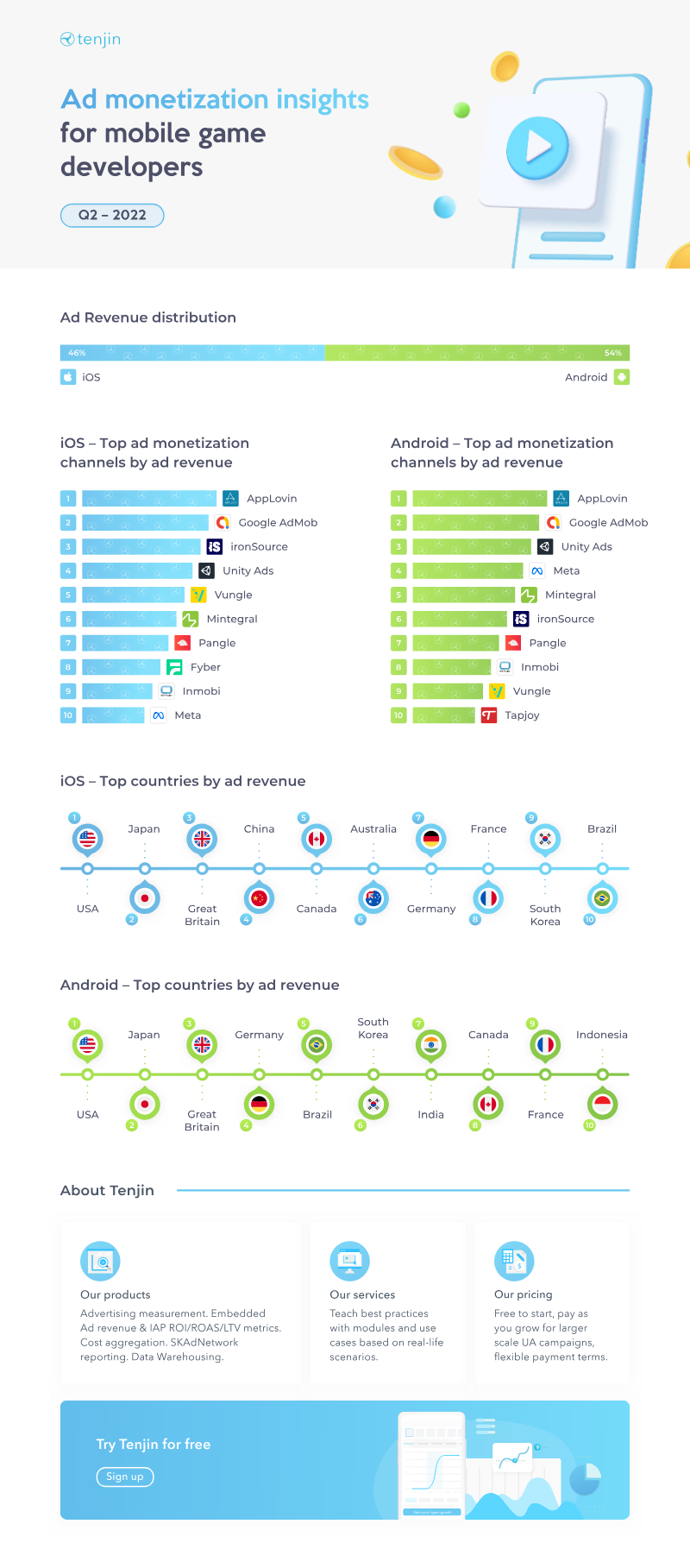
The 2022 ad monetization briefing delivers a data‑driven overview of revenue‑generation strategies for mobile game developers, emphasizing measurement, optimization, and regional performance trends. Core insights reveal that ad‑based income accounts for a majority share of total monetization, with a highlighted 54 % figure indicating the proportion of revenue derived from advertising across the surveyed markets. The analysis spotlights key territories—Germany, Japan, South Korea, Canada, and Indonesia—illustrating how each region contributes to overall earnings and how localized user acquisition (UA) campaigns influence cost structures and return on ad spend.
A central theme is the importance of precise analytics to drive return on investment (ROI), return on ad spend (ROAS), and lifetime value (LTV) calculations. The briefing outlines a suite of measurement tools that aggregate ad revenue, in‑app purchase (IAP) data, and cost metrics, integrating SKAdNetwork reporting for iOS environments and offering flexible data‑warehousing solutions. These capabilities enable developers to assess campaign performance at scale, compare cost aggregation across organic and paid acquisition channels, and refine budgeting decisions based on real‑time insights.
Tenjin’s platform is positioned as a turnkey solution for developers seeking to embed advanced measurement modules without upfront cost, operating on a free‑to‑start, pay‑as‑you‑grow pricing model. The service package includes advertising measurement, cost aggregation, and data‑warehousing, designed to support both emerging studios and larger publishers in optimizing ad revenue streams. While specific methodological details such as sample size or data sources are not disclosed, the briefing draws on 2022 market data to inform best‑practice recommendations for maximizing monetization efficiency across the highlighted global regions.
- Advertising accounts for 54% of total revenue across the mobile game markets surveyed in 2022.
- Effective monetization requires integrating ad revenue, in-app purchase data, and cost metrics to accurately calculate ROI, ROAS, and LTV.
- Key regional markets for mobile game monetization include Germany, Japan, South Korea, Canada, and Indonesia.
- Developers must utilize tools that support SKAdNetwork reporting for iOS environments and aggregate cost data across both organic and paid acquisition channels.
- Tenjin offers a measurement platform for ad revenue and cost aggregation that operates on a free-to-start, pay-as-you-grow pricing model.
+1
TenjinJan 2022

Report42 pages
For the Game
The global gaming industry is undergoing a transformative shift into a primary mass medium, projected to reach 3.5 billion players and $225 billion in revenue by 2025. This evolution is characterized by gaming’s role as a central pillar of culture and social connection, with over a third of players utilizing the medium specifically for socialization. Analysis across 21 global markets reveals that gamers are highly engaged "super-consumers" who spend nearly 60 hours a week across television and internet platforms, making them a critical demographic for brand attention.
To effectively reach this audience, the industry must move beyond traditional demographic stereotypes and adopt a motivation-based segmentation. This approach identifies six distinct player types, allowing for more authentic engagement. However, a significant gap remains between the diverse player base and the industry’s internal demographics, which remain predominantly male and white. Prioritizing equity, inclusion, and accessibility is essential for future growth, as evidenced by the commercial success of titles that prioritize inclusive design and representation.
Successful brand integration requires a departure from standard advertising in favor of intrinsic in-game experiences and value-driven partnerships. Strategies such as gamified commerce, immersive virtual events, and the utilization of original intellectual property yield higher attention and recall rates than traditional social media formats. By fostering mutually beneficial relationships and respecting established gaming codes, brands can leverage the medium not just for visibility, but as a sophisticated tool for long-term community building and commercial innovation.
- The global gaming industry is projected to reach 3.5 billion players and $225 billion in revenue by 2025.
- Gamers are high-value 'super-consumers' who engage with television and internet platforms for nearly 60 hours per week.
- Over one-third of the global player base uses gaming primarily as a social platform, necessitating a shift toward community-focused engagement strategies.
- Effective audience targeting requires moving beyond traditional demographics to a motivation-based segmentation model that identifies six distinct player types.
- Internal industry demographics remain predominantly white and male, creating a strategic gap that can be addressed through inclusive design to drive commercial success.
+2
dentsuJan 2022
Presentation55 pages
FY2021 Presentation Material
CyberAgent achieved record-breaking financial performance in fiscal year 2021, characterized by consolidated sales of 666.4 billion yen and a more than threefold increase in operating profit to 104.3 billion yen. This surge was primarily catalyzed by the Game business, which experienced 68.6% year-over-year growth following the massive commercial success of Uma Musume Pretty Derby. While the Game segment provided the most significant profit contribution, the Internet Advertisement business maintained steady double-digit growth, and the Media segment narrowed its operating losses through the expansion of ABEMA and the WINTICKET betting platform.
The strategic focus for the period centered on leveraging high-performing assets to fund long-term growth initiatives. WINTICKET emerged as a critical driver within the Media segment, capturing 25% of the Keirin online betting market and tripling its transaction volume. Simultaneously, the company utilized profits from its established advertising and gaming pillars to invest in ABEMA’s digital transformation and content offerings, including pay-per-view services. This diversification strategy aims to stabilize the inherent volatility of the gaming industry, which led to the omission of specific earnings forecasts for the upcoming fiscal year.
Future growth is predicated on a robust pipeline of high-profile intellectual properties and strategic partnerships with industry leaders such as Nintendo, SEGA, and Bandai Namco. Upcoming releases, including titles based on the Final Fantasy VII and Jujutsu Kaisen franchises, are expected to sustain the momentum established in 2021. By aligning its corporate purpose with digital innovation and cross-media expansion, the organization seeks to transition from a gaming-heavy profit structure toward a more balanced ecosystem where media and advertising provide consistent, long-term value.
- CyberAgent achieved record-breaking FY2021 performance with 666.4 billion yen in consolidated sales and a 104.3 billion yen operating profit, representing a more than threefold increase.
- The Game business was the primary profit driver, recording 68.6% year-over-year growth fueled by the commercial success of Uma Musume Pretty Derby.
- WINTICKET captured 25% of the Keirin online betting market and tripled its transaction volume, significantly contributing to reduced operating losses in the Media segment.
- The Internet Advertisement business maintained steady double-digit growth, serving as a stable financial pillar alongside the high-volatility gaming segment.
- Management opted not to provide earnings forecasts for the upcoming fiscal year due to the inherent revenue volatility associated with the gaming industry.
+1
CyberAgentOct 2021
Presentation50 pages
3Q FY2021 Presentation Material: April to June 2021
CyberAgent experienced exceptional financial growth during the third quarter of fiscal year 2021, covering the period from April to June. Consolidated sales reached 192.2 billion yen, representing a 70.3% year-over-year increase, while operating profit surged more than fivefold to 44.5 billion yen. This performance was primarily catalyzed by the Game business, specifically the massive commercial success of Uma Musume Pretty Derby. The title surpassed nine million downloads within five months of its launch, driving segment sales up by 151.7% and operating profit by over 480%. The success of this intellectual property has further expanded into a multi-media franchise encompassing anime, music, and live events, prompting an upward revision of full-year forecasts to 650 billion yen in sales and 100 billion yen in operating profit.
The media segment, led by the streaming platform ABEMA, also demonstrated significant momentum with quarterly sales more than doubling to 10.5 billion yen. Weekly Active Users reached a peak of 14.9 million, supported by high-profile sports broadcasting and original content. A critical component of this segment's monetization strategy is the WINTICKET online betting service, which saw transaction volumes grow 5.5 times year-over-year to 39.3 billion yen through strategic integration with ABEMA’s programming.
Beyond current hits, the strategic focus remains on technological innovation and pipeline development. The advertising business reported high adoption rates for AI-driven creative tools, while the gaming division is preparing for future growth with high-profile upcoming titles based on the Final Fantasy VII and Jujutsu Kaisen franchises. These results indicate a robust diversification strategy where high-performing gaming assets and integrated media services drive record-breaking financial outcomes across the Japanese market.
- CyberAgent’s consolidated sales grew 70.3% year-over-year to 192.2 billion yen in 3Q FY2021, with operating profit increasing more than fivefold to 44.5 billion yen.
- The 'Uma Musume Pretty Derby' game drove a 151.7% increase in gaming segment sales and a 480% surge in operating profit, reaching nine million downloads within five months of launch.
- Driven by the success of 'Uma Musume', CyberAgent revised its full-year forecasts upward to 650 billion yen in sales and 100 billion yen in operating profit.
- The ABEMA streaming platform saw quarterly sales more than double to 10.5 billion yen, supported by a peak of 14.9 million Weekly Active Users.
- The WINTICKET online betting service, integrated with ABEMA, achieved a 5.5-fold year-over-year increase in transaction volume to 39.3 billion yen.
+1
CyberAgentJul 2021
Presentation52 pages
2Q FY2021 Presentation Material: January to March 2021
CyberAgent experienced exceptional financial growth during the second quarter of fiscal year 2021, characterized by a 26.6% year-over-year increase in consolidated sales to 163.4 billion yen and a doubling of operating profit to 25.8 billion yen. This performance was primarily catalyzed by the Game business, which achieved record-high quarterly sales of 63.9 billion yen. The massive success of Uma Musume Pretty Derby, which secured over five million downloads within its first 45 days, served as the primary engine for this expansion. Coupled with the strong performance of titles like NieR Re[in]carnation and a robust pipeline including Final Fantasy VII Ever Crisis, the company significantly upgraded its full-year forecasts, raising sales targets to 600 billion yen and nearly doubling its projected operating profit range.
The media segment, centered on the ABEMA platform, demonstrated significant scale despite ongoing operating losses of 3.4 billion yen. Sales for the segment grew 1.4 times year-over-year, reaching 19.8 billion yen, bolstered by the rapid expansion of the online betting service WINTICKET. Transaction volumes for WINTICKET surged 9.1 times annually to 31.9 billion yen, highlighting a successful diversification of revenue streams beyond traditional advertising. Weekly active users remained stable at approximately 12 million, supported by a strategic mix of original dramas, variety content, and anime.
To sustain this momentum, the organization is prioritizing digital transformation and cross-media strategies. The Internet Advertisement business reached record-high performance levels, while ABEMA is undergoing a comprehensive user interface redesign to better integrate linear and on-demand viewing. These initiatives, combined with AI-driven operational efficiencies, aim to transition the media segment toward long-term monetization while maintaining the high-growth trajectory established by the gaming and advertising divisions within the Japanese market.
- CyberAgent’s consolidated sales grew 26.6% year-over-year to 163.4 billion yen in 2Q FY2021, with operating profit doubling to 25.8 billion yen.
- The Game business reached record quarterly sales of 63.9 billion yen, driven primarily by the launch of 'Uma Musume Pretty Derby,' which surpassed five million downloads in 45 days.
- Due to strong gaming performance, CyberAgent raised its full-year sales forecast to 600 billion yen and nearly doubled its projected operating profit range.
- The media segment, anchored by ABEMA, saw sales grow 1.4 times year-over-year to 19.8 billion yen, despite recording an operating loss of 3.4 billion yen.
- WINTICKET online betting transaction volume surged 9.1 times year-over-year to 31.9 billion yen, providing a critical revenue stream outside of traditional advertising.
CyberAgentApr 2021
Report30 pages
The State of Mobile Game Advertising: U.S. 2021
The mobile game advertising landscape in the United States remained resilient throughout the first half of 2021, showing no immediate negative impact from industry-wide privacy changes such as the Identifier for Advertisers (IDFA) updates. Data indicates that mobile games continue to dominate the share of voice (SOV) across major ad networks, with several networks reporting an increased focus on gaming-related advertisements. The industry is characterized by a strategic alignment between specific ad networks and target demographics, where networks like YouTube cater to younger, male-dominated audiences interested in strategy and RPG titles, while platforms like Adcolony attract older, female-focused demographics, particularly within the casino genre.
Video remains the primary creative format for mobile game advertisers, though playable ads have gained significant traction. While playable formats were historically reserved for hypercasual and puzzle games, mid-core titles such as Call of Duty: Mobile and State of Survival have increasingly adopted simplified mini-game versions of their titles to drive user acquisition. This trend highlights a broader shift toward creative experimentation, which also includes the use of relaxing background music to differentiate casual titles and the deployment of real-world conversational ads that emphasize social proof or financial rewards.
The analysis, which covers the period from 2018 through the second quarter of 2021, utilizes data from major ad networks including AppLovin, MoPub, Facebook, AdMob, and Unity. Findings suggest that successful user acquisition strategies rely on matching game genres with networks that possess compatible user bases. As the market evolves, publishers are increasingly leveraging these granular insights to optimize their creative assets, moving beyond traditional video formats to more interactive and narrative-driven advertising techniques that capitalize on player psychology and specific genre appeal.
- Mobile game advertising in the U.S. remained resilient through H1 2021, showing no immediate negative impact from IDFA privacy changes.
- Mobile games continue to dominate the share of voice across major ad networks, with platforms like AppLovin, MoPub, Facebook, AdMob, and Unity reporting an increased focus on gaming-related advertisements.
- Successful user acquisition strategies are increasingly dependent on matching specific game genres to networks with compatible demographics, such as YouTube for younger, male-dominated strategy/RPG audiences and Adcolony for older, female-focused casino players.
- While video remains the primary creative format, mid-core titles like Call of Duty: Mobile and State of Survival are increasingly adopting playable ads, a format previously limited to hypercasual and puzzle games.
- Publishers are shifting toward creative experimentation, incorporating tactics such as relaxing background music for casual titles and real-world conversational ads that emphasize social proof or financial rewards.
+3
Sensor TowerJan 2021

Report7 pages
Audio Ad Engagement in Mobile Games
This analysis examines the efficacy of in-game audio advertising as a non-intrusive alternative to traditional video and banner formats within the mobile gaming industry. The primary thesis posits that audio ads maintain player engagement and retention by allowing gameplay to continue uninterrupted, thereby fostering a more positive brand association compared to conventional, disruptive advertising models.
Research findings are derived from a combination of market surveys and behavioral testing. A YouGov survey of 2,200 respondents highlights that 86% of UK adults dislike video ads, while 28% identify audio ads as their preferred monetization model. Behavioral testing conducted by Go Live Test confirms that 100% of participants continued playing during audio ad delivery and achieved 100% brand recall when ads were paired with a companion banner. Furthermore, the data indicates a significant engagement advantage, with audio ads achieving a click-through rate (CTR) of approximately one click per 1.4 listens, vastly outperforming the 0.08% average CTR typical of static banners.
The effectiveness of this format is further validated by a Warner Music Group case study targeting 18-to-30-year-olds in the United States. The campaign achieved a 1.78% CTR—representing a 1,000% increase over traditional banner standards—and an ad completion rate exceeding 75%, significantly higher than the 4% to 8% industry standard for skippable video ads. Additionally, the campaign recorded a 1.8% bounce rate on the destination page, suggesting high intent among users who engaged with the audio format.
These findings suggest that audio advertising offers a viable solution for developers and brands seeking to monetize a global audience of 2.8 billion mobile gamers without compromising the user experience. By integrating seamlessly into the background of gameplay, audio ads mitigate the frustration associated with screen-blocking video ads, ultimately driving higher engagement and more favorable brand outcomes.
- Audio ads achieve a click-through rate (CTR) of approximately one click per 1.4 listens, vastly outperforming the 0.08% average CTR of static banners.
- A Warner Music Group campaign targeting 18-to-30-year-olds achieved a 1.78% CTR, representing a 1,000% increase over traditional banner standards.
- Behavioral testing shows 100% of participants continued gameplay during audio ad delivery, with 100% brand recall when ads were paired with a companion banner.
- The Warner Music Group campaign recorded an ad completion rate exceeding 75%, significantly higher than the 4% to 8% industry standard for skippable video ads.
- A YouGov survey of 2,200 UK adults found that 86% of respondents dislike video ads, while 28% prefer audio ads as a monetization model.
+4
AudioMobJan 2021
Whitepaper63 pages
White Paper on Global Mobile Games 2021
The 2021 mobile gaming landscape was defined by a transition toward creative-led advertising strategies necessitated by rising acquisition costs and shifting privacy regulations. As iOS privacy changes prompted a strategic pivot toward Android platforms, the industry experienced a 200% surge in ad creatives and a 34% year-over-year increase in CPMs on major platforms like Meta. With the United States emerging as the most expensive market at an average CPM of $28.18, advertisers increasingly prioritized data-driven optimization and regional targeting to maintain return on investment amidst a broader 5% slowdown in total advertiser market growth.
While casual and puzzle games maintained the highest volume of individual advertisers globally, RPGs consistently dominated in total creative output across key regions, including Southeast Asia, Hong Kong, Macao, and Taiwan. To combat market saturation, developers shifted toward high-engagement formats, specifically vertical video ads exceeding 30 seconds and playable end cards. These creative strategies, often incorporating celebrity endorsements and real-people trailers, became essential tools for driving conversions in a competitive environment where traditional tracking methods faced significant headwinds.
Looking toward future growth, the industry is increasingly focused on globalization and the refinement of hybrid monetization models. Developers are diversifying revenue streams by integrating NFTs and combining traditional in-app purchases with ad-based structures. Furthermore, the adoption of privacy-compliant user acquisition, such as early SKAN testing and AI-driven optimization, has become a prerequisite for success. As companies expand into emerging markets like the Middle East and the CIS, the combination of M&A activity, social feature integration, and sophisticated monetization frameworks will remain central to navigating the complexities of the post-privacy mobile ecosystem.
- Rising acquisition costs and iOS privacy regulations triggered a 200% surge in ad creatives and a 34% year-over-year increase in CPMs on platforms like Meta.
- The United States became the most expensive market for mobile advertising, reaching an average CPM of $28.18.
- Total advertiser market growth slowed by 5% in 2021, forcing developers to prioritize data-driven optimization and regional targeting to protect ROI.
- While casual and puzzle games lead in advertiser volume, RPGs dominate total creative output in key regions including Southeast Asia, Hong Kong, Macao, and Taiwan.
- Developers are countering market saturation by adopting high-engagement formats, such as vertical video ads longer than 30 seconds and playable end cards featuring celebrity endorsements.
+4
SocialPetaJan 2021