
Report31 pages
Sports Tech Market 2025
The 2025 sports‑technology market experienced an unprecedented surge of private capital, with roughly 500 announced transactions totaling $14.3 billion. Early‑stage investments alone contributed about $8.8 billion, underscoring a robust pipeline of emerging innovators and a strong appetite among venture investors for nascent solutions across performance analytics, fan engagement, and digital infrastructure. This influx of funding reflects a broader confidence in the sector’s growth trajectory and its expanding role within the global sports ecosystem.
Concurrently, the year was marked by a wave of mega‑valuations and record‑size mergers and acquisitions, most prominently the $10 billion acquisition of the Los Angeles Lakers and the $6.1 billion purchase of the Boston Celtics. These franchise deals, together with a $76 billion NBA media‑rights package, illustrate the escalating financial stakes attached to elite sports properties and the premium placed on content distribution platforms. Valuation metrics for traditional sports‑tech firms stabilized around an average EV/EBITDA multiple of 4.2× and a revenue multiple near 13×, indicating a mature market where profitability and top‑line growth are increasingly scrutinized by investors.
Overall, the analysis captures a market that is both capital‑intensive and consolidation‑driven, with the United States serving as the focal point for high‑profile transactions while broader global trends echo similar patterns of investment and valuation. The data suggest that continued inflows of private capital, coupled with strategic M&A activity, will shape the competitive landscape and set valuation benchmarks for the next phase of sports‑technology development.
- The sports tech market reached a record $200 billion in total deal value across 1,026 announced transactions in 2025.
- M&A activity was dominated by two mega-deals: Netflix's $82.7 billion proposed acquisition of Warner Bros Discovery and Saudi PIF/Silver Lake's $55 billion acquisition of EA.
- Private placements hit a record $14.3 billion in 2025, a 1.5x growth in value since 2023, despite the total number of financing deals declining to 500.
- New capital for sports tech-focused funds exceeded $12 billion in 2025, highlighted by Apollo Global Management launching a $5 billion strategic sports investment vehicle.
- The Fantasy, Esports & Betting segment led capital raised in private placements, featuring landmark rounds for Polymarket ($2.2 billion) and Kalshi ($1.5 billion).
+1
Drake Star PartnersJan 2025
Presentation17 pages
Financial Results 9M24
PCF Group S.A. presents its financial and operational results for the first nine months of 2024, focusing on the performance of its global development studios and its VR-specialized subsidiary, Incuvo. The report covers the group’s activities across its primary hubs in Europe and North America, tracking the evolution of its workforce and project portfolio through September 30, 2024.
Financial performance for the 9M 2024 period shows total revenues of PLN 131.9 million, an increase from PLN 111.3 million in the same period of 2023. This growth was primarily driven by the recognition of revenues from the release of Bulletstorm VR in the first quarter and an increase in Work-for-Hire (WFH) revenues during the third quarter. However, profitability was negatively impacted by several factors, leading to a net loss of PLN 33.3 million compared to a loss of PLN 13.4 million in the previous year. Key detractors included a PLN 7.8 million write-down related to Project Red and revenue adjustments for Project Gemini following amended contract terms with Square Enix, which lowered margins. Adjusted EBITDA fell to negative PLN 1.7 million from a positive PLN 8.5 million in 9M 2023.
Operational highlights focus on the VR portfolio managed by Incuvo. Green Hell VR continues to expand with a co-op mode scheduled for release on December 16, 2024, following its addition to Meta Quest+ in June. Development of Project Bison, an internal IP, is progressing through the vertical slice phase with a planned 2025 premiere. Conversely, active development on Bulletstorm VR concluded in September 2024 following the version 1.4 update. The group’s total headcount remained stable at 767 employees, with a significant concentration of developers in Warsaw and North American studios.
- PCF Group reported a net loss of PLN 33.3 million for 9M 2024, widening from a PLN 13.4 million loss in the same period last year.
- Total revenue grew to PLN 131.9 million from PLN 111.3 million, driven by the release of Bulletstorm VR and increased Work-for-Hire activity.
- Adjusted EBITDA dropped to negative PLN 1.7 million, down from a positive PLN 8.5 million in 9M 2023.
- Profitability was hit by a PLN 7.8 million write-down for Project Red and margin compression on Project Gemini following contract amendments with Square Enix.
- Incuvo’s internal IP, Project Bison, is currently in the vertical slice phase with a scheduled premiere in 2025.
+1
PCF GroupNov 2024

Report21 pages
Game Developer Collective Survey Results: November 2024
The November 2024 Game Developer Collective Survey examines how game developers allocate resources to software tools and services, focusing on the adoption of game engines, cloud platforms, and ancillary technologies. The central thesis is that while the market now offers a broader array of solutions than ever before, studios face divergent realities: many are eager to leverage these options to boost efficiency and output, yet a substantial portion confronts tightening budgets that limit further investment. This tension is reflected in the “Industry Conditions and Performance” findings, which portray a challenging commercial environment for the sector.
Key observations indicate that developers increasingly view diversified toolsets as pathways to improved productivity, but cost pressures are intensifying across regions. The survey highlights a split between studios that can expand their technology stack and those that must defer additional spending, underscoring a growing disparity in capability to innovate. The analysis also signals that forthcoming research on “Working Environments,” slated for release in January 2025, will delve deeper into how these financial constraints intersect with workplace dynamics and talent management.
The study spans a global developer base, encompassing respondents from the Americas, Europe‑Middle East‑Africa, and Asia‑Pacific, and captures sentiment as of November 2024. Although specific sample sizes and data sources are not disclosed in the excerpt, the findings are presented under the Omdia research umbrella, with standard disclaimer language indicating that the material is provided “as‑is” and reflects the original publication date. The survey’s conclusions serve as a barometer of current investment trends and the fiscal pressures shaping the game development landscape.
- As of November 2024, the game development sector is defined by a growing disparity between studios capable of expanding their technology stacks and those forced to defer spending due to tightening budgets.
- Developers increasingly view the adoption of diversified software tools, cloud platforms, and ancillary technologies as the primary pathway to improving productivity and output.
- Intensifying cost pressures across global regions are creating a challenging commercial environment that limits the ability of many studios to invest in new innovation.
- The current market offers a broader array of software solutions than ever before, yet these options are being met with fiscal constraints that restrict widespread adoption.
- Future industry analysis, scheduled for release in January 2025, will examine how these ongoing financial constraints specifically impact workplace dynamics and talent management.
+1
Game Developer CollectiveNov 2024
Report36 pages
Gaming Industry Report: Q3 2024
• 2024 market size: $188bn (+2.1% YoY) Total gamers in 2024 by region (millions): • Public markets: leading public gaming ETFs up 22- • 36% YTD (vs S&P 500 = 21%) Middle East & Africa Venture funding in Q3‘ 24: $517m across 92 deals 559 (funding +1% QoQ, number of deals -14% QoQ) (16%) • Epic sidesteps Apple in the EU, sues Google Europe (454 3,422m • Discord launches Activities ...
- The gaming market size in 2024 is $188 billion, showing a 2.1% year-over-year growth. Asia-Pacific accounts for the largest share of gamers with 1,809 million (53%), followed by Europe with 454 million (13%).
- Venture funding in Q3 2024 reached $517 million across 92 deals, marking a 1% increase in funding quarter-over-quarter but a 14% decrease in the number of deals. Total private market funding for 2024 is $3,739 million, with a 15% QoQ increase in Q3.
- Public market gaming ETFs are significantly outperforming the S&P 500, with leading ETFs up 22-36% year-to-date compared to the S&P 500's 21%.
- Unity has fully removed its Runtime Fee, reverting to a seat-based subscription model with increased revenue and funding ceilings for Unity Personal (up to $200k) and price increases for Unity Pro (+8%) and Unity Enterprise (+25%).
- Epic Games is actively challenging platform policies, launching its own iOS app store in the EU with a maximum 12% commission and suing Google and Samsung over anti-competitive practices related to app distribution on Android.
+5
KonvoyOct 2024
Report17 pages
Console/PC Games Investment Report September 2024
The analysis presents a comprehensive review of investment and merger‑and‑acquisition activity within the console and PC video‑game sector for the 2023 fiscal year, positioning 2023 as an outlier driven primarily by Microsoft’s $68.7 billion acquisition of Activision Blizzard. Total deal value reached $69.5 billion across 200 transactions, a 612 % increase in value yet a 25 % decline in transaction count compared with 2022, and twice the combined value of the preceding five‑year period (2018‑2022). Investment volume fell to $627.8 million across 161 deals, while M&A volume surged to $68.8 billion in 39 deals, accounting for more than 99 % of North American M&A value. IPO activity contracted sharply, with six offerings generating $46 million in market capitalisation, down 85 % from the prior year.
Geographically, North America and Europe dominated private investment, contributing $184.7 million (29 % of volume) and $358.8 million (57 % of volume) respectively, while Australia and New Zealand saw limited activity aside from a government grant program. Investors favored micro‑studios (median six employees), whereas acquirers targeted slightly larger teams (median 39 employees). Blockchain‑related deals comprised 15 % of investment value but only 13 % of transaction count, highlighted by Mythic Protocol’s $6.5 million seed round.
Methodologically, the review counts only closed transactions, excluding announced deals, and treats SPAC proceeds as the investment amount rather than post‑transaction valuation. Data are drawn from a proprietary, sixteen‑year‑old database that tracks Western‑focused game‑industry deals across development, publishing, and technology, ensuring consistency and comparability across quarters. The findings underscore a market concentrated around a few mega‑deals, with modest activity elsewhere and a clear shift toward larger, strategic acquisitions.
- The 2023 fiscal year saw total deal value reach $69.5 billion, a 612% increase driven almost entirely by Microsoft’s $68.7 billion acquisition of Activision Blizzard.
- While total deal value surged, the actual number of transactions fell by 25% compared to 2022, and investment volume dropped to $627.8 million across 161 deals.
- M&A activity dominated the market with $68.8 billion across 39 deals, accounting for more than 99% of North American M&A value.
- IPO activity contracted significantly in 2023, with only six offerings generating $46 million in market capitalization, an 85% decline from the previous year.
- Private investment was concentrated in Europe and North America, which contributed 57% ($358.8 million) and 29% ($184.7 million) of investment volume, respectively.
+2
DDMSept 2024
Report1 pages
Project & Studio Financing Snapshot July 2024
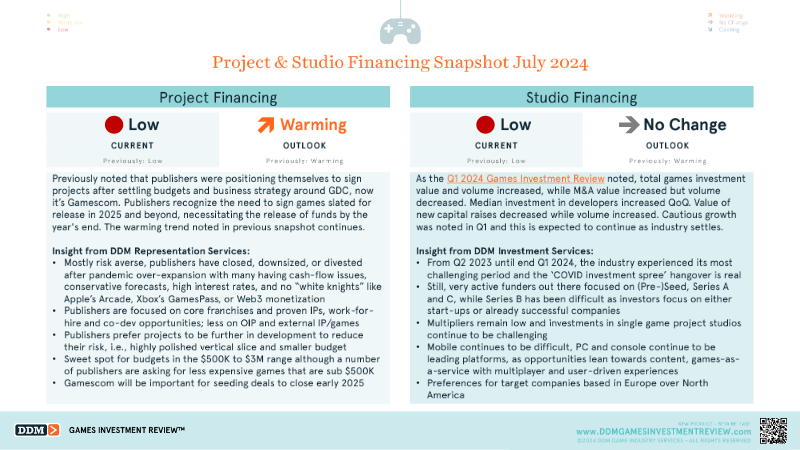
The snapshot evaluates financing conditions for game projects and development studios as of mid‑2024, highlighting a persistently constrained capital environment while noting modest signs of warming in project funding. Publishers remain risk‑averse after pandemic‑driven over‑expansion, with many having reduced staff, divested assets, and facing cash‑flow pressures compounded by high interest rates and the absence of large platform backers. Consequently, they prioritize core franchises, proven IP and work‑for‑hire arrangements, demanding projects that are further along in development, feature polished vertical slices, and fall within a budget sweet spot of roughly $500 k to $3 million, though an emerging demand for sub‑$500 k titles is evident. The upcoming Gamescom event is expected to catalyze deal flow for releases slated for 2025 and beyond.
Studio financing remains low with no change in outlook, reflecting cautious growth after a volatile Q1 2024 period in which total investment value and volume rose, M&A value increased while deal count fell, and median developer investment grew quarter‑over‑quarter. New capital raises saw a decline in total value but an increase in deal count, underscoring a shift toward smaller, more frequent funding rounds. Investors continue to focus on early‑stage (pre‑seed, Series A) and later‑stage (Series C) opportunities, while Series B financing proves scarce as capital gravitates toward either nascent start‑ups or already successful entities.
Geographically, funders exhibit a preference for European‑based studios over North American counterparts, and platform trends show mobile projects facing heightened difficulty, whereas PC and console titles dominate, especially those built around games‑as‑a‑service, multiplayer, and user‑generated content models. Overall, the financing landscape is characterized by conservative publisher behavior, modest but steady studio investment, and a strategic emphasis on later‑stage, lower‑risk projects as the industry settles post‑pandemic.
- Publishers are prioritizing low-risk projects with budgets between $500k and $3 million, though there is an emerging demand for titles under $500k.
- Investment is heavily skewed toward early-stage (pre-seed/Series A) and late-stage (Series C) rounds, leaving Series B financing scarce.
- Funding trends show a shift toward smaller, more frequent capital raises, evidenced by a decline in total new capital value despite an increase in deal count.
- PC and console titles—specifically those featuring games-as-a-service, multiplayer, or user-generated content—are currently prioritized over mobile projects.
- Investors are showing a geographic preference for European-based studios over North American counterparts.
+1
DDMJul 2024

Report145 pages
State of Web3 in Saudi Arabia
Saudi Arabia has emerged as the dominant hub for Web3 investment in the Middle East and North Africa, capturing 51 % of Q1 2024 venture‑capital funding with $429 million across 163 deals. This concentration reflects a supportive ecosystem that blends proactive government initiatives, a growing pool of local founders, and active participation from international investors. The market is presently skewed toward consumer‑facing applications such as DeFi, GameFi and SocialFi, while foundational protocol development remains limited, highlighting a clear opening for infrastructure builders.
Founders of Saudi‑based Web3 ventures underscore the rapid maturation of the sector, citing high‑profile partnerships—including Animoca Brands with NEOM, collaborations with Hedera, and alignment with Vision 2030—as catalysts for growth. Yet they identify three persistent barriers: inadequate user‑friendly interfaces, insufficient public and investor education, and ambiguous regulatory frameworks that impede both builder activity and funding cycles. Sector‑specific use cases—blockchain‑enabled freelance payments, Sharia‑compliant insurance, and localized NFT platforms—are viewed as primary drivers of mass adoption.
Government commitment reinforces this trajectory, with $37.7 billion earmarked for esports and $13.3 billion for gaming, complemented by sizable venture funds such as Wa’ed’s $500 million vehicle and 500 Global’s $2.4 billion under management. Notable projects illustrate tangible impact: Tharawat Green Exchange aims to plant ten million trees by 2030, while Ticket Souq has generated $3.3 million in gross merchandise value, serving 36 k users across 55 events in ten countries. Stakeholders agree that clear, supportive regulation, robust education, and targeted technology investment are essential to translate this momentum into sustainable, high‑pay‑off outcomes for the kingdom’s burgeoning gaming, fintech, e‑commerce and proptech sectors.
- Saudi Arabia captured 51% of all MENA Web3 venture capital funding in Q1 2024, totaling $429 million across 163 deals.
- The government has committed $37.7 billion to esports and $13.3 billion to gaming, supported by major investment vehicles like Wa’ed’s $500 million fund and 500 Global’s $2.4 billion under management.
- While the market is currently concentrated in consumer-facing sectors like DeFi, GameFi, and SocialFi, there is a significant supply gap for foundational infrastructure development.
- Founders identify three primary barriers to growth: a lack of user-friendly interfaces, insufficient public and investor education, and regulatory ambiguity.
- High-profile partnerships, such as Animoca Brands with NEOM and collaborations with Hedera, are serving as key catalysts for sector maturation under the Vision 2030 framework.
+2
AdaverseJul 2024
Report15 pages
Mobile Games Annual Investment Report
The mobile gaming investment landscape in 2023 was characterized by a strong concentration of capital within early-stage ventures, with a significant emphasis on blockchain integration and infrastructure. Venture capital activity was led by prominent firms such as Andreessen Horowitz, which deployed 63 million dollars across eight investments, including a notable 33 million dollar seed round for Proof of Play. This trend highlights a strategic pivot toward developers who combine traditional mobile gameplay with decentralized technologies and infrastructure solutions.
Investment patterns reveal a diverse range of sub-sectors receiving capital, including social gaming, AI-driven development, and fantasy sports. For instance, Lumikai focused heavily on the Indian market and social platforms, leading a 22 million dollar round for Eloelo. Meanwhile, firms like BITKRAFT Ventures and Animoca Brands continued to bridge the gap between mobile and web3, funding projects like Redemption Games and Upland. While early-stage seed and Series A rounds dominated the volume of transactions, late-stage funding remained selective, as evidenced by Animoca Brands’ 11.9 million dollar raise.
Geographically and operationally, the sector shows a global distribution of capital, targeting both established publishers and niche studios. Total round values for top investors ranged from approximately 15 million to over 60 million dollars, signaling a cautious but steady flow of capital into the mobile ecosystem. The data suggests that while the broader gaming market faced economic headwinds, investors remained committed to high-growth areas such as blockchain-enabled rewards platforms, mid-core mobile development, and innovative monetization models through digital ownership.
- Venture capital in 2023 prioritized early-stage mobile gaming ventures, specifically those integrating blockchain technology and decentralized infrastructure.
- Andreessen Horowitz led investment activity by deploying 63 million dollars across eight deals, including a 33 million dollar seed round for Proof of Play.
- Investment focus remained diverse, spanning social gaming, AI-driven development, and fantasy sports, exemplified by Lumikai’s 22 million dollar investment in Eloelo.
- Firms such as BITKRAFT Ventures and Animoca Brands actively funded projects like Redemption Games and Upland to bridge the gap between traditional mobile gaming and Web3.
- While early-stage seed and Series A rounds dominated transaction volume, late-stage funding remained highly selective, highlighted by Animoca Brands’ 11.9 million dollar raise.
+1
DDMJun 2024
Report19 pages
Q2’24 Gaming Deals Report
The second quarter of 2024 marks a period of stabilization for the global gaming industry, signaling an end to the post-pandemic "hangover" phase. Private investments established a new quarterly benchmark of $1 billion across 116 rounds, driven by a steady volume of early-stage venture capital. While late-stage deal-making remains sluggish due to ongoing market headwinds, early-stage activity has normalized around stable Seed rounds and more volatile Series A funding. Corporate venture capital has also shifted toward increased co-investment alongside traditional venture firms.
The mergers and acquisitions segment shows a gradual recovery in deal volume, though the total value of closed transactions remains lower than historical peaks due to a lack of large-scale announcements. Public offerings continue to be the most muted segment, with listing activity remaining low amid macroeconomic instability and turbulence in gaming stocks. Geographically, Asia remains the primary driver for mobile gaming hits, with titles like Dungeon & Fighter: Origin generating significant in-app purchase revenue. On PC and console platforms, Steam full-game sales grew 27% year-over-year, largely supported by a robust catalog of indie and AA titles.
The analysis covers global transactions involving video game publishers, developers, and platform technology providers, excluding pure gambling and non-gaming blockchain entities. Data is sourced from public media, business partners, and market insights, focusing on closed transactions rather than announced deals. The methodology utilizes a weighted average ranking system for venture funds based on both total deal participation and lead investor roles. Overall, the findings suggest the industry is entering a more predictable growth phase characterized by cautious but consistent investment and a diversifying PC/console market.
- Private investment in the gaming industry reached a new quarterly benchmark of $1 billion across 116 rounds in Q2 2024, signaling a stabilization of the market.
- Steam full-game sales grew by 27% year-over-year, driven primarily by a strong performance from indie and AA titles.
- Early-stage venture capital is fueling current market activity, while late-stage deal-making remains sluggish due to persistent economic headwinds.
- Mergers and acquisitions are seeing a gradual recovery in volume, though total transaction values remain below historical peaks due to a lack of large-scale deals.
- Asia continues to lead the mobile gaming sector, with titles such as Dungeon & Fighter: Origin driving significant in-app purchase revenue.
+1
InvestGameJun 2024
Report19 pages
Q2'24 Gaming Deals Report: Gradual Recovery
The second quarter of 2024 gaming industry analysis highlights a period of sustained activity in early-stage venture capital and a growing market for independent and mid-sized titles. The findings track global investment trends, mergers and acquisitions, and platform-specific performance across North America, Western Europe, Asia, and emerging markets. Data is compiled from public media, business partners, and market insights, focusing specifically on video game publishers and developers while excluding gambling and non-gaming blockchain entities.
Investment activity in Q2 2024 was characterized by a robust early-stage venture capital environment. BITKRAFT emerged as the most active fund by deal count, participating in 18 rounds, while a16z Games led in total deal value, participating in transactions worth $124 million. Geographically, Asia led in early-stage investment volume with $320 million across 28 deals, followed by North America with $162 million. Late-stage venture capital remained more concentrated, with North America securing $239 million across seven deals.
Market performance data indicates a healthy period for software sales. Steam full-game sales grew 27% year-over-year, a trend largely attributed to a strong catalog of AA and indie titles. In the mobile sector, Asia remains the primary driver of high-revenue releases; Dungeon & Fighter: Origin significantly outperformed other new titles, generating $227 million in net revenue from 5.4 million installs. Other notable mobile successes included Wuthering Waves and Gakuen Idolmaster, reflecting the continued dominance of Action RPGs and simulation genres in the region.
The analysis concludes that while the industry continues to navigate shifting capital flows, the appetite for early-stage innovation remains high. Strategic shifts are also evident in the publishing sector, noted by the launch of new labels like Knights Peak, which focus on co-publishing premium PC and console titles for global audiences.
- Steam full-game sales grew 27% year-over-year in Q2 2024, driven primarily by strong performance from independent and mid-sized titles.
- Asia led global early-stage investment with $320 million across 28 deals, while North America dominated late-stage venture capital with $239 million across seven deals.
- BITKRAFT was the most active early-stage investor by volume with 18 rounds, while a16z Games led in total deal value with $124 million invested.
- The mobile game 'Dungeon & Fighter: Origin' significantly outperformed competitors in Asia, generating $227 million in net revenue from 5.4 million installs.
- The publishing sector is seeing strategic shifts toward co-publishing models for premium PC and console titles, exemplified by the launch of new labels like Knights Peak.
+1
InvestGameJun 2024
Report6 pages
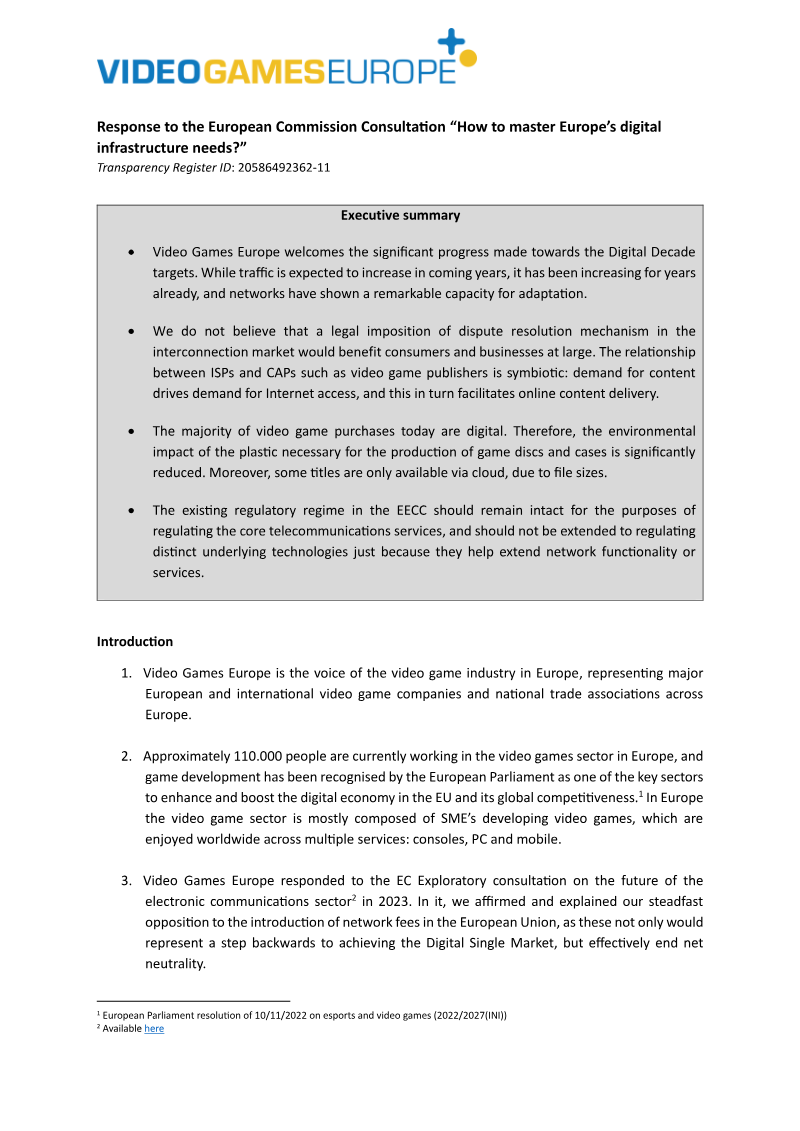
How to Master Europe’s Digital Infrastructure Needs?
Video Games Europe argues that Europe’s digital infrastructure policy should reinforce, rather than reshape, the existing market dynamics that underpin the continent’s thriving video‑game ecosystem. Representing roughly 110 000 employees and a €24.5 billion industry in which 53 percent of Europeans play, the association stresses that the sector’s growth is driven by digital distribution, which already reduces the environmental burden of physical media and, in many cases, relies on cloud delivery to limit data transfer. Typical online gameplay consumes between 60 and 80 megabytes per hour, with even the most data‑intensive titles rarely exceeding 250–300 megabytes, a fraction of the traffic generated by video streaming services.
The response highlights that network operators successfully managed the surge in traffic during the COVID‑19 lockdowns and that game publishers have collaborated with ISPs and content‑delivery networks to smooth peak loads through measures such as off‑peak download scheduling. It refutes claims that content providers “free‑ride” on ISP infrastructure, noting that publishers already pay for enhanced upload capacity and invest in their own CDN and data‑centre assets. Consequently, the relationship between content and application providers and ISPs is portrayed as symbiotic, fostering competition and consumer choice.
Against proposals to impose network fees or extend the European Electronic Communications Code to cloud services, the association warns that such pre‑emptive regulation could undermine net neutrality, increase consumer prices, and jeopardise Europe’s digital competitiveness. It calls for regulatory stability to protect investment security and urges that any infrastructure deployment be guided by concrete market demand rather than aspirational targets. The position draws on industry data, BEREC assessments of network resilience, and the sector’s own mitigation practices, concluding that preserving the current regulatory framework will best support sustainable growth and innovation across Europe’s digital economy.
- Video Games Europe opposes new network fees or expanded regulation of cloud services, arguing these measures would threaten net neutrality, increase consumer costs, and damage European digital competitiveness.
- The European video game industry generates €24.5 billion in annual revenue and employs approximately 110,000 people, with 53 percent of the European population participating in gaming.
- Gaming traffic is significantly lower than video streaming, with typical online gameplay consuming 60–80 megabytes per hour and high-intensity titles rarely exceeding 300 megabytes per hour.
- Game publishers refute 'free-riding' allegations by noting they already invest in their own data centers and content-delivery networks (CDNs) while paying for enhanced upload capacity.
- The industry maintains that existing market dynamics are sufficient, citing the successful management of COVID-19 traffic surges and ongoing collaboration with ISPs to schedule downloads during off-peak hours.
+3
Video Games EuropeJun 2024
Presentation15 pages
Financial Results Q1 2024
PCF Group S.A. reported its financial results for the first quarter of 2024, highlighting a period of significant revenue growth and improved profitability. The primary thesis of the financial update is the successful execution of the group’s multi-project strategy, supported by both work-for-hire contracts and the development of original intellectual property. Geographically, the group maintains a strong international presence with major studios in Warsaw, Rzeszów, Montreal, and Newcastle, supported by a total workforce of 763 people as of March 31, 2024.
Financial performance in Q1 2024 showed a substantial increase in revenue to 56.9 million PLN, compared to 34.9 million PLN in the same period the previous year. This growth was driven by the release of Bulletstorm VR and ongoing work on Project Maverick. EBITDA rose to 11.0 million PLN, a significant improvement over the 3.0 million PLN recorded in Q1 2023. Net profit also turned positive, reaching 11.0 million PLN compared to a net loss of 0.9 million PLN in the prior year. Management attributed this increased profitability to a high revenue base and a disciplined cost approach, despite increased spending on the publishing team.
The production pipeline remains robust across several segments. In the AAA category, Projects Bifrost and Victoria are progressing according to schedule under a self-publishing model, both having received internal greenlights for 2025-2026 release windows. The VR segment, managed through InCuvo, continues development on Green Hell VR updates and the upcoming Project Bison. Additionally, work-for-hire projects remain stable, with Project Maverick reaching its target developer headcount and negotiations continuing with Square Enix regarding other collaborations. The balance sheet remains healthy, with 138.6 million PLN in cash and bonds and total assets valued at 505.1 million PLN.
- PCF Group achieved a net profit of 11.0 million PLN in Q1 2024, a significant turnaround from the 0.9 million PLN net loss recorded in Q1 2023.
- Quarterly revenue grew to 56.9 million PLN, up from 34.9 million PLN in the prior year, driven by the release of Bulletstorm VR and progress on Project Maverick.
- EBITDA rose to 11.0 million PLN, compared to 3.0 million PLN in Q1 2023, reflecting a disciplined cost approach alongside higher revenue.
- The company maintains a strong liquidity position with 138.6 million PLN in cash and bonds and total assets valued at 505.1 million PLN.
- Self-published AAA titles Projects Bifrost and Victoria are on track for release windows between 2025 and 2026.
+2
PCF GroupMay 2024

Report43 pages
Keywords Studios FY 2023 Results
Keywords Studios achieved a resilient financial performance in 2023, reporting €780 million in revenue and a total growth rate of 13%. While the company faced significant headwinds from currency fluctuations and labor strikes in the United States, it maintained a strong organic growth rate of approximately 9% when adjusting for these factors. Performance across service pillars was mixed; the Create division experienced robust organic growth of 17.3%, whereas the Globalize and Engage sectors contended with market volatility and project cancellations. Despite these pressures, the firm maintained an adjusted operating margin of 15.6% and an EBITDA of €158.3 million, supported by a high cash conversion rate of 82.3%.
The strategic focus remains centered on aggressive expansion within the $38 billion video game content market, specifically targeting a revenue milestone exceeding €1 billion. This growth is fueled by a record €225 million investment in five high-quality acquisitions during 2023, supported by a $400 million revolving credit facility. Management intends to sustain an annual M&A spend of roughly €100 million while keeping net leverage below 2.0x. This consolidation strategy positions the firm to capitalize on the increasing complexity and cost of AAA game development, where budgets for major franchises now reach up to $1 billion.
Operating across 26 countries with a workforce of 13,000, the company currently services over 70% of top-tier industry award winners. The outlook for 2024 and beyond is positive, predicated on a recovery in global content volumes and the strategic integration of artificial intelligence to enhance creative and support services. By leveraging its global scale and technology-driven service pillars, the firm aims to maintain its leadership position as the industry continues to trend toward increased externalization and sophisticated content production.
- Keywords Studios reported €780 million in revenue for 2023, representing 13% total growth and 9% organic growth despite currency headwinds and U.S. labor strikes.
- The company achieved an adjusted operating margin of 15.6% and an EBITDA of €158.3 million, supported by a strong cash conversion rate of 82.3%.
- Management is pursuing a revenue target exceeding €1 billion, supported by a €225 million investment in five acquisitions during 2023 and a $400 million revolving credit facility.
- The 'Create' division outperformed with 17.3% organic growth, while the 'Globalize' and 'Engage' sectors faced challenges from market volatility and project cancellations.
- The firm plans to maintain an annual M&A spend of approximately €100 million while keeping net leverage below 2.0x to capitalize on the rising costs of AAA game development.
+1
Keywords StudiosMar 2024

Report49 pages
State of Play: Spring Edition
Mobile gaming has solidified its position as the industry’s primary driver, currently engaging 1.9 billion players and tracking toward $118 billion in annual revenue by 2027. This growth is occurring alongside a fundamental restructuring of digital commerce. Regulatory shifts, such as the European Union’s Digital Markets Act and recent judicial rulings, are dismantling the traditional walled gardens of major app stores. By forcing the adoption of alternative billing systems and out-of-app commerce, these changes allow developers to bypass standard commission fees and engage in direct-to-consumer marketing, fundamentally altering the economics of mobile distribution.
The industry is simultaneously transitioning toward a cross-platform ecosystem where seamless play and unified payment systems across mobile, PC, and console are becoming standard. Consumer behavior supports this shift, as 87% of multiplayer gamers now engage in cross-platform play. Younger demographics, specifically Gen Alpha and Gen Z, exhibit a 52% payer conversion rate, significantly outperforming older cohorts. To capture this value, developers are increasingly forming strategic alliances with telecommunications providers to integrate 5G infrastructure and mobile wallets, ensuring frictionless transactions in a "cross-pay" environment.
Despite a significant cooling in investment during 2023—characterized by a 75% drop in Web3 funding and a 43% decline in merger and acquisition activity—the sector is recalibrating toward a sustainable "new normal." The workforce is becoming more formalized, with nearly three-quarters of designers holding university degrees. Market analysts anticipate a recovery throughout 2024, marked by a 20% increase in deal flow and the entry of major media entities like Netflix and Disney. This stabilization is supported by a shift in venture capital toward alternative models that prioritize marketing and operational support over traditional equity-only investments.
- Mobile gaming is the industry's primary growth engine, with 1.9 billion players and projected annual revenue of $118 billion by 2027.
- Regulatory changes like the EU's Digital Markets Act are dismantling app store walled gardens, enabling developers to bypass standard commission fees through alternative billing and direct-to-consumer commerce.
- Cross-platform play is now a standard expectation, with 87% of multiplayer gamers participating and developers increasingly integrating 5G and mobile wallets to facilitate unified 'cross-pay' ecosystems.
- Younger demographics (Gen Alpha and Gen Z) are driving monetization, exhibiting a 52% payer conversion rate that significantly outperforms older player cohorts.
- After a 2023 downturn featuring a 75% drop in Web3 funding and a 43% decline in M&A activity, the market is projected to recover in 2024 with a 20% increase in deal flow.
+1
XsollaMar 2024

Report11 pages
Gaming Report: Q1 2024
The gaming venture capital landscape in the first quarter of 2024 reflects a market reaching a steady state, characterized by a shift away from speculative Web3 and metaverse investments toward more sustainable development and content-focused funding. Global venture activity during this period totaled $1.3 billion across 153 deals. While deal count remained largely flat compared to the previous quarter, total deal value increased by 22.1% quarter-over-quarter. Despite a 17.3% year-over-year decline in deal volume, the market is currently on track to exceed 2023’s aggregate funding levels, suggesting a stabilization of capital deployment within a more realistic valuation environment.
Development-focused companies, particularly those specializing in blockchain infrastructure and developer tools, captured significant attention in early 2024, momentarily outpacing content-focused investments. However, the broader industry remains highly competitive, with PC and console gameplay increasingly concentrated in established "forever titles." New content faces a challenging landscape, as only a small fraction of total playtime is dedicated to non-annual franchise releases. Investors are increasingly prioritizing high-quality content and scalable infrastructure, creating a more selective, investor-friendly environment.
The report also highlights the growing importance of in-game advertising as a critical monetization strategy. With major industry players and brands integrating programmatic ad solutions, the sector is seeing increased utility for both developers and advertisers. Companies like Anzu exemplify this trend, leveraging technology to bridge the gap between brand reach and measurable return on investment. As the industry moves past the hype-driven cycles of the pandemic, the focus has shifted toward long-term operational efficiency and proven monetization models, with exit activity expected to improve as market conditions stabilize.
- Global gaming venture capital reached $1.3 billion across 153 deals in Q1 2024, marking a 22.1% quarter-over-quarter increase in total deal value.
- The market is trending toward stabilization with a shift away from speculative Web3 and metaverse funding in favor of sustainable development and infrastructure-focused investments.
- Despite a 17.3% year-over-year decline in deal volume, current funding levels put the industry on track to exceed the total aggregate capital deployed in 2023.
- New content faces a difficult market entry as PC and console player engagement remains heavily concentrated within established 'forever titles' and annual franchises.
- In-game advertising is emerging as a critical monetization strategy, with companies like Anzu utilizing programmatic solutions to bridge the gap between brand reach and measurable ROI.
+4
PitchBookJan 2024
Report33 pages
Q1 2024 Gaming Deals Report
The gaming industry is currently navigating a period of strategic stabilization defined by cautious capital deployment and a pivot toward long-term profitability. High interest rates and broader macroeconomic pressures have dampened late-stage financing and public listing activity, leading investors to prioritize capital efficiency over aggressive expansion. Despite these headwinds, the ecosystem remains supported by a robust foundation of over $15 billion in dry powder held across more than 65 gaming-focused funds, which continues to fuel a healthy pipeline of early-stage seed investments.
Market performance is increasingly bifurcated across platforms. The PC and console sectors demonstrate notable resilience, bolstered by the consistent success of independent studios and sustained engagement on digital storefronts like Steam. In contrast, the mobile gaming market is undergoing a necessary contraction following post-pandemic volatility and the persistent impact of privacy-related advertising headwinds. While mobile startups currently face significant barriers to entry and a decline in late-stage venture interest, the sector is expected to initiate a gradual recovery by 2025 as business models adjust to the new regulatory and acquisition landscape.
Looking ahead, the industry is transitioning away from the speculative growth patterns of previous years toward a more disciplined investment environment. Syndicate-based funding has emerged as a primary mechanism for risk mitigation, reflecting a broader trend of collaborative investment. As the market stabilizes, expectations are shifting toward an uptick in midcap merger and acquisition activity throughout the remainder of the year. This evolution underscores a fundamental industry-wide commitment to sustainable growth, with investors increasingly favoring established platforms and proven development teams over high-risk, late-stage ventures.
- The gaming industry is shifting toward disciplined, long-term profitability as high interest rates and macroeconomic pressures reduce late-stage financing and public listing activity.
- Over $15 billion in dry powder remains available across more than 65 gaming-focused funds, ensuring a steady pipeline for early-stage seed investments despite broader capital constraints.
- PC and console sectors show resilience through strong independent studio performance and consistent engagement on platforms like Steam, while mobile gaming faces a contraction due to privacy-related advertising headwinds.
- Mobile gaming is projected to begin a gradual recovery by 2025 as business models adapt to new regulatory and acquisition environments.
- Syndicate-based funding has become the primary mechanism for risk mitigation, reflecting a market-wide trend toward collaborative investment strategies.
+2
InvestGameJan 2024

Report15 pages
Levelling Up: State of India Interactive Media and Gaming Research FY24
The Indian interactive media and gaming sector has emerged as a significant economic force, reaching a market valuation of $12.5 billion in fiscal year 2024. Within this landscape, gaming stands out as the fastest-growing segment, contributing $3.8 billion to the total market. Driven by a 20% compound annual growth rate, the gaming industry is projected to reach $9.2 billion by fiscal year 2029. This growth is underpinned by a massive user base of 590 million gamers, which expanded by 23 million individuals over the past year, and a 30% increase in average weekly engagement time, now reaching 13 hours per user.
Monetization trends reveal a shift toward midcore gaming, which experienced a 53% year-on-year revenue increase. In-app purchases remain the primary growth driver, with the average revenue per paying user rising 15% to $22. While real-money gaming continues to be a major contributor, it faces margin compression due to recent regulatory and taxation adjustments. Despite these challenges, the sector benefits from high user sophistication, with significant overlap between real-money and midcore gaming audiences.
The findings are based on a comprehensive mixed-methods study conducted between May and October 2024, incorporating primary survey data from 2,269 smartphone users across 16 Indian cities alongside secondary market analysis and industry expert interviews. The research highlights a maturing ecosystem supported by government recognition of gaming as a "sunrise sector." Policy developments, including the establishment of Centers of Excellence for Animation, Visual Effects, Gaming, and Comics, and the formal classification of esports as a sport, signal a transition toward a more structured and mainstream industry environment.
- The Indian gaming sector reached a $3.8 billion valuation in FY24 and is projected to grow at a 20% CAGR to reach $9.2 billion by FY29.
- India’s gaming ecosystem now includes 590 million users, with average weekly engagement increasing by 30% to 13 hours per user.
- Midcore gaming is a primary growth engine, recording a 53% year-on-year revenue increase, while average revenue per paying user rose 15% to $22.
- Real-money gaming remains a significant market contributor but is currently experiencing margin compression due to recent regulatory and taxation adjustments.
- The broader interactive media and gaming market in India is valued at $12.5 billion as of FY24.
+1
LumikaiJan 2024

Report24 pages
From Volatility to Stability: Q3 2024 Gaming Deals Report
The third quarter of 2024 marks a period of stabilization for the global gaming industry, signaling a transition from post-pandemic volatility toward a new, normalized market environment. The industry has moved past the extreme fluctuations of the COVID-19 era, with capital deployment for private investments settling at approximately $1 billion across 120 rounds. While public markets remain under pressure, the quarter saw the first initial public offering in two years, suggesting a cautious but potential thaw in public listing activity.
Key findings reveal a strategic shift in investor focus, as capital increasingly flows toward platform and technology sectors rather than traditional gaming content. This trend is evidenced by a sharp uptick in private investments for infrastructure, payment, and development tools. Within the gaming segment, early-stage venture capital remains consistent, while late-stage fundraising continues to face significant headwinds. Corporate venture capital has emerged as a vital component of the ecosystem, frequently co-investing with traditional venture firms to support studios and tech providers.
Geographically, North America and Western Europe remain the primary hubs for investment activity, though the mobile market continues to rely heavily on Asian developers for new top-performing releases. Steam sales data reflects a divergence in performance, with AA and indie publishers driving a 35% year-over-year growth in gross revenue, while AAA titles have experienced stagnation.
The analysis relies on tracking closed transactions within the video game industry, excluding pure gambling, betting, and non-gaming blockchain entities. By monitoring deal types—including control and minority mergers and acquisitions, venture capital rounds, and public offerings—the data provides a comprehensive view of capital flows. The findings emphasize that while the gaming sector faces ongoing challenges in late-stage funding, the broader ecosystem is finding stability through diversified investment in gaming-adjacent technologies and a resilient indie development scene.
- The gaming industry has transitioned to a normalized market environment, with Q3 2024 private investment totaling approximately $1 billion across 120 rounds.
- AA and indie publishers are outperforming the broader market, driving a 35% year-over-year growth in gross revenue while AAA titles remain stagnant.
- Investor capital is shifting away from traditional content toward infrastructure, payment systems, and development tools.
- Public market activity shows signs of a thaw with the first initial public offering in two years, despite continued pressure on public listings.
- Early-stage venture capital remains consistent, but late-stage fundraising continues to face significant headwinds.
+3
InvestGameJan 2024
Report32 pages
Gaming Report 2024: Meet the Moment
The global video game market, valued at $196 billion in 2023, is entering a period of sustained expansion with a projected annual growth rate of 6% through 2028. This upward trajectory is primarily fueled by younger demographics who increasingly utilize gaming environments as essential hubs for social interaction, creative expression, and commerce. To capitalize on this shift, industry leaders must pivot away from traditional, siloed development toward immersive, cross-platform ecosystems that prioritize interoperability and the integration of user-generated content. Expanding intellectual property across diverse media formats is now a critical requirement for maintaining relevance and maximizing consumer engagement.
The industry is simultaneously undergoing a structural transition toward a hardware-agnostic model, necessitated by the rise of cloud-based distribution and the demand for seamless, multi-channel experiences. As market saturation intensifies, the high failure rates observed in mobile gaming underscore the need for more rigorous operational discipline. Companies are increasingly required to align product development, finance, and marketing functions through data-driven strategies. By leveraging artificial intelligence to optimize user acquisition and retention, organizations can better navigate the volatility of the current landscape and address the growing disparity between headcount expansion and actual revenue growth.
To secure long-term viability, gaming organizations are modernizing their internal structures by standardizing development tools and fostering entrepreneurial autonomy. This evolution includes a holistic integration of generative AI into core workflows to improve operational efficiency and scale production capabilities. Furthermore, as competition for specialized talent intensifies, firms are refining their compensation and support models to align with broader technology industry standards. These combined technological and organizational shifts are essential for navigating current market turbulence and ensuring that gaming entities remain competitive in an increasingly complex and interconnected digital economy.
- The global video game market reached a $196 billion valuation in 2023 and is projected to grow at an annual rate of 6% through 2028.
- Industry growth is driven by younger demographics treating gaming environments as primary hubs for social interaction, commerce, and creative expression.
- Market leaders must transition from siloed development to immersive, cross-platform ecosystems that prioritize interoperability and user-generated content.
- The industry is shifting toward a hardware-agnostic model, requiring companies to adopt cloud-based distribution and seamless multi-channel experiences.
- Organizations must integrate generative AI into core workflows to improve operational efficiency, scale production, and address the disconnect between headcount growth and revenue.
+2
Bain & CompanyJan 2024

Report17 pages
Global MSP Report
The Global MSP Report presents a comprehensive analysis of the managed services provider (MSP) market, focusing on transaction activity, valuation trends, and strategic consolidation across the United States and Europe. The report documents a sharp increase in private‑placement activity during Q4 2024, with deal value rising from $34 million in Q3 to $2.2 billion, driven largely by platform deals and a 83% share of total activity involving strategic buyers acquiring multiple MSPs. Strategic consolidation remains robust, with six of the top ten players each adding at least four MSPs between 2023 and 2024, while financial investors continue to focus on single‑company investments.
Market valuation data indicate that the global MSP sector reached $305 billion in 2024 and is projected to grow at a CAGR of 7.2% to $571 billion by 2033, reflecting escalating IT complexity and demand for cost‑efficient services. Deal concentration is highest in IT services (88% of Q4 2024 activity), with software, networking, and communications sectors contributing smaller shares. The report lists 58 announced M&A deals in Q4 2024, with a total of 500 transactions completed since 2013 by the reporting firm.
Key outcomes highlighted include rapid deployment of new technology, cost efficiency gains, and enhanced service capabilities. The analysis draws on Pitchbook and Drake Star data, covering 2023‑2024 transactions across North America, Europe, and the Middle East, and provides detailed transaction tables for individual deals, including revenue, deal size, and acquirer information.
- The global MSP market reached a valuation of $305 billion in 2024 and is projected to grow at a 7.2% CAGR to $571 billion by 2033.
- Private-placement deal value surged from $34 million in Q3 2024 to $2.2 billion in Q4 2024, driven by a high volume of platform deals.
- Strategic buyers dominated Q4 2024 activity, accounting for 83% of total transactions as they aggressively acquired multiple MSPs.
- Six of the top ten industry players completed at least four MSP acquisitions each between 2023 and 2024, signaling robust sector consolidation.
- IT services accounted for 88% of all M&A activity in Q4 2024, with the remaining volume distributed across software, networking, and communications.
+1
Drake StarJan 2024