Report23 pages
Gaming the Future: How to Make an Impact With Younger Generations
Gaming has become the dominant entertainment medium for younger generations, with 80 % of under‑18s actively gaming and Gen Z allocating up to 22 % of free time to play. The study, combining first‑party data from SuperAwesome and Anzu with social listening, qualitative research, quantitative surveys, syndicated data, brand lift studies and parent‑tracking panels, covers the UK, France, Germany, the United States and global markets from 2023‑24. A sample of 30 000 children, teens and young adults (ages 4‑24) plus parent responses informs the analysis.
Key findings show that gaming captures more attention than social media for Gen Z, with 55 % of under‑18s reporting a strong affinity for branded in‑game experiences. Younger gamers are highly receptive to ads, with 75 % of Gen Z players in the UK and US saying in‑game ads improve their experience, compared to 34 % of older adults. In‑game advertising drives higher brand recall (+7 pts) and purchase intent (+9 pts) for audiences under 34, and generates a “halo effect” that boosts brand affinity by up to 86 % among under‑18s. Parents report that children influence household spending, with 86 % saying their child’s opinions matter in purchases and 82 % prioritising items for children.
The report recommends a multi‑platform, contextual approach that respects emerging data‑protection regulations and Age Appropriate Design Codes. It emphasizes early engagement before brand loyalties lock at age 16, contextual targeting over behavioural profiling, and rigorous creative vetting to avoid manipulative design. The analysis underscores gaming’s strategic importance for reaching Gen Alpha and Gen Z, offering measurable lift across awareness, consideration and purchase stages.
- Gaming has become the primary entertainment medium for younger demographics, with 80% of under-18s actively gaming and Gen Z dedicating up to 22% of their free time to play.
- In-game advertising significantly outperforms traditional metrics for younger audiences, driving an 86% boost in brand affinity among under-18s and increasing brand recall by 7 points and purchase intent by 9 points for those under 34.
- Younger gamers are notably more receptive to in-game ads than older adults, with 75% of Gen Z players in the UK and US reporting that ads improve their gaming experience compared to only 34% of older adults.
- Children exert substantial influence on household economics, as 86% of parents report that their child’s opinions impact household purchases and 82% prioritize spending on items for their children.
- Gaming captures more attention than social media among Gen Z, with 55% of under-18s expressing a strong affinity for branded in-game experiences.
+4
AnzuApr 2026
Report90 pages
2026 Global Mobile Gaming Marketing Trends White Paper
The white paper establishes that the mobile‑gaming advertising ecosystem expanded rapidly in 2025, with more than 90 000 active advertisers and an influx of roughly 8 000 new entrants each month, a 22 % year‑over‑year rise. Advertisers increasingly deploy fresh creatives, with video accounting for 74 % of all ads—up 14 % YoY—and Android remains the dominant acquisition platform, though iOS shares grow for mid‑core and hard‑core titles.
Top mobile games in 2025 show a clear split between volume‑driven casual installs and value‑focused premium titles. Casual hits such as Block Blast! and Subway Surfers dominate downloads, while mid‑core and premium games generate the bulk of revenue. Leading spenders—FunPlus, Yotta Games, Hungry Studio—continue to favor Android for lower cost‑per‑install acquisition, whereas iOS delivers higher monetization per install.
The industry is moving from a linear funnel to an “Infinity Loop” model that integrates acquisition, retargeting, and lifecycle actions. Aarki’s supervised‑AI engine demonstrates the potential to boost lifetime value by up to 30 % and reduce campaign volatility, underscoring the importance of a unified, data‑driven full‑funnel strategy that prioritizes LTV over instant installs.
Early‑stage mobile games must achieve rapid habit formation, with 60‑minute daily play by week 2 and high alliance join rates. Paid‑traffic validation is critical; a Day‑1 acquisition rate below 35 % signals readiness issues. Creative trends vary by genre: lightweight socializing and parkour mini‑games dominate SLG spend, RPGs favor narrative IP‑linked content, while simulation and casual titles rely on realistic or viral short‑video formats that capture 70–80 % of impressions.
Regional insights reveal puzzle and casino titles lead creative trends in 2026, with Japan/Korea driving new creative volume and Southeast Asia showing higher local IP acceptance. Mobile‑gaming ad spend rises modestly in Oceania and South America, with Android dominating creative output. A strategic pivot toward “authenticity‑utility‑impact” stacks—solving real problems and building defensible communities—drives higher retention, while AI‑powered creatives accelerate rapid testing. Finally, marketers increasingly adopt AI and programmatic DSPs beyond walled gardens; performance gaps and trust issues persist, yet data show significant install uplifts when CTV campaigns complement mobile ads, indicating a shift toward transparent, scalable programmatic solutions.
- The mobile gaming advertising ecosystem grew by 22% year-over-year in 2025, with over 90,000 active advertisers and 8,000 new entrants joining monthly.
- Video content now accounts for 74% of all mobile game ads, representing a 14% year-over-year increase in usage.
- A shift toward an 'Infinity Loop' marketing model, supported by supervised AI, can increase player lifetime value (LTV) by up to 30% by integrating acquisition, retargeting, and lifecycle management.
- Android remains the primary platform for volume-driven acquisition due to lower costs, while iOS is increasingly favored for mid-core and hard-core titles to maximize monetization per install.
- Early-stage games require a Day-1 acquisition rate of at least 35% and 60 minutes of daily play by week two to signal long-term viability.
+1
SocialPetaApr 2026
Report3 pages
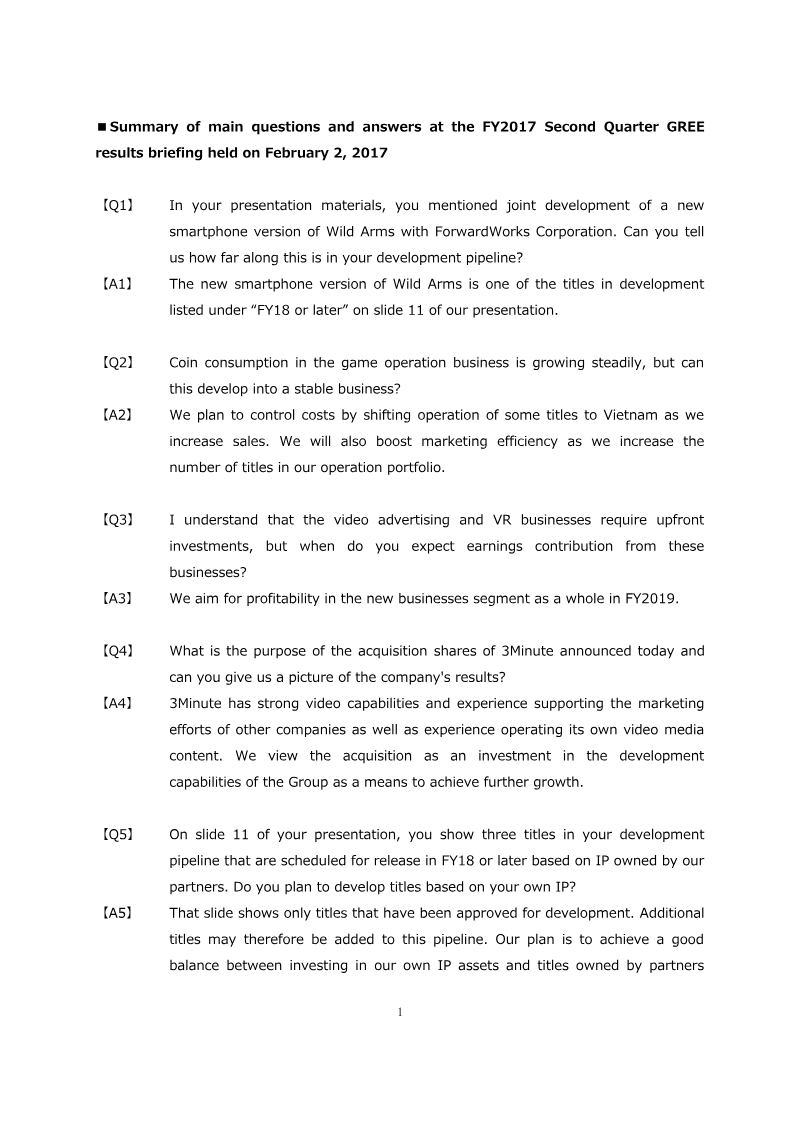
Summary of Questions and Answers: FY2017 2Q GREE Results Briefing
The briefing clarified GREE’s strategic focus for FY2017 and beyond. The company confirmed that a smartphone adaptation of Wild Arms, developed with ForwardWorks Corporation, remains in the FY18‑later pipeline. To stabilize coin‑consumption revenue from its game operation segment, GREE plans to shift operations of select titles to Vietnam and enhance marketing efficiency as its portfolio expands. New ventures in video advertising and virtual reality are expected to reach profitability by FY2019, while the acquisition of 3Minute is positioned as an investment in video‑content capabilities to support broader growth.
Regarding intellectual property, GREE indicated that its development pipeline includes both partner‑owned IP and its own assets, aiming for a balanced mix. The company highlighted Rara‑MAGI’s strong launch performance and noted that coin consumption for other overseas native titles has declined quarter‑over‑quarter, though a new title is slated for late second half release. Seven titles scheduled for the latter half of the year will see roughly half released in Q3 and the remainder in Q4, with Rara‑MAGI already live.
Operating income is projected to dip in Q3 due to increased fixed costs from new releases. GREE will evaluate ongoing titles, closing those unlikely to grow while reallocating resources to high‑potential games. Poor performance is attributed mainly to insufficient content depth or breadth at launch, and lessons learned will inform future development.
- GREE expects Q3 operating income to decline due to increased fixed costs associated with a pipeline of seven new game releases scheduled for the second half of the fiscal year.
- The company is shifting operations for select titles to Vietnam and improving marketing efficiency to stabilize coin-consumption revenue within its game segment.
- New business ventures in virtual reality and video advertising are targeted to reach profitability by FY2019.
- GREE acquired 3Minute to bolster its video-content capabilities as part of a broader growth strategy.
- The smartphone adaptation of Wild Arms, developed in partnership with ForwardWorks Corporation, is confirmed for release in FY2018 or later.
+3
GREE
Report3 pages
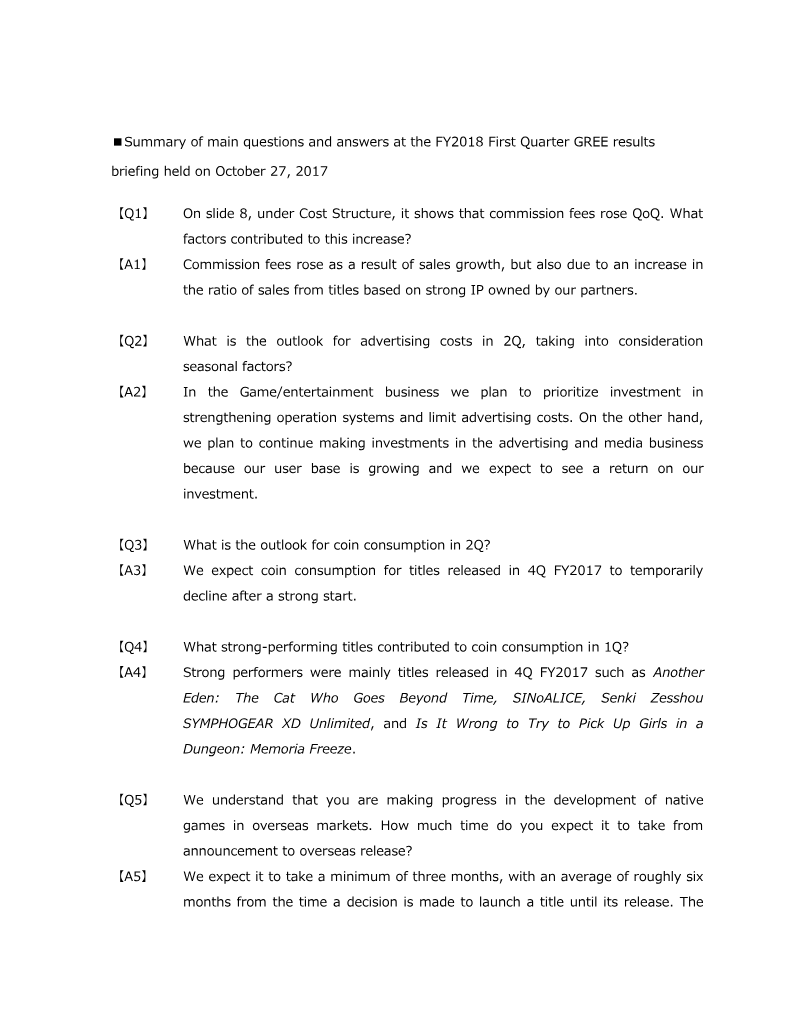
Summary of Main Questions and Answers at the FY2018 First Quarter GREE Results Briefing
The briefing, held on October 27 2017, focused on GREE’s first‑quarter FY2018 performance and future strategy. Commission fees rose quarter‑on‑quarter, driven by overall sales growth and a higher proportion of revenue from partner titles with strong intellectual property. Advertising spend outlook for the second quarter varies by segment: the game and entertainment arm will tighten costs while continuing to invest in advertising for its expanding user base, expecting a return on investment. Coin consumption is projected to dip temporarily after the strong start of Q4 FY2017 releases, yet titles such as Another Eden: The Cat Who Goes Beyond Time, SINoALICE, Senki Zesshou SYMPHOGEAR XD Unlimited, and Is It Wrong to Try to Pick Up Girls in a Dungeon: Memoria Freeze drove robust coin usage in Q1.
GREE’s overseas native‑game development pipeline is expected to take a minimum of three months from announcement to launch, averaging six months. The company emphasizes delivering versions faithful to the original Japanese product and local operation for success in China, noting that Chinese users prefer authenticity and require localized fine‑tuning with strong local partners. In the VR arena, GREE is expanding its development knowledge base and partnering to provide access points for users lacking personal VR hardware, anticipating market growth.
Regarding the domestic native‑game environment, GREE acknowledges rising user expectations and a challenging acquisition landscape. Leveraging its financial strength and industry relationships, the company plans large‑scale development and mixed‑media initiatives to deliver hit titles. Sales of native games are expected to experience a temporary decline before operations are strengthened—through larger support teams, content enhancement, overseas launches, and tailored promotional activities—to drive subsequent growth.
- GREE’s Q1 FY2018 revenue growth was driven by increased commission fees from partner titles that leverage strong intellectual property.
- Key titles driving robust coin consumption in Q1 included 'Another Eden: The Cat Who Goes Beyond Time', 'SINoALICE', 'Senki Zesshou SYMPHOGEAR XD Unlimited', and 'Is It Wrong to Try to Pick Up Girls in a Dungeon: Memoria Freeze'.
- The company expects a temporary decline in native game sales as it transitions to larger support teams, enhanced content, and more aggressive promotional activities to drive future growth.
- GREE’s overseas native-game development pipeline requires a minimum of three months from announcement to launch, with an average lead time of six months.
- Success in the Chinese market is predicated on delivering versions faithful to original Japanese products while utilizing strong local partners for necessary fine-tuning.
+3
GREE
Report2 pages
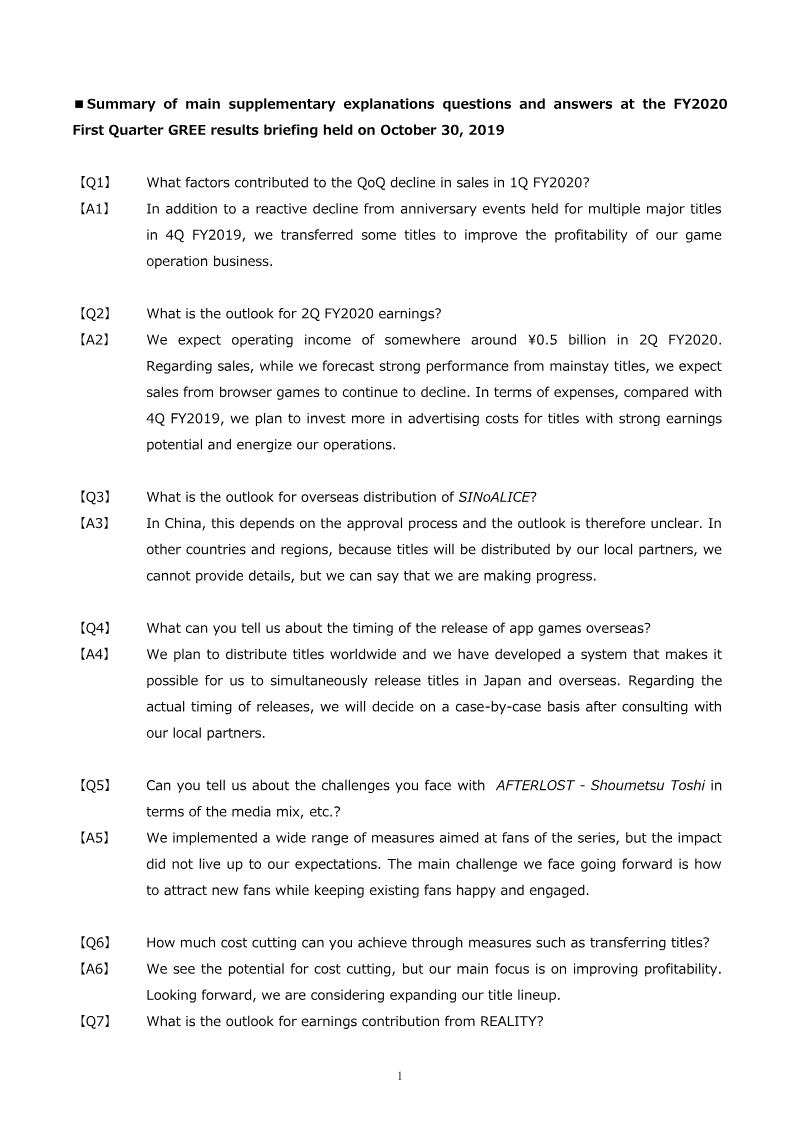
Summary of main supplementary explanations questions and answers at the FY2020 First Quarter GREE results briefing held on October 30, 2019
The briefing addressed key financial and operational questions for GREE’s first quarter of FY2020. A decline in sales was attributed to a reactive drop following anniversary events for major titles in the previous quarter and strategic title transfers aimed at improving profitability. Management projected operating income of roughly ¥0.5 billion for the second quarter, with strong expectations for core titles but a continued decline in browser game revenue; advertising spend was to increase on high‑potential games. Overseas distribution of SINoALICE remains uncertain in China due to regulatory approval, while other regions rely on local partners and progress is ongoing. Global release strategy now allows simultaneous launches in Japan and abroad, with timing set on a case‑by‑case basis after partner consultation. Challenges for AFTERLOST – Shoumetsu Toshi include attracting new fans while retaining existing ones, despite extensive fan‑targeted measures. Cost‑cutting through title transfers is viewed as a means to improve profitability, with plans to broaden the title lineup. Earnings contribution from REALITY depends on internal factors such as lifetime value enhancement and external 5G infrastructure development; the focus is on steady content portfolio expansion and platform functionality rather than rapid growth before full infrastructure deployment.
- GREE projects an operating income of approximately ¥0.5 billion for the second quarter of FY2020.
- First-quarter sales declined due to the conclusion of major title anniversary events and the strategic transfer of titles to improve overall profitability.
- Management expects browser game revenue to continue its decline while increasing advertising spend on high-potential mobile titles.
- The global release strategy has shifted to allow for simultaneous launches in Japan and international markets, contingent on partner consultation.
- The release of SINoALICE in China remains stalled due to pending regulatory approval, while other international markets rely on local distribution partners.
+3
GREE
Report2 pages
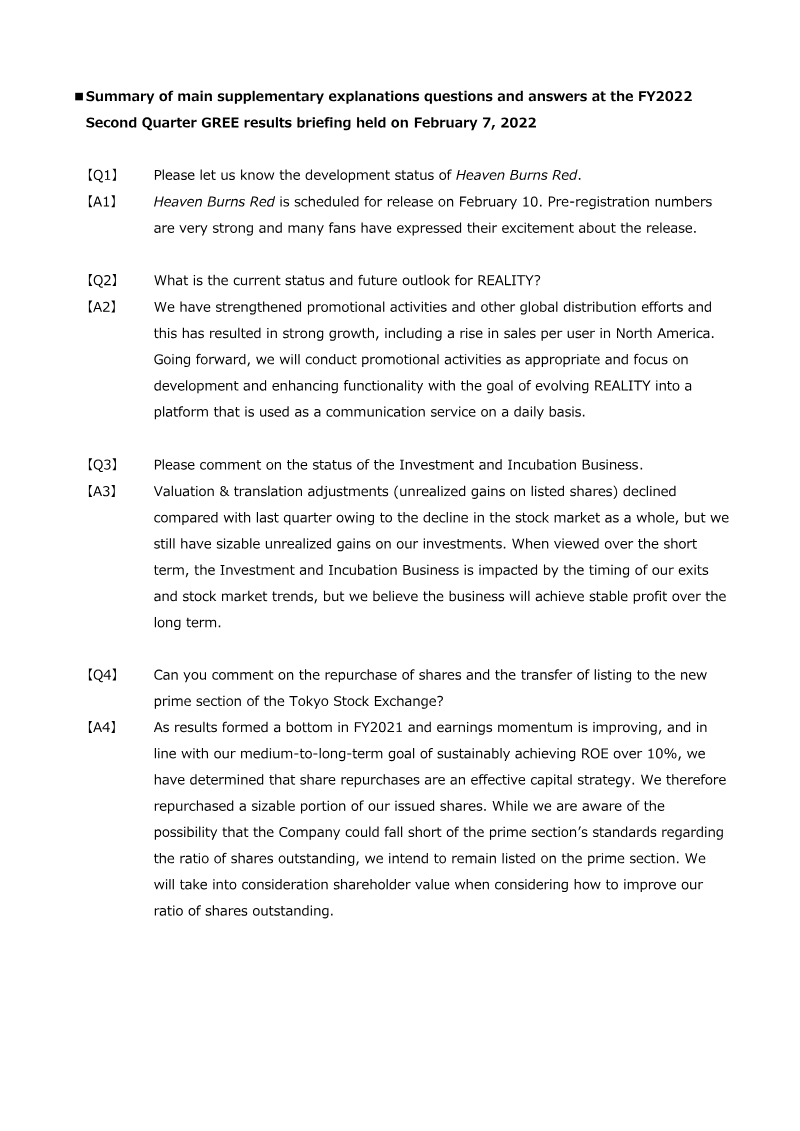
Summary of Main Supplementary Explanations Questions and Answers: GREE FY2022 Second Quarter Results
The briefing clarifies GREE’s strategic focus and financial outlook for the second quarter of FY2022. The company announces that “Heaven Burns Red” will launch on February 10, noting strong pre‑registration figures and fan enthusiasm. For the “REALITY” platform, GREE reports accelerated promotional efforts that have boosted North American sales per user; future plans emphasize continued marketing and feature development to position REALITY as a daily communication service. In the Investment and Incubation Business, unrealized gains on listed shares have fallen due to broader market declines, yet the firm maintains sizable gains and expects long‑term profitability despite short‑term exit timing effects.
Capital strategy is highlighted through a substantial share repurchase program aimed at sustaining an ROE above 10 % and maintaining listing status in the Tokyo Stock Exchange’s prime section, even as share‑outstanding ratios approach regulatory thresholds. The “Money held in trust” line item is explained as short‑term, low‑risk investments treated similarly to cash. Finally, the company projects third‑quarter operating income for its Internet and Entertainment segment between ¥1.5 billion and just under ¥2.0 billion, driven by contributions from new titles.
Overall, the presentation outlines GREE’s product rollout plans, market expansion tactics, investment portfolio resilience, capital allocation priorities, and near‑term earnings expectations within the broader context of a recovering market environment.
- GREE is launching the new title 'Heaven Burns Red' on February 10, 2022, supported by strong pre-registration figures.
- The company projects third-quarter operating income for its Internet and Entertainment segment to be between ¥1.5 billion and just under ¥2.0 billion, driven by new title contributions.
- GREE has initiated a substantial share repurchase program to maintain an ROE above 10% and ensure compliance with Tokyo Stock Exchange Prime section listing requirements.
- The 'REALITY' platform is undergoing accelerated promotional efforts in North America, resulting in increased sales per user as the company pivots toward a daily communication service model.
- Unrealized gains on listed shares within the Investment and Incubation Business have declined due to broader market conditions, though the firm maintains significant overall gains.
+3
GREE
Report1 pages
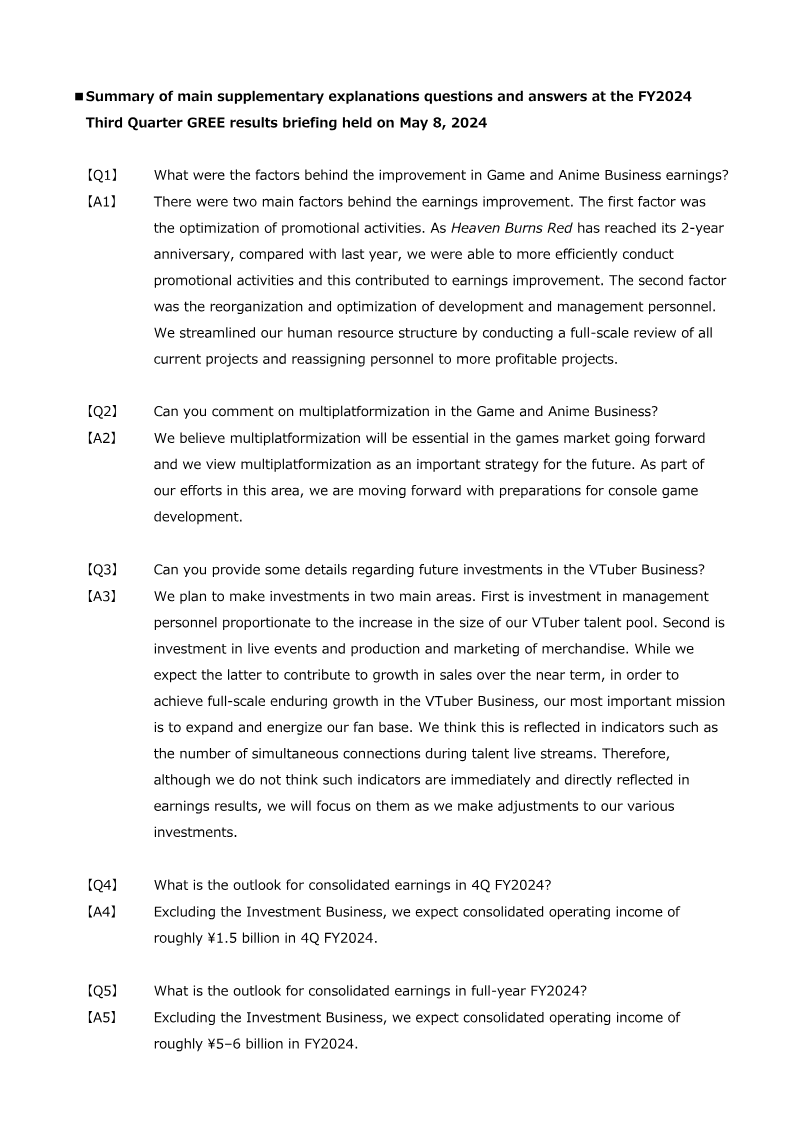
Summary of Main Supplementary Explanations Questions and Answers: FY2024 Third Quarter Results Briefing
The briefing clarified that the FY2024 third‑quarter earnings improvement in GREE’s Game and Anime Business stemmed from two primary initiatives: a more efficient promotional strategy following the second anniversary of “Heaven Burns Red,” and a comprehensive reorganization that reassigned staff to higher‑margin projects. The company emphasized multiplatformization as a strategic priority, noting active preparations for console game development to capture broader market segments.
In the VTuber segment, planned investments focus on expanding management capacity in line with a growing talent roster and enhancing live‑event production, merchandise marketing, and fan engagement metrics such as concurrent viewer counts. While these initiatives are expected to drive near‑term sales, the company views sustained growth as contingent on deepening fan base loyalty.
Financial outlooks presented exclude investment business figures. Consolidated operating income for the fourth quarter is projected at approximately ¥1.5 billion, and full‑year FY2024 earnings are estimated between ¥5–6 billion. These targets reflect the company’s confidence in its streamlined operations and strategic expansion across gaming, anime, and VTuber platforms.
- GREE projects a full-year FY2024 consolidated operating income between ¥5 billion and ¥6 billion.
- The company forecasts a consolidated operating income of approximately ¥1.5 billion for the fourth quarter of FY2024.
- Earnings growth in the Game and Anime Business was driven by optimized promotional spending for 'Heaven Burns Red' and the reallocation of staff to higher-margin projects.
- GREE is prioritizing multiplatformization, with active preparations underway to expand game development into the console market.
- VTuber segment investments are targeting increased management capacity, live-event production, and merchandise marketing to boost fan engagement metrics.
+2
GREE
Report98 pages
Corporate Responsibility Report 2020
World Alzheimer's Day 2020: Ending The Stigma Aroui In support of this year's theme - 'Let's talk about dementiar - Elsevier articles and book chaptets focused on challenging the fear and stigma assoclated 2 ZERO 3 GOOD HEALTH QUALITY 5 GENDER 6 HUNGER AND WELL-BEING EDUCATION EQUALITY ABLECTES 12RESPONSIBLE 13CUMATE 14 UNITMES CONSUMPTION ACTION BELOW WATER RELX is a global provider of information-based analytics and decision tools for professional and business...
- RELX achieved significant environmental reductions in 2020: Scope 1 and 2 carbon emissions decreased by 64% against a 2010 baseline, energy and fuel consumption at key locations dropped by 52% against a 2010 baseline, and total waste generated at reporting locations fell by 78%.
- The company purchased renewable electricity equivalent to 100% of its global consumption in 2020 and attained 100% through green tariff purchases in Europe and green-e certified renewable energy certificates in the United States.
- RELX is a UN Global Compact LEAD company, actively contributing to UNGC Expert Network and SDG working groups on Decent Work in Global Supply Chains (SDG 8) and Peace, Justice and Strong Institutions (SDG 16).
- Reed Exhibitions transformed an exhibition venue in Vienna into a 3,111-bed field hospital for COVID-19 patients in March 2020, with the first 880 cubicles built in three days.
- RELX scored 94% in the Workplace Pride Benchmark in 2020, an increase from 61% in 2019, and held its first virtual Pride Festival.
RELX
Report79 pages
2020 Corporate Responsibility Report
OVERVIEW 3 PEOPLE & COMMUNITIES 32 A Letter from our Chairman & CEO and CSO 3 Employee Health & Safety 33 About This Report Our Company 4 Employee Engagement & Development 35 Keurig Dr Pepper (KDP) has reported on Key Highlights 5 Diversity & Inclusion ...
- All K-Cup pods produced by Keurig Dr Pepper (KDP) are now recyclable, made from #5 polypropylene plastic.
- KDP achieved 90% recyclable or compostable packaging across its total portfolio in 2020, up from 86% in 2018, and increased post-consumer recycled (PCR) content to 22% in 2020 from 20% in 2018.
- KDP aims to replenish 100% of the water used for beverages in its highest water-risk operating communities by 2025, with a 20% improvement in water use efficiency targeted by the same year.
- KDP achieved its 100% responsibly sourced coffee commitment and has engaged over 1 million people in its supply chain since 2014 to improve their lives, with over $64 million in social impact investments since 2003.
- KDP's plastic packaging that is recyclable or compostable increased from 64% in 2019 to 74% in 2020, and PCR content in plastic packaging rose from 0.4% in 2019 to 2% in 2020.
+1
Keurig Dr Pepper
Report10 pages
Winning on Google Discover: A Data-Driven Guide for Gaming Media
The brief explains how Google’s February 5, 2026 “Discover core update” expands the personalized content feed and shifts traffic from traditional search to Discover, especially for gaming media. Across 197 active gaming sites in the Raptive network, roughly half of Google traffic originates from Discover, with a 20 % rise in sites receiving feed impressions after the update. The report identifies three key performance drivers that correlate with both Discover visibility and overall revenue: high U.S. traffic concentration, deep session depth, and structured editorial content such as guides and reference databases. Sites that meet these criteria see stronger Discover performance, while those dominated by forum‑style or low‑differentiation content face greater volatility.
Methodologically, the analysis draws on internal Raptive data from 6,000+ sites and external sources like Chartbeat and Google Search Console. It highlights early post‑update signals: Discover traffic is growing for smaller publishers, click volatility remains high due to real‑time recommendation algorithms, and AI summaries now occupy about half of feed impressions. The brief recommends five high‑impact actions—optimizing Core Web Vitals, crafting Discover‑specific headlines, adding author voice, aligning publishing calendars with gaming events, and correcting meta tags—to boost Discover clicks.
The document concludes by outlining Raptive’s support services, including a forthcoming Discover Workbook and personalized audits that have historically yielded an 89 % RPM uplift for gaming publishers. The brief positions Discover as a critical, data‑driven channel for gaming media amid declining search traffic and AI‑generated content.
- Google Discover now accounts for roughly 50% of Google traffic for gaming sites within the Raptive network, following a February 5, 2026 core update that shifted traffic away from traditional search.
- Sites that prioritize high U.S. traffic concentration, deep session depth, and structured editorial content like guides and databases experience superior Discover performance and revenue stability.
- Following the February 2026 update, 20% more gaming sites began receiving Discover feed impressions, with smaller publishers seeing notable traffic growth.
- AI-generated summaries currently occupy approximately 50% of all Discover feed impressions, contributing to high click volatility for publishers.
- Publishers relying on forum-style or low-differentiation content face increased traffic volatility compared to those producing structured, expert-led editorial content.
+2
RaptiveMar 2026

Report8 pages
PEGI: European Game Information
The text serves as an educational and promotional overview of the Pan‑European Game Information (PEGI) rating system, using a comic‑style narrative to capture the attention of younger gamers while delivering core information about age‑based content classification. Its central thesis is that PEGI provides the most comprehensive mechanism for informing consumers about video‑game suitability, thereby ensuring safe and informed purchasing decisions across Europe.
Key points emphasize that PEGI operates in more than thirty countries and employs a traffic‑light colour scheme to convey age recommendations: green icons for games suitable for all audiences (ages 3 and 7), amber for intermediate levels, and red for titles restricted to adults (18+). The system also includes content descriptors that clarify specific elements that may affect suitability, reinforcing transparency for parents and players. The narrative illustrates the progression through various “worlds” representing age brackets—3, 7, 12, 16, and 18—highlighting that each tier is tailored to increasingly experienced gamers.
The scope is continental, covering the European video‑game market and all major platforms, with references to the official website and downloadable applications for iPhone, Android, and Windows 7 Phone. No empirical methodology is presented; the piece relies on descriptive exposition and visual storytelling rather than survey data. Overall, the material positions PEGI as a reliable, universally adopted standard that guarantees 100 % informed choice for consumers.
- The PEGI rating system is the standardized age-classification mechanism for video games across more than 30 European countries.
- Age suitability is communicated through a traffic-light color scheme: green for ages 3 and 7, amber for intermediate levels, and red for 18+ restricted titles.
- The system utilizes specific content descriptors alongside age ratings to provide transparency regarding the elements that influence a game's suitability.
- PEGI ratings cover all major gaming platforms and are designed to facilitate informed purchasing decisions for both parents and players.
- The classification framework is structured into five distinct age brackets: 3, 7, 12, 16, and 18.
+1
AEVI

Report17 pages
Adjust Guide to Deep Linking
This technical guide outlines the strategic importance and functional mechanics of deep linking within the mobile app ecosystem. The primary thesis is that deep links are essential tools for streamlining the user experience, reducing friction, and driving higher conversion rates compared to standard mobile web interfaces. By directing users to specific in-app content rather than generic homepages, marketers can significantly improve retention and re-engagement through targeted campaigns across email, social media, and SMS.
The scope of the analysis covers the technical distinctions between three primary types of links: default, deferred, and contextual. Default deep links function only when an app is already installed, while deferred deep links—facilitated by specialized SDK integrations—route non-users to the appropriate app store before delivering them to the intended internal page upon installation. The guide also examines platform-specific solutions like Apple’s Universal Links, noting their ability to prevent error messages while highlighting limitations regarding attribution data and support within major apps like Facebook.
Key data points emphasize the commercial impact of native app environments, noting that consumers purchase at three times the rate of the mobile web. Furthermore, with 70% of emails opened on mobile devices, the integration of deep links into owned media channels is presented as a critical driver of revenue. The conclusion suggests that as digital interactions expand into voice, television, and automotive platforms, deep linking and cross-device tracking will remain the foundational technology for maintaining a cohesive and measurable mobile marketing strategy.
- Mobile app users purchase at three times the rate of those using mobile web interfaces, making deep linking a primary driver of conversion.
- Integrating deep links into owned media channels is critical for revenue, particularly as 70% of all emails are currently opened on mobile devices.
- Deferred deep links are essential for acquisition, as they route new users through the app store installation process before landing them on the specific content they originally clicked.
- Default deep links are limited to users who already have the app installed, whereas deferred deep links utilize SDK integrations to bridge the gap for non-users.
- Apple’s Universal Links prevent common error messages but face limitations regarding attribution data and compatibility with major platforms like Facebook.
+1
Adjust

Report31 pages
The Dual Frontier: A Retailer’s Framework for Agentic Commerce
Retailers frequently adopt LLM‑powered chat widgets without addressing the core friction points that shape shopper behavior. The analysis argues that meaningful agentic commerce emerges when AI is tailored to a retailer’s specific product categories, customer profiles, and pain points. By deploying onsite ambient intelligence that proactively surfaces assistance when shoppers display confusion, retailers can intervene before friction escalates. Off‑site agent commerce remains nascent; catalog data quality and the availability of structured attributes are critical bottlenecks that must be resolved to enable reliable recommendations and transactions.
Data quality is identified as a pivotal differentiator. In an agentic environment, insufficient data can prevent a retailer from entering a shopper’s consideration set entirely, whereas in traditional e‑commerce it merely dampens conversion rates. The framework stresses the need to provide agent platforms with enough data for accurate recommendations while protecting proprietary signals from competitors. A calibrated approach—balancing “share freely,” “share selectively,” and “protect” signals—is essential to maintain trust, enhance recommendation confidence, and drive higher conversion rates.
A quantitative readiness diagnostic offers a pragmatic path forward. Four pillars—catalog, technical infrastructure, organizational capacity, and strategic urgency—are scored on a 32‑point scale. Scores of 26–32 signal mature foundations and immediate learning loops; 18–25 require focused catalog work over 8–12 weeks; 10–17 suggest a narrow pilot with partner support; and 0–9 indicate foundational improvements are needed before any agent rollout. Building these capabilities in‑house can take 12–18 months, whereas partnering with a platform such as Moloco Commerce Media accelerates deployment through catalog normalization, real‑time decisioning, and holdout‑based incrementality frameworks.
- Retailers must prioritize high-quality, structured catalog data, as insufficient data in an agentic environment causes total exclusion from a shopper's consideration set rather than just lower conversion rates.
- A 32-point readiness diagnostic across four pillars—catalog, infrastructure, organizational capacity, and strategic urgency—determines the viability of agentic commerce, with scores of 26–32 indicating immediate readiness and 0–9 requiring foundational work.
- Retailers should adopt a calibrated data-sharing strategy, categorizing signals into 'share freely,' 'share selectively,' and 'protect' to balance recommendation accuracy with the need to safeguard proprietary competitive advantages.
- Partnering with platforms like Moloco Commerce Media can bypass the 12–18 month timeline required for in-house development by providing immediate access to catalog normalization and real-time decisioning frameworks.
- Effective agentic commerce requires shifting from passive chat widgets to proactive ambient intelligence that intervenes when shoppers display signs of confusion.
+2
InvestGameFeb 2026
Report88 pages
Gaming and Esports in Vietnam: A New Arena for Brands
Vietnam’s gaming and esports landscape has evolved into a high‑growth, culturally resonant channel for brands targeting the country’s youthful, tech‑savvy population. With one‑third of the populace engaged in esports and an adult gamer rate of 85 %—the highest globally—the market is driven by widespread smartphone penetration, robust 4G coverage, and a demographic where roughly 70 % are under 25. Mobile titles dominate, particularly MOBAs and FPS games, while PC gaming remains significant; casual players account for nearly half of the audience.
Consumer behavior shows intense engagement: gamers spend 1–3 hours per session, seek entertainment (85.9 %), stress relief (74.7 %), and social interaction (46.5 %). Streaming platforms such as YouTube Gaming and Facebook Gaming lead, with Twitch lagging behind. Brands that sponsor mobile esports events or partner with key opinion leaders (KOLs) can tap into this high‑interaction environment, especially as 51 % of gamers trust KOL recommendations and 42 % purchase endorsed products.
Investment trends confirm the sector’s appeal. Global esports spend reached $844 million in 2021, with 9.9 % allocated to Vietnam. In‑game advertising that offers prizes (49 %) and video content (40 %) yields the strongest purchase intent, particularly for electronics, tech, and gaming accessories. Best practices emphasize customized creative assets, reward‑based incentives, and authentic collaborations—examples include Adidas “Time In” with Ninja, Dashing’s team sponsorship, and Mastercard’s League of Legends partnership—demonstrating higher recall than traditional sports ads.
Practical engagement strategies recommend experiential pop‑ups, in‑game placements, and co‑creation with publishers (e.g., Louis Vuitton’s LVxLOL) to deliver authentic touchpoints. Cause‑based campaigns resonate with Gen Z’s social consciousness, while treating esports as a “co‑business” encourages integrated, audience‑centric messaging. Overall, Vietnam’s rapidly expanding mobile and PC gaming ecosystem offers brands a fertile arena for digital fluidity, agile research, influencer partnerships, and localized media strategies to capture high‑growth engagement.
- Vietnam has the world's highest adult gamer rate at 85%, with a demographic where 70% of the population is under 25 and one-third of citizens are engaged in esports.
- Mobile gaming dominates the market, supported by high smartphone penetration and 4G coverage, with gamers typically spending 1–3 hours per session.
- Influencer marketing is highly effective, as 51% of gamers trust key opinion leader (KOL) recommendations and 42% report purchasing products endorsed by them.
- In-game advertising featuring prizes (49%) and video content (40%) generates the strongest purchase intent, particularly for electronics, tech, and gaming accessories.
- Vietnam captured 9.9% of the $844 million global esports spend in 2021, signaling significant market appeal for international investment.
+3
Decision LabFeb 2026

Report9 pages
Mobile App User Trends: MENA Ramadan 2026
The analysis focuses on mobile application usage patterns observed during the Ramadan period of 2026 across the Middle East and North Africa (MENA) region. The primary objective is to quantify shifts in user engagement, subscription behavior, and platform preference relative to the preceding year and a broader baseline average. Key metrics examined include overall app usage, subscription growth, in‑app purchases, and social media interaction.
Findings indicate a pronounced rise in overall app engagement during Ramadan 2026, with total usage increasing by approximately 111 % compared to the same period in 2025. Subscription activity shows a 42 % uptick, while in‑app purchase volume climbs by 91 %. Social media engagement metrics—measured through likes, shares, and comments—exhibit a 63 % increase. When benchmarked against the average growth rate for the same timeframe (2025‑2026), these figures represent a significant acceleration, suggesting heightened consumer activity during the holy month.
The data set covers all MENA markets and aggregates daily usage logs from a representative sample of mobile devices. The methodology involved longitudinal tracking of app sessions, transaction records, and social media interactions over the 30‑day Ramadan period. Comparative analysis was performed against both the previous year’s Ramadan metrics and a rolling 12‑month average to isolate seasonal effects.
In conclusion, the Ramadan period of 2026 drove substantial growth across multiple facets of mobile app consumption in MENA, with overall usage and monetization metrics surpassing historical trends. These insights underscore the strategic importance of tailoring app offerings, promotional campaigns, and user experience enhancements to align with cultural and religious calendars in the region.
- Overall mobile app engagement in the MENA region during Ramadan 2026 increased by 111% compared to the same period in 2025.
- In-app purchase volume saw a significant surge, rising by 91% during the 30-day Ramadan period.
- Social media interaction, measured by likes, shares, and comments, grew by 63% compared to the previous year.
- Subscription activity experienced a 42% uptick during the 2026 Ramadan period.
- Growth metrics across usage and monetization significantly outperformed both the previous year's Ramadan data and the rolling 12-month baseline average.
+2
InvestGameJan 2026

Report38 pages
The AI Disruption Index: How AI Is Reshaping Consumer Discovery
The AI Disruption Index demonstrates that artificial intelligence is fundamentally altering how U.S. consumers discover and purchase brands, with one‑third of adults now using personal AI agents to find products and nearly half employing AI for purchase research. A survey of 283 marketing leaders across fifteen verticals, coupled with analysis of more than 3,000 apps that collectively amassed over 200 billion downloads, confirms that AI has already eroded traditional discovery channels and is poised to disintermediate services that depend heavily on paid search and weak customer relationships.
Generative‑AI agents pose the greatest threat to news, education, health & fitness, retail, and on‑demand services, where AI can replace conventional search and recommendation workflows. Only sectors with strong regulatory or content moats—such as financial services, media rights holders, and auto OEMs—retain a defensive advantage. The study underscores that brands must embed AI‑driven personalization and deepen direct customer relationships to counter the risk of zero‑click discovery.
Mobile applications emerge as the primary competitive advantage for brands able to own the customer journey. They provide first‑party data, closed‑loop measurement, and personalized experiences that are difficult for AI agents to replicate. The report recommends three strategic priorities: investing in superior mobile app experiences, unifying and activating customer signals through comprehensive data profiles, and rethinking channel mixes to favor resilient, direct‑engagement platforms over fragmented paid or organic search. These actions will enable brands to mitigate AI‑driven disruption and secure long‑term customer loyalty across the United States.
- One-third of U.S. adults now use personal AI agents for product discovery, while nearly 50% utilize AI for purchase research.
- AI-driven 'zero-click' discovery is actively eroding traditional paid search and organic search channels, threatening sectors like retail, education, and health & fitness.
- Sectors with strong regulatory or content moats, specifically financial services, media rights holders, and auto OEMs, currently maintain a defensive advantage against AI disintermediation.
- Mobile applications serve as the primary defense against AI disruption by enabling first-party data collection, closed-loop measurement, and personalized experiences that AI agents cannot easily replicate.
- Brands must shift strategic focus away from fragmented search channels toward direct-engagement platforms to secure long-term customer loyalty.
+2
InvestGameJan 2026
Report32 pages
Festive Season 2025: App Marketing Trends and Strategies for India
India’s festive season—from Onam in August through Diwali and Christmas in December—drives more than 30 % of the country’s annual digital advertising spend, making it a pivotal period for app marketers. In 2024, mobile games alone attracted over 3.2 billion downloads and generated $151 million in‑app purchase revenue, while non‑gaming verticals such as shopping, food delivery and OTT experienced sharp install spikes during key festivals. The data reveal a 53 % rise in mobile ad spend from Q1‑Q2 to Q3‑Q4, with installs up 36 % and re‑engagements soaring 69 % during the peak festive window, underscoring the season’s high‑value user acquisition and monetisation potential.
User‑acquisition efficiency improved markedly, with CPI falling by approximately 12 % while CPA remained stable. Video and playable ads delivered the highest ROAS—up to 4.2× in fintech and 3.8× in e‑commerce—and programmatic/OEM placements on Xiaomi and Samsung yielded significant conversion lifts, particularly in Tier‑2 and Tier‑3 cities. Creatives that refreshed weekly, incorporated localized language, and employed urgency cues such as countdowns outperformed static ads, highlighting the need for agile, culturally relevant creative and a diversified media mix that extends beyond Meta and Google into programmatic and OEM channels.
Marketers are increasingly leveraging data‑driven platforms—Singular, MobuppsX, Sensor Tower, Pathmatics and others—to optimise acquisition, retention and media spend. By integrating MAFO, iRTB, advanced fraud prevention and audience‑retention analytics, brands can reduce wasted spend, improve advertising ROI and accelerate growth across web, social and mobile channels. A unified data‑house approach enables faster campaign optimisation, measurable engagement gains and stronger competitive positioning during India’s lucrative festive period.
- India's festive season (August–December) accounts for over 30% of annual digital ad spend, driving a 36% increase in installs and a 69% surge in re-engagements during the peak window.
- Mobile gaming remains a primary growth driver, recording 3.2 billion downloads and $151 million in-app purchase revenue in 2024.
- Ad spend efficiency improved during the festive period, with a 53% increase in mobile ad investment accompanied by a 12% reduction in cost-per-install (CPI).
- Video and playable ads are the most effective formats, delivering up to 4.2× ROAS in fintech and 3.8× in e-commerce.
- Programmatic and OEM placements on devices like Xiaomi and Samsung are essential for capturing growth in Tier-2 and Tier-3 cities.
+3
InvestGameJan 2026
Report36 pages
Winning with Creative: Building, Testing, and Scaling High-Performance Ads
The purpose of the analysis is to demonstrate that creative content remains the decisive lever for growth in an advertising environment increasingly fragmented by privacy constraints and platform diversity. By measuring “Return on Creative” through volume, variety, and versioning, marketers can isolate incremental value per asset and scale profitable campaigns across platforms.
High‑performance ads are defined by rapid, data‑driven testing and creative diversification. In e‑commerce and lifestyle categories, first‑person point‑of‑view walkthroughs that showcase everyday use outperform generic user‑generated content, with a 350 % lift in ad spend when winning templates are paired with top assets. TikTok’s “TikTok‑first” structure—hook, body, close—shows that 30‑second videos with sound on can raise purchase intent by up to 77 %. AI tools such as TikTok Symphony deliver a 57 % efficiency gain in content creation, underscoring the necessity of automated, localized creative testing for scaling.
The three‑stage CRAFTSMAN+ framework provides a systematic approach to creative optimization. Stage 2 refines concepts by testing talent, video duration, and demographic fit to identify the most engaging format. Stage 3 fine‑tunes assets—including intro hooks, audio, CTA copy, and visual elements—to lock in the winning creative, benchmark performance, and scale campaigns. Narrative structure (education‑focused versus social proof) and localized storytelling drive higher conversion rates and return on ad spend, while structured fatigue monitoring (CTR decay, spend decline) enables proactive creative refreshes.
Geographically the findings apply to major digital markets worldwide, with a focus on platforms such as TikTok and broader social media ecosystems. The time period covers the most recent advertising cycles, reflecting current privacy regulations and platform algorithm changes. Overall, the analysis concludes that dynamic, interactive creative—tested rapidly and scaled strategically—offers the highest growth potential for brands navigating today’s complex advertising landscape.
- High-performance ads achieve a 350% lift in ad spend when winning templates are paired with top-performing assets.
- TikTok-first video structures—comprising a hook, body, and close—can increase purchase intent by up to 77% when using 30-second, sound-on formats.
- AI-driven content creation tools, such as TikTok Symphony, provide a 57% efficiency gain in the production process.
- First-person point-of-view walkthroughs demonstrating everyday product use consistently outperform generic user-generated content.
- The CRAFTSMAN+ framework optimizes performance by systematically testing variables like talent, video duration, and demographic fit before fine-tuning specific elements like hooks and CTAs.
+3
MolocoJan 2026

Whitepaper90 pages
2026 Global Mobile Apps Marketing Trends
The 2026 mobile marketing landscape is defined by a fundamental transition from media-centric targeting to creative-driven acquisition, necessitated by tightening privacy constraints and the saturation of traditional advertising channels. Competitive advantage now hinges on the speed of creative iteration and the ability to unify product development, monetization, and distribution. By leveraging early behavioral signals to predict long-term value, industry leaders are successfully aligning short-term performance metrics with sustainable user lifecycle growth. This evolution is supported by a strategic shift toward AI-powered personalization and behavior-driven gamification, as non-gaming applications increasingly adopt the engagement tactics traditionally reserved for the mobile gaming sector.
Data from 2025 reveals a period of significant market consolidation, marked by a 16.7% decline in active advertisers alongside a 73.3% surge in creative output per advertiser. Playable ads have emerged as the premier format, consistently yielding the highest attention duration, scroll-stop rates, and conversion metrics. While the AI app sector experienced a sharp 48% contraction in the number of advertisers, top-tier players have responded by aggressively scaling localized marketing efforts. Simultaneously, the finance and health sectors have maintained greater stability, focusing on service-centric, medical-grade solutions and persuasive, value-based messaging to capture mature markets in North America and Europe.
Global strategies for 2026 prioritize a balanced media mix, typically favoring video content, while emphasizing hyper-local operations in emerging regions like Southeast Asia and the Middle East. Success in these diverse markets requires intensive user education and culturally nuanced, scenario-based ad updates. As the industry moves toward subscription-based models and on-device AI integration, the focus has shifted from mere technological development to the large-scale monetization of AI-enhanced user experiences. Ultimately, the market is moving toward a future of highly segmented, interactive, and performance-driven advertising that prioritizes technical precision and regulatory compliance to foster long-term user trust.
- The mobile marketing landscape has shifted from media-centric targeting to creative-driven acquisition, evidenced by a 73.3% surge in creative output per advertiser alongside a 16.7% decline in the total number of active advertisers.
- Playable ads are currently the top-performing format, consistently delivering the highest conversion metrics, scroll-stop rates, and attention duration.
- The AI application sector underwent a significant contraction in 2025, with the number of active advertisers dropping by 48%.
- Industry leaders are prioritizing the use of early behavioral signals to predict long-term user value, effectively bridging the gap between short-term performance metrics and sustainable lifecycle growth.
- Non-gaming applications are increasingly adopting engagement tactics from the mobile gaming sector, specifically utilizing AI-powered personalization and behavior-driven gamification.
+4
SocialPetaJan 2026
Report31 pages
State of Digital Advertising India 2026
The analysis presents a comprehensive overview of India’s digital‑advertising landscape, emphasizing its rapid expansion and the shifting strategic focus of advertisers. In 2025 the market surpassed the $4 billion threshold and is projected to exceed $5 billion in 2026, reflecting robust demand across multiple verticals. Shopping emerged as the dominant category, accounting for 28 % of total spend and delivering an 18 % year‑on‑year increase, while software recorded the strongest growth rate at 84 % YoY. Food‑and‑dining services and automotive sectors also posted notable gains of 38 % and 4 % respectively, underscoring a diversified expansion beyond traditional e‑commerce.
The competitive environment is concentrated among a handful of large advertisers, with Flipkart, Amazon and Reliance leading in impression share. A clear strategic shift is evident toward performance‑driven, audience‑specific creative, as brands increasingly deploy tailored messaging to capture high‑yield, short‑duration placements. This trend intensifies during the festive half‑year, when domestic players in generative‑AI services, food‑delivery, and film promotion amplify spend on segment‑focused creatives to maximize visibility.
Overall, the findings illustrate that India’s digital‑advertising ecosystem is entering a phase of accelerated growth, driven by both expanding spend in core categories and a pronounced move toward data‑centric, personalized creative execution. The outlook suggests continued market deepening, with advertisers likely to prioritize precision targeting and seasonal intensity to sustain momentum through 2026.
- India’s digital advertising market surpassed $4 billion in 2025 and is projected to exceed $5 billion in 2026.
- Shopping remains the dominant advertising category, representing 28% of total spend with an 18% year-on-year increase.
- Software recorded the highest growth rate among all sectors, surging 84% year-on-year.
- Flipkart, Amazon, and Reliance currently hold the largest share of advertising impressions in the market.
- Food-and-dining services and the automotive sector posted notable growth of 38% and 4% respectively.
+1
Sensor TowerJan 2026