Reports matching your filters
The mobile gaming landscape is currently defined by a strategic shift toward casual and hybrid-casual experiences, which serve as the primary engine for industry growth and user acquisition. While the market faces significant headwinds in the form of rising acquisition costs—particularly on iOS, where the $4.83 cost-per-install is nearly eight times higher than on Android—high-performing regions like North America continue to deliver a sustainable Day 7 return on ad spend of 5.9%. This economic environment has triggered a transition away from hyper-casual titles toward puzzle games, which now command 37% of installs, and hybrid-casual models that integrate complex meta-layers and sophisticated LiveOps into accessible core mechanics.
Monetization strategies are becoming increasingly diversified as developers move beyond traditional advertising. The rise of "progressive offers" and "engagement offers" has transformed in-app purchases by tying discounts and rewards directly to active gameplay milestones. Furthermore, the industry is seeing a surge in collaborative "partner events" and social mechanics, such as win streaks and digging minigames, to stabilize and boost baseline revenues. These engagement-driven tactics are often paired with the emergence of external web stores, allowing developers to bypass platform fees and foster direct-to-consumer relationships through exclusive loyalty rewards and daily gifts.
The casualization of the market extends even to mid-core titles, which now rely on casual mechanics for 74% of their installs. Emerging subgenres like 3D match and Mahjong Solitaire are gaining significant traction, reflecting a broader trend of deepening gameplay depth within the casual category. By combining simple core loops with complex monetization structures and social event formats, developers are successfully navigating the high-cost acquisition environment to maintain long-term player retention and revenue growth across global markets.
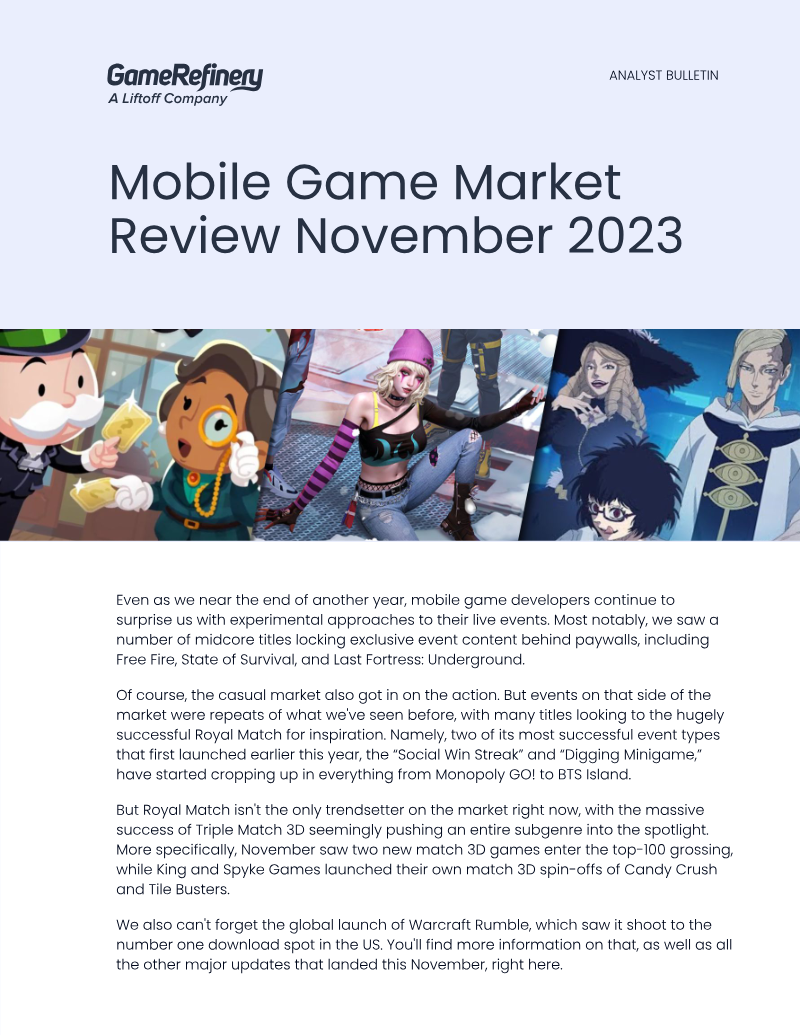
The mobile gaming market in November 2023 was characterized by the proliferation of specific event mechanics and the rise of the 3D match subgenre. Analysis of market leaders reveals that Royal Match has become a primary trendsetter for casual titles. Its "Social Win Streak" and "Digging Minigame" mechanics were widely adopted by competitors such as Monopoly GO!, Matchington Mansion, and BTS Island. Simultaneously, the success of Triple Match 3D spurred a wave of new entries in the 3D match category, including Match Factory and spin-offs from established franchises like Candy Crush.
A significant shift occurred in the midcore segment, where developers increasingly experimented with pay-gated event content. Titles such as Free Fire, State of Survival, and Last Fortress: Underground implemented exclusive rewards and gameplay modes accessible only through direct purchases or premium currency top-ups. This trend suggests a strategic move toward more aggressive monetization of live events, moving away from purely engagement-based models to those requiring financial entry points for participation.
Geographically, the US market saw major activity with the global launch of Warcraft Rumble, which achieved the top download spot and maintained a top-50 grossing position. In China, Soul Knight Prequel demonstrated the continued strength of the roguelite genre, reaching the top of the download charts. Other notable developments included the expansion of user-generated content via the Stumble Workshop in Stumble Guys and the rapid emergence of mobile clones inspired by the viral Nintendo Switch title, Suika Game. These findings indicate a highly reactive market where developers quickly iterate on successful mechanics and viral trends across both casual and midcore segments.
The global game development landscape is currently undergoing a fundamental transition driven by escalating project complexity and the widespread adoption of live service models. With 95% of studios now pursuing or planning live service strategies, the industry faces a critical mismatch between traditional production pipelines and the need for rapid, iterative release cycles. Rising development costs affect 77% of studios, fueled by consumer demands for AAA quality and the technical debt inherent in maintaining custom middleware. Consequently, 88% of developers are actively seeking new technological solutions to address systemic inefficiencies, particularly regarding long build times and fragmented collaborative 3D art pipelines.
To mitigate these challenges, there is a significant shift toward a "buy vs. build" philosophy, with 65% of studios prioritizing off-the-shelf tools over proprietary systems to accelerate time-to-market. Modern development is increasingly adopting SaaS-inspired DevOps practices, modular architectures, and automated testing to improve developer velocity and ensure the stability required for live operations. These infrastructure investments are viewed as vital business drivers, as technical outages or defects in a live service environment result in immediate player churn and revenue loss.
The industry's future growth depends on the integration of emerging technologies such as cloud infrastructure and artificial intelligence to streamline content creation and enhance player experiences. As market saturation and production risks intensify, the move toward agile, software-centric engineering practices represents a necessary departure from legacy norms. Studios that successfully leverage these innovations to reduce technical debt and improve production sophistication are positioned to become the next generation of category leaders in an increasingly competitive global market.
In-game events have become a cornerstone of mobile game monetization and player retention, with 90% of the top 100 grossing mobile titles utilizing seasonal events. This analysis examines the strategic implementation of these live operations across major global markets, including the US, China, and Japan, focusing on data from late 2020 through late 2021.
The findings indicate that seasonal events are highly effective at re-engaging existing players and acquiring new ones. In the US, developers primarily leverage public holidays like Christmas and Halloween, while Asian markets utilize region-specific occasions such as China’s Qixi Festival and Japan’s Sakura season. Successful implementations often combine UI changes with playable content, such as the tower defense mode in Genshin Impact’s Lantern Rite event, which drove daily revenue from $200,000 to over $1.25 million. Revenue is typically generated through time-limited skins, themed currencies, and special gacha mechanics.
Promotional collaborations with external brands represent a significant growth area, appearing in 42% of the top 100 US iOS games—a steady increase since 2017. This trend is even more pronounced in Asia, where 51% of top Chinese games and 62% of top Japanese games feature collaborations. These partnerships extend beyond gaming IPs to include non-gaming brands like KFC or virtual influencers like Kizuna AI. The latter’s partnership with Sky: Children of the Light demonstrated the power of niche fanbases, pushing the game to over $1 million in daily revenue through a single $20 accessory kit.
Methodologically, the insights are derived from GameRefinery’s proprietary three-layered taxonomy, which categorizes games by category, genre, and subgenre. The data highlights that while events are ubiquitous among top-tier titles, they remain underutilized by lower-ranking games, serving as a key differentiator for market leaders across the casual, mid-core, and casino segments.
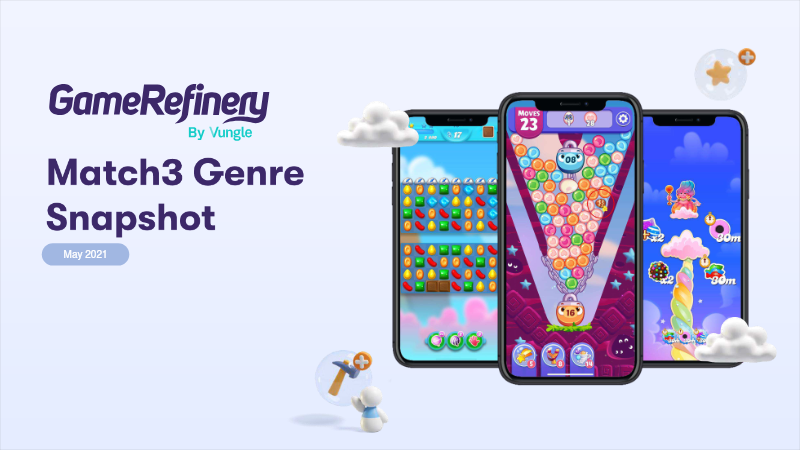
The Match3 subgenre represents the largest individual segment of the US iOS mobile gaming market, accounting for approximately 16% of total market revenue as of May 2021. While the category has long been dominated by established titles that have maintained chart positions for years, recent market shifts indicate a move away from traditional swapping mechanics. Notably, none of the new Match3 titles entering the top 500 grossing rankings over the last 18 months utilize standard swapping gameplay, signaling a diversification in core mechanics and the rising importance of meta-layers.
Meta-elements, particularly those focused on decoration and customization, have become essential components for modern success in the genre. Successful megahits like Royal Match and Project Makeover demonstrate the effectiveness of combining core puzzle gameplay with deep progression systems and sophisticated monetization strategies. Data indicates that recurring live events, special event rewards, and limited-time in-app purchase offers have the highest impact on revenue. Furthermore, social features such as guild mechanics and "send/ask help" systems are increasingly vital for driving engagement and retention.
Player motivation analysis, based on a survey of over 7,000 mobile gamers across English-speaking Western markets, reveals distinct psychological drivers within the genre. While "Thinking and Solving" remains the primary driver for traditional titles like Candy Crush Saga, newer successful entries increasingly lean into "Customization and Decoration" and "Role-playing and Emotions." This shift reflects a broader industry trend where loss aversion mechanics and social competition are leveraged to enhance the player experience and maximize lifetime value in a highly competitive landscape.
The snapshot presents a comprehensive overview of in‑game event strategies across the global mobile gaming market, focusing on seasonal and promotional collaboration events. It establishes that 90 % of the top‑grossing 100 mobile titles deploy seasonal events, while 40 % of US iOS top‑100 games feature brand collaborations. These events are highlighted as key drivers for player re‑engagement, new user acquisition, and revenue spikes, with examples such as Sky: Children of the Light’s Kizuna AI partnership and Genshin Impact’s Lantern Rite event, which each generated multi‑million daily revenue surges.
The report details the taxonomy of events—UI changes, limited‑time offers, playable content, and special bundles—and identifies profitable revenue streams: time‑limited skins, character drops, themed currency, and gacha mechanics. Seasonal calendars list major holidays (Christmas, Lunar New Year, Halloween) and region‑specific observances (Double Five in China, Sakura season in Japan), underscoring the importance of cultural relevance.
Geographic scope covers North America, China, and Japan, with data on event adoption rates: 51 % of Chinese top‑100 games and 62 % of Japanese top‑100 games use promotional collaborations, compared to 42 % in the US. Methodology relies on GameRefinery’s SaaS platform, aggregating revenue and event data from thousands of titles.
Key conclusions emphasize that events remain a differentiator for high‑performing games, offering scalable monetization and cross‑brand synergy. The snapshot recommends that developers evaluate event fit against audience demographics, content alignment, and potential for brand partnership to maximize engagement and revenue.