Mirror's Edge
3 documents in the library are about Mirror's Edge, from writers such as Game Developers Conference and Extra Credits, the newest from 2019. Each has a summary and key insights with the page they come from.

Mirror's Edge is a first-person action-adventure game focused on parkour and free-running. Set in a heavily surveilled city, players control Faith, a courier who traverses rooftops using wall-runs, jumps, and slides to deliver sensitive information. The gameplay emphasizes momentum and fluid movement over combat, with a focus on finding the fastest path through urban environments.
- Released
- Nov 11, 2008
- Developer
- EA Digital Illusions CE
- Publisher
- Electronic Arts
- Genres
- Platform, Puzzle, Adventure
- Platforms
- PlayStation 3, PC (Microsoft Windows), Xbox 360
- Links
- Wikipedia
Game data from IGDB.com
Documents about Mirror's Edge
Mirror's Edge Catalyst: Evolving and Creating a Style
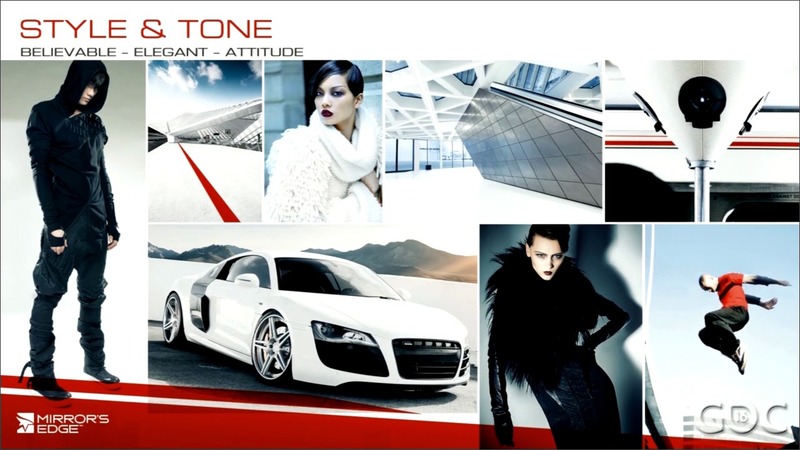
Mirror’s Edge Catalyst establishes a distinct visual identity by balancing minimalist artistic expression with the functional requirements of an open-world traversal system.
- DICE established a '70/30' design rule for Mirror's Edge Catalyst, where 70% of the environment is based on real-world precedents and 30% is stylized to maintain a distinct, futuristic aesthetic.
- The team utilized a 'less is more' philosophy to create an elegant, minimalist world, intentionally removing visual noise, dirt, and clutter to emphasize clean, pristine shapes.
- To ensure visual consistency, the team defined strong keywords and used mood boards to align the entire development team on the game's core tone and aesthetic goals.
Level Design Workshop: Architecture in Level Design
The application of architectural principles to level design serves as a powerful tool for establishing mood, guiding player behavior, and creating cohesive game environments.
- Architectural consistency in structural layout, materials, and massing is more critical for player immersion than achieving photorealism.
- Designers should establish a 'party'—a fundamental organizational logic—to ensure that circulation, massing, and materials create a unified atmosphere.
- Spatial geometry should be used to intuitively guide player behavior and navigation, reducing the need for explicit signposting or decorative detail.

What Does Tomorrow Look Like? - How We Envision the Future - Extra Credits
The visual representation of the future has historically served as a mirror for contemporary societal anxieties and aspirations.
- Modern video games frequently rely on derivative mash-ups of 20th-century tropes rather than creating original aesthetic identities that reflect contemporary global concerns.
- The lack of a cohesive, modern vision for the future prevents the gaming industry from effectively engaging with the complexities of current societal issues.
- Historical aesthetic movements, such as 1920s Art Deco, 1960s space-age idealism, and 1980s cyberpunk, provided a shared cultural vocabulary that contemporary media currently lacks.