Transcript
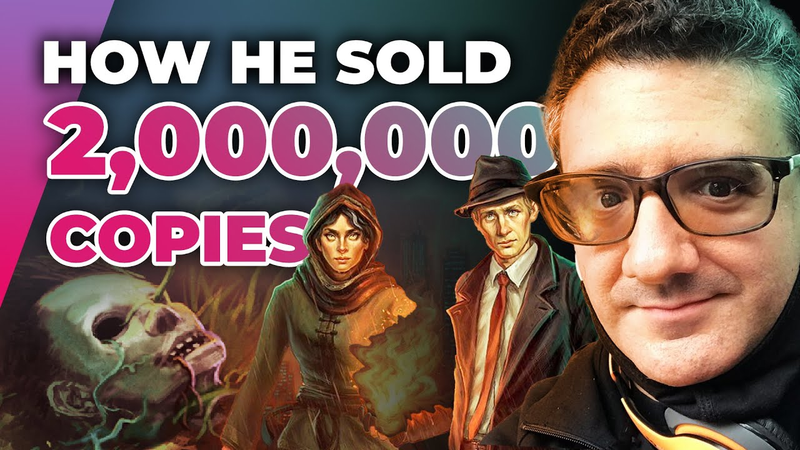
In this video, we're going to talk about why that crappy game you're working on might be worth way more than you think it is. And also, at the end of the video, I'm going to tell you my successful launch equation. It's going to determine if the game you're working on is going to be a successful launch. I am not saying that my games are wildly successful. In fact, these two games right here, this one and this one, they're not what I would call wildly successful. This one, I believe, is going to be because I think Twisted Tower, it's it's incredible. We're working on it right We're really excited about it. It's beautiful. It's our first big 3D game uh published by 3D Realms. But let's go ahead and check out the Steam page for my first game, Pinstripe. And maybe I can kind of prove my point here. The reviews are good. We've got a very positive score, but only about 1,744 reviews. Okay. And some of them aren't that great. But this right here, this number is what I look at often because I say, "Wow, only only about 2,000 people," and I'm rounding up here. I'm being generous. Only about 2,000 people reviewed this game. Yet, this game brought in over I think it's close
to $500,000 total. The same is true with Neverong. Okay, Neverong is actually less reviews. I think Neverong has somewhere around 800 reviews. So, how is Neverong supporting my family? How did how did we how were how were we paying our bills? Just because let's say your game doesn't go isn't wildly successful on Steam doesn't mean the game is not providing you income. Okay, believe it or not, we made way more money with Apple than we did with Steam for Neverong because we actually partnered with Apple. Um, this game is also on Xbox is on PlayStation. A lot of game developers paradigms are Steam, give me money from Steam, that's all they think about is Steam. when in reality it is a much larger I would say storm cloud dripping various drops of income and so stop thinking only about steam
okay start thinking about the broad picture and think about the long-term picture a lot of people only think well I need money for two months I want to make $100 when I launch the game no instead you should be thinking how how much money is this game going to make in three years in four years because most game develop velopers or I say game developer hobbyists meaning people who make games on the side. They have a target like this in their mind. They aim for the bullseye and they expect to hit smack dab in the center which is lots of money from game sales. That's their expectation. And so I expected the moment I was going to pull back that arrow, aim at the target, I would hit smack dab in the center. Well, the reality is this. I've never I've never hit the the bullseye. I have never hit the bullseye, guys. And when I think of lots of money, I think maybe two $3 million per game. I've never hit the bullseye. And so, a
lot of you are going to hit here. Okay, let's just pretend that this number is $10. You made $10 off your game. And so, what happens is you get really, really discouraged and you think that you're not cut out for it. This is not the the job for you. I mean, isn't it obvious? I mean, look at this. Of course, this isn't the job for you. You can't even hit the target. What's wrong with you? But of course, guys, this is normal. This is life. This is I mean, it's any career. You're going to miss the target entirely at the beginning. And so, I want to encourage you with some blunt words, which is don't be so immature to think that you're going to hit the target. Even the target, the target being making some money with your first game. You tell yourself, "I uniquely suck." And I put the word uniquely here. And guys, again, I'm talking to myself here. I used to talk this way to myself. What I mean here, what this phrase uniquely means, is that
you are different than everybody else. So maybe you won't make any money and then you'll get like five people who leave comments that just say, "This game is crap." Right? And honestly, guys, this is what I have to tell myself constantly, okay? When I'm feeling insecure, when I'm feeling like I really missed the mark with my games, it's a selfish way to think. And the reason it's selfish is because all these other hardworking game developers who are finally finally on their 10th game successful, it's almost like saying you deserve what they've got when in reality, you have not done nearly as much work as these successful game developers. Okay. A great example I can think of is Jay Armstrong, the creator of Colt of the Lamb. You do not get this level of notoriety by just randomly releasing a game. Look at this. 53,000 reviews. So Jay has been making games as long as I have, which is 16, 17 years. None of them were this successful by
far. That he finally knocked it out of the park and it took a lot of effort and a lot of hard work. This is my successful launch equation. This is like brilliant. This is like nuclear physics right here. L stands for failed launch divided by five. This equals one successful launch. Okay, so I mean honestly it's a silly equation. Um but it it helps me remember how infrequent a wildly successful launch is. Okay, and these are I'm just pulling these numbers out of my butt based on experience. But go ahead and write this down if you can, guys. How many fi how many failed launches do we need for one successful launch? Does anybody know how to do algebra? Five. That's right. Five. Um, I would say that it's not that you you spend two years making a game and you do that five times. That's 10 years. That's ridiculous. You need to be releasing small, tiny, crappy games. Okay? And you need to do
this as quick as possible. just knock out this equation as quick as you can. And I think that's a great way to think. We need to think of these as battle scars, okay? Um, another way to think of it as reps, guys. You know, you you you're not going to get big and strong like uh Uncle Thomas here without putting in some reps in the morning. Do you guys see a a a common theme here? Um, obviously it takes a while to make to release a great game. Um, but the common theme here is something was driving these people to continue to make games, right? Um, something drove me to continually release games. Let's count how many games I've released. Coma, Skinny, Geometry Wars, Flash, Flash, Geometry Wars. I I totally ripped off Geometry Wars. Um, Pans, Apples, Coma, Pinstripe, I'm working on Twisted Tower, and then three other mini games that I released last year. This is an interesting equation, though, because I don't even know if there's a threshold. Like once you hit five failed launches, then I think the equation changes to
just one launch equals a successful launch. Meaning you've learned how to successfully launch a game, then you can continually replicate that once you've accomplished this equation. I think that most successful game developers, I should have changed this text here. Most game successful game developers, this is what their target actually looks like. And I could say this is what mine looks like. Now notice it's not polarized. Notice it's not there's a ton of uh arrows all around and they totally miss the target and then there's like five that hit the center. Notice how it's spread evenly. What does this mean? It means that there's a variety of amounts of income. And when we talk about success, I'm talking about financial success. Okay, guys, that's what that's kind of our paradigm we're in right now. You'll notice that there's a variety of um ranges at which we've hit the target. And what does this mean? Well, this is just a bunch of different drips of income. Okay, three games that bring in income
in a variety of different ways every month. And it's like first of the month all the way to like the eighth. I'm getting different drips of income from my games. Sometimes it's a lot of money, sometimes it's very little money. Okay. But it's because of this spread here. Let's to ed take a look at Edmond McMillan, the creator of Super Meat Boy. This is not the full list. I just screenshotted something from Wikipedia. This is insanity. Look how many games this guy made. He's wildly successful now creating Binding of Isaac, Super Meat Boy. But look how much this man had to do to be successful. So again, our our the theme that I'm seeing in these developers is they just must have loved making games. Surprise, surprise. I'm going to give you a Disney answer here. You've got to fall in love with that dream if you're going to be successful.
Same is true with Jonathan Blow. Now, his career is a little different, right? Um instead of making a ton of games, he just worked a lot. Okay? He worked at a variety of different companies and his career is pretty broad. So you can see here all the way from 2000 to 2008, I'm sorry, to to 2005, he hadn't even made braid yet. He was working on a variety of other projects. You can see he worked as a contractor um for Oddworld, DSX, Thief. So he had to work on these games, these these games that weren't his before he became successful in his own game, which is Braid and then uh Witness. That's my advice for those of you who are like, I can't find time in my day. I don't want to hear it. Um because I had to do it. I had to do this just like the rest of you. Um, I was up sometimes 5:00 in the morning, sometimes 6:00 in the
Auto-generated captions from YouTube — names and numbers may be misheard.
Key insights
Distilling the key insights…
Ask AI about this video
Cite this video
Citation
Generating citation…























Comments