1 free read left. Create a free account for unlimited reading + AI research.
Create free account
Western & Japanese RPGs - II: Narrative vs. Expression - Extra Credits
Key insights
6 takeaways- 01Western RPGs are designed to place the player inside a story, prioritizing personal expression and the ability to inhabit a role through customization and choice.
- 02Western RPGs utilize systems such as morality choices and character customization to facilitate the player's desire to become a character they are not.
- 03JRPGs are structured to tell a specific story to the player, positioning the user as a director or puppet master guiding pre-defined protagonists.
- 04Both genres share a foundation in abnegation, which provides a low-effort way to de-stress through clear metrics of success like leveling systems and progress bars.
- 05The fundamental distinction between the two genres is rooted in the specific human desires they satisfy rather than their mechanical differences.
- 06The shared reliance on reward structures like grinding and growth metrics keeps both genres categorized together despite their differing psychological objectives.
Ask AI about this video
Transcript
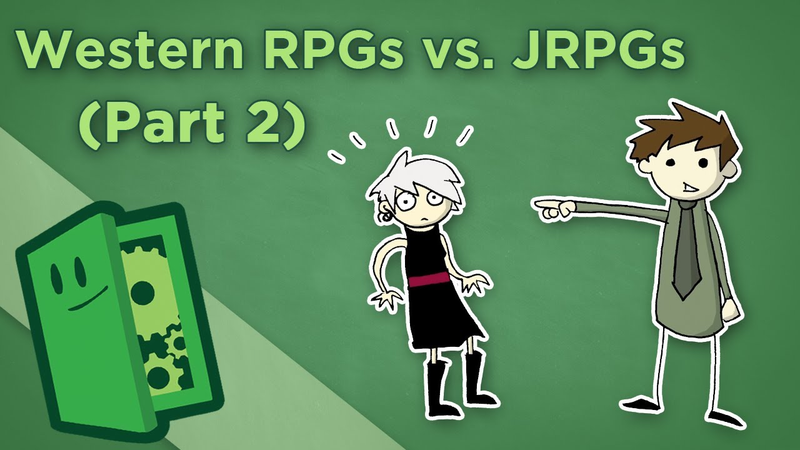
Hey, welcome back. We are going to continue our discussion on Western and Japanese RPGs this week. But first, you guys know Kathleen, right? One of the folks with LoadingReadyRun? She's the girl on Checkpoint. She also works on Feed Dump, Loading Time, Commodore Hustle, Failhouse, Things My Cat Hates. You do a lot of things. Anyway, apparently she still doesn't have enough to do, so she's doing guest art for us this week. Yay. So, last time we talked about how the RPG became popularized in both Japan and the United States independently of one another, leading to two very different takes on the genre, which we'll explore in more detail today. We also discussed how we talk about genres, principally how strange it is that we seem to popularly define video game genres by surface elements or camera angles, rather than by underlying emotions and human desires which the genres play to. When you pick up a romance novel as opposed to a comedy, you're fundamentally looking for different things. It doesn't matter if
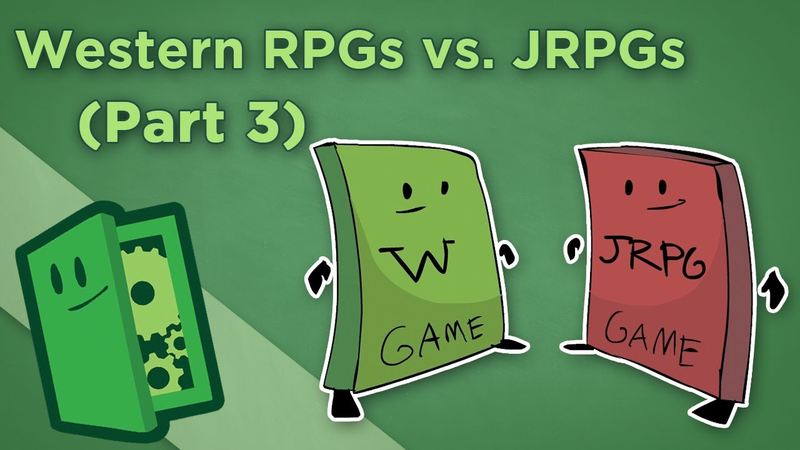
they have the same editing style or type of prose, you can still tell the difference. Similarly, we don't think of Battlefield 3 as an RPG even though it uses a leveling system in the multiplayer, and we don't think of Fallout 3 as an FPS even though you spend most of your time in it shooting in the first person. Why? Because it's the underlying reasons we play these games that define their genre, not the mechanics. So, with that in mind, let's get back to looking at JRPGs and Western RPGs. First, let's look at why JRPGs and Western RPGs are so clearly distinct. A lot of people might start by looking at the common differences between combat systems, but when you think about it, those aren't really the emotional core of why we play most of these games, so we'll save them for next week. What's the core engagement of the JRPG? Well, JRPGs tend to focus on narrative, the drama of the group. You ever notice how in JRPGs the protagonist isn't usually you? The protagonist is their own person with their own personality and desires and goals, while you, the player, are more of a puppet master, directing their actions and the actions of those they happen to be with. This division between player and main character allows the developer to tell a carefully crafted story and frees them from the constraint
of a single focused perspective. So, what about Western RPGs? Well, narrative can be a big part of their appeal, but most Western RPGs tend to focus more on the elements of fantasy and expression. Now, when I say fantasy, I'm not talking about orcs and elves or the story setting. I'm talking about when a game allows you to become something you're not. When you totally feel like a badass space marine or a heroic knight or a one-man army. When you step into a role and feel the fulfillment of becoming something you could never be. That's the element of fantasy. Notice how most Western RPGs make us the protagonist rather than simply operating one as we do in JRPGs. This is to help reinforce that sense of fantasy. It handicaps the narrative a bit and it takes some of the emphasis away from the interpersonal interactions between the ancillary characters just because it's harder to spend time focusing on how the non-primary characters relate to one another, but it really helps the player to become the role. So, that's fantasy. The other key element is expression. Expression is simply the ability to express who you are through the game. We often think of this in terms of dialogue choices and morality systems, but that's just the surface. Choosing your character class in an MMO, that's an expression of self. Thoroughly
customizing what gear you use either to create a play style that's your own or it simply to make your character look exactly the way you want. That's totally an expression of self. You'll find that this emphasis on personal expression is much more common in Western RPGs than in JRPGs. So, I guess the simplest way to put it is that JRPGs generally tell you a story while Western RPGs place you in a story. These are fundamentally different experiences. They're both equally valid and can be used to great effect, but they play to very distinct desires within us. We lump them all together under the RPG label, but we play them for entirely different reasons, which pretty much makes them two distinct genres. The reason these two genres evolved this way may in part be cultural. The divide between the emphasis on the group versus the emphasis on the individual, as well as the desire for clean storytelling as opposed to the much more messy focus on personal expression may be rooted in long-standing traditions in both of these originating nations, but it certainly doesn't mean that a JRPG can't come out of the United States or that a Western RPG can't come out of Japan. Again, these are just very poorly chosen names for two disparate genres. We should probably come up with something else to call them. And by we, I mean
somebody else, cuz I suck at coming up with names for this stuff. So, why do we conflate these at all? Well, they do share one common element, abnegation. Abnegation in media is the desire to use that media as a way to just check out, de-stress, or pass some time. You know those days when you come home and you're exhausted and you just want to curl up and watch a rerun of an old junk food TV show, or read a lame fantasy novel again or something, because it's easy and it doesn't require anything of you. Or maybe you look at your game collection and decide to pop in that favorite old RPG just to finish a quest or two. You got a great action game you're in the middle of, but right now it just feels like it would require too much effort, and you'd rather just grind a couple levels or something. That's the root desire known as abnegation. This is pretty much the common thread in all RPGs. All of these types of games give us easy checklists to tick off, or clear metrics for success, progress bars we can fill up, without requiring too much of us physically or mentally to do so. That's not to say there aren't some difficult RPGs out there, but even the most difficult ones still reward you for going back and finding something easy to grind, which is not true of many other game types. I mean, when was the last time you found yourself grinding in a platformer? Additionally, RPGs usually
offer us the opportunity to make something grow. There's some debate amongst professional designers about whether the desire to make something grow is really a core form of engagement by itself, but I'm kind of leaning toward yes on that one, and it seems worth mentioning either way. So, one aims to tell you a story, and the other invites you to live out a fantasy and express aspects of yourself in the world they've created. These genres are often grouped together because they share some of the same surface elements, as well as an ease of play combined with visible success metrics and rewards that allow us to tune out when we want. But, in the end, each type of RPG satisfies different fundamental desires. So, this leads us to the question most people are actually asking when they write in. Why are Western RPGs crushing JRPGs by most accounts these days? We'll try to answer that one next week. Thanks again to Kathleen for joining us. If you haven't already, go watch a couple episodes of Checkpoint and LoadingReadyRun. Well worth your time. See you next week.
Summary
The fundamental distinction between Western and Japanese role-playing games (RPGs) lies not in their mechanics, but in the underlying human desires they satisfy. While both genres are often conflated due to shared surface-level features, they represent distinct experiences. Japanese RPGs (JRPGs) prioritize narrative, focusing on the drama of a group and the development of pre-defined protagonists. In this structure, the player acts as a director or puppet master, guiding characters through a carefully crafted story.
Conversely, Western RPGs emphasize fantasy and personal expression. The core appeal of the Western model is the ability for the player to inhabit a role, becoming a character they are not, such as a heroic knight or space marine. This is supported by systems that allow for self-expression, including character customization, dialogue choices, and morality systems. Ultimately, JRPGs are designed to tell a story to the player, whereas Western RPGs are designed to place the player inside a story.
Despite these differences, both genres share a common foundation in abnegation—the desire to de-stress through low-effort engagement. RPGs provide this through clear metrics for success, such as leveling systems, progress bars, and the ability to grind, which offer a sense of growth and accomplishment without requiring intense mental or physical exertion. While cultural factors regarding group versus individual focus may have influenced the evolution of these genres, their shared reliance on these specific reward structures is what keeps them categorized together, even as they serve fundamentally different psychological needs.














Comments