1 free read left. Create a free account for unlimited reading + AI research.
Create free account
The Content Conundrum - Why So Many Games Feel Generic - Extra Credits
Key insights
6 takeaways- 01Prioritizing high-fidelity visual assets often forces developers to sacrifice the volume of unique items, abilities, and world-building elements, leading to smaller and less immersive game worlds.
- 02Procedural generation is frequently misused as a cost-saving shortcut, resulting in repetitive, bland experiences that lack the depth of human-designed lore.
- 03The obsession with perfect game balance often stifles variety; classic titles succeeded by offering a wide array of gear and possibilities rather than perfectly optimized, limited options.
- 04Developers can increase world depth by utilizing low-cost, high-impact methods like text-based descriptions and inventory icons, which leverage player imagination to fill in visual gaps.
- 05Modular animation systems, clever re-skinning, and thoughtful writing allow studios to expand game worlds without the prohibitive costs associated with AAA-standard visual assets.
- 06Content density acts as a form of fidelity, meaning a high volume of unique, hand-crafted elements is more effective at creating a lived-in world than high-end graphical polish.
Ask AI about this video
Transcript
Once upon a time, we built sprawling games with hundreds of items, scores of spells, and dozens of different monsters. But today, most games have kind of started to shy away from that, instead only providing a handful of each. Where did all of our Symphony of the Nights or our Baldur's Gates or our Daggerfalls go? They all vanished before the content conundrum. This video is brought to you by Cheddar. Check the description for a link to their YouTube channel. Whenever a game incorporates unique elements, it greatly adds to its richness and depth, giving the world a sense of history. They make it feel like this isn't just a place the designer created for a player, but rather a realm where others have lived, struggled, created, and built. Take the Souls series for instance. So much mythos is delivered through thoughtful, hand-crafted items, each of which a designer took time to give a name and make feel purposeful. Think about how different a Souls game would be if they used a Diablo-esque system for their
equipment, and every enemy could possibly drop a pointy stick of the rooster or a shiny shield of darkness, all with algorithmically generated stats. But the Souls series stands almost alone today in the amount of unique-feeling content it has. Why is this? Well, the answer is probably something many of you have already considered, but I wanted to dive into it with a little more depth, because the answer is cost. As games got shinier and more fancy, the cost of developing new top-tier content for games got ever more expensive. So the amount of unique content, and by content I just mean, you know, stuff in the world, went down. But how much did it have to go down by? Well, let's make a loose list of costs of adding new non-procedurally generated content into a game. This won't be accurate for all games, and it's just going to be an ordered list, but it'll serve for what we're trying to get at. So roughly, from most to least expensive, it probably goes: new zones, new characters including enemies, new abilities, assuming you need to create unique animations and lots of particle
effects, new items that show up on the character, especially if they require a new set of animations, abilities that have little to no animation or particle effects to go with them, and items that don't show up on the character. Now, for years the AAA space has focused on delivering those first four on the list to the most finely rendered, incredibly detailed degree it can. And this is great. There are a ton of games that genuinely benefit from all that pizzazz, but it does mean our games have had less and less stuff in them. We've had smaller land masses, less abilities, and fewer items to play with. But that's not the only option. The bottom two on that list, abilities that don't have a lot of flash and items that only appears an icon in your equipped screen, are orders of magnitude less expensive than the other things listed, which means that, especially for indie teams, there are ways to deliver on games that feel content-rich in a way that most AAA games just don't. But there are two things that seem to be getting in the way: procedural generation and concern that everything has to be balanced. The
procedural generation hang-up seems to have trickled down from the AAA space. Because content is so expensive to make in the AAA world, we've been trying to find all sorts of ways to automatically generate it. But the truth is that procedural generated content all feels bland, dull, and gamey unless you have an actual human being go back and take a pass at making it feel more alive. It's why most Diablo gear feels less meaningful than Souls gear. Actually, we may have to have an episode on that at some point. Zoe, write that down. But I digress. Good procedurally generated content is actually very hard to do. Even some AAA or well-funded double-A projects like Sea of Thieves and No Man's Sky have fallen into the trap of spending all their effort on really intricate procedural generation systems, figuring that if we build a procedural system, it'll build all the content for us. Yeah, up top. Who wants lunch? But once all that procedural dust settles, they're left with very little content at all. This can mean that indies have to
be even more conscientious about how much they rely on these systems and how much time they sink into them. That's not to say that they can't be great though, like Dwarf Fortress or Rogue Legacy, but you really have to know exactly what you're using them for and still allow yourself some time to hand tweak the results. Unfortunately of late, James has seen too many indies fall for this AAA procedural hype train. Because the AAA world talks about procedural generation and how it's going to save everyone a lot of time and money. But truth be told, most indies would probably be much better served just hand crafting 200 items for their games. The problem is this mythical thing called balance. People fear that if they put too much stuff into their game, it's going to make it feel unbalanced. And look, balance is great. It's something we should all strive for, but almost no games are truly perfectly balanced. When you look at something like a Souls game or Symphony of the Night, there's so much gear that you'll never wear into battle and so many weapons you'll never take a swing with
because they're just not that good. That's the point though, and them being there still adds to the game. And on the other side, Divinity 2 shipped with several game breaking combos and it was still a lot of people's game of the year. In some cases, because it had enough possibilities to create game breaking interactions. So, let's hop back on that list. What do you need to do if you want to make a modern Morrowind or a new take on an old school Fallout? First, the less expensive that you can make your art, the better. So, 2D if it fits your game or some simpler 3D. Next, remember the list. If an item only appears as a tiny image in your inventory and a set of stats on your character, that's okay. Because people have the ability to imagine those things. And when you do want to have items visibly show up in gameplay? Don't think every item needs the full AAA treatment to feel unique. If you use the same set of animations for most of your sword class items in order to avoid creating whole new sets of animations for every weapon, great. If you've got a
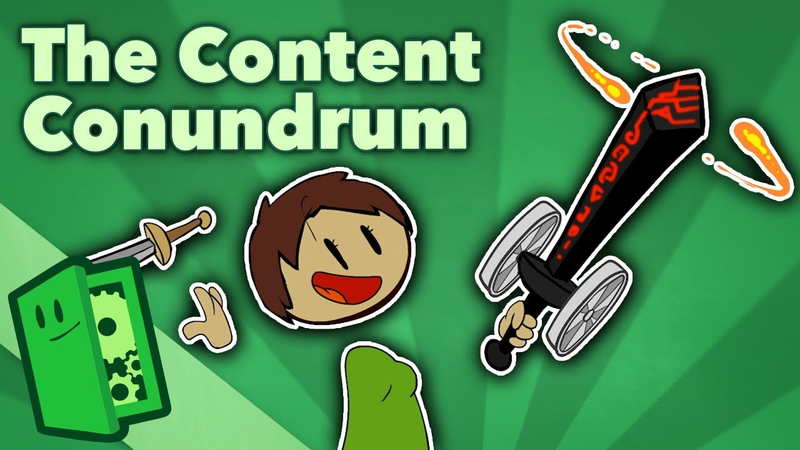
modular system where you can create 20 sword swings and then assign each sword type weapon five of them, all the better. That presents a huge array of different feeling weapons. And remember the power of re-skinning. If you take a regular old sword, make it black, put some glowing runes on the side, add a bunch of accoutrement like spinning rims, fire coming out of it, etc. Man, will it feel different to the player than just some long sword you recolored? Lastly, don't forget the power of writing. A few sentences about each game item will make your world feel holistic, lived in, and will do much more to make your truly special gear feel special than some of the things we do that would take 10 times as long to create. In the end, it's important to remember that the high-quality, low-content style of game creation that many modern AAA games strive for isn't bad. In fact, it's perfect for certain types of games. But other types of games, like Symphony of the Night or old-school classic CRPGs that require a lot of content to feel rich and alive, have become much less prevalent because of the cost of
content. But the beauty of these games is that they don't actually require the same level of visual fidelity as most modern AAA games do. In fact, in these games, content is fidelity because it's the content that makes the world seem real. It would be a shame to abandon these types of games simply because we've forgotten the tricks we used to use when we used to make them. Until next time. This episode was brought to you by Cheddar, a recently launched YouTube channel with videos that cover business, technology, media, and news, but without all the boring parts. One of their videos I just watched was about the birth of microtransactions, and to this day, I still can't believe it all started with that shiny, shiny horse armor. So, if that sounds right up your alley, subscribe to their channel and check out more of their stuff. Tell them Extra Credits sent you.
Summary
The modern gaming industry faces a content conundrum where the pursuit of high-fidelity visuals has led to a decline in the sheer volume of unique items, abilities, and world-building elements. While AAA studios prioritize high-cost assets like detailed animations and complex particle effects, this approach often results in smaller game worlds and fewer meaningful choices for players. The thesis posits that developers, particularly in the indie space, can create richer, more immersive experiences by prioritizing hand-crafted content over the over-reliance on procedural generation and the obsession with perfect game balance.
Procedural generation is frequently misused as a cost-saving shortcut, often resulting in bland, repetitive experiences that lack the depth of human-designed lore. Instead of chasing algorithmic variety, developers are encouraged to utilize lower-cost methods to expand their game worlds. This includes focusing on items that function through inventory icons and text-based descriptions, which allow players to use their imagination to fill in the gaps. By decoupling content from high-end visual fidelity, creators can implement modular animation systems, clever re-skinning, and thoughtful writing to provide a sense of history and purpose to their game worlds.
Ultimately, the pursuit of perfect balance should not come at the expense of variety. Many classic, highly regarded titles thrived precisely because they offered a vast array of gear and possibilities, even if some were not perfectly optimized. By shifting focus away from the AAA standard of high-fidelity, low-content design, developers can recapture the depth found in classic CRPGs and exploration-heavy titles. Content itself serves as a form of fidelity, and prioritizing a high volume of unique, hand-crafted elements is essential for building worlds that feel truly lived-in and alive.
























Comments