1 free read left. Create a free account for unlimited reading + AI research.
Create free account
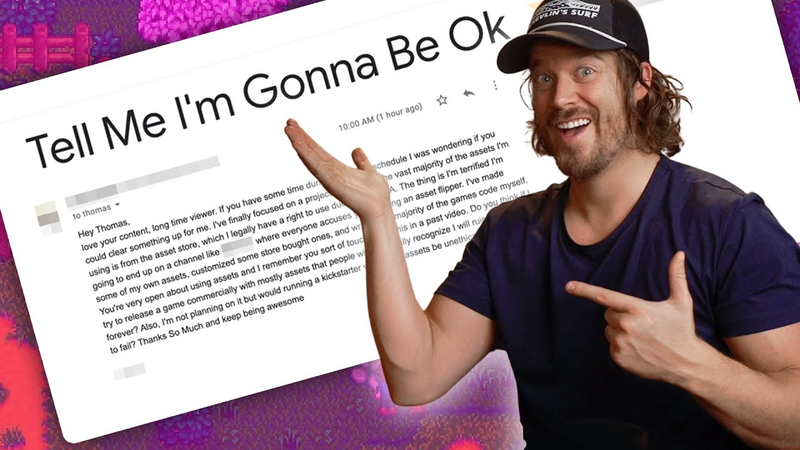
So I got this email from a game dev ("TELL ME I'M GOING TO BE OK")
Key insights
6 takeaways- 01Using legally acquired assets for commercial releases or crowdfunding campaigns like Kickstarter is standard, ethical industry practice.
- 02The stigma against 'asset flipping' is caused by a lack of visual and auditory cohesion rather than the use of store-bought assets themselves.
- 03The 'spotlight effect' causes developers to overestimate public scrutiny, as audiences are generally indifferent to asset origins if the final product is engaging.
- 04Developers should adopt specific art styles, such as stylized, low-fidelity, or pixelated aesthetics, to unify disparate assets into a singular, intentional look.
- 05Professional reputation is not defined by a single project failure, as the ability to pivot and improve after a poorly received title is a common narrative of career growth.
- 06Releasing imperfect games is a necessary part of the iterative process required to master game development and achieve long-term professional stability.
Ask AI about this video
Transcript
so i got an email with the subject line tell me i'm going to be okay one of my goals with this channel is to help you guys realize that you're going to be okay as a game developer you don't need to feel anxious or stressed out now before i open up this email and read the email to you i want to let you know that you can download my free 2d game kit below it's totally free use it for personal projects or commercial projects whenever you want into eternity i really don't care i just want to make things easier for you guys so feel free to click that link below and download that's my treat to you all right let's make this subscriber's life a little bit easier as well let's read this email and by the way i totally understand the tone and the feeling of this email because i've been there but i'm gonna be blunt here to hopefully get to the point make it easier for you guys to understand and this individual to understand and calm your nerves a little bit all right here's the email tell me i'm going to be okay hey thomas i love your content long time viewer i've finally focused on a project that i want to finish the vast majority of the assets i'm using are from the asset store which i legally have the right to
use the thing is i'm terrified i'm going to end up on a channel like blah this this channel i blurred out but it's basically a channel where they kind of crap on game developers where everyone accuses you of being an asset flipper i've made some of my own assets customized some store-bought ones and written the majority of the game's code myself you're very open to using assets and i remember you sort of touching on this in a past video do you think if i try to release a game commercially with mostly assets that people will eventually recognize them and i'm going to ruin my it's a little bit dramatic i've been here but this is a little bit dramatic will will these assets ruin my career forever also i'm not planning on it but would running a kickstarter with these assets be unethical and destined to fail um i'm sorry sorry to be joking about it i just know how this feels and and let's just get to the point here this is called the spotlight effect so basically what you're feeling here in this email is the spotlight effect which is
basically you think everybody cares about what you care about you think the world is watching you and they're really not the majority of the world is thinking about themselves okay most of the time most people are thinking about themselves not whether you're an asset flipper so that's my first point try this is something that i felt when i was starting my game career and as i've put myself out there in front of a camera every week and released games and been featured by you know the press and and featured on youtube channels with like jacksepticeye or pewdiepie the that that um that spotlight effect diminishes and sort of diffuses and suddenly you're like nobody cares and if they do care it like lasts for a day right so people don't really care about you like you think they do now here's when people do care and that's my second point here's when people do care about your game being an asset flip game it's not when they recognize an asset
pack that's not they don't care about that it's not a big deal what they care about is when you've thrown a bunch of assets together and it doesn't look cohesive looks like a mess so if and i do recommend all of you use assets but it just to save time we don't have million dollar budgets for our games so if you're going to use assets make sure you do it cohesively here's two ways to do that the first way is to make a toonie styled game a stylized game a good example of this is the first tree by my buddy david whaley and he uses an asset pack called stylized nature pack i'm going to use this for my game father as well it's a great asset pack it's awesome or you can make a game that's sort of crunchy and old school pixelated that's that's because you can compress down any texture you get let's say you have a bunch of high-res textures and one of them is toony and one of them's really really detailed and realistic if you compress those down and pixelate them inside of unity and then compress
down the sound effects as well in the music everything feels old school and feels feels cohesive in that way so that's just something to think about those are just two ways that you can make it make a asset flip game more cohesive the second thing i want to talk about is this whole question of legality that you've mentioned here first off you said let's see here you did mention that you have the right to use them via this eula agreement but you did mention here down will will running a kickstarter with these assets be unethical no no i mean that's not really something you should worry about because you're using them legally anyway so it's okay to launch a game on steam and similarly it's totally okay to launch a game on kickstarter because kickstarter all it really is is it's a it's kind of a pre-order platform that's really kind of what it is i mean a lot of people don't like that that's what i say but it really is if you look at the majority of the projects on there a lot of well
a lot of them already have a publisher so they're just basically pushing pre-orders all right so no it's not unethical as long as you you're downloading them from the unity asset store now my final point here i think this is really important and i kind of giggled about this i'm trying to be encouraging here so i apologize if i'm a little callous i just i've been here you said will this ruin my career forever there's a lot of things that you think will ruin your career as a game developer so for me one of the things i thought would really ruin my career is if i released an indie game and with a publisher and it didn't recoup what they paid for it so let's say they put a hundred thousand dollars into the game to help me finish it and then it didn't bring back a hundred thousand dollars in my head at the time and by the way that didn't happen but that was a fear i had in my head i was like if this if i don't recoup what they paid i'm never going to be able to work with a publisher again because the current publisher i'm working with will spread that news that i don't make games that bring back value right
that's that's just an unnecessary fear it's not true making projects that fail is part of making projects and becoming successful you see this a lot with game video film studios what they'll do is they'll make 10 movies that are crap and they'll hope that one succeeds right so a lot of directors we wonder why are these directors making so many movies that suck and they keep getting work or why do these video game companies keep releasing crappy games but they keep getting enough funding to do it again and again and again well that's because it's kind of like a shotgun approach these studios whether film studios or video game studios they release like 10 games and they just hope that one succeeds and they keep doing it over and over and over again working with the same people now this is this isn't to say that eventually you do kind of lose credibility but you really shouldn't be worried especially if you're young i'm going to assume you're young here because most of my students and most of my subscribers are
young in your head you think one project one bad project is gonna destine you for failure and ruin your career forever if you're not failing if you assume that all you're gonna do is succeed that's going to ruin your career you have to fail to have a successful career okay failure is part of having a successful career so let's say you do release an asset flip game and it's incohesive and it's it looks like crap and it sucks let's say you release bear simulator like let's see let's say you were the dev who did that which by the way you know i'm not a huge fan of crapping on that developer at all but i know that that game really hurt his reputation let's say you do that so what move on like you'll be okay i guarantee you if the bear simulator developer released a good game now everyone would be so thrilled it would probably get a ton of press so in a way it's a it's an asset to to have
released a bad game and then turn it around and make a good game so you really shouldn't be worried about that well i hope i sort of calmed your nerves a little bit take that spotlight that harsh hot spotlight that's projected onto your ego right now all of you and try and just imagine diffusing it and and and maybe you pump a fog machine onto the stage and it just diffuses a little bit people aren't i know that's a weird metaphor people don't care they don't care about you they don't care about your project like you do all right it's just a game so let's relax have fun make crappy games because in the end making crappy games ultimately leads to making great games all right guys be sure to download that free 2d game kit below it's my treat to you that's going to make life a lot easier for you guys if you're making a 2d game and if that's not interesting to you i do have a webinar below as well which talks about how to turn a demo or a prototype into six figures how to also launch a kickstarter
campaign and also build an army on social media that supports your work now and into the future so click those two links below if you're interested in you know helping calm those nerves and making things easier for you i want to do that for you guys it's my treat to you i will talk to you later peace or no what do i end with cheers
Summary
The primary concern addressed is the anxiety surrounding the use of pre-made assets in commercial game development and the fear of being labeled an asset flipper. The central thesis is that developers often suffer from the spotlight effect, an irrational belief that the public is hyper-focused on their work and will judge them harshly for using store-bought assets. In reality, the audience is largely indifferent to the origin of assets, provided the final product is cohesive and engaging.
The analysis emphasizes that the stigma associated with asset flipping stems not from the use of store-bought content itself, but from a lack of visual and auditory cohesion. To mitigate this, developers are encouraged to adopt specific art styles—such as stylized or low-fidelity, pixelated aesthetics—that unify disparate assets into a singular, intentional look. Furthermore, the use of legally acquired assets for commercial releases or crowdfunding campaigns like Kickstarter is deemed entirely ethical and standard industry practice.
Regarding career longevity, the discussion highlights that the fear of a single project failure ruining a professional reputation is largely unfounded. Drawing parallels to the film and gaming industries, the analysis notes that failure is a necessary component of long-term success. Even if a developer releases a poorly received title, the ability to pivot and produce a high-quality project subsequently can actually serve as a narrative of growth. Ultimately, the advice encourages developers to embrace the iterative process, acknowledging that releasing imperfect games is a vital step toward mastering the craft and achieving professional stability.























Comments