1 free read left. Create a free account for unlimited reading + AI research.
Create free account
Saving the World with Games - Citizen Science and More - Extra Credits
Key insights
6 takeaways- 01Large-scale crowdsourcing through games can mobilize massive participant bases, exemplified by EyeWire engaging 250,000 players to map complex neural circuits.
- 02Games like Play to Cure: Genes in Space demonstrate the efficacy of integrating scientific data analysis into engaging gameplay mechanics, such as using space-themed shooters to process cancer research microarray data.
- 03Applications like SuperBetter incorporate cognitive behavioral therapy principles into game design to support patient recovery and physical rehabilitation.
- 04Professional medical training is being transformed by platforms like Level Ex and Night Shift, which allow surgeons to refine their skills and reduce diagnostic errors in simulated environments.
- 05The United Nations’ Block by Block initiative has utilized Minecraft across 35 countries to facilitate community-led urban planning and identify local safety concerns.
- 06Gamified citizen science projects leverage human pattern recognition to solve complex research problems faster than traditional algorithms, such as when 57,000 Foldit players deciphered an AIDS-related enzyme structure in three weeks after a decade of scientific stagnation.
Ask AI about this video
Transcript
In many games today, it's our job as the player to gather our gear, throw on a brave face, and challenge the forces of evil threatening the game's world. But, instead of battling the icon of sin in Doom Eternal or Animal Crossing's eternal capitalist Tom Nook, whom I'm totally going to pay back soon, promise, what if there were some real-life evils that we could help defeat while we played? Well, it turns out there are. So today, we wanted to showcase some opportunities for gamers to make a difference in just that way. Thanks so much to Great Courses Plus for sponsoring this episode. Want to learn how to see their amazing lectures for free? Stay tuned until after the episode. Before we begin our exploration of games that can do real-world good, it's important to mention an idea called citizen or crowdsourced science. That's when research is conducted entirely by or with significant contributions by non-professional scientists. And one of the most famous examples of this is SETI@home. Even though it wasn't a game, the project allowed the general public
to contribute to the search for intelligent life beyond our Earth simply by running its software on home computers connected to the World Wide Web. SETI@home went live on May 17th, 1999, and has been running for 21 years, only recently ending distribution of new work to users to concentrate on processing the data they've compiled after all that time. And while intelligent interstellar life has yet to be discovered, the project itself inspired the imaginations of over 5 million users, which brings us to the rise of citizen science games. One great example is Play to Cure: Genes in Space, a game from Cancer Research UK, released in 2014. The game allowed players to help scientists looking for cancer-causing genes hiding in gigabytes of data. And that data was preserved as spots on slides called microarrays, where each spot contained a gene or a known DNA sequence. However, computers were taking too long to analyze it, and it turns out the human eye is faster. Okay, but how did they get thousands of non-scientist gamers to track the peaks and valleys of a microarray by dodging asteroids in a rogue-like shooter set in
outer space. For real, when players mapped a course in the game for their spaceship, they were actually scanning microarray data for faults that are the telltale signs of cancer. And after the success of Genes in Space, Cancer Research UK went on to several more games to analyze breast, bladder, and lung cancer samples. And there are quite a few other games continuing this citizen science endeavor, including EyeWire, where 250,000 players become heroes of neuroscience and solve 3D puzzles to map neuron branches and complete reconstructions of cells and ultimately entire circuits of the brain. Phylo, that's helping to decipher our DNA and identify new genes. And then there's a game called Eterna, which is a game that allows its top players to create their own RNA designs that are brought to life at Stanford University School of Medicine. You know, I think I've seen this movie. In fact, medicine is an especially promising area for games and game developers. And game designer Jane McGonigal found this out up close and personal. In 2009, she was diagnosed with a concussion so severe the pain persisted for weeks and left
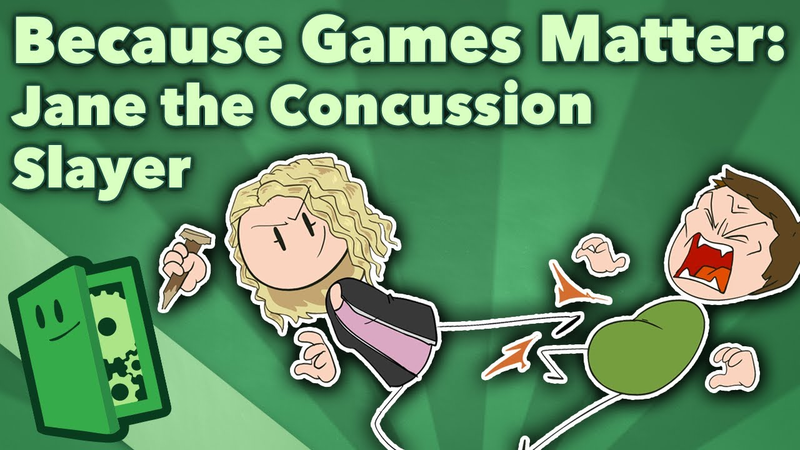
her feeling suicidal. So she designed a game originally titled Jane the Concussion Slayer. While it didn't stop the pain, it did help relieve some of her anxiety and depression about her condition. And the game itself draws from cognitive behavioral therapy as the players battle mobs. And then in 2012, the game was redesigned as a phone app under the new moniker Super Better. McGonigal had a very personal reason for designing her game. She's just one of many examples of a growing movement to make games that do more than simply teach a subject. Rather, to make games that directly develop their players' powers. For instance, a company called Level X is helping doctors level up at a variety of skills through training their muscle memory in complex tasks of their field. It's kind of like in Super Smash Brothers where the more you practice, the better you'll get at the required movement and timing. And though their naming conventions aren't exactly uninspiring with titles like Gastro EX, Airway EX, and you get the idea. But, their heart's definitely in the right place, even if that place is called Cardio EX. Another approach in assisting
a different side of medical training can be found in a title called Night Shift from Shell Games. It's a story-driven adventure game with characters players will care about, specifically aimed at helping train ER doctors to reduce errors. Game players are also benefiting in other ways thanks to some high-tech wizardry. The mixed reality game Skyfarer was designed in 2017 at USC by a big team led by Marianna Goetzis with Christina Leelan as the manager for its usability study. Skyfarer helps keep wheelchair-bound patients with spinal cord injuries on track with their physical therapy by turning normal boring repetitive exercises into fun adventures like canoeing down a virtual river. And a new team of students are currently working on a quite timely version for everyone locked up at home during the pandemic. We also can't count out the good that some commercial games have brought into the world when adapted to address real-life situations. The game Super Monkey Ball, with its twisting turning gameplay, is cited as dramatically improving doctors' laparoscopic techniques. And then there's good old Minecraft. Back in 2012
again, the United Nations began a program called Block by Block that used Minecraft to get residents involved with the planning of their public spaces to best suit them. Funded by the sales of Microsoft merchandise, it's continued to provide local populations with Minecraft to help with similar projects all over the world. Block by Block is currently being used in 35 countries, everywhere from Kirtipur, Kathmandu to Le Cayes, Haiti to help work through a myriad of community design problems, such as in 2017 in Hanoi, Vietnam when young girls used Minecraft to identify badly lit areas where walking was dangerous. But, let's end today with possibly the most famous of the citizen science games to date, Foldit. The objective of the game is to fold the structures of selected proteins, the highest scoring attempts of which are analyzed by medical experts and used to attack real diseases. A 2010 paper in the scientific journal Nature credited Foldit's then 57,000 players with results that outperformed algorithmically calculated solutions. And their most famous success was in
2011 when their gamers helped unlock the structure of an AIDS-related enzyme, a problem that had stumped scientists for a decade that the Foldit players accomplished in 3 weeks. As you can see, there are quite a few games out there designed to do some real good in the real world. But our planet is in no short supply of evils to fight. So during this time of social distancing and self-isolating, maybe try your hand at some of these crowdsourced science games. We'll leave a list of the ones we talked about in this episode in the description below. And if you're looking for a crowdsourced science game to help out with our most recent health crisis, Foldit is a great place to start. As their 240,000 users are still folding away, many of whom focus on COVID-19. Remember, our favorite pastime isn't just fun and games. Sometimes the games we play can be fun and do some real good. See you next week, everyone. Once again, thanks so much to our sponsor for this episode, Great Courses Plus, an on-demand video resource for learning featuring lectures and courses from the world's top professors and experts from National Geographic, The
Smithsonian, and more. And with topics spanning science, cooking, history, photography, literature, or even how to play chess, you're sure to find something you're psyched about. Actually, because I was feeling nostalgic for extra sci-fi, I just checked out the course How Great Science Fiction Works. It's a deep dive into the mechanics of what makes sci-fi last in the cultural consciousness and why the genre keeps us coming back again and again. You know, besides the sandworms and space wizards. And right now, you can try Great Courses Plus for free and check out their library of over 11,000 video lectures on your desktop, tablet, or phone, wherever you learn best. Just head to the greatcoursesplus.com/extracredits and check it out for yourself. Legendary thanks to our patrons Ahmed Ziad Turk, Alicia Bramble, Casey Musgraves, Dominic Valenciana, Gunner Clovis, Kyle Murgatroyd, El Mamoun Chikhaoui, and Orioles 1.
Summary
Games serve as powerful tools for citizen science and real-world problem-solving, moving beyond entertainment to facilitate tangible contributions to medicine, urban planning, and physical therapy. By leveraging crowdsourced intelligence, these initiatives allow non-professional participants to assist in complex research tasks that often exceed the speed or efficiency of traditional computational algorithms.
Key examples of this impact include Foldit, where 57,000 players successfully deciphered the structure of an AIDS-related enzyme in three weeks—a task that had previously stumped scientists for a decade. Similarly, Play to Cure: Genes in Space utilized a space-themed shooter to crowdsource the analysis of microarray data for cancer research, while EyeWire engaged 250,000 players in mapping neural circuits. These projects demonstrate that gamified tasks can effectively harness human pattern recognition to advance scientific discovery.
Beyond research, games are increasingly integrated into professional training and healthcare. Level Ex and Night Shift provide medical professionals with platforms to refine surgical skills and reduce diagnostic errors, while applications like SuperBetter utilize cognitive behavioral therapy principles to aid patient recovery. Furthermore, the United Nations’ Block by Block initiative has utilized Minecraft across 35 countries to empower local communities in urban planning, allowing residents to identify and address safety concerns in public spaces. These diverse applications illustrate that the gaming medium possesses significant utility in addressing global challenges, ranging from disease research and physical rehabilitation to community development and professional medical training.















Comments