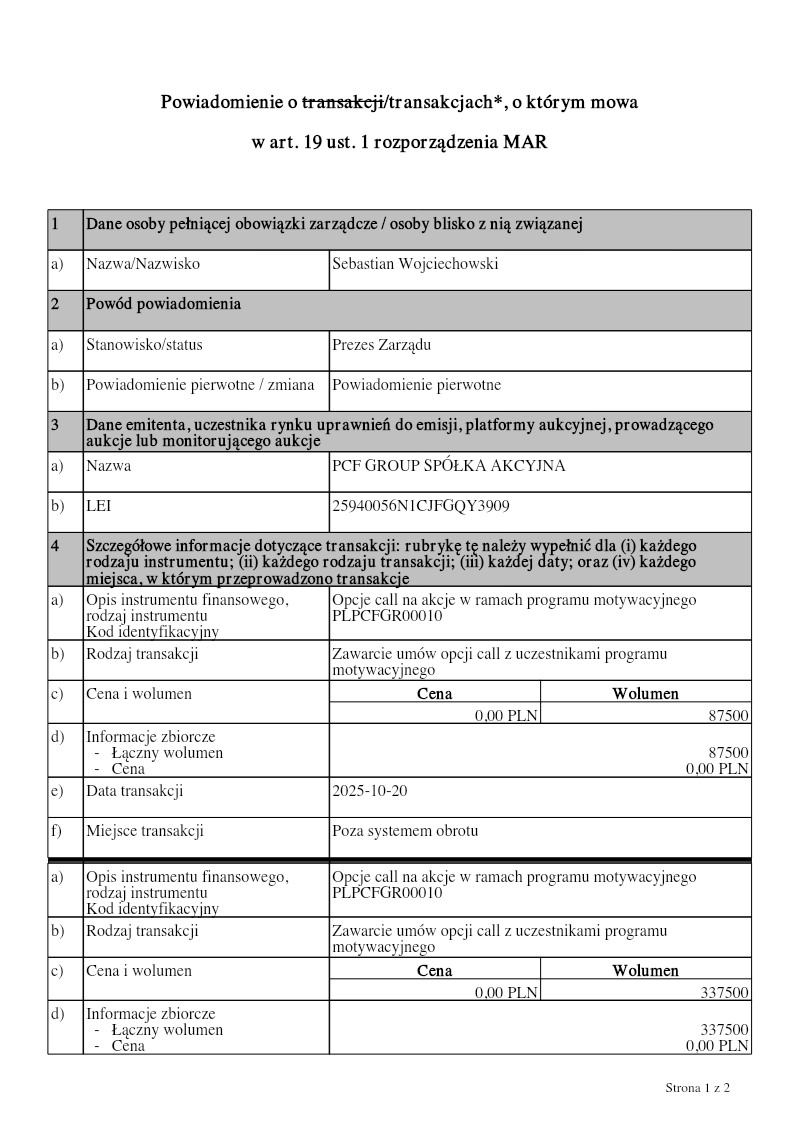
Updated Mar 23, 2026 by PCF Group
Report
Published by PCF Group
The document announces that Krafton, Inc. has entered into an investment agreement to acquire shares of PCF Group S.A. under a capital increase authorized by the extraordinary general meeting, allowing up to 5 853 941 new ordinary shares of series F at a nominal value of PLN 0.02 each. The agreement obligates Krafton to purchase shares representing 10 % of the company’s capital and voting rights at an issue price of PLN 40.20 per share, with the company guaranteeing allocation upon fulfillment of Krafton’s subscription commitment. The investment contract grants Krafton rights of first negotiation and first refusal on future projects such as Project Victoria or Project Bifrost if released outside a self‑publishing model, and includes anti‑dilution, tag‑along, and drag‑along provisions. Both parties have executed lock‑up agreements lasting until 28 March 2024 and standard representations, warranties, and indemnity clauses. The agreement is governed by Polish law, has a ten‑year term with automatic renewal provisions, and allows Krafton to terminate under specific circumstances such as cancellation of the offer or failure to meet subscription deadlines; no penalties are stipulated. The report, prepared under EU Regulation MAR, is strictly informational and restricted to qualified investors within the European Economic Area, excluding public distribution in jurisdictions such as the United States, Canada, Australia, Japan, and South Africa. It contains forward‑looking statements subject to risks and uncertainties, and disclaims any investment recommendation or guarantee.
PEOPLE CAN FLY Raport bieżący nr 12/2023 Data sporządzenia: 28 marca 2023 r. Temat: Zawarcie umowy inwestycyjnej dotyczącej objęcia przez Krafton, Inc. akcji w podwyższonym kapitale zakładowym PCF Group S.A. Podstawa prawna: Art. 17 ust. 1 Rozporządzenia MAR Treść raportu: NINIEJSZY RAPORT BIEŻĄCY I ZAWARTE W NIM INFORMACJE PODLEGAJĄ OGRANICZENIOM I NIE SĄ PRZEZNACZONE DO PUBLIKACJI, OGŁOSZENIA, DYSTRYBUCJI LUB PRZESŁANIA, BEZPOŚREDNIO ANI POŚREDNIO, W CAŁOŚCI ANI W JAKIEJKOLWIEK CZĘŚCI, NA TERYTORIUM STANÓW ZJEDNOCZONYCH AMERYKI, AUSTRALII, KANADY, REPUBLIKI POŁUDNIOWEJ AFRYKI, JAPONII ANI INNYCH KRAJÓW, GDZIE PUBLIKACJA, OGŁOSZENIE, DYSTRYBUCJA LUB PRZESŁANIE BYŁOBY NIEZGODNE Z PRAWEM. PONADTO, NINIEJSZY RAPORT BI EŻĄCY SŁUŻY WYŁĄCZNIE CELOM INFORMACYJNYM I W ŻADNEJ JURYSDYKCJI NIE STANOWI OFERTY PAPIERÓW WARTOŚCIOWYCH. PROSIMY O ZAPOZNANIE SIĘ Z WAŻNYMI INFORMACJAMI ZAMIESZCZONYMI NA KOŃCU NINIEJSZEGO RAPORTU BIEŻĄCEGO. Działając na podstawie art. 17 ust. 1 Rozporządzenia Parlamentu Europejskiego i Rady (UE) nr 596/2014 z dnia 16 kwietnia 2014 r. ( „Rozporządzenie MAR”) Zarząd spółki PCF Group S.A. ( „Spółka”) niniejszym informuje, że w wyniku negocjacji zmierzających do zawarcia umowy inwestycyjnej dotyczącej objęcia przez Krafton , Inc.
t. 17 ust. 1 Rozporządzenia Parlamentu Europejskiego i Rady (UE) nr 596/2014 z dnia 16 kwietnia 2014 r. ( „Rozporządzenie MAR”) Zarząd spółki PCF Group S.A. ( „Spółka”) niniejszym informuje, że w wyniku negocjacji zmierzających do zawarcia umowy inwestycyjnej dotyczącej objęcia przez Krafton , Inc. („Inwestor”) akcji Spółki, które zostaną wyemitowane na podstawie uchwały nr 4/02/2023 Nadzwyczajnego Walnego Zgromadzenia S półki w sprawie podwyższenia kapitału zakładowego Spółki o kwotę nie większą niż 117.078,82 PLN w drodze emisji nie więcej niż 5.853.941 akcji zwykłych na okaziciela serii F o wartości nominalnej 0,02 PLN każda („Oferta”), informacja o których została przekazana do publicznej wiadomości raportem bieżącym nr 11/2023 z dnia 28 marca 2023 r., w dniu 28 marca 2023 r. pomiędzy Spółką, kluczowym akcjonariuszem Spółki i Prezesem Zarządu Spółki Sebastianem Wojciechowskim („ Kluczowy Akcjonariusz ”) a Inwestorem została zawarta umowa inwestycyjna dotycząca warunków objęcia przez Inwestora akcji serii F oraz innych praw i obowiązków umownych każdej ze stron w związku z inwestycją, w tym obowiązków informacyjnych Spółki wobec Inwestora („Umowa Inwestycyjna”).
Zgodnie z Umową Inwestycyjną w terminie określonym w Umowie Inwestycyjnej Inwestor zobowiązał się do objęcia takiej liczby akcji serii F (w zaokrągleniu do najbliższej liczby całkowitej), która po zakończeniu Oferty będzie reprezentować 10.00% kapitału zakładowego Spółki i głosów na Walnym Zgromadzeniu Spółki („Akcje Oferowane”) po cenie emisyjnej 40,20 PLN za każdą Akcję Oferowaną, niezależnie od liczby akcji serii F objętych przez inwestorów uczestniczących w Ofercie oraz ceny emisyjnej akcji serii F dla pozostałych inwestorów uczestniczących w Ofercie. Pod warunkiem wykonania przez Inwestora zobowiązania do złożenia zapisu, Spółka zagwarantowała Inwestorowi przydział Akcji Oferowanych w ramach Oferty. Akcje Oferowane zostaną objęte przez Inwestora za wkład pieniężny. Zgodnie z Umową Inwestycyjną, jeżeli Spółka będzie rozważać wydanie Projektu Victoria lub Projektu Bifrost w modelu innym niż self-publishing, Inwestor będzie miał prawo do pierwszeństwa w negocjacjach ( right of first negotiation) , jak również prawo do pierwszeństwa zawarcia umowy (right of first refusal) w odniesieniu do wszelkich takich umów.
rozważać wydanie Projektu Victoria lub Projektu Bifrost w modelu innym niż self-publishing, Inwestor będzie miał prawo do pierwszeństwa w negocjacjach ( right of first negotiation) , jak również prawo do pierwszeństwa zawarcia umowy (right of first refusal) w odniesieniu do wszelkich takich umów. Ponadto, Kluczowy Akcjonariusz przyznał Inwestorowi prawo przeciwdziałające rozwodnieniu, prawo pierwszeństwa nabycia akcji oraz prawo przyłączenia ( tag-along right) (które odpowiada prawu pociągnięcia ( drag-along right ) przy sługującemu Kluczowemu Akcjonariuszowi). Zarówno Inwestor, jak i Kluczowy Akcjonariusz złożyli standardowe deklaracje lock -up dotyczące ich pakietów akcji w Spółce, które będą obowiązywać do 28 marca 2024 r. Strony złożyły także zwyczajowe oświadczenia i zapewnienia oraz ustaliły umowne zasady odpowiedzialności każdej ze Stron z tytułu ewentualnego naruszenia postanowień Umowy Inwestycyjnej. Umowa Inwestycyjna została zawarta na czas określony 10 lat ze zwyczajowymi postanowieniami o automatycznym jej rozwiązaniu. Inwestor może rozwiązać Umowę Inwestycyjną w określonych okolicznościach, w szczególności w przypadku odwołania Oferty przez Spółkę lub jej niezrealizowania w terminie 10 dni roboczych od dnia publikacji śródrocznego skonsolidowanego sprawozdania f inansowego Spółki za pierwszy kwartał 2023 r. Umowa nie przewiduje żadnych kar umownych. Umowa podlega prawu polskiemu. WAŻNE INFORMACJE
i w przypadku odwołania Oferty przez Spółkę lub jej niezrealizowania w terminie 10 dni roboczych od dnia publikacji śródrocznego skonsolidowanego sprawozdania f inansowego Spółki za pierwszy kwartał 2023 r. Umowa nie przewiduje żadnych kar umownych. Umowa podlega prawu polskiemu. WAŻNE INFORMACJE Niniejszy raport bieżący został sporządzony zgodnie z art. 17.1 Rozporządzenia Parlamentu Europejskiego i Rady (UE) nr 596/2014 z dnia 16 kwietnia 2014 r. w sprawie nadużyć na rynku (rozporządzenie w sprawie nadużyć na rynku) oraz uchylającego dyrektywę 2003/6/WE Parlamentu Europejskiego i Rady i dyrektywy Komisji 2003/124/WE, 2003/125/WE i 2004/72/WE oraz art. 56 ust. 1 pkt 2 ustawy zdnia 29 lipca 2005 r. o ofercie publicznej i warunkach wprowadzania instrumentów finansowych do zorganizowanego systemu obrotu oraz o spółkach publicznych. Niniejszy raport bieżący służy wyłącznie celom informacyjnym. Spółka publikuje go wyłącznie w celu przekazania istotnych informacji dotyczących warunków oferty jej akcji. Niniejszy raport bieżący nie służy w żaden sposób, bezpośrednio ani pośrednio, promowaniu oferty, zapisów lub zakupu akcji Spółki, o których mowa w niniejszym raporcie bieżącym („ Akcje Nowej Emisji ”) i nie stanowi reklamy, ani materiału promocyjnego przygotowanego lub publikowanego przez Spółkę dla potrzeb promocji Akcji Nowej Emisji, ich subskrypcji, zakupu lub oferty, ani wcelu zachęcenia inwestorów, bezpośrednio czy pośrednio, do nabycia lub objęcia Akcji Nowej Emisji.
Akcje Nowej Emisji ”) i nie stanowi reklamy, ani materiału promocyjnego przygotowanego lub publikowanego przez Spółkę dla potrzeb promocji Akcji Nowej Emisji, ich subskrypcji, zakupu lub oferty, ani wcelu zachęcenia inwestorów, bezpośrednio czy pośrednio, do nabycia lub objęcia Akcji Nowej Emisji. Spółka nie
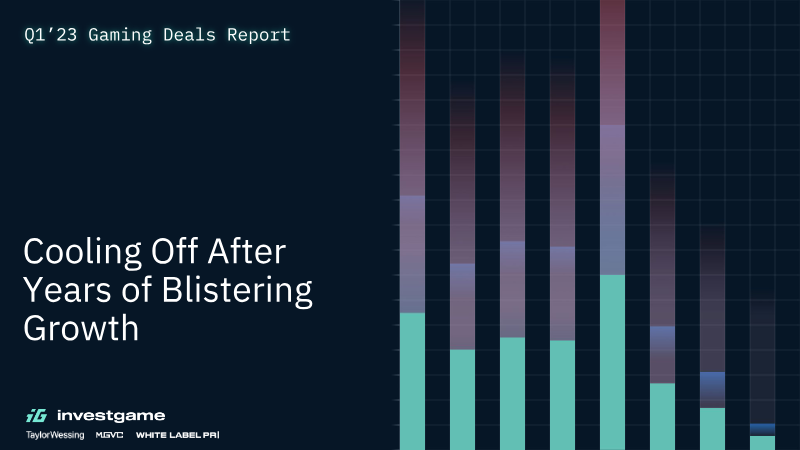
The global gaming industry experienced a notable resurgence in early 2025, characterized by a rebound in merger and acquisition activity and sustained interest in private financing. During the first quarter, 48 announced acquisitions reached a total value of $4.4 billion, anchored by the significant $3.5 billion acquisition of Niantic’s games division by Scopely. Simultaneously, the private placement market remained active, recording 149 deals worth $3.5 billion. These investments were primarily concentrated in mobile-focused developers and companies integrating artificial intelligence into their entertainment platforms, with major strategic entities like Savvy Games Group and Tencent continuing to drive market momentum. Despite this activity, the financial landscape remains bifurcated. While the broader sector shows signs of recovery, with the Drake Star Gaming Index posting a 16.37% gain, performance remains highly volatile across the top 35 public gaming companies. Valuation disparities are particularly pronounced; industry leaders such as NVIDIA and AppLovin command premium revenue multiples, while many other firms face a more challenging environment. Furthermore, while early-stage funding remains accessible, later-stage financing continues to present significant hurdles for companies seeking capital. Looking forward, the industry is positioned for a gradual increase in consolidation as public markets stabilize. Strategic focus is shifting toward the integration of AI and advanced technological platforms, which are expected to serve as primary catalysts for future growth. As market conditions improve, the sector is likely to see a renewed pipeline of initial public offerings, signaling a transition toward a more mature and diversified investment climate for global gaming stakeholders.
The gaming industry is currently navigating a period of strategic stabilization defined by cautious capital deployment and a pivot toward long-term profitability. High interest rates and broader macroeconomic pressures have dampened late-stage financing and public listing activity, leading investors to prioritize capital efficiency over aggressive expansion. Despite these headwinds, the ecosystem remains supported by a robust foundation of over $15 billion in dry powder held across more than 65 gaming-focused funds, which continues to fuel a healthy pipeline of early-stage seed investments. Market performance is increasingly bifurcated across platforms. The PC and console sectors demonstrate notable resilience, bolstered by the consistent success of independent studios and sustained engagement on digital storefronts like Steam. In contrast, the mobile gaming market is undergoing a necessary contraction following post-pandemic volatility and the persistent impact of privacy-related advertising headwinds. While mobile startups currently face significant barriers to entry and a decline in late-stage venture interest, the sector is expected to initiate a gradual recovery by 2025 as business models adjust to the new regulatory and acquisition landscape. Looking ahead, the industry is transitioning away from the speculative growth patterns of previous years toward a more disciplined investment environment. Syndicate-based funding has emerged as a primary mechanism for risk mitigation, reflecting a broader trend of collaborative investment. As the market stabilizes, expectations are shifting toward an uptick in midcap merger and acquisition activity throughout the remainder of the year. This evolution underscores a fundamental industry-wide commitment to sustainable growth, with investors increasingly favoring established platforms and proven development teams over high-risk, late-stage ventures.
Huuuge, Inc. experienced a period of financial contraction and strategic realignment during the first nine months of 2024. Total revenue fell to $189.1 million, a 10.9% year-over-year decline driven primarily by a shrinking social casino market and a deliberate 21.5% reduction in user acquisition spending. This downturn was reflected in key performance indicators, as Daily Active Users and Daily Paying Users decreased by 13.8% and 19.0% respectively. Consequently, net profit for the period dropped to $46.9 million from $62.8 million in the previous year, while Adjusted EBITDA fell 22.6% to $62.3 million. Despite the decline in top-line growth, the company successfully optimized its distribution channels and capital structure. Revenue from direct-to-consumer platforms nearly doubled to $20.4 million, now accounting for 10.8% of total revenue. This shift helped mitigate platform-related costs and supported a robust Adjusted EBITDA margin of 35.5%. Furthermore, the company executed a significant $70 million share buyback program, retiring approximately 7.14 million shares. Even after this substantial capital outlay, liquidity remains strong with $125 million in cash and cash equivalents as of September 30, 2024. The company’s portfolio remains heavily concentrated, with core franchises Huuuge Casino and Billionaire Casino generating 98% of total revenue. To diversify its offerings, strategic investments were made in Bananaz Studios and Empire Games via Simple Agreements for Future Equity. While facing legal contingencies—including a $1.7 million settlement provision and ongoing "unlawful gambling" litigation in the United States—management maintains that these issues, along with geopolitical risks in Israel, have not materially impacted operations. The overall outlook emphasizes a transition toward high-margin direct-to-consumer sales and disciplined cost management amid a challenging broader market for social casino gaming.
The third quarter of 2024 marks a period of stabilization for the global gaming industry, signaling a transition from post-pandemic volatility toward a new, normalized market environment. The industry has moved past the extreme fluctuations of the COVID-19 era, with capital deployment for private investments settling at approximately $1 billion across 120 rounds. While public markets remain under pressure, the quarter saw the first initial public offering in two years, suggesting a cautious but potential thaw in public listing activity. Key findings reveal a strategic shift in investor focus, as capital increasingly flows toward platform and technology sectors rather than traditional gaming content. This trend is evidenced by a sharp uptick in private investments for infrastructure, payment, and development tools. Within the gaming segment, early-stage venture capital remains consistent, while late-stage fundraising continues to face significant headwinds. Corporate venture capital has emerged as a vital component of the ecosystem, frequently co-investing with traditional venture firms to support studios and tech providers. Geographically, North America and Western Europe remain the primary hubs for investment activity, though the mobile market continues to rely heavily on Asian developers for new top-performing releases. Steam sales data reflects a divergence in performance, with AA and indie publishers driving a 35% year-over-year growth in gross revenue, while AAA titles have experienced stagnation. The analysis relies on tracking closed transactions within the video game industry, excluding pure gambling, betting, and non-gaming blockchain entities. By monitoring deal types—including control and minority mergers and acquisitions, venture capital rounds, and public offerings—the data provides a comprehensive view of capital flows. The findings emphasize that while the gaming sector faces ongoing challenges in late-stage funding, the broader ecosystem is finding stability through diversified investment in gaming-adjacent technologies and a resilient indie development scene.