1 free read left. Create a free account for unlimited reading + AI research.
Create free account
PIXEL ART is EASIER than I thought! (Lord Of The Rings game art)
Key insights
6 takeaways- 01Hue shifting is a critical technique for establishing specific seasonal moods and environmental storytelling within the constraints of a limited pixel art palette.
- 02Successful 2D pixel art adaptation relies on an iterative 'guess and check' workflow that balances technical experimentation with deep fidelity to the source material's architectural and cultural motifs.
- 03Atmospheric depth and lighting are achieved through specific technical strategies, including the use of dithering for light simulation and the layering of silhouettes to create perspective.
- 04Authenticity in fantasy world-building is best achieved by replacing generic aesthetic choices with researched, specific cultural markers like Elvish runes and architectural flourishes.
- 05Foreground development serves as a primary tool for creating visual depth, ensuring that complex cinematic scenes are effectively translated into a retro gaming aesthetic.
- 06Maintaining a small-scale thumbnail view throughout the design process is essential to ensure that character proportions and environmental forms remain readable at low resolutions.
Ask AI about this video
Transcript
If you're going to make anything Lord of the Rings, like uh in my case, a Super Nintendo version of Rivendell with pixel art. If you're going to do anything like that, you better treat it with some respect. Kind of like Peter Jackson did. So hopefully by the end of this video, if you stick around, hopefully you'll see that I tried my best to treat Rivendell with some respect. So, as you can see here, I've kind of taken colors from actual illustrations of Rivendell and I've just placed them onto my canvas. And as we come towards the camera here, like all of my other artwork, we start with a very light sort of brownish yellow and we come towards the camera and we get more and more saturated. In this case, we're becoming more and more blue. Although with this piece of art, it's a little bit different because honestly, the left side of the canvas, I want it to be a little bit darker blue and the right side of the canvas, I wanted it to be brighter. The thing about Rivendella is it looks almost like it's emitting light
from a source. Basically, where the waterfalls are here, I wanted it to feel like an invisible light bulb in the center there. So, it's really challenging actually to accomplish this. One of the best ways that you could accomplish this is have silhouettes. So, in my case, I've got silhouettes of these spires sort of coming up out of the fog here. And I'm even trying a little bit of a dithering effect here. I grabbed a Google image of some dithering spheres. And I just sort of stamped them around all over the place here. And I'm using it to create some dithering for some bushes. And that's allowing the silhouettes in the left side of the screen. And then also the dithering on the right side of the screen here. That allows for that that light source coming from the waterfalls. Here, I'm adding some highlights and shadows to try and create some layering here and also some glows of the windows just to make it feel more like Rivendell, the houses and the buildings you see in the film. So, when I'm working on 2D art, I don't really know what I'm making. I'm referencing some images on Google. I'm not copying really anything. I'm just sort of guessing and checking. And I
think this is sort of a muscle that you build in your brain as you're working on 2D art, whether it's pixel art or vector art and even 3D art. You just sort of practice for years and what happens is subconsciously your hand knows what it's doing and in my case I'm just using a simple mouse right here. Your hand knows what it's doing but your brain doesn't really know what it's doing. It's just sort of a guess and check process and eventually you'll figure out what your world looks like. Right now while I was working on this I didn't really have an idea of what this world looked like. You can see I'm just sort of throwing shapes around and playing with things and trying to get an idea of okay, what does Rivendell look like in a 2D space? So, you can see here that I'm just slowly starting to add motifs of the Elvish culture. And I just Googled Elvish motifs, Lord of the Rings, and I found all these different shapes here.
And slowly things start feeling more and more Elvish. It's really about the flourishes. That's really what makes it look like Lord of the Rings. [music] And we're going to see towards the end of this video how everything becomes more and more Elvish. Right now it looks like a village that you might see honestly where I live which is near the Blue Ridge Mountains. So that was kind of bothering me. So towards the end of this video, you're going to see that I really started focusing more on the Elvish culture. Now I'm just slowly adding highlights and shadows. And you can see I've even done some hue shifts on the layers. I've hue shifted the ground and added a couple of orange leaves here to make it feel a little bit more like it's [music] September or October. And even added some very subtle sun shafts in the background there, making it feel like there's fog and mist interacting with the sunlight. As I mentioned in pretty much every
single one of my time-lapse videos, when I'm making 2D art, I always recommend that you do not forget about the foreground. The foreground is really what's going to make your illustration pop. What's really cool about this illustration is it looks like we've got the foreground completed here, but what I'm going to show you is there's a lot more room to move towards the camera. Don't ever think that you're done moving towards the camera because there's always room to move towards the camera. That was all background elements. So here I am working on the ground that the player can walk on. And this is specifically where I started focusing on, okay, if I want to make this actually Riendell, if I want to be respectful to the Rivendell culture mentioned in the book and created by J.R.R. Tolken, what do I do? I simply Google searched Elvish House Lord of the Rings and got this illustration here or this rendering and I started mimicking a lot of the flourishes you might see in
the arches. [music] I also created some brick here. I was really proud of this brick. Brick is really tough. It's all about highlights and low lightss and and being smart with that geometry. Then I also added some Elvis runes that I Googled and I created one Elvish rune for this pillar and you'll see just in a bit that I have another Elvish rune that I'm going to add to another pillar. So these are actual Elvis runes. Not sure what they mean, but hey, figured I'd add them to the pillars here. This was one of my favorite things to do. It's totally okay to trace some Google images. Why not, guys? Because this is just fan art. But more importantly, I wanted to stay true to the film because honestly, I feel like you should respect the film as much as the books. So, I just took some flourishes from the actual [music] film. And I just placed those all around the scene, cleaned them up a little bit to create fences and also some supporting beams below the
stairs. Now, I'm not going to lie, this was a really painful process. This isn't really my cup of tea. I'm not a very specific kind of illustrator. Most of my videos I brag about how quick I get things done. [music] And what I'm learning lately, especially I'm learning this from my modeler, Filipe. He's working on my game father for me. He's a 3D modeler. He is so intentional about [music] era. He's intentional about architecture and he wants things to feel like they have a place and they have a purpose and he takes his time. I really respect that. So, I wanted to try that in this video here. Try and be very, very intentional with the culture of the illustration. Especially when you're making a Lord of the Rings game into a 2D game. you really should be respecting it. Had a little bit of liberty here to be honest and just created some cool little lamp posts here with some bugs flying around them. And this is where things got a little bit tricky. You could see that I'm going to spend a lot of time guessing and
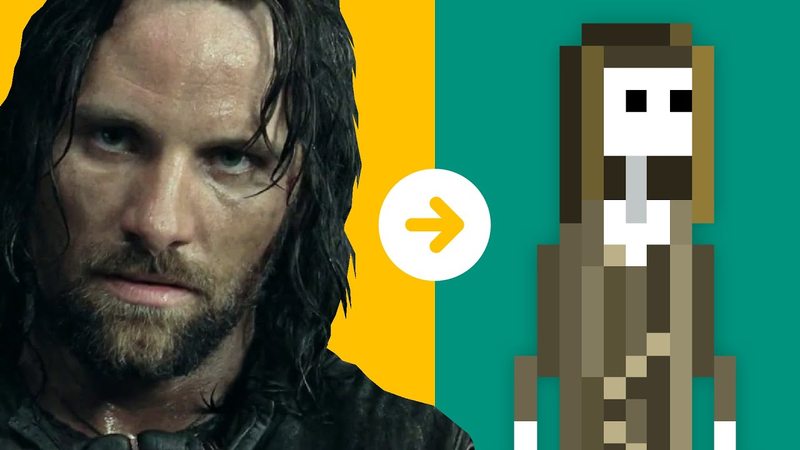
checking on this protagonist. This is Aragorn. [music] And Aragorn is going to be hanging out with Arwin. This is actually one of my favorite scenes from the Fellowship of the Ring. As you can see, I don't really know what I'm doing here, but I'm just guessing and checking. One of the tricks, especially with protagonist, but this is relevant for 2D art [music] in general. One of the tricks is if you have a second monitor, I highly recommend you have a second monitor, but if you have a second monitor, have a tiny little thumbnail of your illustration, a duplicate of it on the right side of your screen. You can actually do this in Photoshop so that you can watch yourself drawing, but at a smaller scale. It's really going to help you understand the shapes and the forms. [music] And that's how I got the characters looking well pretty decent here. They look like they have weight. They look like they're actually standing. And now Arwin is holding Aragorn's hand. And there's little heart butterflies. And this is the final result. [music]
So again, just to just to reiterate, we've got the runes that are directly from Gerard Tolken. We've got the gazebo of Elron's Council over there in the background. We've got the waterfalls of Rivendell. We have the flourishes that are pulled directly from the film in the fencing and the posts. And then obviously Arwin and Aragorn. Obviously, you got to take a little bit of liberty when you're creating 2D characters because you don't have a lot of room to work with. But he's wearing his tunic. He's holding his sword. And more importantly, he's holding Arwin's hand. All right, guys. I'm really proud of this one. I actually enjoyed this a lot. Took a long time. I hope you enjoyed it. Be sure to comment below. Leave a like.
Summary
The creation of 2D pixel art environments requires a balance between technical experimentation and thematic fidelity to source material. The primary objective is to demonstrate the process of adapting complex, established fantasy settings—specifically the Lord of the Rings location of Rivendell—into a stylized, Super Nintendo-inspired pixel art format. The central thesis posits that successful world-building in 2D art relies on an iterative process of trial and error, combined with a deep, intentional respect for the architectural and cultural motifs of the original intellectual property.
The methodology emphasizes a "guess and check" workflow, where the artist utilizes reference imagery from films and illustrations to inform shape, color, and lighting. Key technical strategies include the use of dithering to simulate light sources and depth, the layering of silhouettes to create atmospheric perspective, and the strategic use of hue shifting to establish seasonal moods. The process also highlights the importance of foreground development to create visual depth, as well as the utility of maintaining a small-scale thumbnail view to ensure character proportions and forms remain readable.
The final output integrates specific cultural markers, such as Elvish runes and architectural flourishes, to ground the scene in its source material. By shifting from a generic village aesthetic to one defined by specific, researched motifs, the artist achieves a more authentic representation. The conclusion underscores that while 2D pixel art is constrained by limited resolution, intentionality in design—such as focusing on character weight and environmental storytelling—allows for a respectful and effective translation of complex cinematic scenes into a retro gaming aesthetic.






















Comments