1 free read left. Create a free account for unlimited reading + AI research.
Create free account
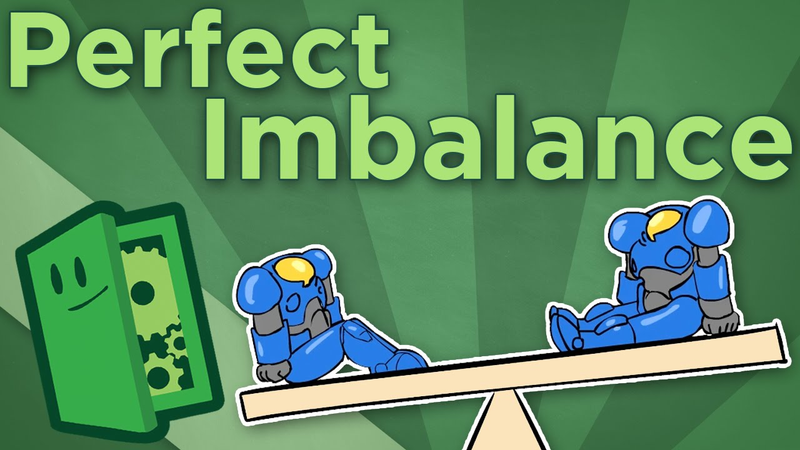
Perfect Imbalance - Why Unbalanced Design Creates Balanced Play - Extra Credits
Key insights
6 takeaways- 01A large pool of diverse options is essential for players to discover emergent solutions to current meta-game threats.
- 02Perfect imbalance prevents games from becoming 'solved' systems by replacing rote memorization with a dynamic, self-correcting meta-game.
- 03Designers should limit power deviations to a 10 to 15 percent range above a mathematical baseline to ensure variety without creating broken, game-ruining elements.
- 04To maintain balance, every character or strategy must have a clear weakness, ensuring no single option can excel at every task.
- 05Intentional, subtle deviations from numerical parity encourage creative experimentation and keep play accessible across different skill levels.
- 06Cyclical imbalance drives player engagement by creating a natural feedback loop where dominant strategies attract counters, which then shift the meta-game.
Ask AI about this video
Transcript
Welcome to the 100th episode of Extra Credits. Before we begin, it is my great pleasure to welcome back Miss Leili Scaldaferri, both as today's artist and as Extra Credits official newest team member. She and Allison will be trading art duties each week, and we couldn't be happier having her on board. So, here we go. A few weeks back, we did an episode on power creep, but in the middle of it we touched on another balance concept that we thought we'd expand on a bit today. The concept of perfect imbalance. So, what is this perfect imbalance of which I speak? Well, fundamentally, it's the idea in game design that you don't always want things to be perfectly balanced. In fact, in most games, you actually want to make sure that there are some imbalances in your system. Not great big haphazard ones, mind you, but carefully crafted subtle ones. You see, many games are actually made far more engaging by just a little bit of imbalance, multiplayer games especially. Now, that probably sounds odd. It's a little counter-intuitive and contrary to what most of us believe, and yet it's
very true. Let me illustrate this with a counter-example. Let's examine chess, often considered the archetypical balanced game. Chess is symmetrical, so by definition, it's balanced. And with the exception of some ancillary rules surrounding tournament rankings, no one's really patched it in a few hundred years. Now, chess is a great game, indubitably, and wouldn't be the game it was if it wasn't so well balanced. But, it does suffer from the standard problems that perfectly balanced games build up, namely that a collection of fixed strategies end up getting established over time. If you've only played casual games of chess at home, it's great. There's thousands of interesting strategies to discover and try out, and your tactics will evolve over the course of a match. But, if you've gone a step further and really looked at taking your game to the next level, you'll find that there's a lot of rote work to do. There are a great number of established strategies and play sequences that you have to memorize before you get to a high enough level of play that you're really experimenting with anything new again, or are once again able to start crafting your own strategies. The set of canonical strategies has built up to such a point that one can spend years, if not decades of one's life studying chess without really getting to create new plays or
develop your own stratagems. Some of you may be familiar with this effect in the original StarCraft as well. When StarCraft came closest to numerical balance, the game changed from a strategy game to an action one. The best possible plays were quickly calculated, and the game came down to who could execute on those strategies the most efficiently. For most players, this changed the game to one of click time and micro, rather than a strategic experience. In fact, like with chess, once you got past the beginner level of play, only the best players in the world could really develop new play styles or create new strategies. Now, this isn't to say that a click time or a micro game is bad or anything, but in both of these cases, these games could be a lot more engaging if deep strategic play wasn't as relegated to the casual or world-class ends of the spectrum. So, now that we've gone over why perfect balance can create a stayed play environment and may actually restrict the number of interesting decisions a player has, let's go back to the concept of perfect imbalance. And to do so, let's talk about League of Legends some more. League of Legends is probably one of the games that uses this concept most effectively. You see, the beautiful thing about imbalance is that it creates a meta game, an evolving state of play that keeps any one play style from being
definitively correct, which in turn allows the players to experiment with different approaches to the game, and gives players an interesting and evolving problem to think about. This allows players at all play levels to be continuously changing their strategies and growing, which in the end means that rather than having a brick wall of rote memorization or reflex skill to overcome before really getting to participate in the strategic or experimental side of the game, players can grow naturally, coming up with strategies that fit their skill level, and then abandoning them as their skills develop and allow them to accomplish a new feat, or rethinking their play style as they rank up enough to start encountering players who know how to counter their current tactics, which brings us to the most important caveat about perfect imbalance. Perfect imbalance isn't haphazard. Game elements aren't wildly out of scope with one another. Rather, there are carefully crafted imbalances built into the system. It's the difference between broken versus out of balance. In most of these cases, the designers will have a mathematical formula for what a reasonably balanced version of the game will look like. The guys at Wizards of the Coast used to call their version the Jedi curve, which was a literal chart of what mana in to power out for each color would look like on a monster with no
abilities, with a set of multipliers listed at the bottom for each of the basic abilities. They then allowed game elements to deviate from this curve by 10 or 15% creating a game around the game of trying to figure the system out. Part of the fun of playing is trying to figure out how to get an edge in a nearly but not perfectly balanced system. The second part of perfect imbalance is what James calls cyclical imbalance. And this is where League of Legends excels. Cyclical imbalance is where a game element, let's call it champion A, is a little better than average. So, a large number of players start using that game element, champion, because they realize that the champion is slightly deviating from the Jedi curve in the positive direction. This in turn gets a lot of players thinking about how to counter that champion. And so, even though champion A is better than average, players figure out that he has weaknesses against champion B. And this gets a lot of players to start playing champion B, which makes champion A suddenly seem weak in the current meta game, the evolving state of play we talked about earlier, which means there's a sudden drop-off in the number of players playing champion A. And now, all of those players are busy looking for a counter for the now dominant champion B, which ends up leading them
to finding champion C, and the cycle continues. This sort of cyclical imbalance creates an interesting and engaging meta game environment that keeps the game from ever feeling stale and keeps players from ever feeling like they've mastered the game and there's nothing left to do. Of course, in a game like League of Legends, it also helps them to monetize their game, but I can't really begrudge them that. They're one of the few studios out there doing free-to-play in a way that's a win for everybody involved. Now, we're almost out of time, but real quick, here are some tips for creating this sort of cyclical imbalance. First, you have to create a game where, no matter how skilled the player is, their character or deck or avatar can't be great at everything. Second, you need to have a firm knowledge of how your pieces interact and what beats what on an intuitive and mathematical level. Finally, as with Magic the Gathering, Ultima Online, and League of Legends, you need to give your players a wide enough pool of options that they they find an answer to whatever you're going to throw at them. Without it having to be one specific predetermined answer you have planned. Hey, I never said creating this kind of balance was easy. So, the next time you see players crying in a forum for some game element to get nerfed, wait a few weeks and see what happens. Did the development team actually have to go in and change things
in a patch? Or have the players moved on and started demanding a different element be nerfed? If it's the latter, you've probably just seen a case of perfect imbalance taking its course. If it's the former, well, the players were probably right and something really was broken. Unless, of course, like with StarCraft, it's a case of the developer attempting to imbalance a perfectly balanced game. Thanks for watching and here's to another 100 episodes. See you next time.
Summary
The concept of perfect imbalance posits that game design benefits from intentional, subtle deviations from strict numerical parity. While traditional game theory often prioritizes perfect symmetry—such as in chess—this approach can lead to stagnant environments where high-level play is defined by rote memorization of established strategies rather than creative experimentation. By contrast, carefully crafted imbalances encourage an evolving meta-game that keeps play fresh and accessible across various skill levels.
The core mechanism of this design philosophy is cyclical imbalance. When a specific character or strategy is slightly stronger than the baseline, it naturally attracts a larger player base. This dominance prompts the community to identify and adopt specific counters, which in turn shifts the meta-game and renders the previously dominant strategy less effective. This continuous, player-driven cycle prevents any single tactic from becoming the definitive solution, ensuring that the game remains an ongoing puzzle rather than a solved system.
To implement this effectively, designers must avoid creating "broken" elements by maintaining a mathematical baseline, such as a power-to-cost curve, and allowing deviations of only 10 to 15 percent. Successful execution requires that no single character or avatar can excel at every task, ensuring that every strength has a corresponding weakness. Furthermore, developers must provide a sufficiently large pool of options so that players can discover diverse, emergent solutions to current threats. Ultimately, this approach transforms the player experience from one of mastering a static set of rules into one of navigating a dynamic, self-correcting ecosystem where strategic adaptation is the primary driver of engagement.






















Comments