Updated Apr 30, 2026 by Konami Holdings Corporation
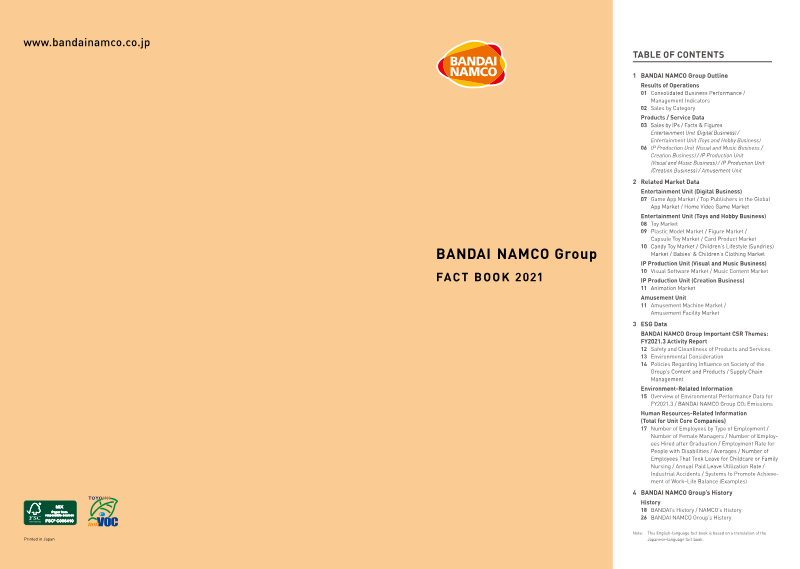
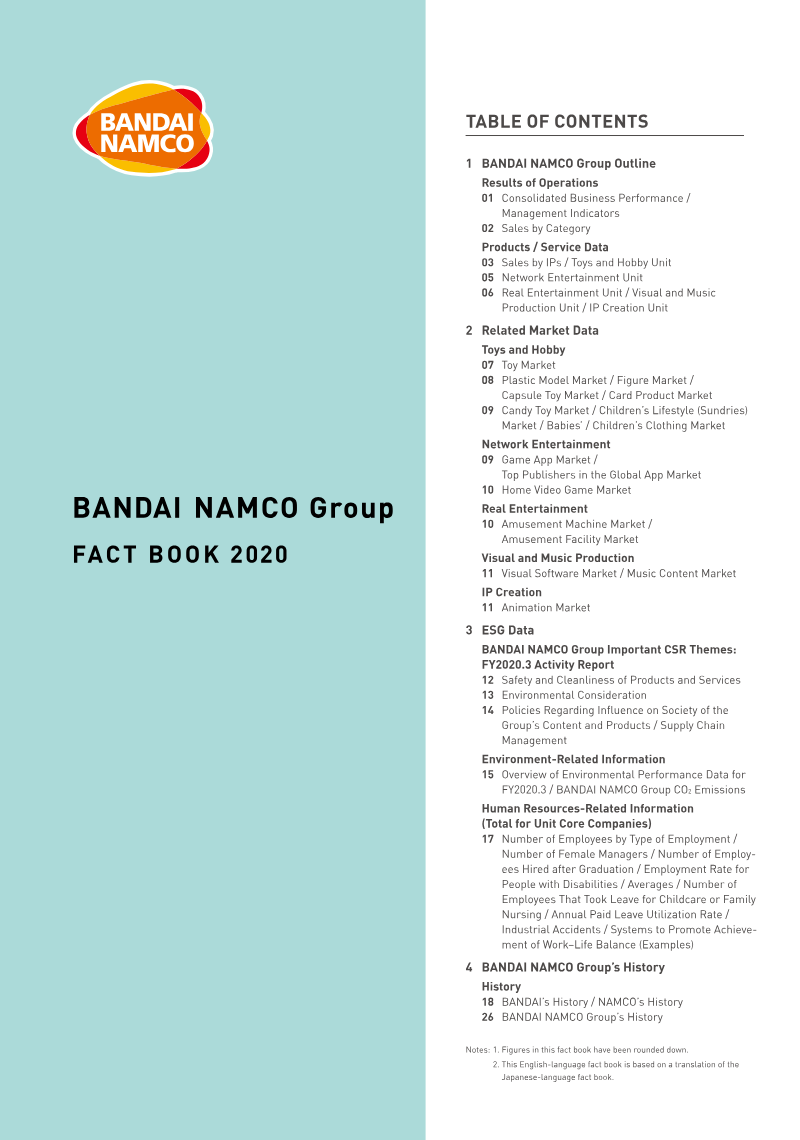
The 2021 Fact Book presents a comprehensive overview of Bandai Namco Holdings’ strategic direction, emphasizing its transformation into a globally integrated entertainment conglomerate and its commitment to corporate social responsibility. Central to the narrative is the thesis that sustained growth across toys, video games, animation and amusement can be achieved through diversified product portfolios, expansive international operations, and proactive sustainability initiatives. The company’s evolution is traced from a collection of independent toy, arcade‑machine and media firms to a unified group after the 2005‑2007 merger of Bandai and Namco. Key milestones include the launch of flagship lines such as Gundam models (over 500 million units shipped), Tamagotchi (exceeding 20 million units), and Zatchbell Battle (300 million units), as well as the development of major video‑game franchises—TEKKEN, DARK SOULS III and Tales—collectively surpassing 50 million sales. International expansion is evident through subsidiaries and regional headquarters in North America, Europe and Asia, reinforced by repeated listings on the Tokyo Stock Exchange and industry recognitions such as Cannes Best Actor and TSE awards. Environmental and social performance data for fiscal year 2021 highlight a suite of CSR actions, including CO₂ reduction targets, supply‑chain safety measures and work‑life‑balance programmes, all framed within the “NEXT STAGE” mid‑term plan aimed at deepening engagement with a mature fan base and broadening cross‑media offerings. The Fact Book thus underscores Bandai Namco’s dual focus on market leadership and sustainable corporate practices across a worldwide footprint and multiple entertainment segments.
Bandai Namco’s 2017 integrated report presents a comprehensive account of the company’s financial, strategic, and governance performance, emphasizing the central role of its “IP‑axis” strategy in achieving record results. By leveraging core intellectual properties across games, toys, visual media, and music, the group generated ¥620.1 billion in net sales and ¥63.2 billion in operating profit, a 27.7 % year‑on‑year increase, while free‑cash flow rose 47.7 %. The Network Entertainment segment contributed 57.9 % of sales and 63.8 % of profit, with flagship franchises such as Mobile Suit Gundam (¥74 billion) and Dragon Ball (¥61 billion) underpinning cross‑media expansion and overseas growth in Asia, Europe, and the Americas. Strategic outlook is framed by the newly launched three‑year “NEXT STAGE” plan, which targets global IP expansion, regional autonomy, and continued innovation to meet mid‑term objectives a year ahead of schedule. Governance is reinforced through a ten‑member board—including three independent directors—and an audit‑supervisory board meeting Japanese Corporate Governance Code standards. A robust compliance and risk‑management framework, performance‑linked director compensation, and extensive investor‑relations activities underscore the company’s commitment to transparency and stakeholder trust. Corporate‑social‑responsibility initiatives achieved a 27 % reduction in CO₂ emissions since FY2012 and introduced universal‑design products and supplier audits. Financially, profit attributable to owners reached ¥44.2 billion, EPS rose to ¥201, and dividends of ¥15.4 billion were declared. Acquisitions such as
The 2015 annual report presents Bandai Namco’s strategic blueprint to become the world’s leading innovator in entertainment, anchored by an IP‑centric growth model and a three‑year “NEXT STAGE” mid‑term plan. The narrative links the company’s 2005 integration anniversary to a renewed “IP‑axis” strategy that drives product development, cross‑SBU collaboration, and geographic expansion, especially across Asia. Financial results for fiscal 2015 show consolidated net sales of ¥565.5 billion, up 11.4 % year‑on‑year, with operating income rising 26.1 % to ¥56.3 billion and an operating margin of 10 %. Net income surged 50 % to ¥37.6 billion, lifting ROE to 13.2 % and ROA to 14.0 %. Operating cash flow reached ¥50.1 billion, expanding cash‑and‑cash‑equivalents to ¥153.8 billion, and a record dividend of ¥62 per share was declared. The mid‑term targets aim for ¥600 billion in net sales and ¥60 billion in operating profit by FY 2018, with a ROE above 10 %. Segment goals include Toys & Hobby sales of ¥250 billion and ¥18 billion profit, Network Entertainment sales of ¥310‑¥
The 2014 annual report presents Bandai Namco Group’s financial performance, strategic direction, and corporate governance for the fiscal year ended 31 March 2014. Net sales reached ¥507.7 billion, a 4.2 % increase over the prior year and the first post‑integration figure to surpass ¥500 billion, while operating income fell 8.2 % to ¥44.7 billion, reflecting an ¥5 billion forward‑looking investment and a ¥1 billion rise in related‑party sales to affiliate Happinet. Net income rose 22.6 % to ¥25.1 billion, delivering a 4.2 % return on equity and an operating margin of 8.8 %. The group’s 7,151 employees generated growth primarily through its Toys & Hobby, Content, and Amusement Facility units. A central strategic thesis is the “IP Axis Strategy,” which positions the strongest intellectual property as a cross‑business engine, deploying it across toys, games, animation, apparel, events, digital services and amusement facilities. The Aikatsu! franchise exemplifies this approach, generating ¥15.9 billion in sales by expanding touch‑points from merchandise to live events and amusement attractions. The strategy underpins the group’s ability to accelerate collaborative IP development and sustain diversified revenue streams. Corporate social responsibility is framed around “Dreams, Fun and Inspiration,” with concrete actions including disaster‑relief programs, reduced‑packaging initiatives, low‑impact materials, universal‑design packaging, and a forest‑support project in Shiga Kogen. Governance is reinforced by a nine‑member board with three independent directors, an Audit & Supervisory Board, a Risk‑Compliance Committee, and an internal‑audit division that together earned the Tokyo Stock Exchange’s Excellence Award for corporate