Updated Apr 30, 2026 by Konami Group Corporation
Financial
Published by Konami Group Corporation
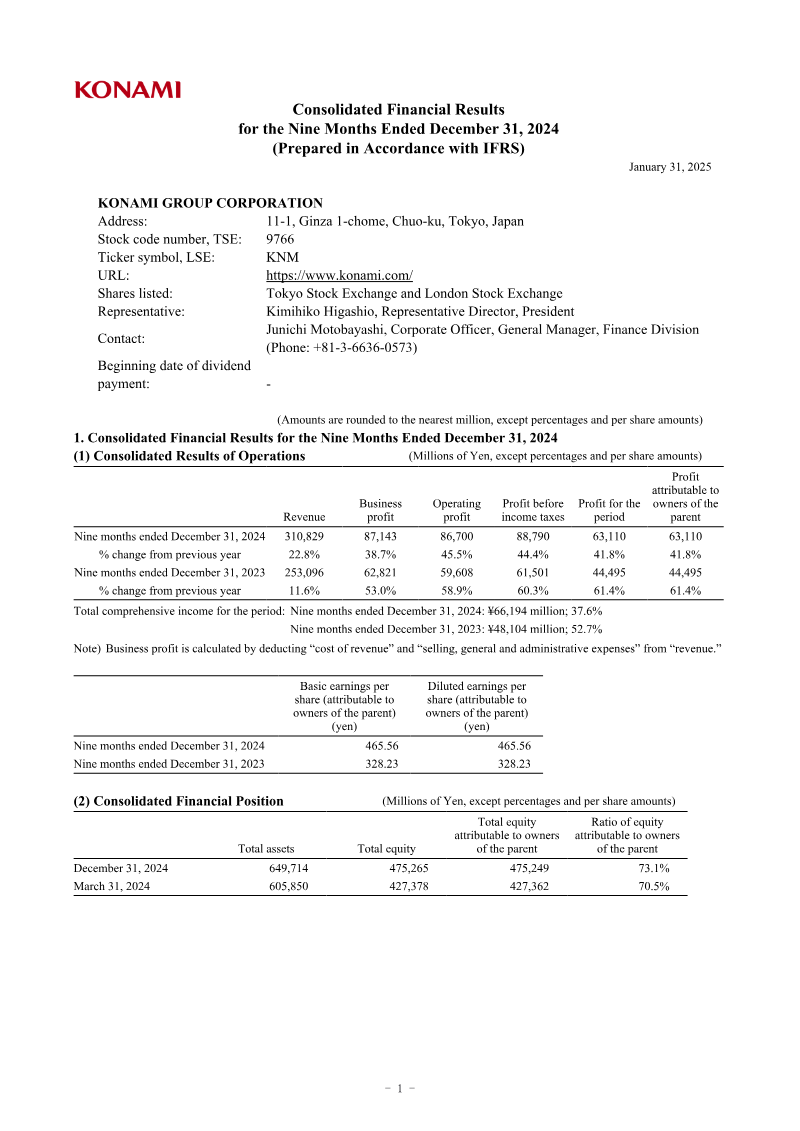
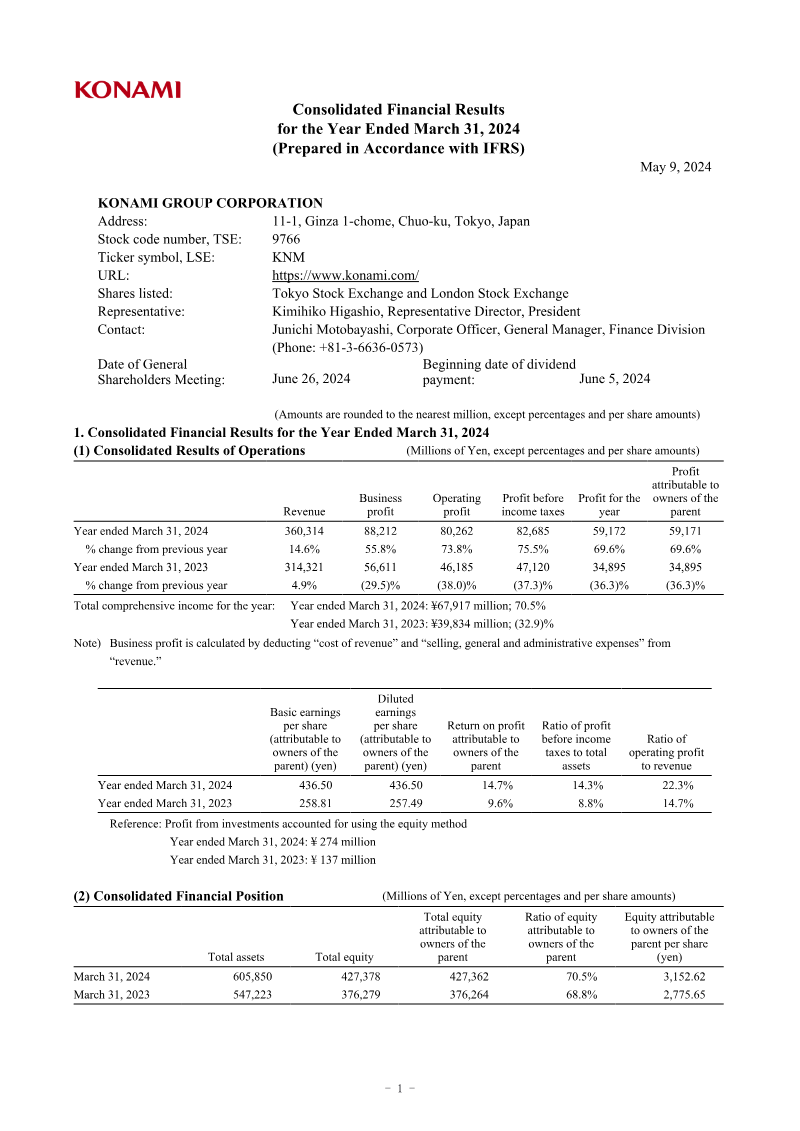
Konami Group Corporation achieved record-breaking financial performance for the fiscal year ending March 31, 2024, characterized by a 14.6% increase in total revenue to ¥360.3 billion and a substantial 69.6% surge in profit attributable to owners of the parent, reaching ¥59.2 billion. This growth trajectory was underpinned by robust performance across all primary business segments, with the Digital Entertainment division serving as a key driver through successful new title launches and consistent updates to core content. Earnings per share saw a marked improvement, rising to ¥436.50 from the previous year’s ¥258.81, reflecting the company’s strengthened market position and operational efficiency. The organization’s financial health is further evidenced by a significant rise in cash and cash equivalents to ¥273,747 million, supported by a 185.5% increase in net cash provided by operating activities. With total assets reaching ¥605,850 million and a solid equity ratio of 70.5%, the company maintains a stable foundation for future investment. Diversified growth was evident across the Gaming & Systems, Sports, and Amusement segments, with the Sports division notably achieving a 415.8% profit increase. These gains were bolstered by strong performance within the Japanese market, which served as a primary catalyst for the overall revenue expansion. Looking toward the fiscal year ending March 31, 2025, the company projects continued momentum with a revenue forecast of ¥380 billion. Strategic initiatives will focus on leveraging core intellectual property, expanding the reach of the DIMENSION slot series and SYNKROS casino systems, and further developing the network of sports and fitness facilities. By maintaining disciplined capital expenditure and consistent dividend distributions, the company remains positioned to sustain its growth trajectory while maximizing shareholder value through its multifaceted business model.
Consolidated Financial Results for the Year Ended March 31, 2024 (Prepared in Accordance with IFRS) May 9, 2024 KONAMI GROUP CORPORATION Address: 11-1, Ginza 1-chome, Chuo-ku, Tokyo, Japan Stock code number, TSE: 9766 Ticker symbol, LSE: KNM URL: https://www.konami.com/ Shares listed: Tokyo Stock Exchange and London Stock Exchange Representative: Kimihiko Higashio, Representative Director, President Contact: Junichi Motobayashi, Corporate Officer, General Manager, Finance Division (Phone: +81-3-6636-0573) Date of General June 26, 2024 Beginning date of dividend June 5, 2024 Shareholders Meeting: payment: (Amounts are rounded to the nearest million, except percentages and per share amounts) 1. Consolidated Financial Results for the Year Ended March 31, 2024 (1) Consolidated Results of Operations (Millions of Yen, except percentages and per share amounts) Profit Business Operating Profit before Profit for the attributable to Revenue profit profit income taxes year owners of the parent Year ended March 31, 2024 360,314 88,212 80,262 82,685 59,172 59,171 % change from previous year 14.6% 55.8% 73.8% 75.5% 69.6% 69.6% Year ended March 31, 2023 314,321 56,611 46,185 47,120 34,895 34,895 % change from previous year 4.9% (29.5)% (38.0)% (37.3)% (36.3)% (36.3)% Total comprehensive income for the year: Year ended March 31, 2024: ¥67,917 million; 70.5% Year ended March 31, 2023: ¥39,834 million; (32.9)% Note) Business profit is calculated by deducting “cost of revenue” and “selling, general and administrative expenses” from “revenue.”
7.3)% (36.3)% (36.3)% Total comprehensive income for the year: Year ended March 31, 2024: ¥67,917 million; 70.5% Year ended March 31, 2023: ¥39,834 million; (32.9)% Note) Business profit is calculated by deducting “cost of revenue” and “selling, general and administrative expenses” from “revenue.” Basic earnings Diluted per share earnings (attributable to per share Return on profit Ratio of profit owners of the (attributable to attributable to before income Ratio of parent) (yen) owners of the owners of the taxes to total operating profit parent) (yen) parent assets to revenue Year ended March 31, 2024 436.50 436.50 14.7% 14.3% 22.3% Year ended March 31, 2023 258.81 257.49 9.6% 8.8% 14.7% Reference: Profit from investments accounted for using the equity method Year ended March 31, 2024: ¥ 274 million Year ended March 31, 2023: ¥ 137 million (2) Consolidated Financial Position (Millions of Yen, except percentages and per share amounts) Total equity Ratio of equity Equity attributable attributable to attributable to to owners of the Total assets Total equity owners of the owners of the parent per share parent parent (yen) March 31, 2024 605,850 427,378 427,362 70.5% 3,152.62 March 31, 2023 547,223 376,279 376,264 68.8% 2,775.65
(3) Consolidated Cash Flows (Millions of Yen) Net cash provided by (used in) cash Cash and Operating Investing Financing equivalents at the activities activities activities end of year Year ended March 31, 2024 103,061 (29,216) (24,199) 273,747 Year ended March 31, 2023 36,098 (42,786) (27,467) 219,263 2. Cash Dividends Cash dividends per share (yen) Cash dividend Total cash Payout ratio rate for equity Record Date First Second Third dividends (consolidated) attributable to quarter quarter quarter Year end Annual (annual) owners of the end end end parent (consolidated) Year ended March 31, - 62.00 - 62.00 124.00 ¥16,805 million 47.9% 4.6% 2023 Year ended March 31, - 62.00 - 69.00 131.00 ¥17,758 million 30.0% 4.4% 2024 Year ending March 31, - 66.00 - 66.00 132.00 30.1% 2025 (Forecast) 3. Consolidated Earnings Forecast for the Year Ending March 31, 2025 (Millions of Yen, except percentages and per share amounts) Basic earnings Profit per share attributable to (attributable Business Operating Profit before owners of the to owners of Revenue profit profit income taxes parent the parent) (yen) Year ending March 31, 2025 380,000 92,500 84,500 84,500 59,500 438.93 % change from previous year 5.5% 4.9% 5.3% 2.2% 0.6% Noted Items (1) Changes in significant consolidated subsidiaries during the period (status changes of subsidiaries due to changes in the scope of consolidation): None (2) Changes in accounting policies and accounting estimate 1. Changes in accounting policies required by IFRS: No 2. Other changes: No 3. Changes in accounting estimate: No
solidated subsidiaries during the period (status changes of subsidiaries due to changes in the scope of consolidation): None (2) Changes in accounting policies and accounting estimate 1. Changes in accounting policies required by IFRS: No 2. Other changes: No 3. Changes in accounting estimate: No (3) Number of shares issued (Share capital) 1. Number of shares issued: (Treasury shares included) As of March 31, 2024 143,500,000 shares As of March 31, 2023 143,500,000 shares 2. Number of treasury shares: As of March 31, 2024 7,942,166 shares As of March 31, 2023 7,941,177 shares 3. Average number of shares outstanding: Year ended March 31, 2024 135,558,384 shares Year ended March 31, 2023 134,830,397 shares
(Reference) Summary of Non-consolidated Financial Results Results for the Year Ended March 31, 2024 (1) Non-consolidated Results of Operation (Millions of Yen, except percentages and per share amounts) Operating revenues Operating income Ordinary income Net income Year ended March 31, 2024 36,686 31,119 32,673 32,115 % change from previous year (24.5)% (28.8)% (27.4)% (27.5)% Year ended March 31, 2023 48,576 43,677 44,997 44,322 % change from previous year 146.8% 171.8% 170.3% 169.9% Basic net income Diluted net income per share (yen) per share (yen) Year ended March 31, 2024 236.92 236.92 Year ended March 31, 2023 328.73 326.95 (2) Non-consolidated Financial Position (Millions of Yen, except percentages) Total assets Total net assets Equity ratio Net assets per share (yen) March 31, 2024 366,557 303,183 82.7% 2,236.56 March 31, 2023 351,413 287,842 81.9% 2,123.38 Reference: Total Stockholders’ equity Year ended March 31, 2024: ¥303,183 million Year ended March 31, 2023: ¥287,842 million Earnings release (Kessan Tanshin) regarding these consolidatedfinancial results is not subject to auditing procedures.
236.56 March 31, 2023 351,413 287,842 81.9% 2,123.38 Reference: Total Stockholders’ equity Year ended March 31, 2024: ¥303,183 million Year ended March 31, 2023: ¥287,842 million Earnings release (Kessan Tanshin) regarding these consolidatedfinancial results is not subject to auditing procedures. Cautionary statement with respect to forward-looking statements and other matters: Statements made in this document with respect to our current plans, estimates, strategies and beliefs, including the above forecasts, are forward-looking statements about our future performance. These statements are based on management's assumptions and beliefs in light of information currently available to it and, therefore, you should not place undue reliance on them. A number of important factors could cause actual results to be materially different from and worse than those discussed in forward-looking statements. Such factors include, but are not limited to: (i) changes in economic conditions affecting our operations; (ii) fluctuations in currency exchange rates, particularly with respect to the value of the Japanese yen, the U.S.
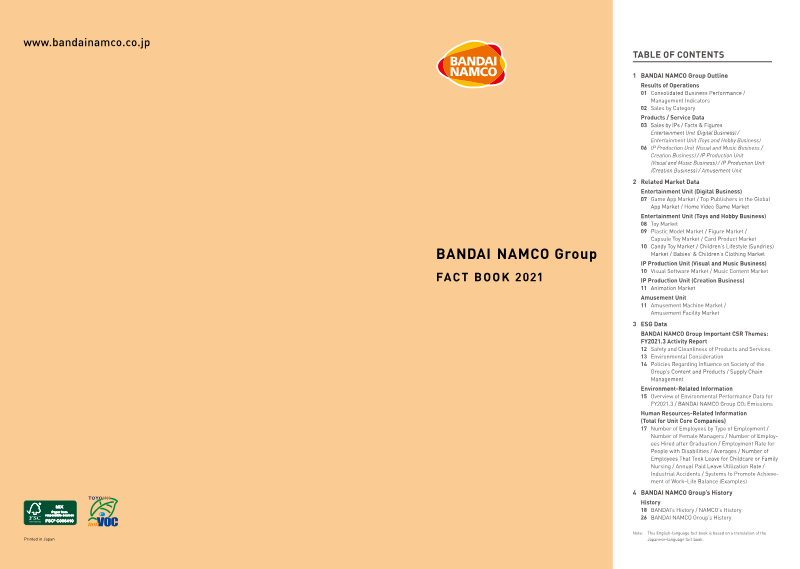
The 2021 Fact Book presents a comprehensive overview of Bandai Namco Holdings’ strategic direction, emphasizing its transformation into a globally integrated entertainment conglomerate and its commitment to corporate social responsibility. Central to the narrative is the thesis that sustained growth across toys, video games, animation and amusement can be achieved through diversified product portfolios, expansive international operations, and proactive sustainability initiatives. The company’s evolution is traced from a collection of independent toy, arcade‑machine and media firms to a unified group after the 2005‑2007 merger of Bandai and Namco. Key milestones include the launch of flagship lines such as Gundam models (over 500 million units shipped), Tamagotchi (exceeding 20 million units), and Zatchbell Battle (300 million units), as well as the development of major video‑game franchises—TEKKEN, DARK SOULS III and Tales—collectively surpassing 50 million sales. International expansion is evident through subsidiaries and regional headquarters in North America, Europe and Asia, reinforced by repeated listings on the Tokyo Stock Exchange and industry recognitions such as Cannes Best Actor and TSE awards. Environmental and social performance data for fiscal year 2021 highlight a suite of CSR actions, including CO₂ reduction targets, supply‑chain safety measures and work‑life‑balance programmes, all framed within the “NEXT STAGE” mid‑term plan aimed at deepening engagement with a mature fan base and broadening cross‑media offerings. The Fact Book thus underscores Bandai Namco’s dual focus on market leadership and sustainable corporate practices across a worldwide footprint and multiple entertainment segments.
**Integrated Report 2019 – Bandai Namco Group – Executive Summary** | Topic | Key Highlights (FY 2019) | Strategic Implications | |-------|--------------------------|------------------------| | **Financial Performance** | • Net sales: **¥732.3 bn** (+8 % YoY) <br>• Operating profit: **¥84.0 bn** (+12 % YoY) <br>• Free‑cash flow: **¥54.9 bn** <br>• Shareholders‑equity ratio: **70 %** <br>• Interest‑bearing debt: **virtually nil** | Strong cash generation and a solid balance‑sheet give the Group flexibility to invest in IP‑driven growth, overseas expansion, and ESG initiatives. | | **Core Business Structure** | • Re‑organized from a three‑SBU model to **five specialized Units**: <br> – Toys & Hobby <br> – Network Entertainment <br> – Real Entertainment <br> – Visual & Music Production <br> – IP Creation <br>• Mid‑term initiatives of Real Entertainment, Visual‑Music Production, and IP‑Creation all **outperformed forecasts**. | The unit‑based architecture aligns resources around the “IP axis” and the 2010 Restart Plan, enabling faster cross‑unit collaboration and clearer performance accountability. | | **Flagship IP Portfolio** | • **THE IDOLM@STER, IDOLiSH 7, Ultraman, Mobile Suit Gundam, Kamen Rider, Super Sentai, Anpanman, PAC‑MAN, Tamagotchi, PRETTY CURE** <br>• Gundam & Dragon Ball singled out for global‑scale pushes. | A diversified IP mix reduces reliance on any single franchise and fuels growth across toys, games, visual media, live experiences, and licensing. | | **IP‑Driven Global Expansion** | **Gundam** <br>• “Chief Gundam Officer” & cross‑unit Gundam Project created. <br>• Simultaneous roll‑outs of visual products, plastic models (> 500 M cumulative shipments), and large‑scale experiences (e.g., 18‑m moving Gundam slated for 2020). <br>• Target markets: **China, North America** (localised content). <br><br>**Dragon Ball** <br>• YouTube masthead campaign → **17 M+ views in one day**. <br>• Net‑sales surge **+932 %** to **¥129 bn**. <br>• 2018 North‑America tour → **300 k+ visitors**, strong limited‑edition sales. | Demonstrates the power of a coordinated, “ALL BANDAI NAMCO” approach: IP‑centric content, merchandising, and experiential activations reinforce each other, driving exponential revenue lift. | | **ESG & Governance Enhancements** | • Board independence: **1/3** of 12 members are outside directors; **Personnel Committee** chaired by an outside director (4/5 members external). <br>• Outside director **Koichi Kawana** appointed (June
The 2018 integrated report presents Bandai Namco’s strategic and financial narrative, emphasizing a record‑high fiscal performance and a forward‑looking “CHANGE for the NEXT” mid‑term plan (FY 2018‑2021). Consolidated net sales reached ¥678.3 billion, up 9.4 % year‑on‑year, while operating profit climbed 18.6 % to ¥75.0 billion, delivering an operating margin of 11.1 % and basic earnings per share of ¥246.3. Shareholder returns were reinforced with a total dividend of ¥123 per share, including a ¥25 special dividend. Growth was driven primarily by the Network Entertainment unit and the launch of a new IP‑Creation Unit, which generated 309 copyrighted titles (2,560 hours of content) and is supported by a ¥25 billion strategic‑investment fund aimed at multiplying IP value 100‑ to 1,000‑fold. The “IP‑axis” strategy extends core franchises such as Gundam, PAC‑MAN, Aikatsu! and IDOLiSH7 across animation, games, toys, novels and live‑action, while new‑entertainment initiatives target digital‑first content, mature fan markets, e‑sports and location‑based venues. Expansion in China includes flagship stores, hologram anti‑counterfeit seals and integrated e‑commerce, reinforcing the group’s global footprint. Corporate governance was strengthened through an independent board of 11 directors (three outside) and an audit‑supervisory board meeting stringent independence criteria, complemented by a risk‑compliance charter, business continuity planning and transparent stakeholder engagement. The CSR agenda, under the “Dreams, Fun and Inspiration” mission, achieved a roughly 20 % reduction in CO₂ emissions, deployment of LED lighting, green‑procurement standards banning 29 hazardous substances, and extensive supplier audits. Financially, the company managed a rise in debt to ¥1.47 trillion, a modest decline in cash reserves, and an effective tax rate of 25.7 % aided by R&D credits. Consistent ROE above 10 % and a clean audit opinion underscore the robustness of the business model, while directors call for further earnings‑model innovation, accelerated global expansion, and diversified talent development to sustain the vision of becoming the leading entertainment company.
Bandai Namco’s 2017 integrated report presents a comprehensive account of the company’s financial, strategic, and governance performance, emphasizing the central role of its “IP‑axis” strategy in achieving record results. By leveraging core intellectual properties across games, toys, visual media, and music, the group generated ¥620.1 billion in net sales and ¥63.2 billion in operating profit, a 27.7 % year‑on‑year increase, while free‑cash flow rose 47.7 %. The Network Entertainment segment contributed 57.9 % of sales and 63.8 % of profit, with flagship franchises such as Mobile Suit Gundam (¥74 billion) and Dragon Ball (¥61 billion) underpinning cross‑media expansion and overseas growth in Asia, Europe, and the Americas. Strategic outlook is framed by the newly launched three‑year “NEXT STAGE” plan, which targets global IP expansion, regional autonomy, and continued innovation to meet mid‑term objectives a year ahead of schedule. Governance is reinforced through a ten‑member board—including three independent directors—and an audit‑supervisory board meeting Japanese Corporate Governance Code standards. A robust compliance and risk‑management framework, performance‑linked director compensation, and extensive investor‑relations activities underscore the company’s commitment to transparency and stakeholder trust. Corporate‑social‑responsibility initiatives achieved a 27 % reduction in CO₂ emissions since FY2012 and introduced universal‑design products and supplier audits. Financially, profit attributable to owners reached ¥44.2 billion, EPS rose to ¥201, and dividends of ¥15.4 billion were declared. Acquisitions such as