Updated Apr 30, 2026 by Konami Group Corporation
France Bed Holdings Co., Ltd. released its consolidated financial results for the six-month period ending September 30, 2025, prepared in accordance with Japanese GAAP. The report details the company’s operating performance, financial position, and cash flow status, while maintaining its previously announced earnings forecasts for the full fiscal year ending March 31, 2026. During the first half of the fiscal year, the company reported net sales of 29,259 million yen, remaining essentially flat compared to the same period in the previous year. However, profitability metrics experienced a decline, with operating profit falling 16.0% to 1,782 million yen and ordinary profit decreasing 17.7% to 1,765 million yen. Profit attributable to owners of the parent reached 1,047 million yen, representing a 20.9% year-on-year decline. Basic earnings per share for the period were 31.20 yen, down from 38.36 yen in the prior year. The company’s financial position as of September 30, 2025, shows total assets of 67,084 million yen and net assets of 39,158 million yen, resulting in an equity-to-asset ratio of 58.3%. Cash flows from operating activities provided 2,541 million yen, while investing and financing activities reflected ongoing capital allocation, including the purchase of treasury shares and continued investment in property, plant, and equipment. Looking ahead to the full fiscal year ending March 31, 2026, the company maintains its forecast of 62,300 million yen in net sales and 4,750 million yen in operating profit. These projections reflect a modest growth expectation of 2.8% in sales and 1.1% in operating profit compared to the previous fiscal year. The company continues to operate under stable accounting policies with no significant changes in the scope of consolidation.
Square Enix has formalized a comprehensive sustainability and governance framework aimed at aligning long-term corporate value with environmental responsibility and human capital development. Central to this strategy is a commitment to achieve net-zero CO2 emissions at Japanese offices and data centers by 2030. This transition is already evidenced by a significant reduction in electricity-related emissions, which fell from 34,320 tCO2 in 2017 to 20,635 tCO2 by 2025. By shifting toward digital sales and renewable energy, the Group seeks to mitigate climate-related risks while modernizing its operational footprint. The organizational focus on human capital emphasizes creativity and employee well-being through specialized training in emerging technologies like AI and blockchain, alongside "Game Dev Boot Camps." Support systems have been expanded to include flexible work-from-home options, daycare concierge services, and gamified wellness initiatives designed to incentivize healthy lifestyles. These efforts are intended to foster a high-performance culture capable of navigating the evolving digital entertainment landscape. Governance is characterized by a clear separation between management oversight and operational execution. The Board of Directors is predominantly composed of independent outside directors who maintained near-perfect attendance throughout the fiscal year ending March 31, 2025. Executive remuneration is strictly tied to performance metrics, including consolidated net sales and operating income, with a significant portion of compensation delivered via restricted stock to align leadership interests with those of shareholders. Furthermore, strategic shareholdings in partners like gumi Inc. underscore a commitment to expanding influence within blockchain, cloud gaming, and the metaverse.
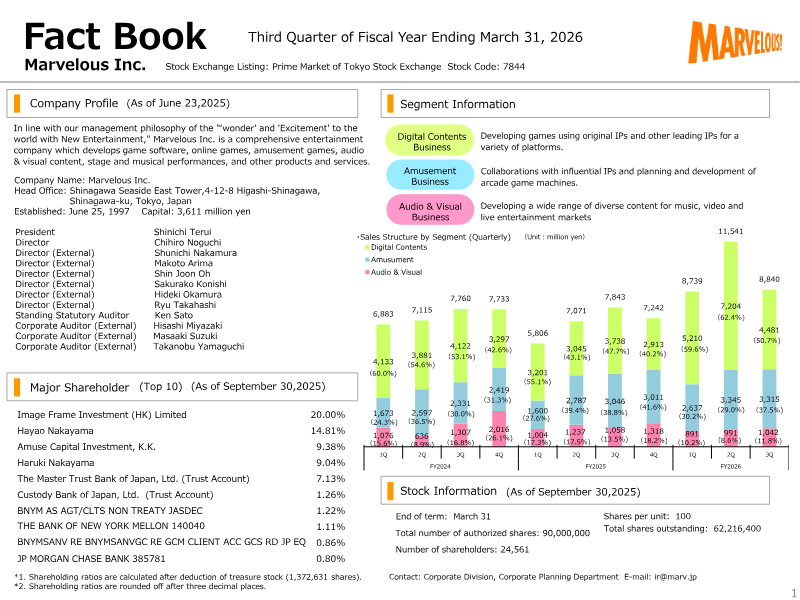
Marvelous Inc. provides a comprehensive financial overview of its performance through the third quarter of the fiscal year ending March 31, 2026. As a Tokyo-based entertainment company, its operations span three primary segments: Digital Contents, which develops games for various platforms; Amusement, focused on arcade game machines; and Audio & Visual, covering music, video, and live stage performances. The data reflects a multi-year trajectory of financial results, including consolidated balance sheets, income statements, and segment-specific sales and income. Financial results for the first nine months of the 2026 fiscal year show net sales of 29,121 million yen, surpassing the full-year totals of the previous two fiscal years. Despite this growth in top-line revenue, operating profit for the period stands at 1,776 million yen, reflecting a lower operating profit ratio of 6.1% compared to 17.9% in 2022. The Digital Contents segment remains the largest contributor to revenue, generating 16,896 million yen in the first three quarters, though it recorded a segment loss of 73 million yen. In contrast, the Amusement segment proved highly profitable, contributing 2,558 million yen in income on sales of 9,298 million yen. The company maintains a stable financial position with total assets of 35,669 million yen and an equity ratio of 76.4% as of December 2025. While net income per share has recovered to 25.56 yen from a loss in 2024, profitability metrics such as Return on Equity have fluctuated significantly over the reported periods. The shareholder structure is anchored by Image Frame Investment (HK) Limited, which holds a 20% stake, followed by founder-related holdings. These figures highlight a period of revenue expansion driven by diverse entertainment segments, tempered by rising costs of sales and shifting profitability within the core digital gaming business.
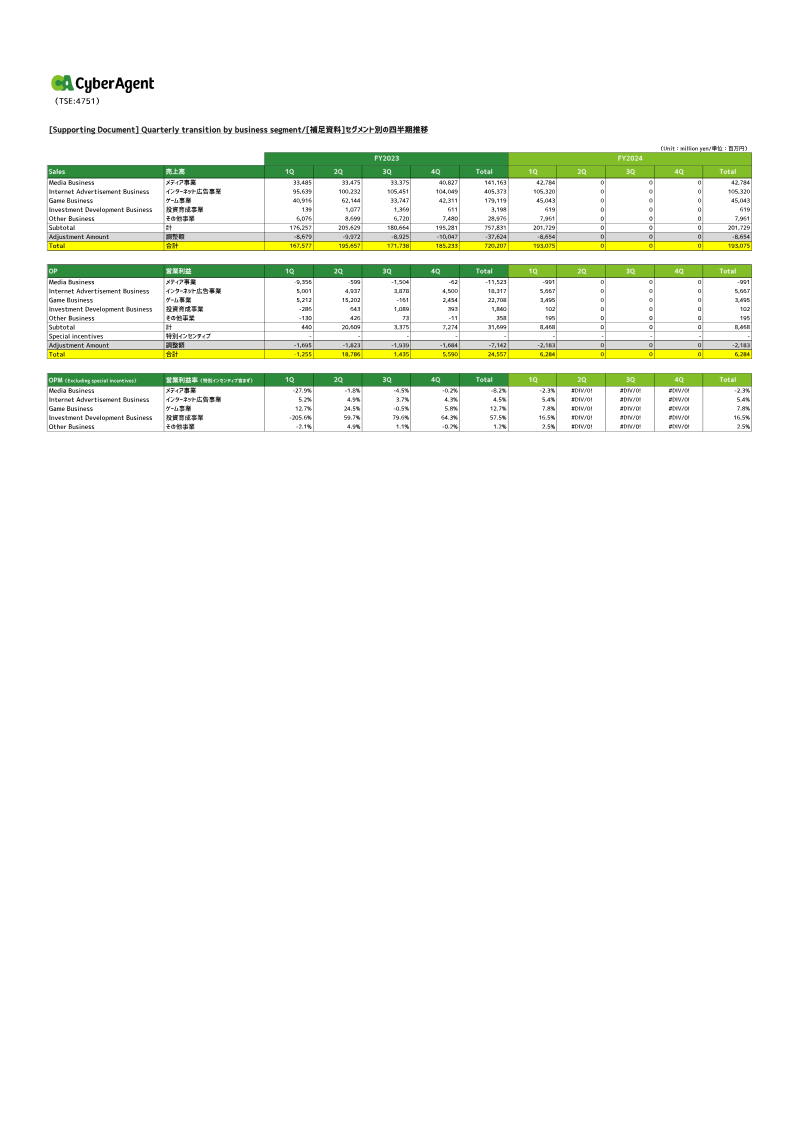
CyberAgent’s financial performance for the first quarter of fiscal year 2024 demonstrates a significant recovery in profitability compared to the same period in the previous year. Total net sales reached 193.07 billion yen, representing a year-over-year increase from the 167.57 billion yen recorded in the first quarter of 2023. Most notably, the consolidated operating income swung from a loss of 1.25 billion yen in the prior year’s first quarter to a profit of 6.28 billion yen, signaling a stabilized financial trajectory across the company’s diverse business segments. The Internet Advertisement Business remains the primary revenue driver, contributing 105.32 billion yen in sales and 5.66 billion yen in operating profit during the first quarter. While the Media Business continues to operate at a loss, its performance has improved substantially; the segment reduced its operating loss from 9.35 billion yen in the first quarter of 2023 to just 991 million yen in the current period. This improvement is reflected in the operating profit margin for the Media segment, which narrowed from negative 27.9 percent to negative 2.3 percent. The Game Business experienced a moderate increase in revenue, posting 45.04 billion yen for the quarter compared to 40.91 billion yen a year earlier. However, the segment's operating profit of 3.49 billion yen and margin of 7.8 percent represent a decline from the 5.21 billion yen and 12.7 percent margin seen in the first quarter of 2023. Despite this contraction in game-related margins, the overall corporate performance was bolstered by the Investment Development and Other Business segments, both of which remained profitable. The data covers the Japanese market and reflects the transition from the full fiscal year 2023 through the initial quarter of 2024.