1 free read left. Create a free account for unlimited reading + AI research.
Create free account
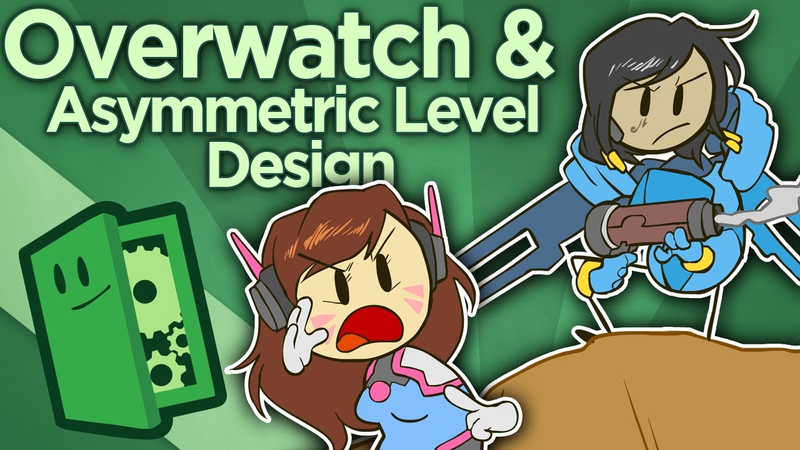
Overwatch and Asymmetric Level Design - What Makes the Maps Fun? - Extra Credits
Key insights
5 takeaways- 01Asymmetric level design in competitive shooters balances tactical depth against fairness by rotating advantages in cover, height, and lines of sight to prevent permanent environmental dominance.
- 02Overwatch utilizes intentional asymmetry to create a narrative of progress, where map geometry and spawn distances shift to favor attackers early on and defenders as the match reaches the final objective.
- 03The design of attacker and defender roles in Overwatch relies on a specific interest curve, using shorter respawn times to facilitate forward momentum for attackers and constrained, defensible positions for defenders.
- 04The reliance on rigid, channeled map design removes the self-correcting mechanisms found in open-map layouts, making the gameplay experience entirely dependent on precise developer tuning.
- 05Failure to perfectly calibrate asymmetric environments can lead to stagnant, unbalanced gameplay, underscoring the necessity for developers to continuously refine map geometry to maintain consistent tension.
Ask AI about this video
Transcript
Let's talk about asymmetric level design, and the interesting case of OverWatch, which for a lot of reasons has some of the most wildly asymmetric levels that I have seen in a multiplayer first-person shooter. Designing levels for competitive multiplayer games where the level design is asymmetric is a contentious thing. Even in games like MOBAs where the map is nearly symmetrical for both teams, minor minute differences, like which characters start near which monsters, create a preference for players and lead to players seeing one starting location as being more advantageous than the other. Meaning somebody's always going to be unhappy. And it's a fine line for a designer to walk. Asymmetry provides variety and creates interesting tactical options for the player every time they play, but it can also leave players just feeling frustrated and like the game is unfair every time they end up on the side they see as having a disadvantage. So first, let's talk about standard asymmetric level design. Usually in asymmetric games, as the designer, you
create all sorts of ways to make the action flow through the map. Whether it's a team deathmatch or capture the flag, you'll notice that on any well-designed map, the action doesn't just occur at one point for the entire length of a match. Instead, you'll find yourself pushing through different choke points or dislodging your opponent from different sets of good cover. You'll be taking different high ground areas or sniper spots as you go. Sometimes these are subtle. Maybe you simply have to push the enemy back enough to move forward to the next bit of cover. Or sometimes these can be as drastic as pushing the enemy out of a set of buildings. But each time this happens and players flow through the map, it does two important things. First, the players get to think through new tactical problems. Lines of sight are constantly changing. Cover layouts change. Height advantages change on different conflict points on the map. This is interesting for the player. It's what makes the game feel vibrant and alive. Second, it constantly switches which team or players have an advantage. Each new stopping point on the player's circulation through the map should alter who gets an edge from the asymmetric
terrain, which keeps the map feeling challenging but fair. There are a number of systems we use to achieve this. Baked into the level itself are conflict points. These are places everybody wants to be because they're objectives or because they're advantageous, like bunkers, hilltops, that sort of thing. Players will naturally gravitate toward those areas, and a fight will naturally erupt around them as players try to take control. As a battle erupts around one of these conflict points, it'll naturally drag other players in because that's where the action is. Eventually, the assaulting side will either push through or find a flank and push the possessing side back, bringing the flow of the game to whatever the next conflict point is as one side falls back and the other one surges forward. Or one of the sides may just give up the point as the fight becomes either no longer tenable or simply unwinnable. Either way, the conflict flows on to new areas. This is often augmented by the spawn system. There's a lot of different philosophies around how to spawn the player into first-person shooters. You could spawn them at a fixed location for the whole match. You could spawn them at
one of a number of fixed spawn points. You could spawn them near a teammate. You could spawn them away from any action that's going on. And there's reasoning behind all of these options. In fact, just talking about what the different spawning mechanics do might make for an interesting episode one day. But for right now, the important thing is that excluding the largely outmoded idea of spawning the player at a single fixed spawning location for an entire match, all of these options help the flow of play and encourages players to move to new conflict points. If the game has power-ups or weapon pickups, these two can be used as conflict points and a way to drive the players from point to point so that the map feels varied but fair. But however you do it, your built-in map flow also has to depend on two other crucial questions. As a designer building an asymmetric map, you have to ask yourself, are the players' goals asymmetric? And are the players' avatars asymmetric? Because both of those have a huge effect on map design. And here is where we get to Overwatch. Because in Overwatch, the answer to both of those questions is yes, at least most
of the time. In Overwatch, there are basically two types of maps. In one type, one team is assaulting, trying to take ground, and the other one is defending, trying to hold ground. In the other type, both teams are fighting to control a central objective. Interestingly, the second game type usually gives us maps that barely feel asymmetric at all. As the design involves only one central conflict point with a group of minor conflict points radiating out from it, which often represent different paths to the central conflict point. Note that this is the only map type where they use a single fully fixed spawn location, implying that the designers felt that asymmetry had far less impact on this map type, and that they didn't have to put as much emphasis on seesawing between which team gets the most advantage out of the map's limited asymmetry. So, let's look at the attackers versus defenders maps, because those are wildly asymmetric. Intentionally so. The flow of each match through these maps is pretty evident. The designers channel the players' movements much more clearly than your standard team deathmatch shooter. And because the designers know the map flow,
this means that they can develop a type of wild asymmetry that creates a specific tension and interest curve for their online FPS, at least theoretically. The first thing to notice on all of these maps is that the attackers have the initial advantage. The first point the defenders are tasked with guarding usually gives the attacker lots of alternate paths to flank from, and a modicum of cover. And the choke points are either relatively easy to break or can be avoided by smart flanking play. On top of that, any defender who gets taken out has to hoof it all the way from their initial spawn point at the end of the map back to the area their team is trying to defend. While the attackers respawn much closer to the initial conflict. Even if the defenders and the attackers suffer equal losses, the respawn distance advantage will push the attack forward. But as points fall or carts are pushed, the situation flips. The attackers' final goal usually sits at the end of one narrow corridor without any alternate routes to flank from and little cover to hide behind. And now, the defenders have
the respawn distance advantage as their spawn point is often right behind the goal. Even trades now work in the defenders' favor as their fallen teammates return to the fight in mere seconds. When this all works, it creates wonderfully nail-biting situations where the games come down to the last second. It makes both the attack and the defense feel like desperate hard-fought struggles, while at the same time giving each match a sense of motion and progress. First, the outer defenses collapse, and then the inner defenses fall until the defenders are left performing a desperate last stand on a patch of ground designed for desperate last stands. But, when you have this massive asymmetry that channels players down a specific path rather than allowing them to flow through the level naturally, you create a much more difficult balance problem. Because normally, when a particular point is a bit too unbalanced in favor of one side or the other, players will naturally move their focus elsewhere and conflict will start again at some other point on the map. But, that's not possible in this case, which means that the balance of Overwatch's attacker-defender maps
needs to be tuned almost perfectly. And some of them are. Some of these levels are masterpieces of multiplayer design. But, there are others where that balance is just slightly off, where the first point typically falls quickly and then the match turns into a 7-minute grind fest where the attackers throw themselves at an overly secure final defense point. Because these maps are designed to flow down one specific path, there's no self-correcting mechanism in place to resolve the imbalance. Hopefully, in time, the Overwatch team will be able to sand away those few remaining rough edges until all of the game's levels live up to that perfectly crafted interest curve. It's a daring and ambitious goal, one that has rarely, if ever, been pulled off. But, they've got a lot of sharp people in that studio, so we'll see what happens. But, Overwatch's asymmetry isn't limited to level design. Next week, we'll talk about the game's most prominent asymmetric feature, its characters. See you then.
Summary
Asymmetric level design in competitive multiplayer first-person shooters presents a significant challenge: balancing variety and tactical depth against the risk of perceived unfairness. Effective map design typically relies on creating a flow of action that moves players through various conflict points, such as objectives or advantageous terrain. By shifting lines of sight, cover, and height advantages, designers can ensure that neither team maintains a permanent environmental edge, keeping the experience challenging and equitable.
In the context of Overwatch, the design philosophy utilizes intentional, high-stakes asymmetry to dictate the flow of matches. On maps featuring distinct attacker and defender roles, the game creates a specific interest curve by manipulating spawn distances and terrain geometry. Attackers typically hold the advantage early in a match due to shorter respawn times and multiple flanking routes, which facilitates forward momentum. As the match progresses, the map design shifts to favor the defenders, who gain shorter respawn distances and more defensible, constrained positions near the final objective. This creates a narrative of progress, moving from initial skirmishes to desperate final stands.
However, this rigid, channeled approach to level design removes the self-correcting mechanisms found in more open maps, where players might naturally shift their focus if a specific area becomes unbalanced. Consequently, the success of these maps depends entirely on precise tuning. While some maps achieve a near-perfect balance, others can suffer from prolonged, stagnant gameplay if the design fails to account for specific imbalances. Ultimately, the effectiveness of such ambitious, asymmetric design hinges on the developer's ability to refine these environments to ensure that the intended tension and sense of progression remain consistent throughout the match.















Comments