Key insights
5 slides
The problem
Memorizing complex cryptographic keys is a significant challenge for users.
Traditional memorization techniques often fail to ensure long-term retention or user confidence in recalling abstract security phrases.
1 / 5
- 01MnemonicMaker utilizes the Method of Loci within a virtual role-playing environment to improve the memorization of BIP 39 recovery phrases.See it on page 2
- 02A 60-day study of 38 participants showed recall success rates between 89.5% and 94.7%, significantly outperforming traditional rote memorization.See it on page 14
- 03Users mastered navigation routes within one to five attempts, demonstrating that gamified spatial memory techniques effectively reduce the cognitive load of security protocols.See it on page 19
- 04The software provides a scalable alternative to conventional storage methods, with potential applications for Shamir’s Secret Sharing schemes and general password security.See it on page 19
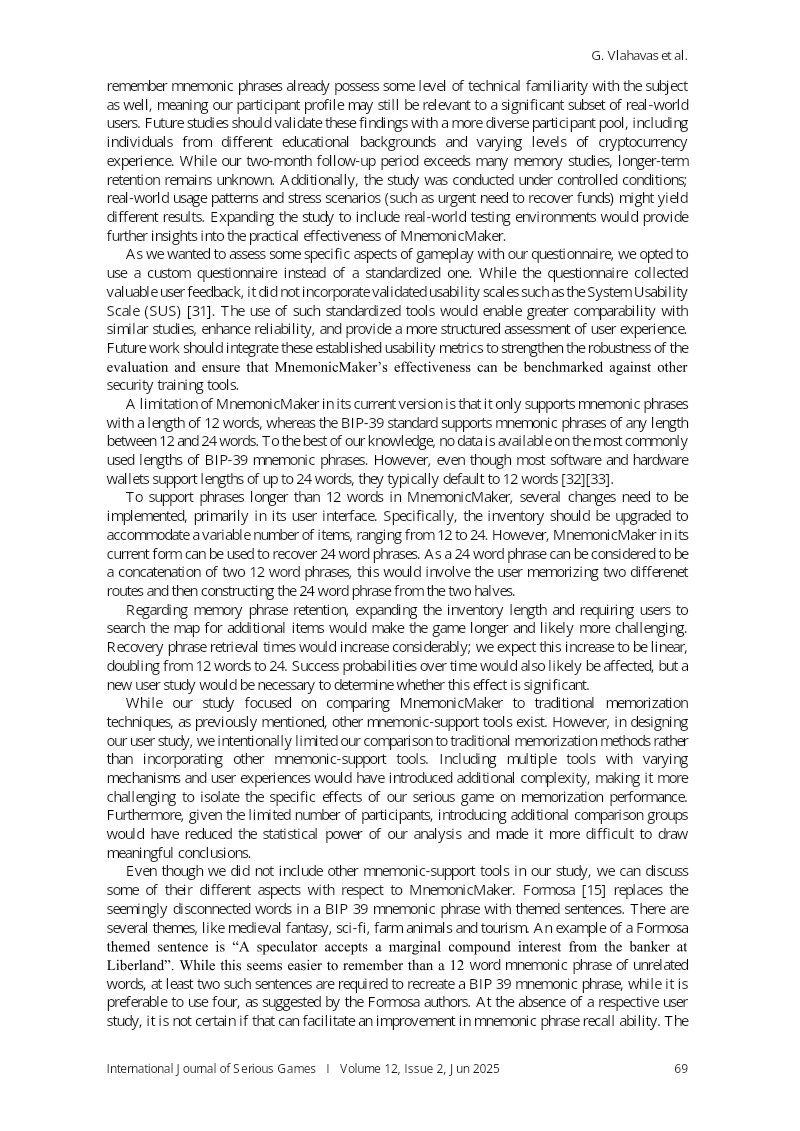
- 05Future development will focus on supporting complex 24-word mnemonic structures and evaluating retention beyond the initial two-month study period.See it on page 17
Ask AI about this report
Summary
MnemonicMaker functions as a serious game designed to enhance the security of cryptocurrency assets by facilitating the memorization of BIP 39 recovery phrases. By integrating the Method of Loci—a mnemonic strategy that utilizes spatial navigation and mental imagery—into an interactive virtual role-playing environment, the software transforms the abstract task of storing complex cryptographic keys into an intuitive, gamified experience. The primary objective is to provide a more reliable alternative to traditional memorization techniques, which often fail to ensure long-term retention or user confidence.
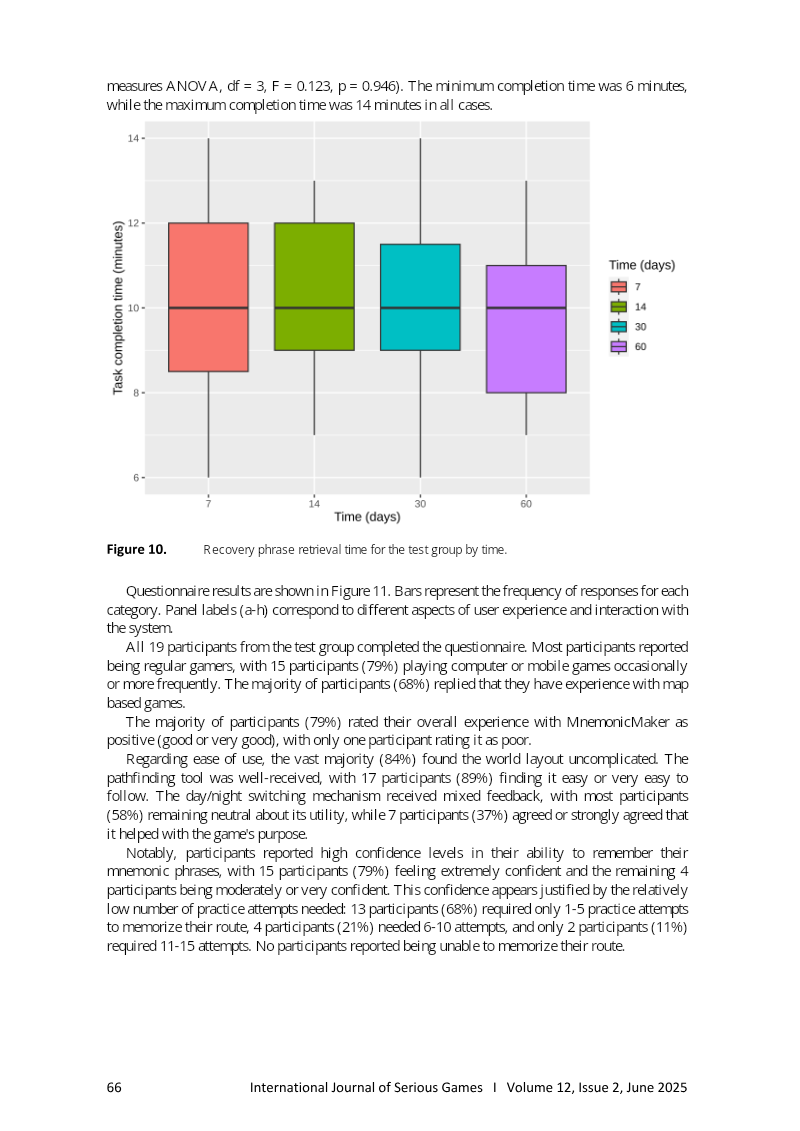
A longitudinal study involving 38 participants over a 60-day period confirms the efficacy of this approach. Test subjects utilizing the game achieved high recall success rates, ranging between 89.5% and 94.7%, significantly outperforming control groups relying on conventional rote memorization. Participants demonstrated the ability to master navigation routes within one to five attempts, reporting high levels of engagement and confidence in their ability to recover their phrases. The game’s mechanics, including pathfinding tools and environmental switching, effectively lower the cognitive load associated with complex security protocols.
While the current findings are limited by a homogeneous sample size, the results suggest that gamification is a scalable solution for improving personal cybersecurity practices. The success of this method indicates potential for broader application, including the management of Shamir’s Secret Sharing schemes and general password security. Future research is expected to address longer-term retention beyond the initial two-month window and expand the game’s capacity to support more complex 24-word mnemonic structures. Ultimately, the integration of spatial memory techniques into digital environments offers a promising pathway for bridging the gap between high-security requirements and human cognitive limitations.