1 free read left. Create a free account for unlimited reading + AI research.
Create free accountLevel Design Does NOT Start With Any Level!
Key insights
6 takeaways- 01Level design should begin by building a versatile toolbox of mechanics rather than constructing individual levels, as the quality of the final product depends on the adaptability of these foundational components.
- 02A scalable level design framework relies on increasing the density of interactions between building blocks, allowing designers to generate diverse experiences from a limited set of assets.
- 03Meaningful gameplay variety is achieved through mechanical synergy, where different systems influence one another to create new outcomes, such as a slowing effect that alters the efficacy of a projectile weapon.
- 04Developers should prioritize mechanics that possess high reusability and context-dependency to maximize production efficiency and avoid the need to create new assets for every challenge.
- 05Relying on simple randomization of static elements leads to repetitive, unengaging gameplay because it fails to integrate mechanics in a way that creates dynamic, interdependent systems.
- 06Contextual placement is essential for differentiation, as terrain and environmental objects must actively interact with game mechanics to ensure they remain useful across various scenarios.
Ask AI about this video
Transcript
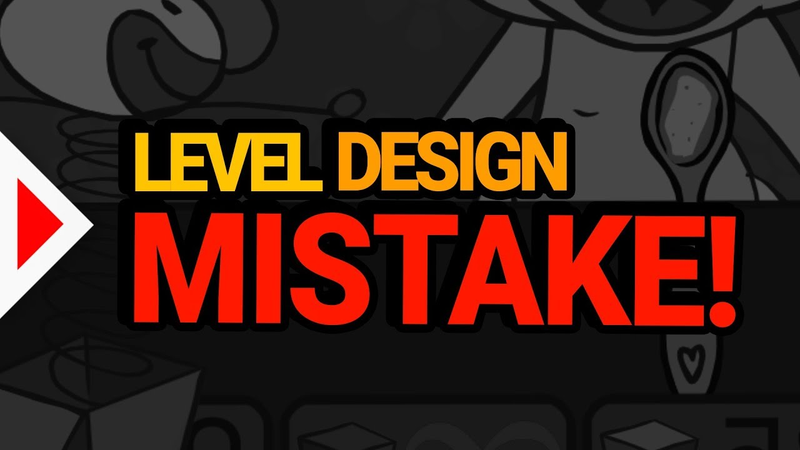
good level design starts before you design a single level unfortunately I had to learn that the hard way with my game spoon tastic baby I made a big level design mistake the game failed and in this video I want to share with you what I think went wrong so you don't need to make the same mistake the goal of the game is to feed the baby unfortunately it doesn't want to be fed it spits it shoots fire it has laser eyes it's basically the devil it even eats your spoon every now and then so it's basically a little baby boss fight game we wanted players to keep playing the game so there is an infinite amount of levels and every level is slightly harder than the level before one thing I realized even back then when I made the game was that levels need to be very different and unique otherwise it would get pretty boring pretty soon and the way I went about solving that issue was to randomize the baby steps in every single level the sets that probably made the most impact were the frequencies of the different attacks so in some levels the players only attacked by lasers and other levels players only attacked by fire and then once again in different levels the baby might use a variety of different attacks we have seven attack
patterns so in theory this should result in a ton of possible combinations right wrong wrong wrong the thing I missed in my thought process was that those attack patterns are not really combined they're still happening one after another doesn't matter how we rearrange them it's the seven exact same building blocks every single time the result was that the levels were pretty boring and the game fade so the first takeaway from this project is that level design is really your best friend if you want to create a lot of content and that's simply due to the fact that rearranging and recombining existing mechanics is a lot more efficient than creating entirely new ones secondly make sure it is possible to recombine your mechanics in meaningful ways in my game overcharge I have blue turrets green turrets but I can also combine them and have both at the same time depending on how I rearranged these turrets as a level designer it will result in a completely different experience and challenge for the player you know in which game that is absolutely not the case yeah also
recombine ability is not a binary thing it's not like you have it or you don't there are a lot of steps in between some mechanics might have some interesting interactions with each other and others might not your goal is obviously to get this net as tense as possible that makes it easier to create interesting and varied levels one way I tried to make the interaction between green and blue turrets more interesting in overcharge for example was by giving green turrets the ability to slow down enemies this way blue turrets have more time to shoot them as well so sooner geez like that are what you're looking for third thing I've learned from spoon tastic is that you've got a leverage context once again if you look at overcharge we can see that this turret has an entirely different context than this turret or than this turret so depending on their surroundings and depending on their context they feel different to use for the player you know in which game that is absolutely not the case yeah the easiest way to create context in my opinion is the terrain but only if your game objects have interesting interactions with the terrain these presents for example use the terrain to
move so yes they have interactions with the terrain not super interesting ones but they do these fireworks on the other hand don't interact with the terrain at all that reduces the reusability of that mechanic quite a lot because we can't give it a different context or at the very least not a vastly different one of course there are other ways to give something context as well for example surrounding objects if you want to have any chance at creating quality levels you've gotta make sure you have a good toolbox and a good set of building blocks that can actually be used and recombined in interesting ways I'd love to keep exploring this topic in future videos and obviously I'll link them here once there's something out sorry that this video was a little short I'll try to get health easy we'll hope this helps you to avoid some of the mistakes I've made in the past let's discuss it in the comments and see you on the next one
Summary
Effective level design is not a task that begins with the construction of a level, but rather with the development of a robust, versatile toolbox of mechanics and building blocks. The primary thesis is that the quality and variety of a game’s levels are directly dependent on how well these individual components can interact, recombine, and adapt to different contexts. Relying on simple randomization of static elements often leads to repetitive, unengaging gameplay, as seen in projects where identical attack patterns are merely rearranged rather than meaningfully integrated.
To maximize content production efficiency, developers should prioritize mechanics that possess high reusability and context-dependency. Meaningful recombination occurs when mechanics influence one another, such as a slowing effect that enhances the efficacy of a projectile weapon. This synergy transforms individual assets into dynamic systems, allowing designers to generate diverse challenges without the need to constantly create new assets from scratch. The goal is to increase the density of these interactions, ensuring that the same building blocks provide distinct experiences depending on their specific arrangement.
Contextual placement serves as a critical tool for differentiation. Terrain and surrounding objects should actively interact with game mechanics to alter their utility and feel. When objects fail to engage with their environment, their reusability diminishes, leading to stagnant level design. By ensuring that mechanics are context-sensitive and capable of complex, interdependent relationships, developers can create a scalable framework that supports infinite, varied gameplay while maintaining high production efficiency. Ultimately, the success of a level design strategy rests on the depth and flexibility of the underlying mechanical foundation.






















Comments