1 free read left. Create a free account for unlimited reading + AI research.
Create free accountArticle Eludamos: Journal for Computer Game Culture
1 free read left. Create a free account for unlimited reading + AI research.
Create free accountArticleEludamos: Journal for Computer Game Culture
John Hopson's 2006 call asked game researchers to become more practical and accessible to developers. Mullen's 2009 essay responds to that call.
Mark Mullen's 2009 essay "Letter from the Wilderness," published in Eludamos, argues that academic game research should be understood as speculative, public-minded inquiry rather than a service to industry profitability. Written as a response to John Hopson's 2006 call that researchers become more practical and accessible to developers, the essay contends that Hopson's instrumental view of research's usefulness is itself limiting. Drawing on Ernest Adams' defense of exploratory scholarship and on science communication literature showing the weakness of deficit-model approaches, Mullen maintains that the field's value lies in long-term inquiry that may not yield immediate commercial returns.
The essay's central claim is that game studies, particularly humanities-based scholarship, is essential to the medium's maturation. Mullen argues that treating players merely as consumers and relying on trial and error produces formulaic, forgettable output, and that interpretive frameworks and hermeneutic research can enrich both design and the industry's long-term health. He points to developers' heavy reliance on debugging and magazine reviews, citing Dovey and Kennedy, as evidence of insularity, and he rejects the stereotype that humanities scholarship lacks testable value, attributing that view to a conflation of game building with creative practice.
Mullen also addresses the cultural standing of games. He argues that the industry's habit of describing games as "only games" or "only a business" weakens their legal and cultural defense against censorship, since art has traditionally received stronger protection as speech. He further observes that gamers exhibit unusually intense and sometimes entitled attitudes, especially in MMORPG communities, and that the field still lacks a settled definition of games. His proposed remedy is collaborative "sandbox" initiatives linking scholars, developers, and media scholars. The essay's evidence is largely argumentative and illustrative rather than quantitative, drawing on examples such as BioShock, F.E.A.R., and press coverage of violence in games.
Each row is a game or company this document names, each column a document, oldest first. A mark means that document names it. Select a row to see those documents.
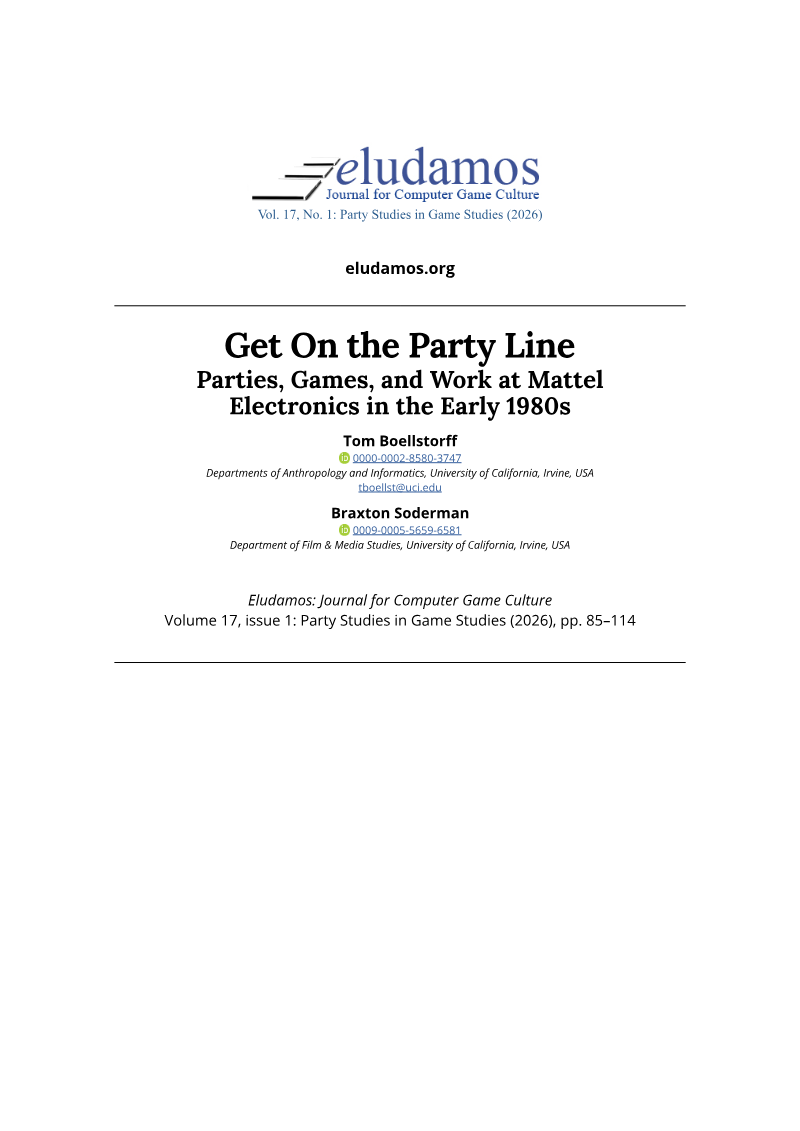
Eludamos: Journal for Computer Game Culture · 2026
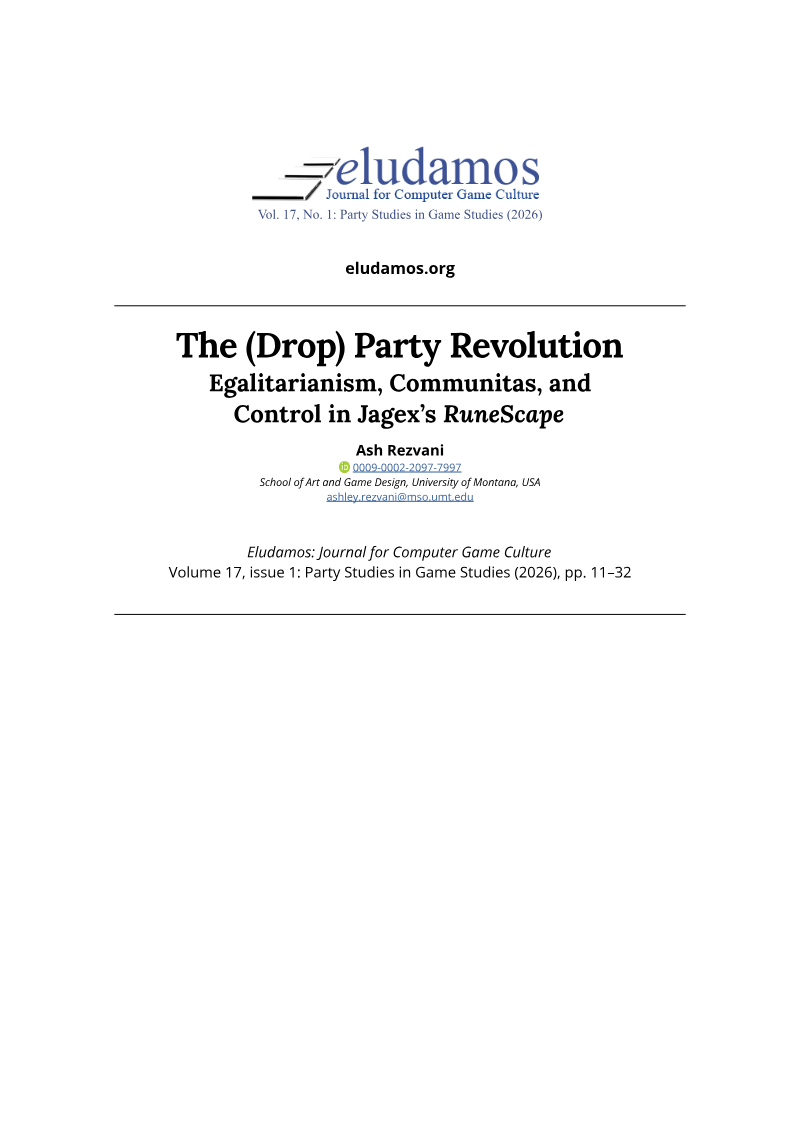
Eludamos: Journal for Computer Game Culture · 2026
Eludamos: Journal for Computer Game Culture · 2026
Eludamos: Journal for Computer Game Culture · 2026
Eludamos: Journal for Computer Game Culture · 2026
Eludamos: Journal for Computer Game Culture · 2026
Eludamos: Journal for Computer Game Culture · 2026
Eludamos: Journal for Computer Game Culture · 2025
Eludamos: Journal for Computer Game Culture · 2025
Eludamos: Journal for Computer Game Culture · 2025
Eludamos: Journal for Computer Game Culture · 2025
Eludamos: Journal for Computer Game Culture · 2025
DiGRA · 2026