1 free read left. Create a free account for unlimited reading + AI research.
Create free accountFinancial report Kadokawa Corporation
1 free read left. Create a free account for unlimited reading + AI research.
Create free accountFinancial reportKadokawa Corporation
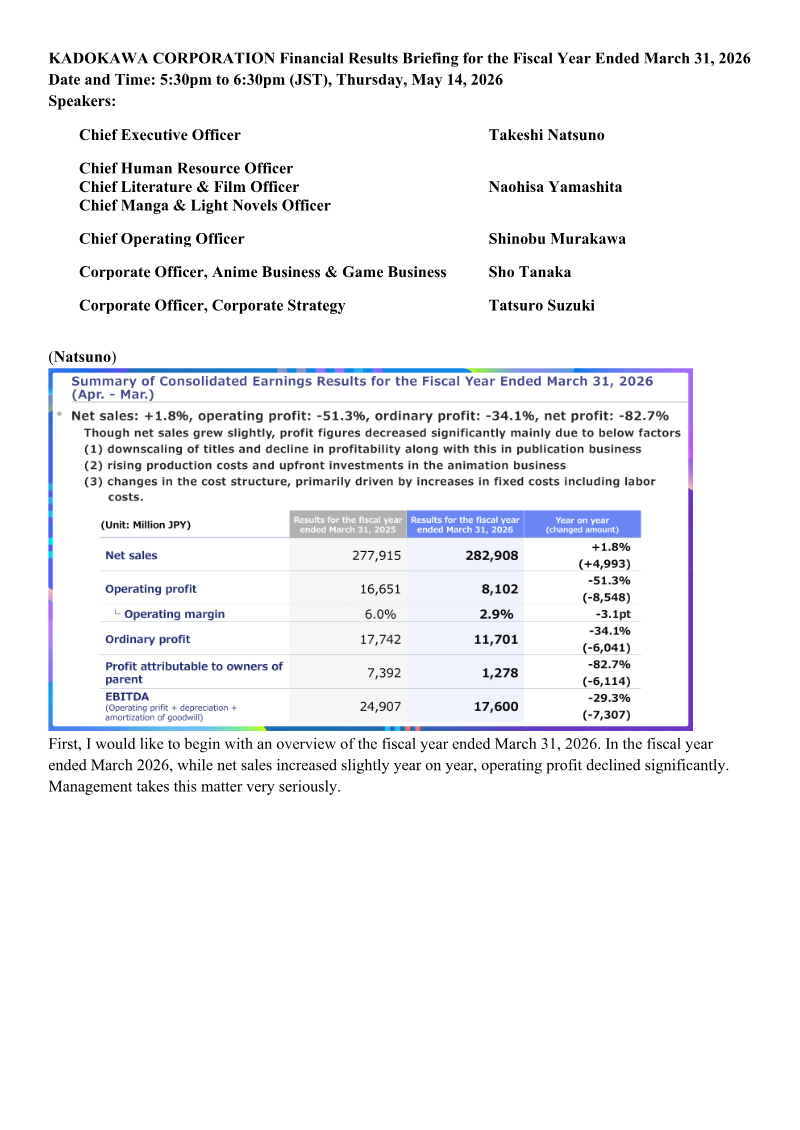
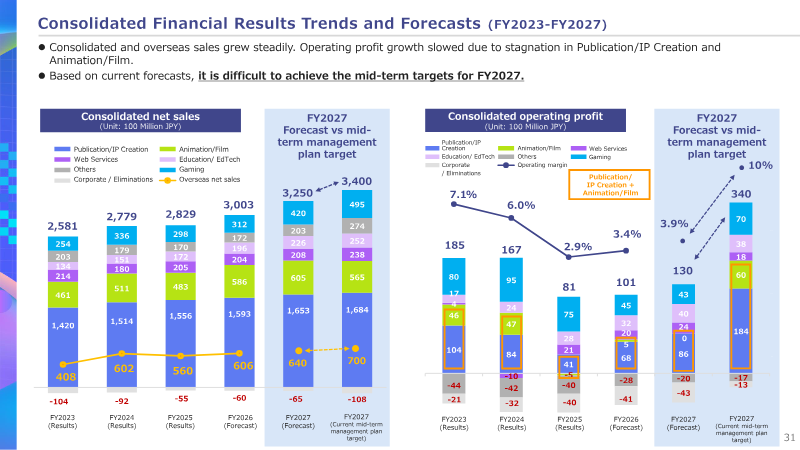
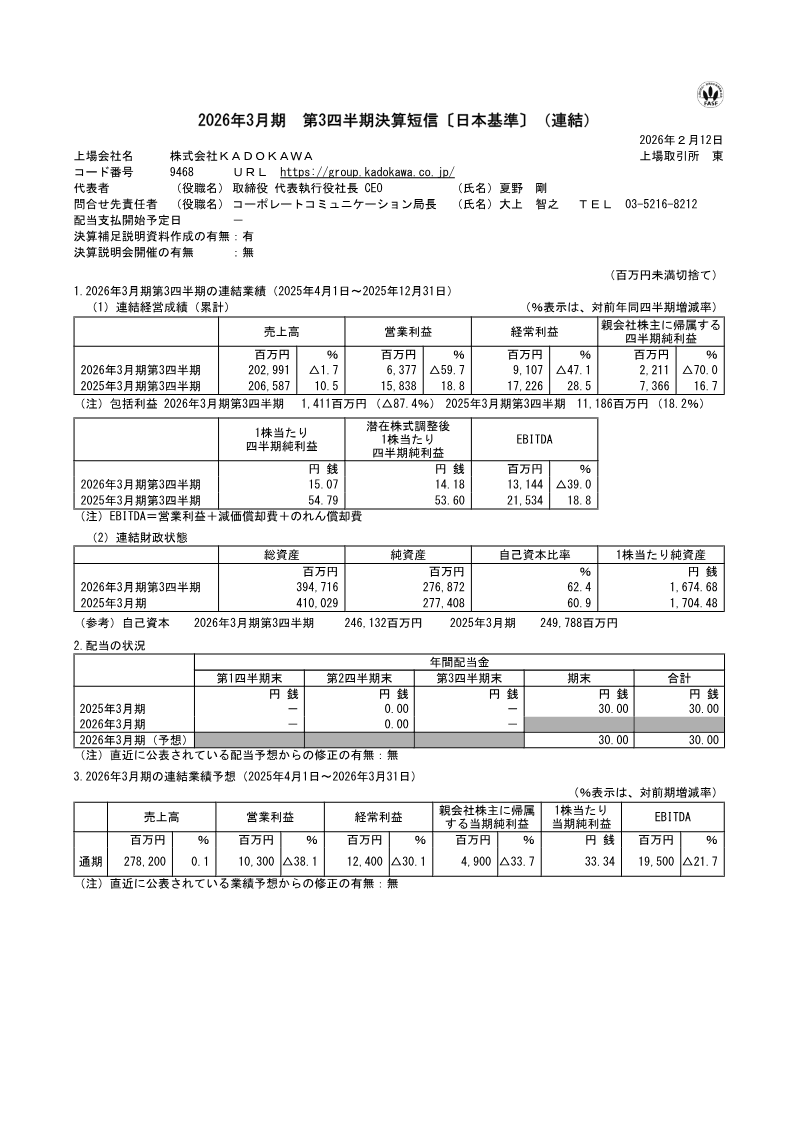
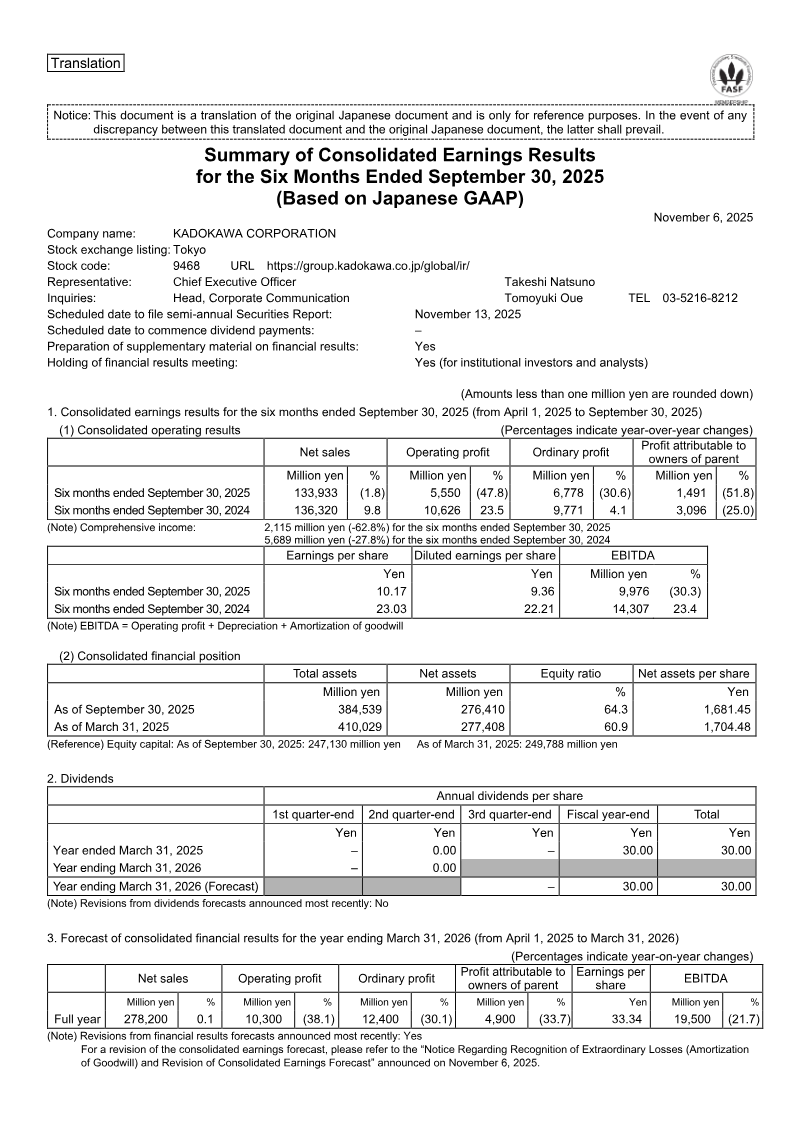
Kadokawa Corporation’s fiscal year ending March 31, 2026, reflects a period of transition characterized by modest revenue growth alongside a substantial contraction in profitability. Consolidated net sales reached 282,908 million yen, representing a 1.8 percent year-on-year increase. However, operating profit plummeted by 51.3 percent to 8,102 million yen, while profit attributable to owners of the parent fell to 1,278 million yen. These financial results were heavily influenced by rising personnel expenses, the amortization of goodwill, and impairment losses, compounded by a lack of major commercial hits within the core Publication, Animation, and Gaming segments.
Despite these challenges, the company is actively diversifying its portfolio, with the Education and EdTech segment emerging as a significant growth engine driven by rising enrollment in online high schools and the expansion of Vantan Inc. Strategic international expansion remains a central pillar of the corporate strategy, evidenced by the acquisitions of Edizioni BD S.r.l. in Italy and SOZO Pte. Ltd. in Southeast Asia. These moves are designed to bolster the company’s global media mix and strengthen its footprint in international publishing and event markets, even as cash and cash equivalents decreased to 90,774 million yen due to these aggressive investment and financing activities.
Looking toward the future, the organization has implemented a Mid-term Management Plan extending through 2032, which prioritizes a strategy of integrating technology with its global media mix. Management is currently focused on structural reforms, including the consolidation of animation production hubs and the rationalization of publishing operations to restore margins. With a sales forecast of 300.3 billion yen for the upcoming fiscal year and a commitment to a 30 percent dividend payout ratio, the company aims to leverage its intellectual property assets to drive long-term value and recover from the recent decline in operational efficiency.



Kadokawa Corporation · 2026



Kadokawa Corporation · 2026

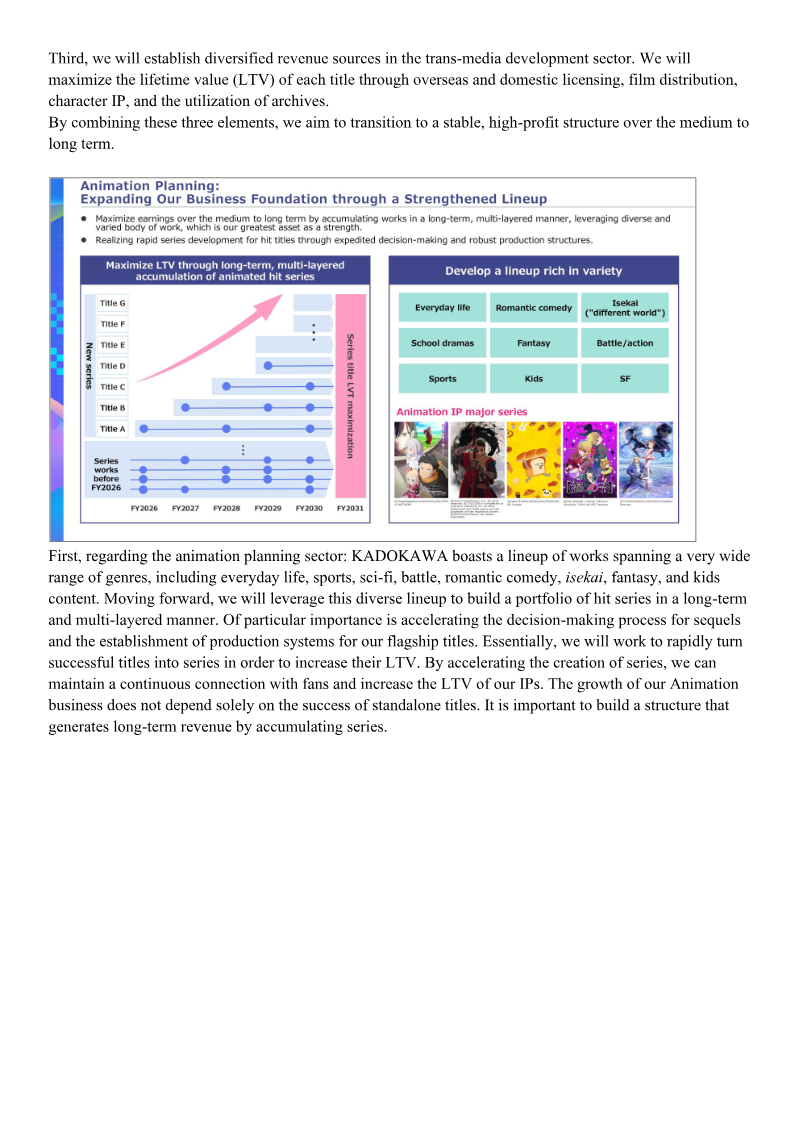
Kadokawa Corporation · 2026
Kadokawa Corporation · 2026



Kadokawa Corporation · 2026



Kadokawa Corporation · 2026


Kadokawa Corporation · 2026
Kadokawa Corporation · 2026
Kadokawa Corporation · 2026



Kadokawa Corporation · 2025
Kadokawa Corporation · 2025
Kadokawa Corporation · 2025
Nihon Falcom · 2026