Investments·Updated Mar 17, 2026 by InvestGame
What can I help with?
AI-powered answers with citations from the library.
What can I help with?
AI-powered answers with citations from the library.
Report · January 1, 2020
Published by InvestGame
This analysis examines global investment and merger and acquisition (M&A) activity within the video game industry from 2020 through 2022. The primary thesis posits that the industry has passed a historic peak of deal-making and is now entering a "Great Reset" characterized by market cooling, lower valuations, and a shift in investor priorities. While the era of massive public offerings and late-stage venture capital (VC) surges has slowed due to macroeconomic headwinds like inflation and rising interest rates, the industry remains fundamentally strong with significant "dry powder" available for early-stage startups and strategic consolidations. The data reveals a volatile three-year cycle. M&A activity reached a zenith in 2022 with $37.7 billion in closed deals—a 199% increase in value from 2021—driven by massive consolidations such as Take-Two’s acquisition of Zynga. Conversely, public offerings plummeted by 82% in 2022 as the IPO and SPAC windows effectively closed. Private investments also saw a 16% decline in value in 2022 after doubling the previous year. Despite these drops, early-stage VC remained resilient, with over $6.2 billion raised by gaming-focused funds ready for deployment. Geographically and segmentally, the scope is global, with specific attention paid to the decline of mobile gaming hype post-IDFA and the rising interest in PC, console, and AI-driven startups. The report highlights a stark cooling in Web3 gaming, where investor "FOMO" has been replaced by a focus on fundamental gameplay and infrastructure. Gender diversity remains a challenge in the sector; 89% of funded or acquired companies were led by men in 2022, a negligible change from 90% in 2021. Methodologically, the findings are based on tracked closed transactions across video game publishers, developers, and hardware providers. Data was aggregated from public media, S&P Capital IQ, and partner insights, utilizing a weighted ranking system to identify the most active investors. The analysis concludes that while the "peak wave" has passed, the industry is transitioning into a more disciplined phase of the investment cycle.
# Summary: Highlights | 2020 | 2021 | 2022 | | --- | --- | --- | | Private Investments | | | | $5.9B 361 Deals | ↑103% 562 Deals | $12.0B ↓16% 16% | | M&As | | | | $12.7B 218 Deals | ↑199% 318 Deals | $37.7B ↑7% ↑7% | | Public Offerings | | | | $15.7B 82 Deals | ↑58% 68 Deals | $24.5B ↓82% ↓82% |
# Tremendous Growth of Interest in the Video Games Industry — The past three years have marked a cycle of robust investments and growing deal activity, which has far exceeded previous periods, and transformed the industry landscape. — Whereas Public Offerings and Late-stage VC activity almost halted, M&As and Early-stage deals may see fewer transactions and at lower valuations. — As economy cools down and the gaming deal activity follows the trend, we have passed the peak wave, and are now gradually entering a new phase of the investment cycle. — Despite the short-term turbulence, the deal activity will remain strong: there is potential for a few significant deals to occur in 2023, as the industry continues to consolidate, supported by strong investors’ interest and enough cash to pursue transformative deals.
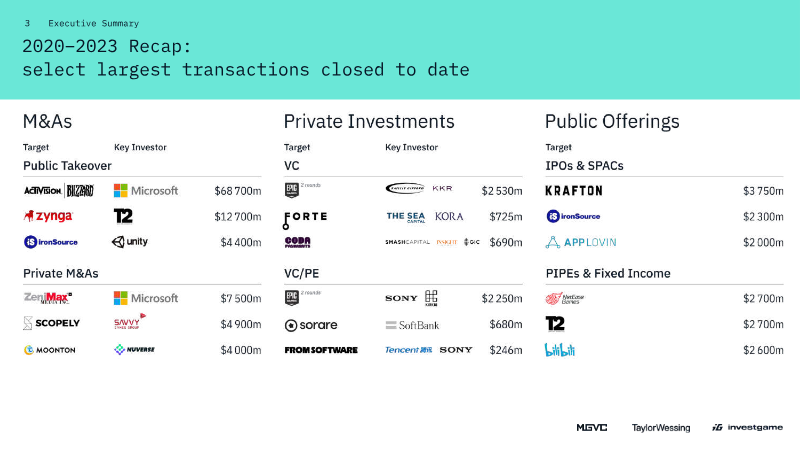
# Unprecedented Influx of VC & Corporate Investments — There’s been a truly unparalleled inflow of investments in the industry recently, surpassing any previous historical levels in both number (over 1460) and value $( \$ 28 B )$ of deals. — We’ve seen an emergence of many new gaming funds and multiple fundraising campaigns closed. This, together with many VC tech funds establishing dedicated gaming practices (e.g., a16z, Lightspeed), will support investments in the sector going forward. — Though current environment suggests we may see fewer deals and lower amounts in Late-stage rounds, Early-stage activity will continue growing, as many funds are looking to deploy massive amounts of dry powder. There’ve also been some shifts in the investor focus recently: — Mobile gaming reached its hype peak in 2020–21, but has since notably declined in 2022, driven by post-IDFA reality. — PC & Console and Cross-platform game developers experienced increased interest from investors. — While Web3 was a major trend back in 2020–2021, AI startups are holding massive appeal currently. — Corporate activity is constantly growing, as valuations decrease and many strategics hold substantial amounts of cash. Table: Select Private Investments Deals | Year | Target | Deal Type | Deal Size, $m | | --- | --- | --- | --- | | 2020 | EPIC GAMES | Late-Stage / Corporate | 1 780 | | 2021 | Late-Stage VC | 1 000 | | | 2022 | Corporate | 2 000 | |
# M&As: Reached Peak, Now Cooling Down - — M&A activity saw continued growth, reaching its peak in 2022, with over $\$ 418$ in the closed deals’ value and additional $\mathord { \sim } \$ 70 B$ of announced deals. - — But it is expected to slow down in the coming year, which is likely to be caused by a decrease in exit valuations and a lack of scalable targets. - — Nevertheless, we believe the M&A activity will stay at a healthy level, well above pre-pandemic levels. - — As valuations came down, and some companies struggled to scale their products, many strategics are exploring investment opportunities to enhance portfolio and obtain new talent and expertise. - — Public takeovers have become a common phenomenon for the market recently. This trend seems to continue in 2023 with the most recent Playtika bid for Rovio. - — One more notable trend in the M&A market is a shift from public acquirers (with much lower trading multiples than 12 months ago) towards private acquirers (with enough cash firepower). - — Additionally, there has been a preference shift in focus, from mobile studios (representing $\sim 5 0 \%$ of the deal value in 2021) towards PC & Console developers and mobile assets purchases recently. Table: Select Notable Closed M&A Deals | Year | Target | Buyer | Deal Size, $m | | --- | --- | --- | --- | | 2020 | peak | zynga | 2 083 | | 2021 | Zenimax | Microsoft | 7 500 | | 2022 | zynga | T2 | 12 700 |
# Public Offerings Coming to a Halt, Challenging Year Ahead — The peak of Public Offerings was reached in 2021, while the following year was marked by a decline in activity. This trend is expected to continue in 2023, with the IPO and SPAC windows remaining closed, and PIPEs becoming less frequent due to low trading multiples. — Share prices of gaming companies undergoing IPO or SPAC recently have significantly decreased compared to the closing price of the first day of trading. — Additionally, the issue of new shares has become an increasingly expensive option to finance the deals (as trading multiples continue to struggle). — Furthermore, the overall macroeconomic environment, characterized by growing inflation and rising interest rates, has also impacted institutional investors’ appetite for gaming and platform and technology sectors. — We expect partial recovery in the second part of 2023. Table: Select Public Offerings Deals | Year | Target | Deal Type | Deal Size, $m | | --- | --- | --- | --- | | 2020 | NetEase Games | PIPE | 2 700 | | 2021 | KRAFTON | IPO | 3 750 | | 2022 | T2 | Fixed Income | 2 700 |
# Top 15 Closed Deals with the Biggest Global Media Coverage Together with White Label PR, we have tracked the most media-covered deals for the period of 2020–2022, ranking them based on the number of mentions in media outlets with 1M+ monthly active users (MAU), within a one-month range after the announcement. To make this data as objective as possible, we did not consider duplicate articles and only used the deals with disclosed transaction value in this methodology. WHITE LABEL PRI | Rank | Target | Lead Investors / Buyers | Deal Type | Deal Value $m | Number of Mentions | | --- | --- | --- | --- | --- | --- | | 1 | Zenimax Media | Microsoft Corporation | Acquisition | 7 500 | 5483 | | 2 | Epic Games | Sony Group Corporation and KIRKBI | Corporate | 2 000 | 653 | | 3 | Bungie | Sony Interactive Entertainment | Acquisition | 3 700 | 327 | | 4 | Zynga | Take-Two Interactive | Acquisition | 12 700 | 252 | | 5 | Glu Mobile | Electronic Arts | Acquisition | 2 100 | 207 | | 6 | Roblox | — | Notes Offering | 1 000 | 187 | | 7 | Sumo Group | Tencent | Acquisition | 1 263 | 107 | | 8 | ironSource | Unity | Acquisition | 4 400 | 100 | | 9 | ironSource | Thoma Bravo Advantage | SPAC | 2 300 | 97 | | 10 | Crystal Dynamics | Embracer Group | Acquisition | 300 | 96 | | 11 | Codemasters | Electronic Arts | Acquisition | 1 200 | 95 | | 12 | Embracer Group | Saudi-Arabia Public Investment Fund | Minority Acquisition | 1 000 | 80 | | 13 | Take-Two Interactive | — | Notes Offering | 2 700 | 67 | | 14 | ESL Gaming | Savvy Gaming Group | Acquisition | 1 050 | 67 | | 15 | Playtika | — | IPO | 1 880 | 62 |
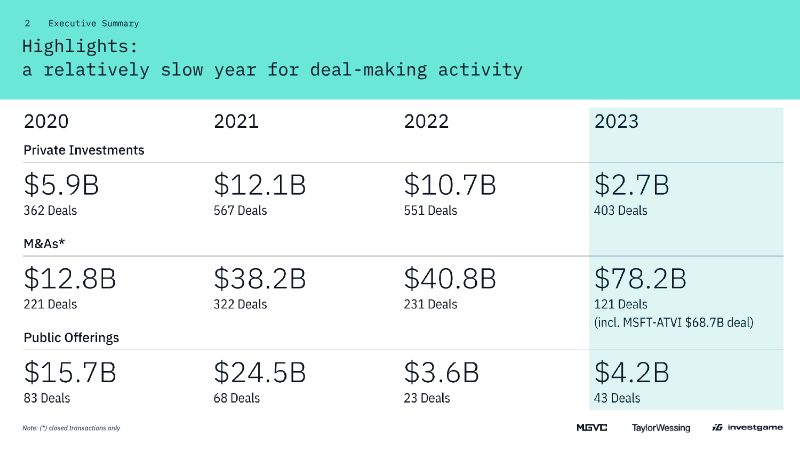
The 2023 Gaming Deals Report evaluates investment activity across the video‑game sector from 2020 through 2023, aiming to clarify how capital flows and transaction structures have reshaped the industry. By aggregating private‑equity, venture‑capital, and merger‑and‑acquisition data, the analysis demonstrates a pronounced shift from early‑stage financing toward large‑scale consolidation, while also tracking the emergence of artificial‑intelligence (AI) applications within game development and publishing. Overall capital raised by private‑equity and venture‑capital funds peaked at $12.1 billion in 2021 before retreating sharply to $2.7 billion in 2023, reflecting a contraction in early‑stage funding. The number of such deals followed a similar pattern, falling from a high of 567 in 2021 to 403 in 2023. In contrast, M&A activity accelerated dramatically, with closed‑deal value more than doubling from $40.8 billion in 2022 to $78.2 billion in 2023, even as the count of transactions remained modest. This divergence indicates that larger players are pursuing strategic acquisitions to capture market share and talent, while smaller firms face tighter financing conditions. AI‑related transactions, though still a niche segment, have shown a steady upward trajectory, with the cumulative count of closed AI deals rising from single‑digit figures in 2020 to over twenty in 2023. The report characterizes AI’s role as evolutionary rather than disruptive, suggesting that developers are integrating machine‑learning tools to enhance production efficiency and player experiences without fundamentally overturning existing business models. Collectively, the findings portray a gaming ecosystem in which capital concentration is intensifying, consolidation is accelerating, and emerging technologies are being incrementally adopted. Stakeholders are advised to monitor the narrowing gap between early‑stage funding and large‑scale M&A, as well as the growing relevance of AI, to anticipate future competitive dynamics.
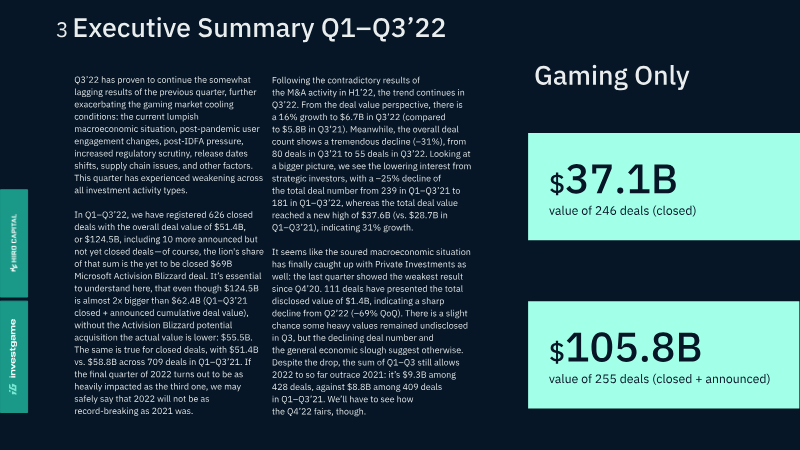
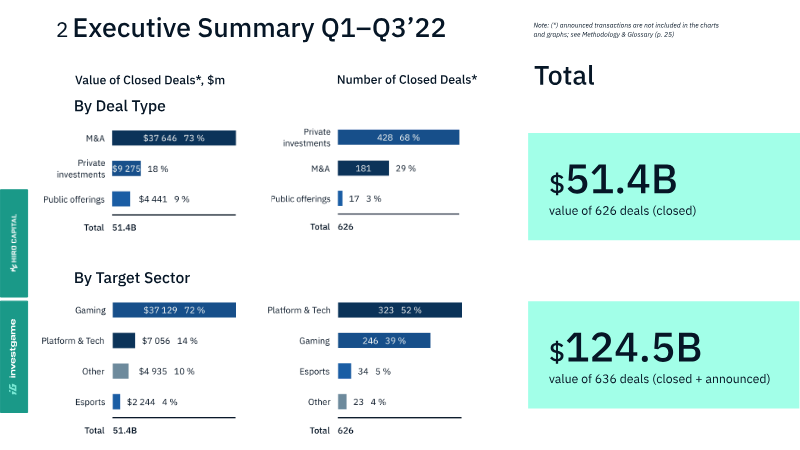
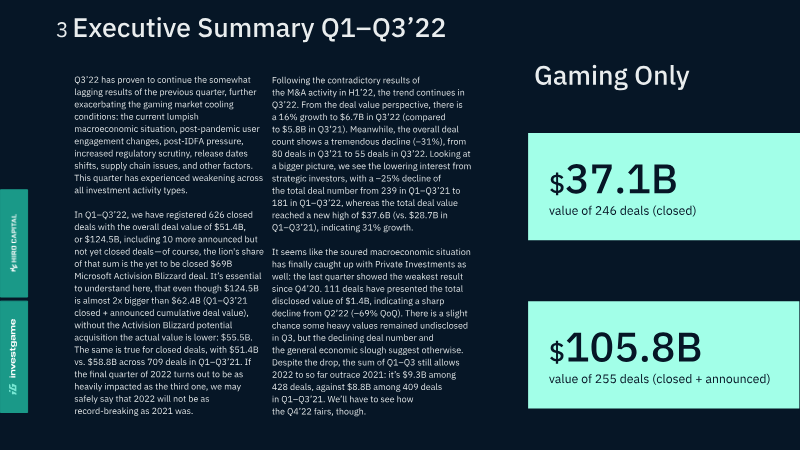
The gaming investment landscape in the first three quarters of 2022 reflects a significant market correction following a record-breaking 2021. While the total value of closed and announced deals reached $124.5 billion—nearly double the previous year's volume—this figure is heavily skewed by Microsoft’s pending $69 billion acquisition of Activision Blizzard. Excluding that single transaction, the market shows clear signs of cooling due to macroeconomic instability, post-pandemic shifts in user engagement, and increased regulatory scrutiny. Strategic mergers and acquisitions (M&A) remain the primary driver of deal value, reaching a record $101.4 billion year-to-date, despite a 40% decline in the number of closed transactions. Major players like Embracer Group, Sony, and Saudi Arabia’s Public Investment Fund (PIF) dominated this activity. Conversely, public offerings have nearly collapsed, reaching their lowest point since early 2020, with deal values shrinking fivefold compared to 2021. Private investments also saw a sharp decline in the third quarter, dropping 69% from the previous quarter, signaling that the "soured" economic climate has finally impacted venture capital and corporate rounds. The report highlights a notable shift in the blockchain and Web3 gaming sectors. While early-stage investment in this space previously drove market growth, the third quarter of 2022 marked the first period of negative growth for blockchain-related investments, with total deal value falling 14% year-over-year. Investors are becoming more selective, moving away from infrastructure platforms toward studios capable of producing engaging content. Geographically, the United States remains the most active market for gaming investments, followed by the United Kingdom and Turkey. Gender diversity remains a challenge for the industry, as 89% of companies receiving investment are male-led, with women-led entities representing only 2% of the total.
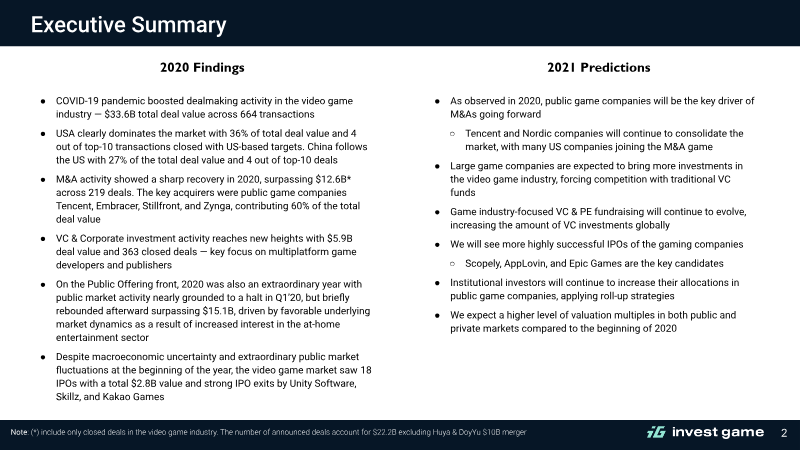
The 2020 fiscal year marked a historic period of consolidation and capital infusion for the global video game industry, largely catalyzed by the COVID-19 pandemic and the resulting surge in at-home entertainment. Total deal value reached $33.6 billion across 664 transactions, encompassing mergers and acquisitions, private investments, and public offerings. The United States and China emerged as the primary geographical drivers, collectively representing 63% of the total deal value. The market demonstrated significant resilience, recovering from a stagnant first quarter to reach record-breaking activity levels in the second half of the year. M&A activity was a primary pillar of this growth, totaling $12.6 billion across 219 deals. This sector was dominated by public strategic acquirers such as Tencent, Embracer Group, Stillfront, and Zynga, who accounted for 60% of the total M&A value. Private investment also reached new heights, with $5.9 billion raised through venture capital and corporate rounds, specifically targeting multiplatform developers and mobile studios. Public markets followed a similar trajectory; after a quiet start to the year, public offerings surpassed $15.1 billion, supported by high-profile IPOs from companies like Unity Software and Kakao Games, as well as significant fixed-income activity as firms moved to refinance debt at lower interest rates. The analysis segments the industry into gaming, platform technology, and esports. While gaming remained the most active sector, platform and tech saw substantial late-stage investments in companies like Roblox and Epic Games. Looking forward, the industry is expected to see continued consolidation led by Nordic and Chinese firms, increased competition between traditional venture capital and large strategic investors, and a robust pipeline of IPO candidates. This data was compiled by tracking closed transactions across public media and financial databases, excluding pure gambling and betting entities to focus on the core video game ecosystem.
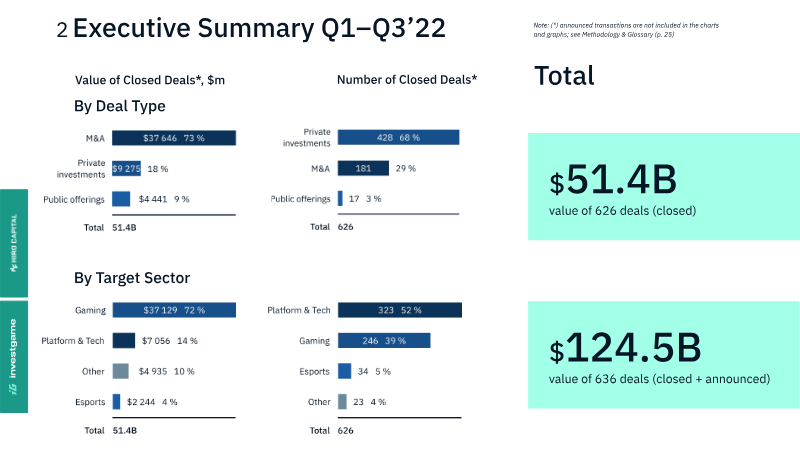
The analysis tracks deal activity across the global gaming ecosystem during the first three quarters of 2022, quantifying both merger‑and‑acquisition (M&A) and venture‑capital trends to assess how regulatory shifts and macro‑economic conditions reshaped investment patterns. A total of 626 transactions closed, generating $51.4 billion in value—a 31 percent rise over the same period in 2021—yet the quarterly count of deals contracted sharply, falling from 80 in Q1 to 55 by Q3. This contraction is attributed to heightened regulatory scrutiny, the fallout from the IDFA privacy changes, and a broader slowdown in economic confidence. M&A activity remained the dominant driver, accounting for roughly 73 percent of total deal value, with gaming‑specific mergers representing 72 percent of that share, underscoring the sector’s preference for consolidation over organic growth. In contrast, venture investment slipped 25 percent year‑over‑year, reflecting investor caution amid the same external pressures. Within the venture segment, crypto‑gaming emerged as a distinct outlier: Series A rounds averaged $40 million, markedly above the $25 million average across all gaming deals, highlighted by sizable raises such as Jot Art’s $55 million, Iskra’s $34 million, and Planetarium Labs’ $32 million. Overall, the period illustrates a market in transition, where large‑scale M&A continues to capture the bulk of capital while emerging niches like crypto‑gaming attract disproportionately high funding despite a general retreat in venture activity. The findings suggest that future deal flow will likely hinge on regulatory clarity and the ability of niche segments to sustain investor enthusiasm in a constrained macro environment.