FinancialInvestGame
Gaming Deals Report 2023: Striving for Elevation
1 Mar 202424 pages~26 min full read
The 2023 Gaming Deals Report evaluates investment activity across the video‑game sector from 2020 through 2023, aiming to clarify how capital flows and transaction structures have reshaped the industry. By aggregating private‑equity, venture‑capital, and merger‑and‑acquisition data, the analysis demonstrates a pronounced shift from early‑stage financing toward large‑scale consolidation, while also tracking the emergence of artificial‑intelligence (AI) applications within game development and publishing.
Overall capital raised by private‑equity and venture‑capital funds peaked at $12.1 billion in 2021 before retreating sharply to $2.7 billion in 2023, reflecting a contraction in early‑stage funding. The number of such deals followed a similar pattern, falling from a high of 567 in 2021 to 403 in 2023. In contrast, M&A activity accelerated dramatically, with closed‑deal value more than doubling from $40.8 billion in 2022 to $78.2 billion in 2023, even as the count of transactions remained modest. This divergence indicates that larger players are pursuing strategic acquisitions to capture market share and talent, while smaller firms face tighter financing conditions.
AI‑related transactions, though still a niche segment, have shown a steady upward trajectory, with the cumulative count of closed AI deals rising from single‑digit figures in 2020 to over twenty in 2023. The report characterizes AI’s role as evolutionary rather than disruptive, suggesting that developers are integrating machine‑learning tools to enhance production efficiency and player experiences without fundamentally overturning existing business models.
Collectively, the findings portray a gaming ecosystem in which capital concentration is intensifying, consolidation is accelerating, and emerging technologies are being incrementally adopted. Stakeholders are advised to monitor the narrowing gap between early‑stage funding and large‑scale M&A, as well as the growing relevance of AI, to anticipate future competitive dynamics.

InvestGame · 2026
InvestGame · 2026

InvestGame · 2026
InvestGame · 2026
InvestGame · 2026

InvestGame · 2026
InvestGame · 2026
InvestGame · 2026
InvestGame · 2026

InvestGame · 2025

InvestGame · 2025
InvestGame · 2025

Aream & Co · 2026
Drake Star Partners · 2026
Modern Times Group · 2026
Drake Star Partners · 2025
Drake Star Partners · 2025
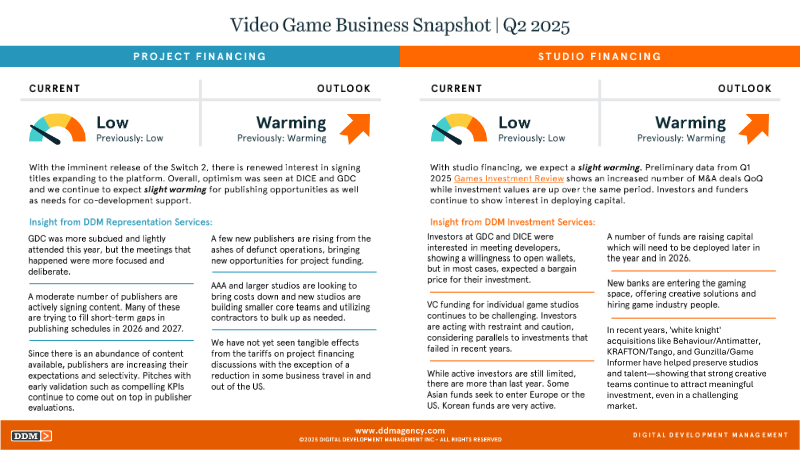
DDM · 2025
Drake Star Partners · 2025
Digital Development Management · 2025
DDM · 2025

Thunderful · 2025
DDM · 2025
Aream & Co · 2025