Related Documents
Report
Mobile Game Market Review: November 2023
This market review analyzes mobile gaming trends and performance for November 2023, focusing on the United States and Chinese markets. The analysis identifies a significant shift in monetization strategies within midcore titles, where developers are increasingly locking exclusive event content and story missions behind paywalls. Notable examples include Free Fire’s Luminous Pass and State of Survival’s Resident Evil collaboration, which required specific purchases or gacha mechanics to access core event gameplay. In the casual segment, the industry is seeing a period of heavy mechanical imitation led by the success of Royal Match. Two specific event archetypes—the "Social Win Streak" (a battle royale-style level progression) and the "Digging Minigame" (a grid-based reward hunt)—have been widely adopted by major titles like Monopoly GO! and Matchington Mansion. Furthermore, the 3D match subgenre is expanding rapidly following the success of Triple Match 3D, with industry giants like King and Peak launching new competitors such as Candy Crush 3D and Match Factory. The review also highlights the impact of viral trends and major intellectual properties. The "watermelon game" craze, sparked by the Nintendo Switch title Suika Game, led to a surge of mobile clones climbing the download charts. Meanwhile, high-profile launches like Warcraft Rumble and Black Clover M demonstrated the continued strength of established IPs, with both titles securing top-tier positions in US download and grossing ranks. Methodology for these findings includes data from live event trackers, download rankings, and revenue performance across major mobile app stores.
GameRefineryNov 2023
Report
Analyst Bulletin: Mobile Game Market Review November 2023
The mobile gaming market in November 2023 was characterized by the proliferation of specific event mechanics and the rise of the 3D match subgenre. Analysis of market leaders reveals that Royal Match has become a primary trendsetter for casual titles. Its "Social Win Streak" and "Digging Minigame" mechanics were widely adopted by competitors such as Monopoly GO!, Matchington Mansion, and BTS Island. Simultaneously, the success of Triple Match 3D spurred a wave of new entries in the 3D match category, including Match Factory and spin-offs from established franchises like Candy Crush. A significant shift occurred in the midcore segment, where developers increasingly experimented with pay-gated event content. Titles such as Free Fire, State of Survival, and Last Fortress: Underground implemented exclusive rewards and gameplay modes accessible only through direct purchases or premium currency top-ups. This trend suggests a strategic move toward more aggressive monetization of live events, moving away from purely engagement-based models to those requiring financial entry points for participation. Geographically, the US market saw major activity with the global launch of Warcraft Rumble, which achieved the top download spot and maintained a top-50 grossing position. In China, Soul Knight Prequel demonstrated the continued strength of the roguelite genre, reaching the top of the download charts. Other notable developments included the expansion of user-generated content via the Stumble Workshop in Stumble Guys and the rapid emergence of mobile clones inspired by the viral Nintendo Switch title, Suika Game. These findings indicate a highly reactive market where developers quickly iterate on successful mechanics and viral trends across both casual and midcore segments.
GameRefineryNov 2023
Report
Mobile Game Market Review October 2023
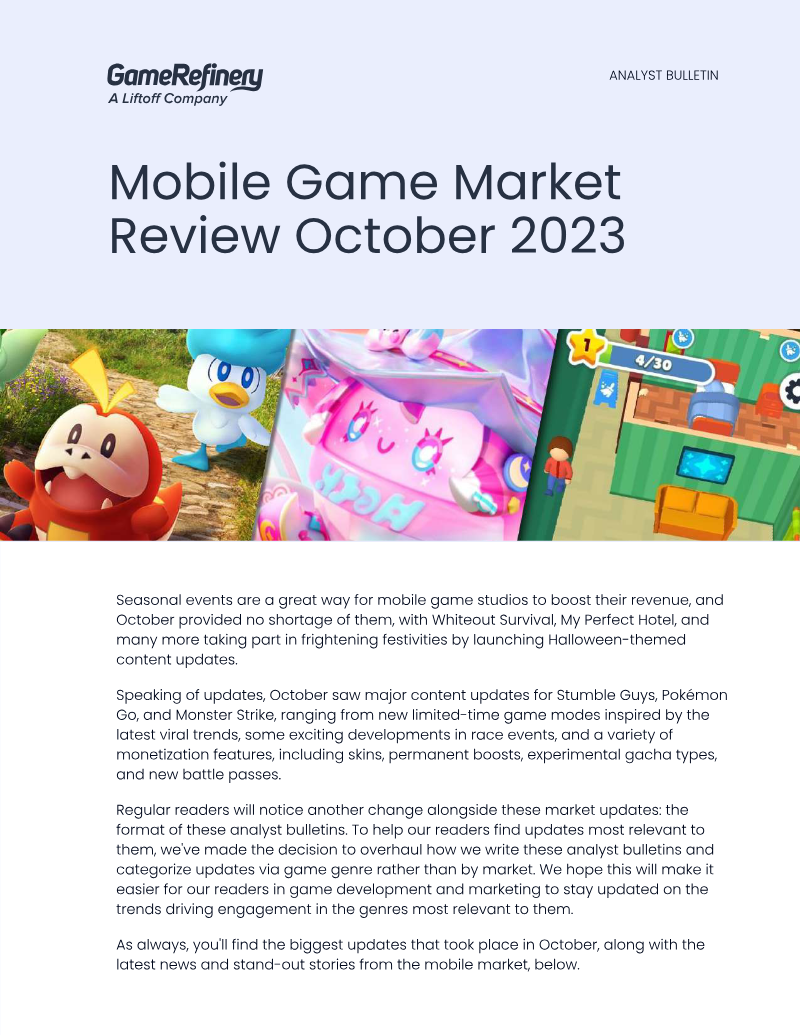
The mobile gaming market in October 2023 was characterized by a heavy reliance on seasonal Halloween content and innovative social features to drive monetization and engagement. Analysis of the period reveals that major titles across the casual and midcore segments utilized limited-time events, crossover collaborations, and experimental gacha mechanics to bolster revenue. Geographically, the review focuses on major global markets, specifically the United States, Japan, and China, highlighting how regional preferences dictate event structures, such as the prevalence of social multi-gachas and location-based business discounts in the Japanese market. In the casual segment, developers increasingly integrated social and competitive mechanics to maintain player interest. Notable examples include Pokémon Go’s introduction of a four-player party system and Eggy Party’s "Pedestrian Street" mode, which emphasizes social hangouts over core gameplay. Data indicates that titles like My Perfect Hotel successfully improved revenue trends by balancing download fluctuations with permanent boost systems and specialized battle passes. Furthermore, the market saw the rise of "challenging" platforming content in the party royale genre, drawing inspiration from viral PC trends to test player perseverance. The midcore sector demonstrated the power of long-term live operations and high-profile collaborations. Monster Strike’s 10th-anniversary celebrations in Japan utilized celebrity partnerships and anime crossovers to maintain its top-tier status. Simultaneously, new entries such as Dungeon Hunter 6 and Reverse: 1999 achieved significant chart positions shortly after launch, with the latter reaching the top 100 in both the US and Japan. The findings suggest a market shift toward hybrid gameplay—such as combining merge mechanics with match-3 puzzles—and the successful localization of high-performing Chinese extraction shooters for Western audiences. Overall, the data underscores that consistent content overhauls and the strategic timing of feature updates remain the primary drivers for scaling performance in a competitive mobile landscape.
GameRefineryApr 2023
Report
Mobile Game Market Review December 2023
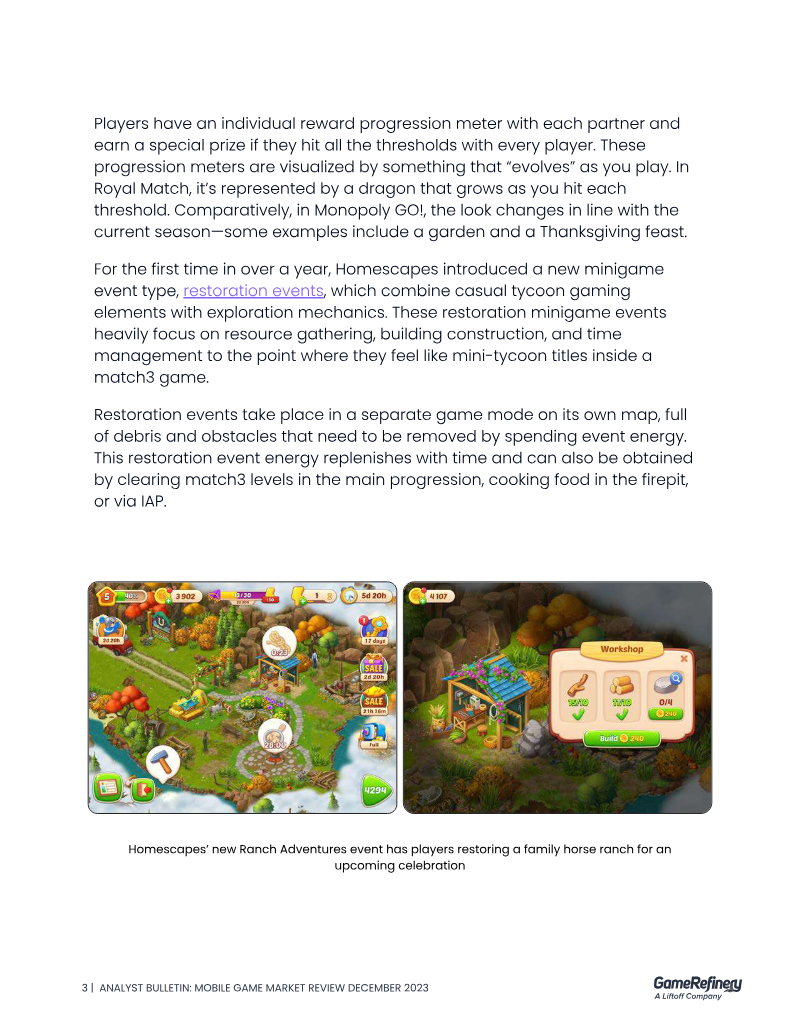
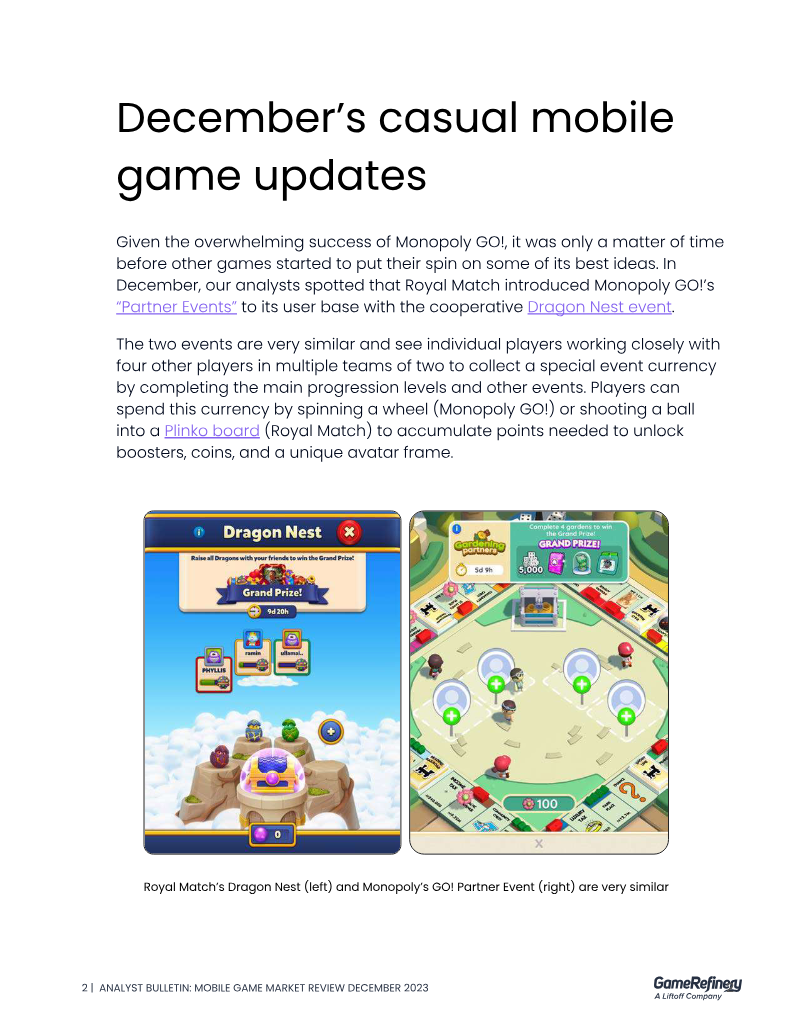
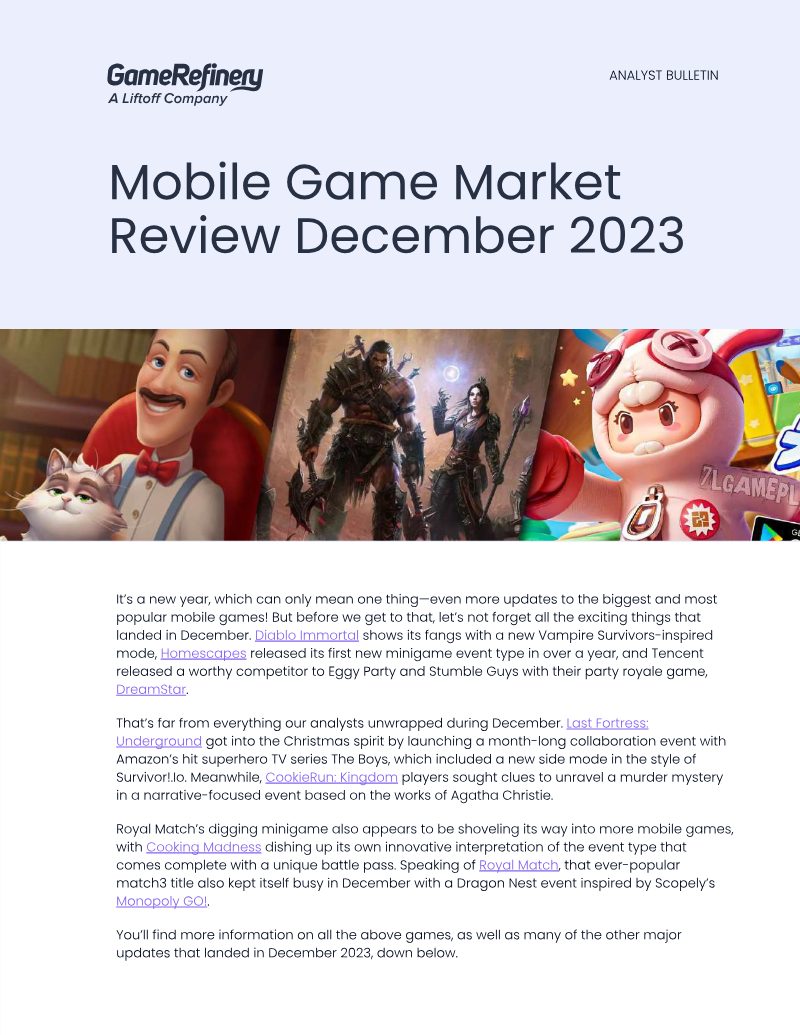
The mobile gaming market in December 2023 was characterized by aggressive experimentation with cross-genre mechanics and high-profile intellectual property collaborations. Analysts observed a significant trend of "genre-blending," where successful mechanics from market leaders were integrated into established titles. Notable examples include Royal Match adopting the cooperative partner event structure popularized by Monopoly GO!, and Diablo Immortal and Last Fortress: Underground introducing roguelite survival modes inspired by Vampire Survivors and Survivor.io. In the casual segment, developers focused on deepening engagement through complex minigames. Homescapes introduced tycoon-style restoration events to its match-3 core, while Cooking Madness innovated by linking a digging minigame directly to battle pass progression. The midcore sector saw diverse narrative and social strategies, such as CookieRun: Kingdom’s Agatha Christie-inspired murder mystery and the launch of Tencent’s party royale title DreamStar in China. DreamStar quickly became a top-grossing competitor to Eggy Party by emphasizing social hubs and user-generated content. Major updates to legacy titles yielded substantial financial results, particularly for Clash of Clans. The introduction of Town Hall 16, building-merging mechanics, and a new hero equipment system drove a 350% daily revenue spike in the United States. Geographically, the review highlights strong performance in the Chinese market for both domestic releases like DreamStar and localized versions of Western hits. Overall, the period demonstrated that mobile developers are increasingly looking beyond their own sub-genres to borrow proven engagement and monetization loops from the broader gaming ecosystem.
GameRefineryDec 2023