Tampere University
4 reports, presentations and talks by Tampere University in the Game Industry Library, the newest “How to Play Academia: Conceptual and Methodological Observations” (2026).
Documents
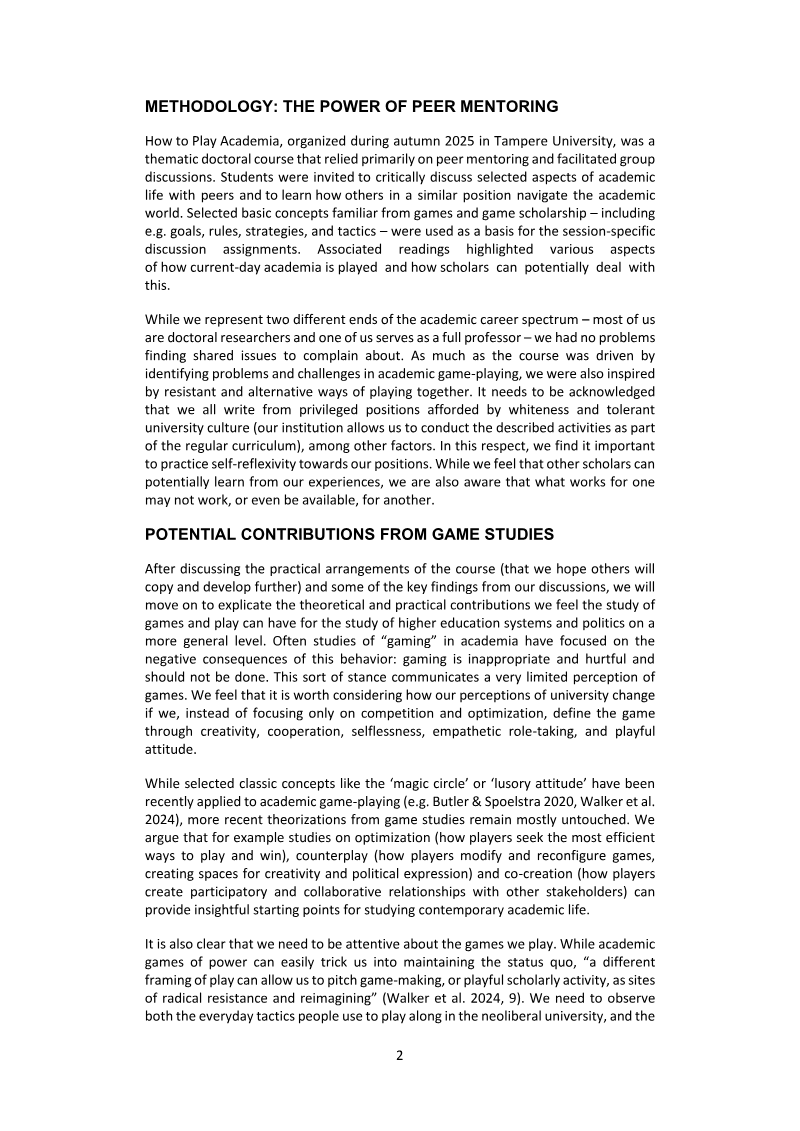
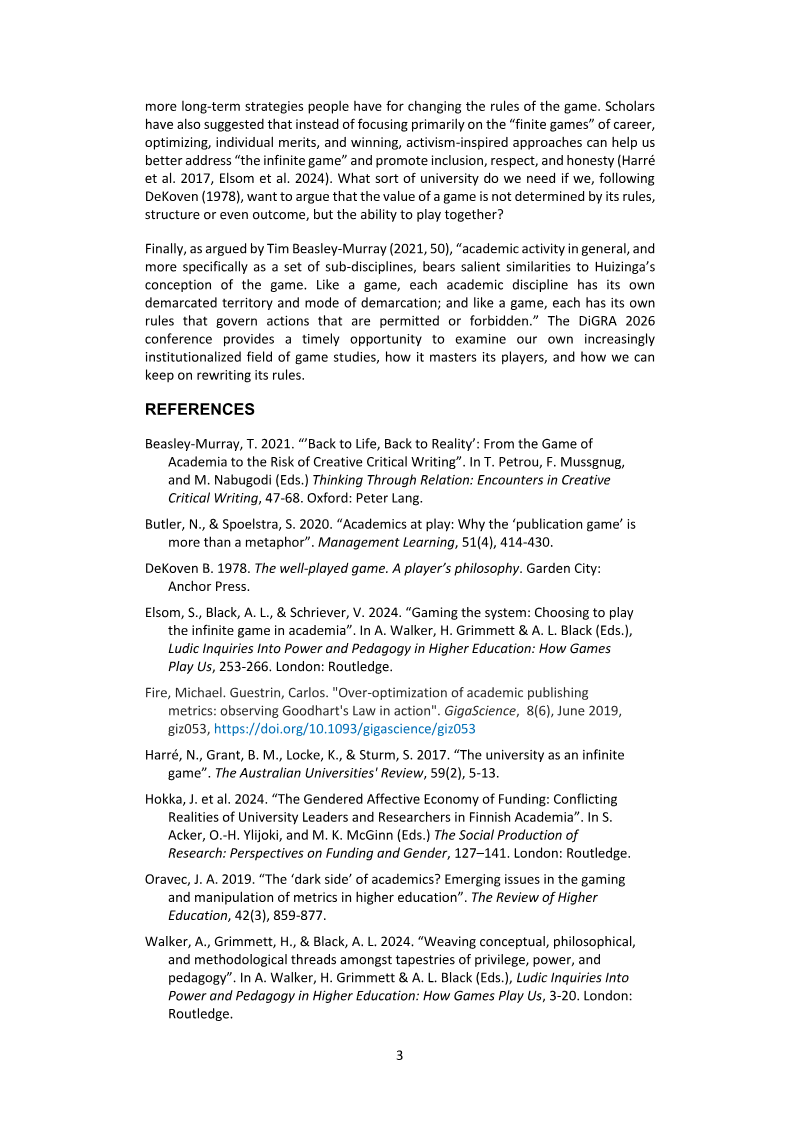
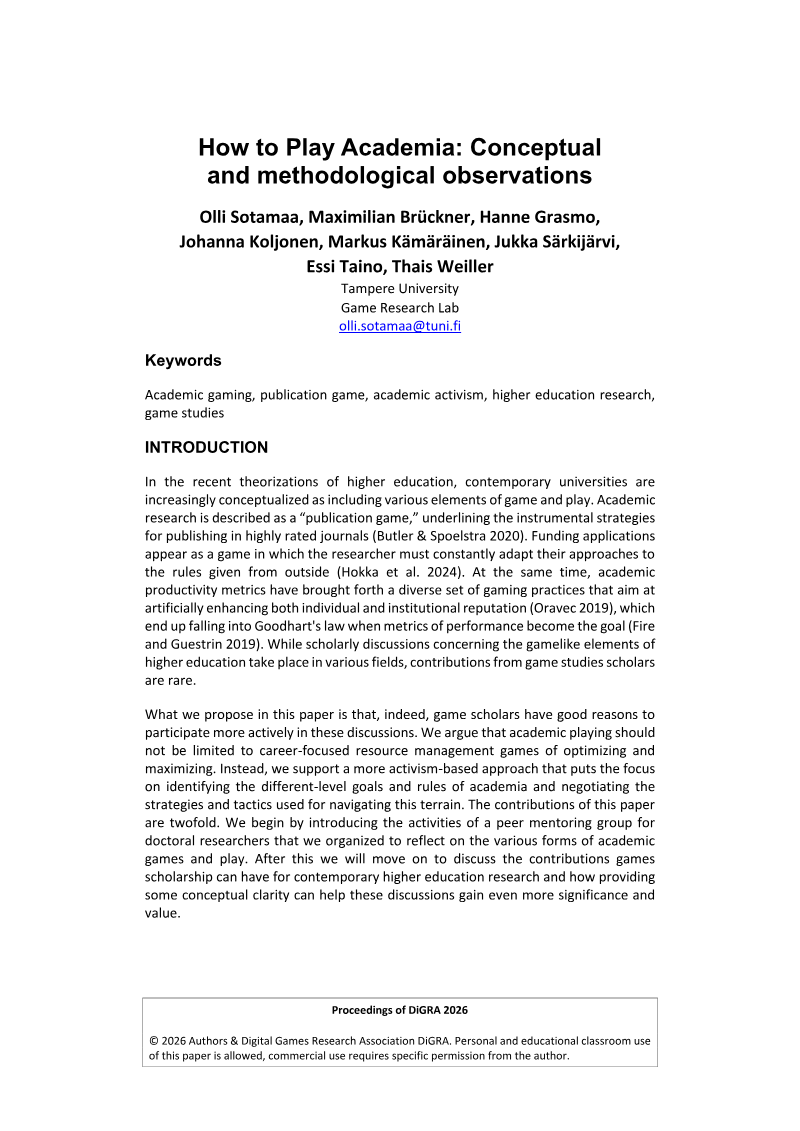
How to Play Academia: Conceptual and Methodological Observations
This paper, "How to Play Academia," argues that game studies scholars should contribute more actively to debates about the gamelike dimensions of contemporary higher education, which are often framed in terms of a "publication game," funding applications as rule-bound play, and the gaming of performance metrics that illustrates…
- The paper argues that game studies should engage more actively with the gamelike dimensions of higher education, such as the publication game, funding applications as rule-bound play, and the gaming of performance metrics illustrating Goodhart's law.
- The authors contend that existing scholarship on academic gaming focuses narrowly on negative consequences and propose an activism-oriented approach examining the goals, rules, strategies, and tactics of academic life.
- The central thesis is that game concepts such as optimization, counterplay, co-creation, the magic circle, and lusory attitude offer richer analytical resources than the dominant resource-management view of academic careers.
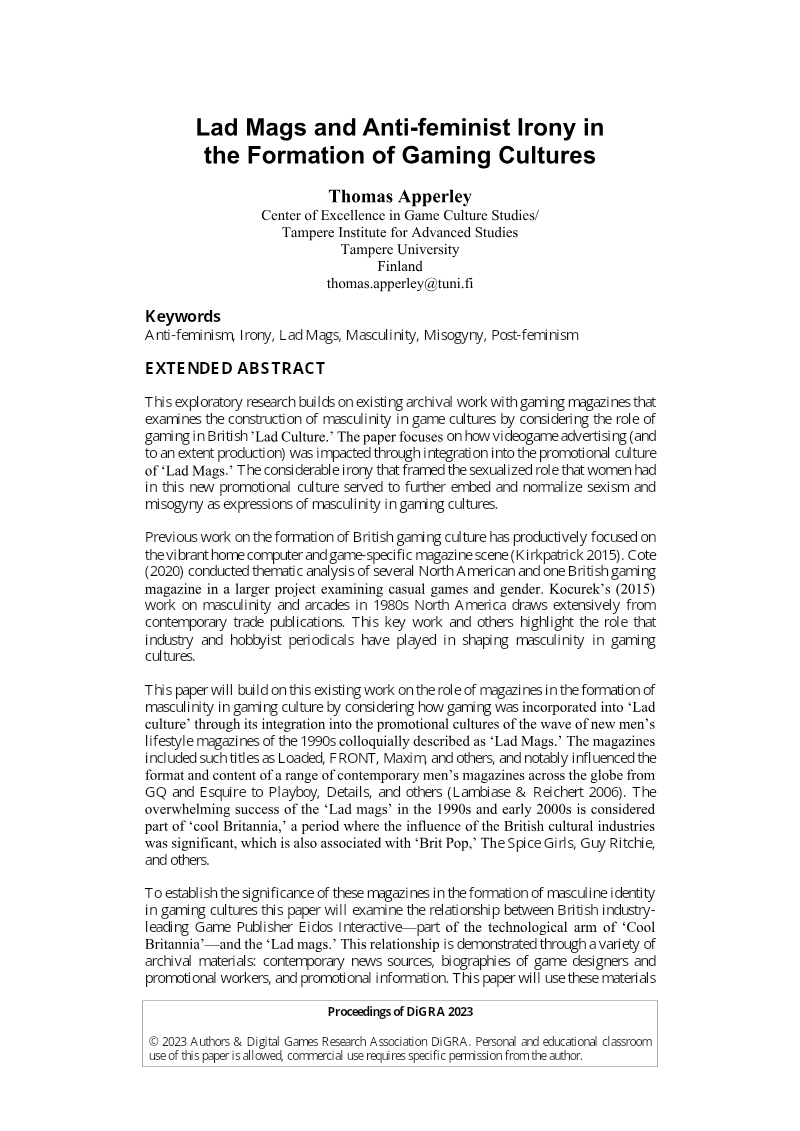
Lad Mags and Anti-feminist Irony in the Formation of Gaming Cultures
This exploratory paper examines how British "Lad Culture" of the 1990s shaped masculinity within gaming culture, focusing on the promotional relationship between the game publisher Eidos Interactive and the wave of men's lifestyle magazines known as "Lad Mags," including Loaded, FRONT, and Maxim.
- The paper argues that Lad Mag promotional strategies, paired with ironic framing of sexualized female characters, further embedded sexism and misogyny as expressions of masculinity in gaming culture during the 1990s.
- Its case studies are three Eidos Interactive titles heavily promoted in 1997: Deathtrap Dungeon, Fighting Force, and Tomb Raider II, whose marketing centered on the glamorized, sexualized presentation of their female protagonists.
- Eidos Interactive used glamour models from Lad Mags such as Loaded, FRONT, and Maxim at promotional events in Europe and North America.

Towards Understanding Game Data Work
This study examines how data work is organized within game companies, asking who performs it, what it involves, and how it reshapes understanding of game work more broadly.
- The study combines two datasets: a collection of game industry job advertisements mentioning data, and semi-structured interviews with 20 Finnish game industry professionals.
- Job advertisements show a growing number of data-intensive positions, often covering parts of the data pipeline or analytics stack, and frame data professionals as key hires, central to decision-making, and in lead roles, suggesting data processes may be shifting power structures within studios.
- The authors propose a three-part typology of game data workers: dedicated data professionals (data scientists, analysts, engineers), 'product people' (management, producers, designers, marketing) who monitor the 'health of the product,' and 'everyday game data workers' in wider development roles saturated with analytics and 'data talk.'
Kinesthetic Elementary Mathematics: Creating Flow with Gesture Modality
Kinesthetic interaction serves as a powerful pedagogical tool for elementary mathematics, specifically designed to foster a state of flow and sustained cognitive engagement among children aged six to eight.
- Integrating gesture-based technology like the Microsoft Kinect into elementary mathematics education significantly improves student immersion, retention, and academic performance.
- Empirical testing with sixty-seven participants demonstrates that physical interaction with digital content facilitates deep work and sustained cognitive engagement.
- Kinesthetic learning is particularly effective for students with diverse needs, such as those with ADHD, as gross motor activity helps stabilize concentration during complex tasks.