Updated Mar 23, 2026 by GREE
Financial
Published by GREE
GREE Inc. reported FY2021 full‑year net sales of ¥56.8 billion, operating income of ¥5.4 billion and EBITDA of ¥6.2 billion, marking year‑on‑year growth in operating income despite a decline in net sales driven by the transfer of its fashion commerce unit and weaker media performance amid COVID‑19. Net income rose to ¥13.5 billion, largely supported by gains from investment‑fund operations and the sale of securities, including an IPO. In Q4, net sales reached ¥13.9 billion and operating income hit ¥1.5 billion, surpassing forecasts; net income for the quarter was ¥4.2 billion, buoyed by investment‑security gains and deferred tax recoveries. The company’s strategic focus centers on three pillars: games, the newly renamed Metaverse business (formerly live entertainment), and advertising/media. Game operations remain stable with multiple new titles slated for release, while global distribution expanded to 72 countries. The Metaverse segment will receive aggressive promotion and development investment, targeting a user base expansion in the U.S. and worldwide; FY22 may see short‑term operating losses of several hundred million yen from upfront promotion costs. Advertising/media profits will be reinvested to sustain growth. GREE’s investment and incubation arm is reclassified as an operating business, aiming for a >10 % return and contributing to long‑term profitability. The company targets an ROE of 10 % or higher, supported by capital efficiency improvements and continued investment in its three growth engines.
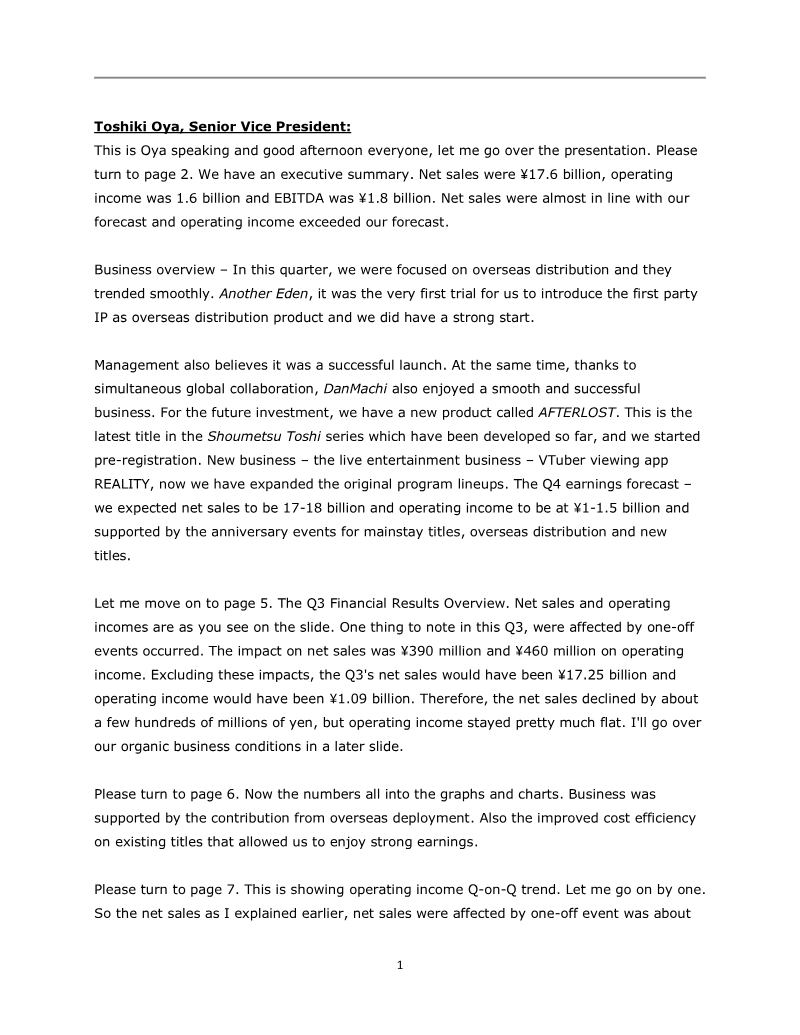
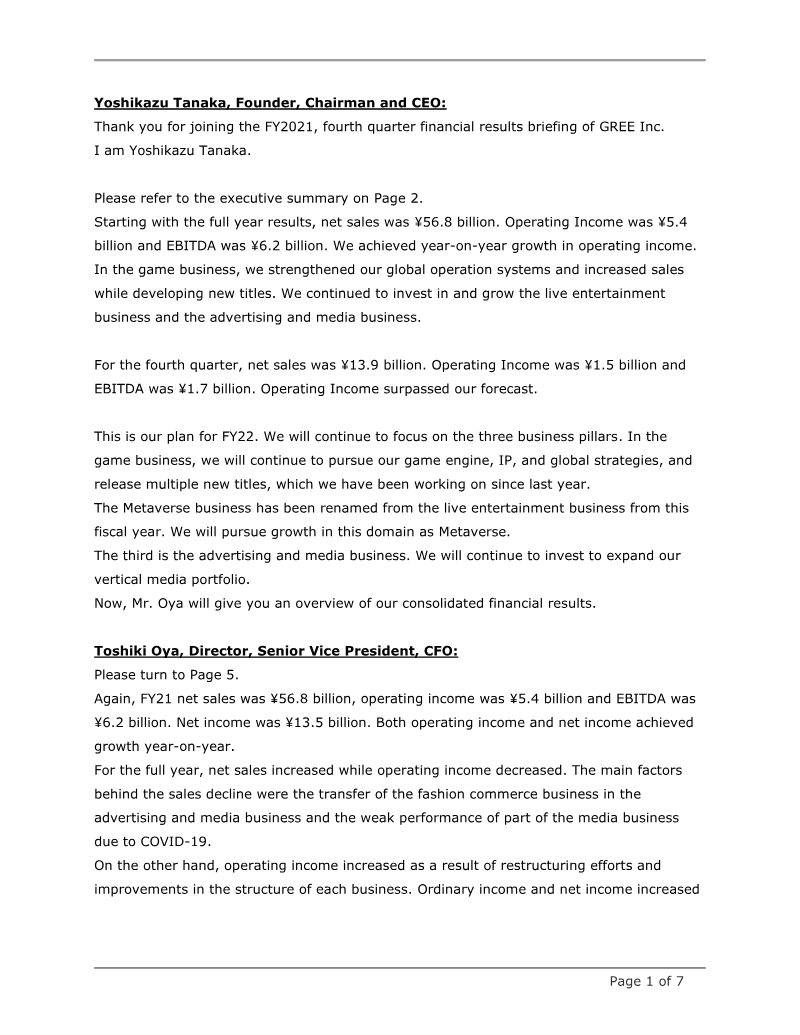
Yoshikazu Tanaka, Founder, Chairman and CEO: Thank you for joining the FY20 21, fourth quarter financial results briefing of GREE Inc. I am Yoshikazu Tanaka. Please refer to the executive summary on Page 2. Starting with the full year results, net sales was ¥56 .8 billion. Operating Income was ¥5.4 billion and EBITDA was ¥6.2 billion. We achieved year-on-year growth in operating income. In the game business, we strengthened our global operation systems and increased sales while developing new titles. We continued to invest in and grow the live entertainment business and the advertising and media business. For the fourth quarter, net sales was ¥13 .9 billion. Operating Income was ¥1.5 billion and EBITDA was ¥1.7 billion. Operating Income surpassed our forecast. This is our plan for FY22. We will continue to focus on the three business pillars. In the game business, we will continue to pursue our game engine, IP, and global strategies, and release multiple new titles, which we have been working on since last year. The Metaverse business has been renamed from the live entertainment business from this fiscal year. We will pursue growth in this domain as Metaverse. The third is the advertising and media business. We will continue to invest to expand our vertical media portfolio. Now, Mr. Oya will give you an overview of our consolidated financial results.
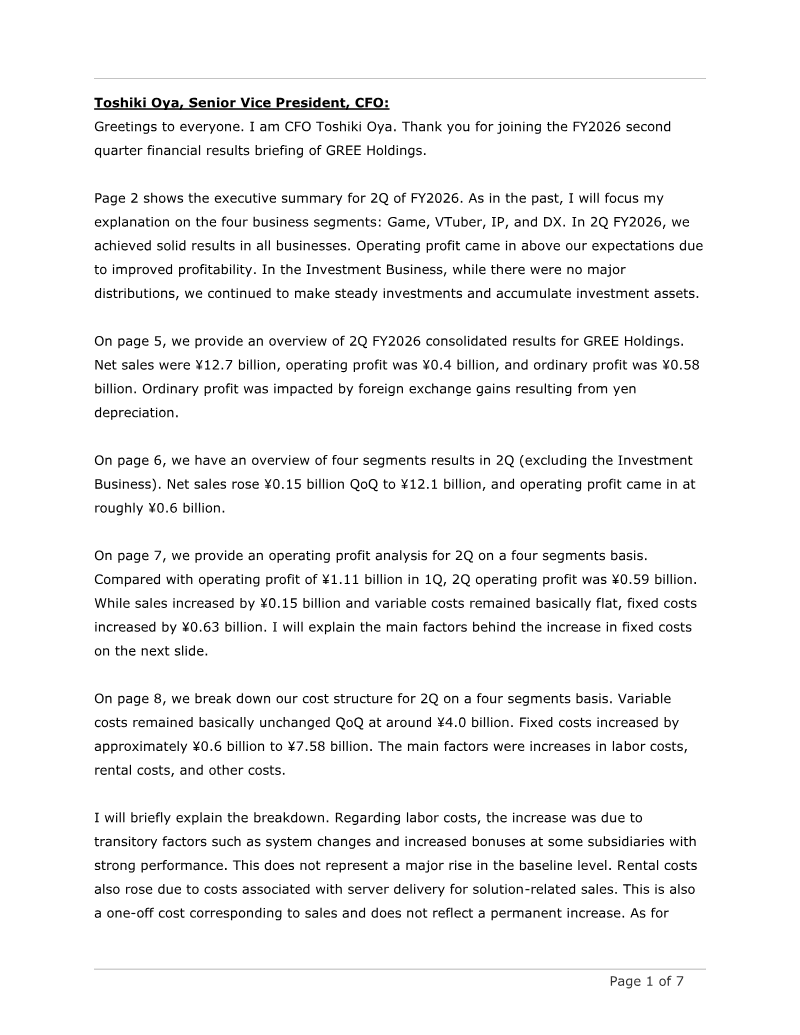
he live entertainment business from this fiscal year. We will pursue growth in this domain as Metaverse. The third is the advertising and media business. We will continue to invest to expand our vertical media portfolio. Now, Mr. Oya will give you an overview of our consolidated financial results. Toshiki Oya, Director, Senior Vice President, CFO: Please turn to Page 5. Again, FY21 net sales was ¥56 .8 billion, operating income was ¥5.4 billion and EBITDA was ¥6.2 billion. Net income was ¥13 .5 billion. Both operating income and net income achieved growth year-on-year. For the full year, net sales increased while operating income decreased. The main factors behind the sales decline were the transfer of the fashion commerce business in the advertising and media business and the weak performance of part of the media business due to COVID-19. On the other hand, operating income increased as a result of restructuring efforts and improvements in the structure of each business. Ordinary income and net income increased Page 1 of 7
significantly on the profit from investment fund operation business and the gain on the sale of investment securities. As for the fourth quarter, net sales and operating income are as explained earlier. I n terms of ordinary income and net income, n et income was ¥4.2 billion, thanks to the gain on the sale of investment securities, with the IPO of one of the companies we had invested and some additional deferred tax assets booked based on better recoverability. Next, Page 6 shows you the trends in the net sales, EBITDA and operating income. We enjoyed firm net sales and operating income. Page 7 shows the analysis of operating income compared to the previous quarter. First, net sales had positive and negative factors. With Another Eden and some other major titles celebrating anniversary during the quarter, anniversary-related sales stayed strong. In the meantime, Assault Lily: Last Bullet hit the lull, after its launch in the third quarter. Overall, the total sales increased slightly. Among variable costs, advertising cost increased a little for anniversary events. As for fixed costs, the provision for bonuses, etc, increased as it was the end of a fiscal year. With all that, operating income for the fourth quarter was ¥1.5 billion. Page 8 shows the cost structure for the fourth quarter. As I said, variable costs increased from the previous quarter due to the app game anniversary events. On the other hand, in commission fees, etc, royalties decreased along with improvement of product mix, thanks to the growth of Another Eden and other first party IPs. As a fixed cost, the provision for bonuses increased. As a result, total costs were ¥12 .4 billion.
he app game anniversary events. On the other hand, in commission fees, etc, royalties decreased along with improvement of product mix, thanks to the growth of Another Eden and other first party IPs. As a fixed cost, the provision for bonuses increased. As a result, total costs were ¥12 .4 billion. Page 9 is about stock repurchase. Stock repurchase has been underway, and as of the end of July 2021, approximately 17 million shares or roughly ¥10 billion have been repurchased. The progress is proportionate to the period passed. Page 10 shows the year-end dividend. The dividend per share will be ¥12.5. Our dividend distribution plan is to maintain DOE at around 2% with consolidated payout ratio of 20% or higher. With the upswing of the fourth Page 2 of 7
quarter net income, we would like to raise the dividend to ¥12.5 per share from the May forecast of ¥11 per share, which means an increase of ¥2.5 from the FY20 actual. Page 11 please. Let me share FY22 outlook with a focus on trends. In FY21, we achieved operating income growth and reached a turning point in earnings. For FY22, we are aiming for growth in both sales and profit based on stable game operation and new titles. While the actual level of operating income will depend on upfront investments in REALITY promotions and others, which will be explained later. Let me look at each business in more detail. For the game business, g ame operations are expected to remain stable. We are also planning to release multiple new titles. As with any game, they may or may not be successful as planned, but our aim is to create new income sources and achieve stable growth. Next is the Metaverse business where we plan to make upfront investments to grow REALITY further. Global distribution outside of Japan is underway in order to expand the user base. Although we will keep an eye on ROI, we may implement promotions of about ¥2 billion to ¥3 billion per year. Financially, such investments will not directly result in decreased profit, but will be recovered over a certain period of time. FY22 could, as a single year, see a negative impact of several ¥100 million, but we may decide to do it in order to accelerate our business growth in FY23 and beyond.
r. Financially, such investments will not directly result in decreased profit, but will be recovered over a certain period of time. FY22 could, as a single year, see a negative impact of several ¥100 million, but we may decide to do it in order to accelerate our business growth in FY23 and beyond. Next is the advertising and media business. In FY21, we achieved a profit for the full year, which has been our goal as I mentioned in the past. From FY22 onward, we will reinvest the profit to make the growth sustainable, aiming for stable growth both financially and operationally. Next is the investment and incubation business. From FY22 , w e have reframed our existing venture capital investments and startup investments as a business. I n line with this change, we will change the classification of their profit and loss from non-operating to operating as net sales and operating income. We expect this business to consistently contribute to profit over the medium to long term and target a return of over 10%. As you all know, investments are quite volatile and results can Page 3 of 7
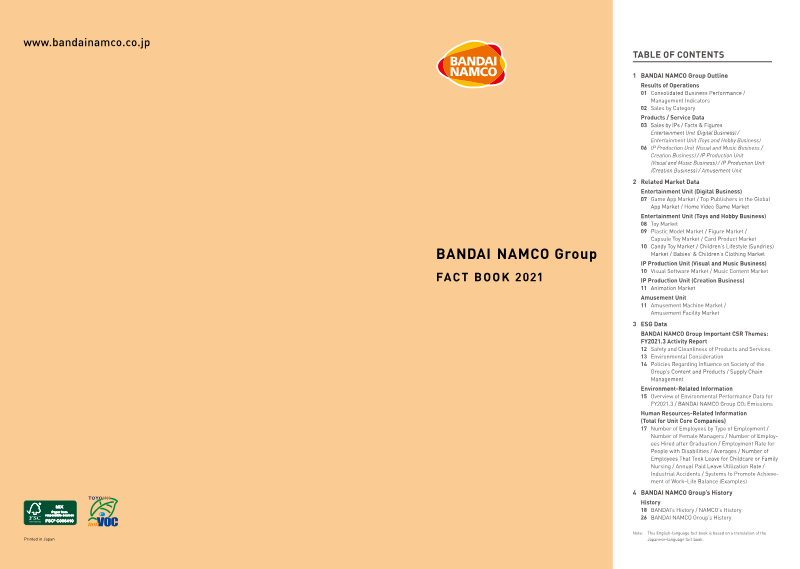
The 2021 Fact Book presents a comprehensive overview of Bandai Namco Holdings’ strategic direction, emphasizing its transformation into a globally integrated entertainment conglomerate and its commitment to corporate social responsibility. Central to the narrative is the thesis that sustained growth across toys, video games, animation and amusement can be achieved through diversified product portfolios, expansive international operations, and proactive sustainability initiatives. The company’s evolution is traced from a collection of independent toy, arcade‑machine and media firms to a unified group after the 2005‑2007 merger of Bandai and Namco. Key milestones include the launch of flagship lines such as Gundam models (over 500 million units shipped), Tamagotchi (exceeding 20 million units), and Zatchbell Battle (300 million units), as well as the development of major video‑game franchises—TEKKEN, DARK SOULS III and Tales—collectively surpassing 50 million sales. International expansion is evident through subsidiaries and regional headquarters in North America, Europe and Asia, reinforced by repeated listings on the Tokyo Stock Exchange and industry recognitions such as Cannes Best Actor and TSE awards. Environmental and social performance data for fiscal year 2021 highlight a suite of CSR actions, including CO₂ reduction targets, supply‑chain safety measures and work‑life‑balance programmes, all framed within the “NEXT STAGE” mid‑term plan aimed at deepening engagement with a mature fan base and broadening cross‑media offerings. The Fact Book thus underscores Bandai Namco’s dual focus on market leadership and sustainable corporate practices across a worldwide footprint and multiple entertainment segments.
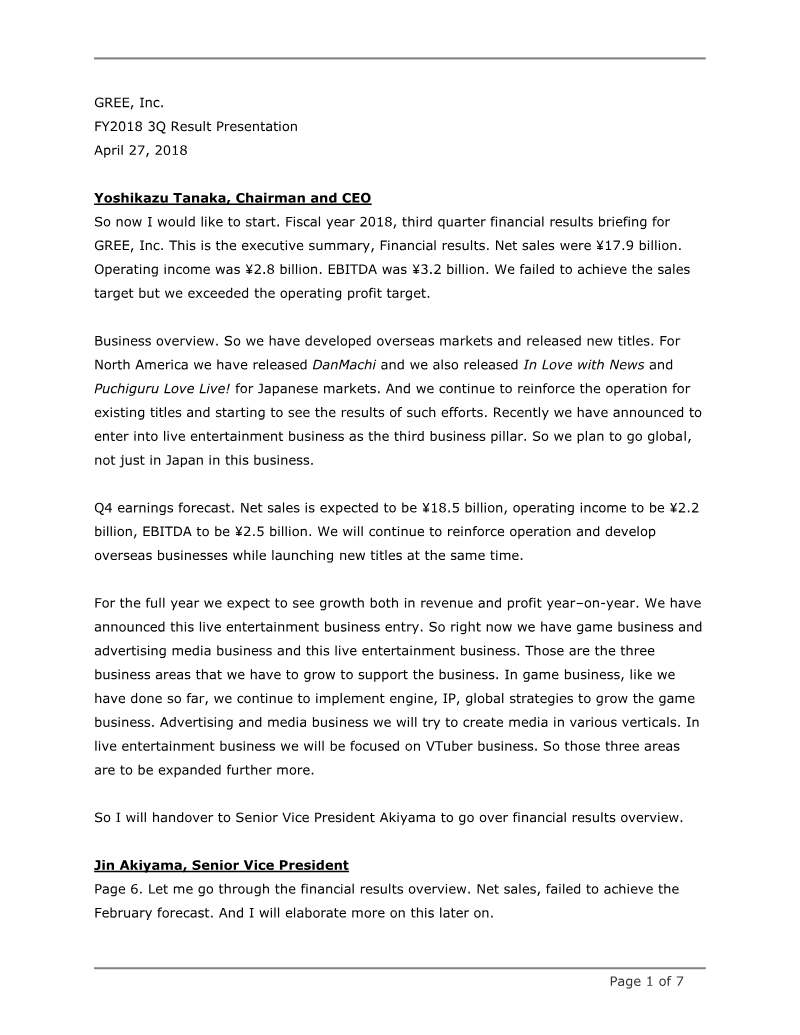
This financial presentation details GREE, Inc.’s performance for the third quarter of fiscal year 2018, ending March 31, 2018. The primary thesis centers on a strategic transition toward a three-pillar business model comprising mobile gaming, advertising and media, and a newly established live entertainment segment. Geographically, the report covers the Japanese domestic market and ongoing expansion efforts into North America, with future plans for Asia and Europe. Financial results for the quarter show net sales of ¥17.9 billion and operating income of ¥2.8 billion. While the company missed its revenue targets due to delays in title launches and business acquisitions, it exceeded profit expectations through aggressive cost reductions. Fixed costs were reduced by ¥500 million, and advertising spending was optimized, resulting in a 15% operating margin. For the fourth quarter, the company forecasts a slight revenue increase to ¥18.5 billion, supported by the global rollout of titles like DanMachi and the domestic performance of new releases such as In Love with News and Puchiguru Love Live!. A significant strategic shift highlighted is the entry into the live entertainment business, specifically focusing on the Virtual YouTuber (VTuber) market. GREE intends to leverage its existing 3D engineering capabilities from its gaming and VR divisions to manage production, distribution, and IP development for VTubers. Additionally, the company is diversifying its gaming portfolio by moving successful mobile IPs like Another Eden to consoles, including the Nintendo Switch. In the media segment, the travel application aumo is noted for its high category ranking, signaling steady growth in vertical media and client acquisition.
Bandai Namco’s 2017 integrated report presents a comprehensive account of the company’s financial, strategic, and governance performance, emphasizing the central role of its “IP‑axis” strategy in achieving record results. By leveraging core intellectual properties across games, toys, visual media, and music, the group generated ¥620.1 billion in net sales and ¥63.2 billion in operating profit, a 27.7 % year‑on‑year increase, while free‑cash flow rose 47.7 %. The Network Entertainment segment contributed 57.9 % of sales and 63.8 % of profit, with flagship franchises such as Mobile Suit Gundam (¥74 billion) and Dragon Ball (¥61 billion) underpinning cross‑media expansion and overseas growth in Asia, Europe, and the Americas. Strategic outlook is framed by the newly launched three‑year “NEXT STAGE” plan, which targets global IP expansion, regional autonomy, and continued innovation to meet mid‑term objectives a year ahead of schedule. Governance is reinforced through a ten‑member board—including three independent directors—and an audit‑supervisory board meeting Japanese Corporate Governance Code standards. A robust compliance and risk‑management framework, performance‑linked director compensation, and extensive investor‑relations activities underscore the company’s commitment to transparency and stakeholder trust. Corporate‑social‑responsibility initiatives achieved a 27 % reduction in CO₂ emissions since FY2012 and introduced universal‑design products and supplier audits. Financially, profit attributable to owners reached ¥44.2 billion, EPS rose to ¥201, and dividends of ¥15.4 billion were declared. Acquisitions such as
The 2014 annual report presents Bandai Namco Group’s financial performance, strategic direction, and corporate governance for the fiscal year ended 31 March 2014. Net sales reached ¥507.7 billion, a 4.2 % increase over the prior year and the first post‑integration figure to surpass ¥500 billion, while operating income fell 8.2 % to ¥44.7 billion, reflecting an ¥5 billion forward‑looking investment and a ¥1 billion rise in related‑party sales to affiliate Happinet. Net income rose 22.6 % to ¥25.1 billion, delivering a 4.2 % return on equity and an operating margin of 8.8 %. The group’s 7,151 employees generated growth primarily through its Toys & Hobby, Content, and Amusement Facility units. A central strategic thesis is the “IP Axis Strategy,” which positions the strongest intellectual property as a cross‑business engine, deploying it across toys, games, animation, apparel, events, digital services and amusement facilities. The Aikatsu! franchise exemplifies this approach, generating ¥15.9 billion in sales by expanding touch‑points from merchandise to live events and amusement attractions. The strategy underpins the group’s ability to accelerate collaborative IP development and sustain diversified revenue streams. Corporate social responsibility is framed around “Dreams, Fun and Inspiration,” with concrete actions including disaster‑relief programs, reduced‑packaging initiatives, low‑impact materials, universal‑design packaging, and a forest‑support project in Shiga Kogen. Governance is reinforced by a nine‑member board with three independent directors, an Audit & Supervisory Board, a Risk‑Compliance Committee, and an internal‑audit division that together earned the Tokyo Stock Exchange’s Excellence Award for corporate