Updated Mar 17, 2026 by mixi
Financial · May 1, 2025
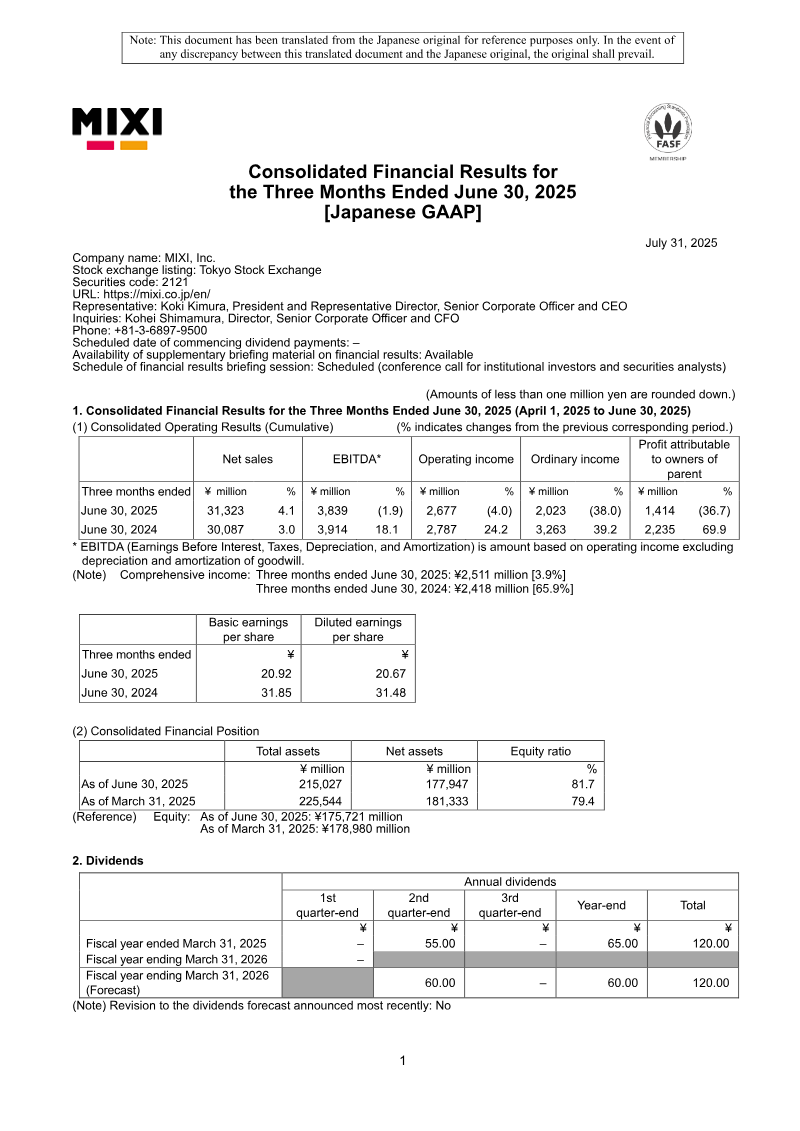
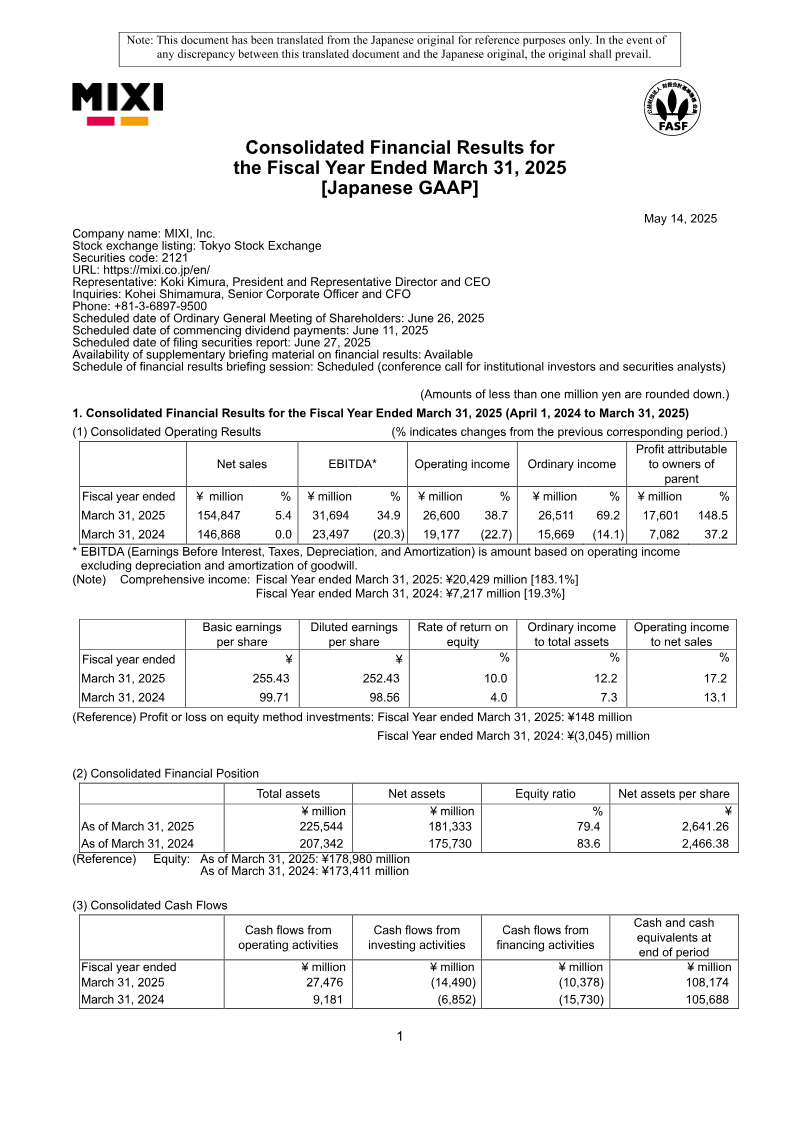
MIXI, Inc. achieved significant financial growth during the fiscal year ended March 31, 2025, characterized by a 5.4% increase in net sales to ¥154.8 billion and a 148.5% surge in profit attributable to owners, reaching ¥17.6 billion. While the core Digital Entertainment segment experienced a minor revenue contraction as engagement for the flagship title Monster Strike stabilized following its tenth anniversary, overall performance was bolstered by the Sports and Investment segments. Growth in these areas was primarily driven by increased betting service sales and strategic share divestments. This profitability was further supported by a ¥7 billion reduction in selling, general, and administrative expenses, specifically within advertising and settlement fees. The financial position remains robust, with total assets expanding to ¥225.5 billion and net cash from operating activities nearly tripling to ¥27.5 billion. Despite this liquidity, the equity ratio saw a marginal decline to 79.4% due to treasury share acquisitions and new borrowings, including a ¥9 billion loan commitment for the subsidiary Chariloto Co., Ltd. The fiscal year was also marked by strategic organizational shifts, including the acquisition of picon, Inc. and the establishment of MIXI Australia, though these were tempered by a ¥1 billion loss resulting from improper transactions at a subsidiary. Operations remain heavily concentrated in the Japanese market, which accounts for over 90% of net sales. Looking toward the fiscal year ending March 31, 2026, the outlook remains cautious with a projected 26.1% decline in profit despite stable sales forecasts of ¥155 billion. Future growth strategies prioritize expansion into AI technologies and the continued scaling of the Sports and Lifestyle segments. To maintain shareholder value, the company has committed to a ¥9.500 million treasury share repurchase program and the cancellation of 2.4 million shares, following a significant rise in basic earnings per share from ¥99.71 to ¥255.43.
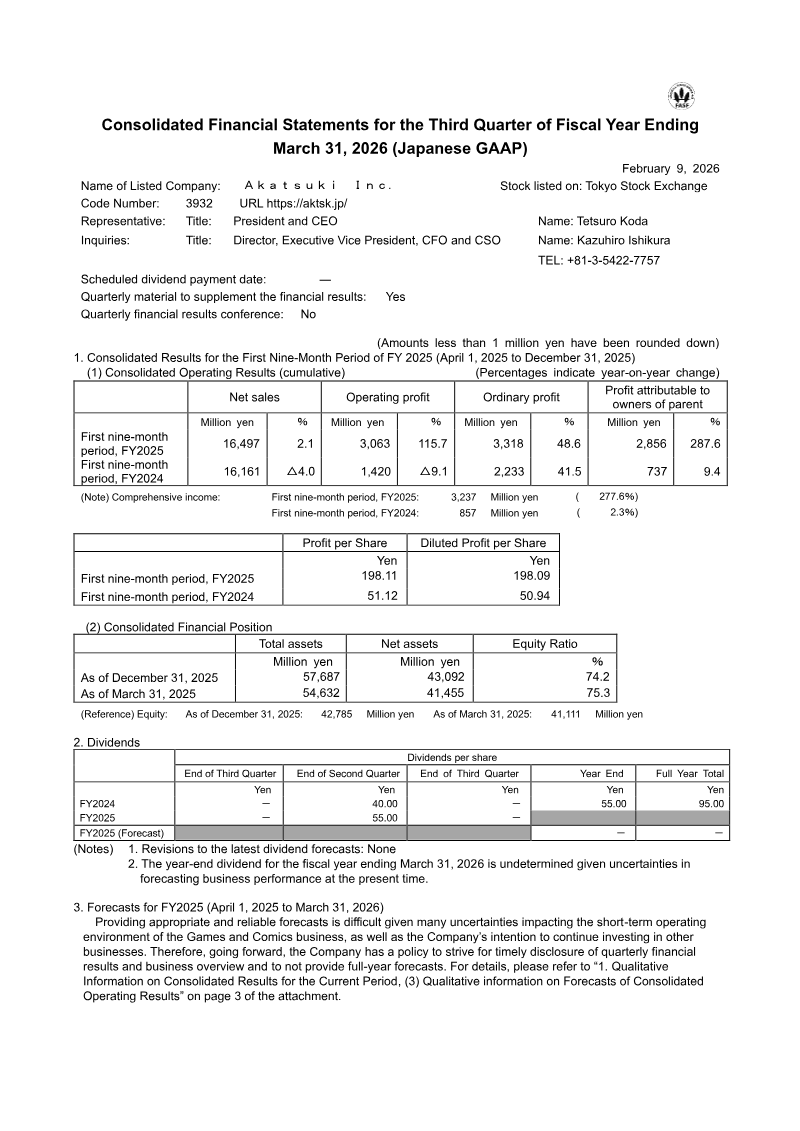
any discrepancy between this translated document and the Japanese original, the original shall prevail. FASF Consolidated Financial Results for the Fiscal Year Ended March 31, 2025 [Japanese GAAP] May 14, 2025 Company name: MIXI, Inc. Stock exchange listing: Tokyo Stock Exchange Securities code: 2121 URL: https://mixi.co.jp/en/ Representative: Koki Kimura, President and Representative Director and CEO Inquiries: Kohei Shimamura, Senior Corporate Officer and CFO Phone: +81-3-6897-9500 Scheduled date of Ordinary General Meeting of Shareholders: June 26, 2025 Scheduled date of commencing dividend payments: June 11, 2025 Scheduled date of filing securities report: June 27, 2025 Availability of supplementary briefing material on financial results: Available Schedule of financial results briefing session: Scheduled (conference call for institutional investors and securities analysts) (Amounts of less than one million yen are rounded down.) 1. Consolidated Financial Results for the Fiscal Year Ended March 31, 2025 (April 1, 2024 to March 31, 2025) (1) Consolidated Operating Results (% indicates changes from the previous corresponding period.) Profit attributable Net sales EBITDA* Operating income Ordinary income to owners of parent Fiscal year ended ¥ million % ¥ million % ¥ million % ¥ million % ¥ million % March 31, 2025 154,847 5.4 31,694 34.9 26,600 38.7 26,511 69.2 17,601 148.5 March 31, 2024 146,868 0.0 23,497 (20.3) 19,177 (22.7) 15,669 (14.1) 7,082 37.2 * EBITDA (Earning
ating income Ordinary income to owners of parent Fiscal year ended ¥ million % ¥ million % ¥ million % ¥ million % ¥ million % March 31, 2025 154,847 5.4 31,694 34.9 26,600 38.7 26,511 69.2 17,601 148.5 March 31, 2024 146,868 0.0 23,497 (20.3) 19,177 (22.7) 15,669 (14.1) 7,082 37.2 * EBITDA (Earnings Before Interest, Taxes, Depreciation, and Amortization) is amount based on operating income excluding depreciation and amortization of goodwill. (Note) Comprehensive income: Fiscal Year ended March 31, 2025: ¥20,429 million [183.1%] Fiscal Year ended March 31, 2024: ¥7,217 million [19.3%] Basic earnings Diluted earnings Rate of return on Ordinary income Operating income per share per share equity to total assets to net sales Fiscal year ended ¥ ¥ % % % March 31, 2025 255.43 252.43 10.0 12.2 17.2 March 31, 2024 99.71 98.56 4.0 7.3 13.1 (Reference) Profit or loss on equity method investments: Fiscal Year ended March 31, 2025: ¥148 million Fiscal Year ended March 31, 2024: ¥(3,045) million (2) Consolidated Financial Position Total assets Net assets Equity ratio Net assets per share ¥ million ¥ million % ¥ As of March 31, 2025 225,544 181,333 79.4 2,641.26 As of March 31, 2024 207,342 175,730 83.6 2,466.38 (Reference) Equity: As of March 31, 2025: ¥178,980 million As of March 31, 2024: ¥173,411 million (3) Consolidated Cash Flows
Net assets Equity ratio Net assets per share ¥ million ¥ million % ¥ As of March 31, 2025 225,544 181,333 79.4 2,641.26 As of March 31, 2024 207,342 175,730 83.6 2,466.38 (Reference) Equity: As of March 31, 2025: ¥178,980 million As of March 31, 2024: ¥173,411 million (3) Consolidated Cash Flows Cash flows from Cash flows from Cash flows from Cash and cash operating activities investing activities financing activities equivalents at end of period Fiscal year ended ¥ million ¥ million ¥ million ¥ million March 31, 2025 27,476 (14,490) (10,378) 108,174 March 31, 2024 9,181 (6,852) (15,730) 105,688
2. Dividends Annual dividends Total Dividend Dividends to Dividends to 1st 2nd 3rd Year- dividends payout ratio shareholders’ equity quarter- quarter- quarter- end Total paid (consolidated) equity (consolidated) end end end (annual) (consolidated) ¥ ¥ ¥ ¥ ¥ ¥ million % % % Fiscal year ended – 55.00 – 55.00 110.00 7,734 110.3 4.4 4.4 March 31, 2024 Fiscal year ended – 55.00 – 65.00 120.00 8,187 47.0 4.7 4.7 March 31, 2025 Fiscal year ending March 31, 2026 – 60.00 – 60.00 120.00 – 4.7 (Forecast) (Reference) We will aim for a target consolidated dividends to shareholders’ equity of 5 percent for the fiscal year ending March 31, 2026. 3. Consolidated Financial Results Forecast for the Fiscal Year Ending March 31, 2026 (April 1, 2025 to March 31, 2026) (% indicates changes from the previous corresponding period.) Profit attributable Basic Net sales EBITDA Operating income Ordinary income to owners of earnings parent per share ¥ million % ¥ million % ¥ million % ¥ million % ¥ million % ¥ Full year 155,000 0.1 25,000 (21.1) 20,000 (24.8) 19,000 (28.3) 13,000 (26.1) 191.84 * Notes: (1) Significant changes in the scope of consolidation during the fiscal year ended March 31, 2025: Yes Excluded: 1 company (Tech Growth Capital LLP) (2) Changes in accounting policies, changes in accounting estimates and retrospective restatement 1) Changes in accounting policies due to the revision of accounting standards: Yes 2) Changes in accounting policies other than 1) above: No 3) Changes in accounting estimates: No 4) Retrospective restatement: No
in accounting policies, changes in accounting estimates and retrospective restatement 1) Changes in accounting policies due to the revision of accounting standards: Yes 2) Changes in accounting policies other than 1) above: No 3) Changes in accounting estimates: No 4) Retrospective restatement: No (3) Total number of issued shares (common shares) 1) Total number of issued shares at the end of the period (including treasury shares): March 31, 2025: 73,730,850 shares March 31, 2024: 73,730,850 shares 2) Total number of treasury shares at the end of the period: March 31, 2025: 5,967,604 shares March 31, 2024: 3,420,835 shares 3) Average number of shares during the period: Fiscal year ended March 31, 2025: 68,910,259 shares Fiscal year ended March 31, 2024: 71,031,698 shares
(Reference) Outline of Non-consolidated Financial Results 1. Non-consolidated Financial Results for the Fiscal Year Ended March 31, 2025 (April 1, 2024 to March 31, 2025) (1) Non-consolidated Operating Results (% indicates changes from the previous corresponding period.) Net sales Operating income Ordinary income Period net income Fiscal year ended ¥ million % ¥ million % ¥ million % ¥ million % March 31, 2025 118,052 2.7 26,280 35.2 25,934 39.9 16,107 120.1 March 31, 2024 114,922 (3.1) 19,438 (25.4) 18,544 (27.5) 7,319 (2.1) Basic earnings Diluted earnings per share per share Fiscal year ended ¥ ¥ March 31, 2025 233.75 231.00 March 31, 2024 103.04 101.86 (2) Non-consolidated Financial Position Total assets Net assets Equity ratio Net assets per share ¥ million ¥ million % ¥ As of March 31, 2025 200,110 179,219 89.0 2,628.81 As of March 31, 2024 189,025 175,175 92.1 2,475.69 (Reference) Equity: As of March 31, 2025: ¥178,136 million As of March 31, 2024: ¥174,065 million * These financial results are outside the scope of audit by a certified public accountant or audit firm.
The fiscal year ended March 31, 2015, marked a transformative period of hyper-growth and financial recovery for mixi, Inc., primarily driven by the explosive success of the mobile title Monster Strike. Net sales surged by 828.9% to ¥112.9 billion, facilitating a dramatic turnaround from a net loss in the previous year to a net income of ¥32.9 billion. This performance significantly bolstered the balance sheet, with total assets expanding from ¥26.4 billion to ¥104.1 billion and cash reserves increasing nearly fourfold to ¥65.4 billion. The Entertainment Business segment became the primary engine of this expansion, with sales rising from ¥3.3 billion to over ¥102.2 billion. To sustain this momentum, the company aggressively scaled its operational investments, increasing advertising expenditures nearly ninefold to ¥9.7 billion and settlement fees to ¥32.7 billion. This liquidity also funded a strategic diversification of the Media Platform Business through high-profile acquisitions, including the ¥11.5 billion purchase of ticket marketplace Hunza, Inc. and the acquisition of fashion e-commerce platform MUSE & Co., Ltd. These moves, alongside entries into the matchmaking and marriage support sectors, resulted in a substantial increase in goodwill to ¥14.1 billion. Geographically, the company remains heavily concentrated in the Japanese market, which accounts for over 90% of sales and assets. Following a five-for-one stock split and a significant rise in net assets per share, the company has shifted toward a more robust shareholder return policy, including increased dividend payouts. Projections for fiscal year 2016 anticipate continued growth, with net sales expected to reach ¥185 billion as the company leverages its strengthened capital structure and diversified service portfolio.
MIXI, Inc. maintained stable net sales of ¥146.8 billion for the fiscal year ended March 31, 2024, despite a 22.7% decline in operating income to ¥19.1 billion. While the Digital Entertainment segment, anchored by the enduring performance of Monster Strike, remains the primary revenue driver, its profitability experienced a year-over-year contraction. Conversely, net income attributable to owners of the parent grew by 37.2% to ¥7.08 billion, a result of reduced non-operating and extraordinary losses relative to the prior year. This financial trajectory is expected to accelerate, with forecasts projecting a 69.4% surge in net income to ¥12.0 billion for the fiscal year ending March 2025. The fiscal period was characterized by strategic capital management and the navigation of impairment challenges. Cash and cash equivalents decreased to ¥105.7 billion, influenced by ¥7.5 billion in treasury share purchases and significant income tax payments. Financial results were further impacted by a ¥2.677 million valuation loss on convertible bonds and impairment losses within the Sports Business and equity-method associates like CALL DOCTOR Co., Ltd. These adjustments reflect a rigorous reassessment of business plans and asset valuations across the Lifestyle and Sports segments. To enhance shareholder value and capital efficiency, the company executed the cancellation of 4.5 million treasury shares and initiated a subsequent repurchase program valued at up to ¥7.5 billion. Basic earnings per share rose to ¥99.71, supporting a consistent annual dividend of ¥110 per share. Despite the amortization of ¥1,338 million in goodwill, the organization maintains a robust balance sheet and a clear focus on stabilizing its core entertainment offerings while optimizing its diversified portfolio for long-term growth.
MIXI, Inc. achieved significant top-line growth during the fiscal year ended March 31, 2023, with net sales rising 20.4% to ¥146,867 million and operating income increasing 39.4% to ¥24,820 million. This performance was primarily driven by the Digital Entertainment segment and the continued strength of its flagship title, Monster Strike. Despite these gains, profit attributable to owners of the parent fell by 49.7% to ¥5,161 million. This decline resulted from substantial non-operating and extraordinary expenses, including a ¥6,604 million loss on equity method investments, a ¥4,818 million impairment loss related to bitbank, inc., and a ¥4,408 million loss stemming from business withdrawals. The fiscal year was characterized by strategic structural shifts, most notably the reclassification of the Investment Business into a primary reportable segment. This change moved operational investment securities to current assets and integrated related gains and losses into net sales and cost of sales. While income before taxes decreased, net cash from operating activities saw a dramatic increase from ¥2,647 million to ¥15,751 million. The company maintained a robust liquidity position, ending the period with ¥118,703 million in cash and cash equivalents, supported by reduced spending on investing and financing activities compared to the previous year. Looking forward, projections for fiscal year 2024 suggest a decline in net sales and operating income, though net profit is expected to recover by 45.3% as the impact of one-time losses diminishes. To enhance capital efficiency and shareholder value, a stable dividend of ¥55 per share was maintained, supplemented by a post-fiscal year authorization of a share repurchase program valued at up to ¥7,500 million. These actions reflect a transition toward a more diversified business model, balancing core digital entertainment assets with strategic investments and portfolio optimization.
Mixi, Inc. achieved significant financial growth during the fiscal year ended March 31, 2021, characterized by a 6.4% increase in net sales to ¥119.3 billion and a substantial 45.8% rise in profit attributable to owners, totaling ¥15.6 billion. This performance was underpinned by a surge in net cash from operating activities, which nearly doubled to ¥34.7 billion. The company’s liquidity remains exceptionally strong, concluding the period with ¥149.8 billion in cash and cash equivalents. This robust capital position supported a stable dividend of ¥110 per share and the authorization of a ¥10 billion share repurchase program intended to enhance capital efficiency. Strategic realignments and acquisitions defined the corporate landscape during this period. The group restructured its operations into three core segments: Digital Entertainment, Sports, and Lifestyle. Following the finalized accounting for acquisitions such as Chiba Jets Funabashi and Net Dreamers, the company reallocated significant costs toward customer-related intangible assets. Expansion into the sports and hospitality sectors continued post-period with the acquisition of a 20.02% stake in HUB CO., LTD. for approximately ¥1 billion, signaling a commitment to diversifying the portfolio beyond traditional digital gaming. Despite the strong historical performance, the outlook for the 2022 fiscal year remains conservative. Projections indicate a potential contraction in profitability, with operating income and net profit forecasted to decline by as much as 47.7% and 45.8%, respectively. This cautious guidance suggests that while the company successfully navigated the previous year's market conditions and improved its cash flow through disciplined investing and operational growth, it anticipates significant headwinds or increased investment requirements that may impact short-term earnings.