1 free read left. Create a free account for unlimited reading + AI research.
Create free account
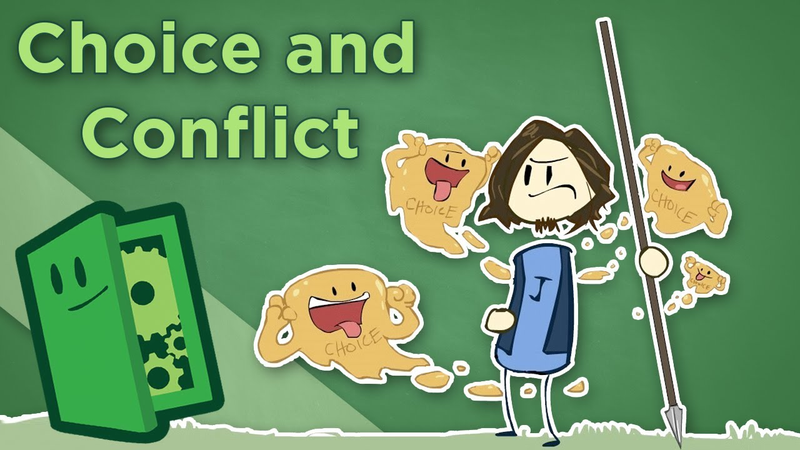
Choice and Conflict - What Does Choice Mean in Games? - Extra Credits
Key insights
6 takeaways- 01Decisions based on clear, optimal outcomes—such as choosing the cheapest price or avoiding damage—are categorized as problem-solving calculations rather than genuine choices.
- 02Meaningful choice in game design is defined by internal conflict between competing objectives, rather than simple logical decision-making.
- 03Games like Super Mario Brothers create tension by placing power-ups in high-risk locations, forcing players to choose between safety and reward.
- 04Titles like Fallout succeed by presenting 'incomparable' scenarios, such as choosing between different character perks that cannot be measured by a single metric.
- 05Effective design forces players to weigh incomparable options, such as balancing immediate survival against long-term progress, where no single path is objectively superior.
- 06Modern game systems, such as talent trees in World of Warcraft, often fail when they reduce diverse options to a common metric like damage output, causing choices to collapse into a single optimal build.
Ask AI about this video
Transcript
So, this week Wait, hang on. Have you guys checked out MovieBob's new show yet? Go give it a watch. It's good stuff. And for that matter, if you haven't already, check out his other long-running show, The Game OverThinker. If you like the kind of thing we do here, chances are pretty good you're going to like that one, too. Intelligent guy, that Bob. Anyway, choice. It's a word you hear thrown around a great deal when talking about games these days, but we often use it only to refer to moral and ethical choices. And while those are some of the most important choices out there, and well worth talking about, as a designer, it kind of bugs James that those are the only choices we focus on. Good games feature choice at every moment. So, today we'll be examining just what choice means. First, let's look at choice in general. It's actually kind of hard to pin down choice because, given free will, it's easy to call everything one does a choice. This tautology isn't very helpful. After all, if everything you do is a choice, then the word has no meaning. So, let's break it down a little. First, there are the autonomic
actions, like breathing, but these are simply actions, not really choices so much. Second, there are reactions, like pulling your hand away from a flame. Again, simply actions, not really choices. Third, there are calculations, and here's where it gets a little more complicated. Calculations are decisions based solely on reason, with a clear correct answer. These sort of mental tasks can be as straightforward as a math problem. Say, I offered to sell you a game for 60 bucks, and your buddy offers to sell you the exact same game for 40 bucks. In this case, deciding which offer to take is a calculation. A slightly more complicated version is deciding not to place your hand on a hot stove. In this case, you know what the result will be if you do so, burning. You know that burning causes you pain, you know that pain is bad, and you probably can't think of anything that putting your hand on the stove would accomplish that could possibly outweigh the consequence of searing pain. Therefore, not putting your hand on the stove clearly the correct decision. Calculation, logical. So, calculations involve decisions, but they're not choices. This is a key point to remember when talking about choice in games. So, what is choice? Choice is overcoming internal conflict. Without conflict,
there is no choice, only decisions. And it is this very fact, this overcoming of internal conflict, that makes choice so engaging. Now, so far this has all been pretty highbrow, so let's start digging into the important stuff. How do we use this in games? Super Mario Brothers. Super Mario Brothers uses choice brilliantly. It sets up a long-term goal, rescue this, defeat that, and a short-term goal, stay alive. It then goes about finding ways to set up situations where these two goals are in opposition. Consider the mushrooms in Super Mario Brothers and how they achieve this. I'll give you a minute. Need a hint? Why do they move? Yep, they move to set up conflict. When you hit a block and a mushroom pops out, that mushroom starts traveling to the right towards the unknown. Getting the mushroom will make you big, allowing you to take two hits before you die, and thus making it more likely that you'll be able to accomplish your long-term goal, save this, defeat that. But, to get the mushroom, you'll probably have to do things that are riskier than what you would normally do, therefore jeopardizing your short-term goal. This type of choice is called an incomplete information problem because the player
is forced into a scenario where they have to make a choice before they have enough data to calculate the outcome. Here, you have to decide whether to chase the mushroom or not before you know exactly where all the enemies will be when you intercept the mushroom. And the mushroom's moving to the right, so as you chase it, you'll uncover dangers previously unknown. The problem with many games is that they let all of the players' objectives align all the time. Or, worse still, they simply give one objective and leave the game to be only about executing the steps to complete that objective. Imagine Super Mario Brothers without mushrooms. Think how much more linear and less exciting it would be. Many modern action-adventure titles fall into this trap. Poorly constructed shooters are prone to it, too. Though, in general, shooters tend to do a little better because they often leave the player conflicted by having the safest path also be the slowest path. So, they set an in-game goal against an out-of-game desire, forcing the player to choose between the speed at which they progress and the reliability of progression. The The type of choice that comes up a lot in games are incomparables. These are your apples and oranges problems. Many of the perks in Fallout fall into this category. Let's see, do I want things to explode into
gooey or chunks, or would I rather be able to carry more stuff? These are both things the player wants, but they're limited to choosing one. So, the player experiences conflict when they're forced to make a choice of this nature. I'm sure many of you guys at one point or another spent longer on the perk screen than you probably needed to. I know I have. The problem with many games is that they mask calculations as incomparables. I know this is getting kind of complex, just stick with me. Take for example World of Warcraft's talent trees. At first glance, the talent trees look like they're full of tough choices. But, ask any experienced WoW player and they'll tell you that there are a few best builds for any given class. The recent Cataclysm overhaul may have mixed things up a bit, but I'm sure the WoW community will pin down their favorite builds again before too long. Anyway, the reason there are best builds for any given class is that, rather than being fundamentally different, all of a player's decisions regarding the talent tree can be related to the same question. Does this raise my damage per second, or does this raise my healing output, etc. By putting a common currency behind all of these choices, they cease to be choices and become problems with definitive answers,
calculations. The reason you see so many World of Warcraft players wearing the same armor and sporting the same builds is because of this reliance on calculations instead of incomparables. Now, of course, there's nothing wrong with calculations and they provide a very specific kind of challenge, which, when done well, as is the case with World of Warcraft, can be very fun. But, when you promote your calculations as choices, you hamstring your ability to make the most interesting calculation challenges possible and you set players up for disappointment when they find themselves doing a problem-solving exercise where they wanted to be making a meaningful choice. So, is choice the end-all be-all of games? Well, no, all types of player actions are important, but good games don't miss opportunities to present players with choice. If you find yourself just mindlessly mashing buttons to make a game progress, we're not doing our job. Well, that's about it for this week. Thanks a lot for watching us, guys. We've had a great time these first few months and the show's only getting started. See you next year.
Summary
The core thesis of this analysis is that meaningful choice in game design is defined by the presence of internal conflict, rather than simple decision-making or logical calculation. While modern gaming discourse often conflates choice with moral or narrative branching, true gameplay choice requires players to navigate competing objectives where no single path is objectively superior.
The analysis distinguishes between three types of player actions: autonomic actions, reactive responses, and calculations. Calculations are defined as decisions based on reason with a clear, optimal outcome, such as choosing the cheaper price for a product or avoiding physical harm. Because these tasks rely on logic rather than internal conflict, they are categorized as problem-solving exercises rather than genuine choices. Conversely, effective game design utilizes incomplete information and incomparable options to force players into situations where they must weigh conflicting goals, such as balancing short-term survival against long-term progress.
Key examples illustrate these concepts: Super Mario Brothers creates tension by placing power-ups in positions that force players to risk their safety to obtain them, while Fallout utilizes "incomparables"—apples-to-oranges scenarios—to force players to prioritize different, equally desirable character perks. The analysis warns that many modern titles fail by masking calculations as choices. For instance, talent trees in World of Warcraft often collapse into singular, optimal builds because they reduce diverse options to a common metric, such as damage output. When developers present these mathematical problems as meaningful choices, they risk player frustration and limit the depth of the gameplay experience. Ultimately, the analysis concludes that while calculations provide valid challenges, designers must prioritize genuine conflict to ensure players are making meaningful decisions rather than merely executing optimal paths.















Comments