1 free read left. Create a free account for unlimited reading + AI research.
Create free account
Building Your Game's UX Strategy Using a Scientific Approach PG Connects Digital #2
Key insights
6 takeaways- 01UX in game development must be treated as a team-wide mindset that aligns design intent with the objective reality of the player's journey rather than relying on developer assumptions.
- 02Development teams must establish clear, shared pillars that define the target audience and core experience to ensure mechanics are accessible and rules are communicated effectively.
- 03Developers must account for the limitations of human cognition, specifically acknowledging that perception is subjective, attention is a finite resource, and memory is fallible.
- 04Teams should adopt a scientific approach to playtesting to move beyond gut feelings and use iterative feedback to identify where design intent fails to translate into intuitive gameplay.
- 05Balancing innovation with established genre conventions is essential to minimize unnecessary learning curves and prevent interface confusion.
- 06Ethical design, which avoids coercive tactics like dark patterns or fear-of-missing-out mechanics, is a critical component for achieving long-term commercial viability.
Ask AI about this video
Transcript
here on the developer toolkit stage sponsored by agora de io we've got celia hodan who is a a freelancer but she's he's going to be talking about um building your game's ux strategy using a scientific approach do we have celia uh we do hello hello so ah there we go there we go perfect well look uh thank you for joining us uh for you're talking about ux um i am we're running a few minutes late but don't worry we'll make sure you get all your time i'm gonna pop back into the background now fade out of you um if people have questions uh about this talk please do drop them in the q a box and i'll come back at the end and help you curate those okay so over to you all right thank you so much dave uh hello everyone i hope that you are safe and doing well um
i'm gonna share my screen so i can [Music] show you my powerpoint there i go and here we are so um so my name is celia and i have a background in psychology i have a phd in psychology uh which i had in france i'm french hence the accent and i've been working in a video game industry in the past uh 10 over 10 years now i started at ubisoft in france then i moved to ubisoft in montreal i worked with the playtest team there and i worked more specifically on the rainbow six franchise then i moved to lucasarts um where i worked at the studio level and i worked also on games i never saw the light of day like star wars 13 13. that was a bit sad and after disney uh shut down lucasarts this is when i moved to epic games that was in 2013 where i uh
i became the director of ux at the studio level so i worked on unreal engine i worked on many games and different platforms like um mobile vr uh console pc and of course i worked uh very closely with the fortnight team i left a epic in 2017 like 2017 and ever since then i'm a independent consultant so i'm spreading the ux love and i'm trying to explain what ux is about and um more specifically ux strategy because now ux is making becoming very trendy but people narrow it down to uh ux slash ui and uh of course ui is very important in ux but it's really not just that uh so this is a very quick talk i'm gonna explain to you all the all these different things so you can ensure to develop a ux strategy um for your project and and at the studio level all right so first of all just a quick definition of user experience
what it is is just to think about what the target users so your player is how are they going to perceive and interact with the game including how engaging this experience is relative to the design intentions so uh you as a developer and when i say developer in this presentation i mean anyone uh working in the creation of a game not just uh programmers so everybody you have a specific mental mode you know what you want to accomplish and uh you build the game with that in mind uh in the in a specific system that has specific constraints when you ship it the game the players are gonna play it and they're gonna make up their own mental model of what they think the game is all about only through their interaction with the system image so anything they interact uh with so every anything they perceive um could be controls art music uh all the things that they perceive and interact with the idea of user experience is to make
sure to align your intentions what you tried to offer your players and we have a lot of tools to do that but really the idea is not to change whatever intention that you have it is to ensure that this is what the players indian are experiencing now ux is very broad um it's it's anything that is uh that your players but also your customers are gonna interact with so of course it starts with advertising start with the first time that players are gonna hear about your game it starts with the launcher if you have a launcher uh all that experience is part of the user experience um i'm more more specialized into the player experience or what you know players are experiencing but i'm using ux as a broad term but of course if you think about ux you have to think about marketing you have to think about customer support you have to think about community management it's it's all of that
um and and that's that's what user experience is it's really shifting from your own perspective so that you can make sure that you understand the perspective of the user and that you can get alignment with what you are trying to accomplish um but also by respecting your your user you placing the user at the center of what you're doing so because of that ux is not just a concern of people with ux in their titles it's not just the concern of people doing ui is the concern of everyone everyone on the team everyone on the studio because ux is a mindset more than anything else it's shifting uh from your own perspective to adopt the perspective of you of the user and it's about placing the the user the the target user at the center of what you do not your not your business goals not uh your your um what you believe the game is
about it's all about your users all of them so there are different steps i'm just going to go for that very quickly because of course we don't have a lot of time but there's four steps that i would like to share with you the first step if you want to have a your strategy is to have alignment on your team and at the studio level about what experience you want to offer and to whom and it seems very uh obvious but believe it or not there's a lot of teams that actually don't have alignment because game developers are passionate and they want to uh um put forward like a system that they love in another game uh and so sometimes there's no real alignment of what experience we want to offer what are really the game pillars what are the main systems what is it we're trying to uh offer to players what experience what what we want them to have like as a as emotions uh is it a game that is supposed to be a collaborative or is it about exploration you know what's the really the essence of the game that
you want to offer and that misalignment happens very very often and sometimes we have it at the beginning and then we lose it as we move forward and this is when it's it's getting really hard to make the right choices and the right trade-offs because they have to be made um by thinking about what experience you want to offer and to whom and that experience is um usually this is what defines uh the the users you know if you if you uh want to make a game that's super hardcore let's say like dark souls well you know that that's going to target this specific uh kind of users and there's nothing wrong with that but you have to know that the the choice that you're making for the experience is gonna exclude some some some people so if it's by design that's fine you know you're gonna exclude people that don't have the patience to your third dark souls um and that and that's okay but you don't want to expect people that had nothing to do with the experience that you want
to offer so this is really uh sounds again very obvious but it's very very important to define the essence of the game and to define who are the players that that love these games and uh what do they what do they care what do they mean with their what are their motivations but also what is the um the the common uh the conventions that they know like if you're making a puzzle game a match three game the players that love much three games are used to certain conventions um but now if you're making a fps or an rpg you have different conventions that is not necessarily going to be understood by players who are not used to playing these games so the more niche your game is though it's it's not asleep very easy but at least you know that there's some shared conventions because the players are going to play this game um they're already they're supposed to know this convention but the broader your game is like think about a game like fortnite that's it's pretty broad it's gonna um a lot of players coming from different
horizons and like different things i'm gonna maybe try it out and check it out and they're probably not used to certain conventions that we have in rpg actually if you came to 49 because you love fps or uh um playing with uh with your friends uh in a fun game you might not know uh all the the the elements of rpg so this is really important and ux again is not about going against the expansion one offer it's not about dumping down the date of the game it's about ensuring that the players are they're gonna fire and your target audience are going to be able to enjoy the game the way you intended so that's the first step and then the second step is like i was saying like shifting perspective because you as the developer you know your game very well you have that curse of knowledge it's your baby you've been thinking about it a lot the problem is that we have a lot of biases uh um humans are pretty biased and we
have a lot of these biases so we need to understand a little bit how the brain works because your players as they come to play to enjoy your game they don't know all the background that you know and uh they don't have the same perspective as you and that's normal because we all have a different perspective so to do that it's it's quite important to understand the brain a little bit so that's a thing that i do a lot i did a lot of um workshops about explaining uh cognitive science so that you can have a little bit of an understanding of the performance but also the limitations that um the brain has because we need to take that into account to offer a great experience suppliers um so we need to anticipate these these problems so very quickly this is just a a broad uh uh illustration of how the brain works when we learn something new or when we interact with something in our environment it's it's always starting with perception we don't learn
from the void we learn and we process information through what is coming up to our senses so in terms of video games it's often visual and audio sometimes hectic but these are the main senses uh that are at play and so we have different inputs coming uh for our senses and we perceive them uh in a certain way and then we're gonna process that information and if we are learning something it's gonna change our memories actually changing um something in our brains as we learn uh we have a brain as is plastic we have brain plasticity so when we learn something it's changing our brain and so from perspective to memory uh of course there's a lot of things happening and we have different factors that's gonna um make that process that learning uh more or less efficient so there's a lot a lot of different factors uh here i'm mainly going to talk about attention because the more attention you give to
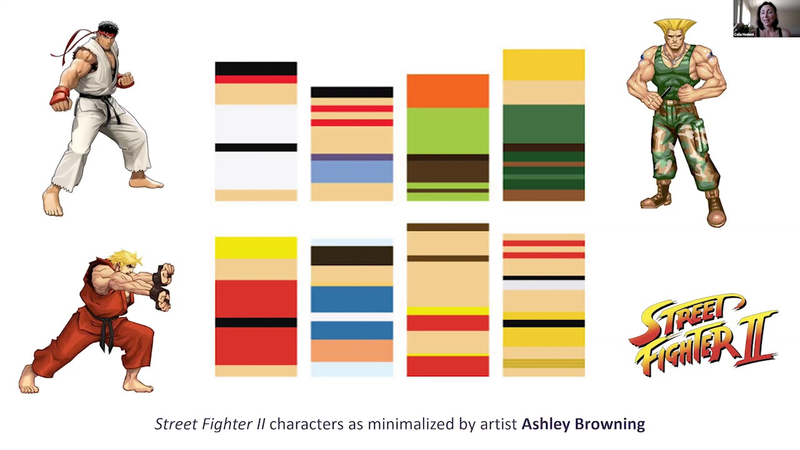
something the better you're going to remember it um so very quickly i'm going to give i'm going to go through it like super super fast uh this and i have i did a lot of presentations on that so feel free to just like look on my website you you'll have like a much deeper description of what i'm gonna talk about here but here's an example um regarding perception if you look at this image probably a lot of you as if your gamer is recognizing the characters from street fighter this is typically what i get like i have like maybe 30 percent of of people when i do it live that is super excited and like yeah street fighter and i have a lot of people in the room they're like what the hell and they might recognize people um sometimes people recognize link in the the top uh right from zelda um but not everybody is perceiving this image in the same way
also if you're colorblind like about eight percent of the male population you also are not perceiving this image in the same way and you feel excluded uh by my little game here and i apologize for that but i'm trying to make a point uh here as well it's really important to shift from that perspective we have that impression that our perception is we're perceived the reality the way it is it is not the case perception is subjective there's the reality out there and we all perceive it in a different way and that perception is impacted by who we are our culture the games we play the things we love the things we expect the context and many many other things and so that's a big limitation that we have in our brain and this is the reason why we play tests so here's an example uh when we were working on fortnite back in 2013 uh we tested a bunch of icons so here i'm talking about ui but again this is not just about the ui and we had
players play a little bit fortnite uh the the prototype that we had and then we asked players what is this what is that and for this icon which is maybe you guessed representing uh the trip icon in fortnite a lot of players actually did not recognize uh did not recognize that icon so we iterated on it to make it much more uh recognizable and so this iteration process is really important this is why we play test because it's not because it seems obvious to you that's going to be obvious to your players and so for all the things that are really critical uh for uh your your playstation to enjoy the game you really need to play test same thing with our memory we have a pretty bad memory we think we memorize a lot of things and pretty accurately we don't this is the forgetting curve we forget a lot of stuff and it's exponential our memory is fallible this is why we have heads for example so that there's information always on screen to have players and they don't have to remember too much stuff so we have to
make sure that we're not overloading uh people's memory um also because the more you have to learn and memorize when you come back to the game maybe a week or two later um there's a lot of things that you might have forgotten and that's gonna be hard for you to stay in the game last thing is attention we are pretty crappy uh also with attention we had scarce attentional resources it's hard for us to uh see the gorilla if you are uh counting the basketball passes uh from a team uh from a team so i'm sorry a lot of people have already seen that video if you have not you can find it easily uh on on youtube and uh that's because our attentional resources are scarce we are not able to multitask we are not scanning the environment very carefully and so for uh your players you know you even if you convey information on screen and you think yes good we convey that on screen they'll be able to to figure it out they might not because they might be focused on something else that they are
interested in and they're not interested into your instructions at that moment or they're not interested in something that you want them to get interested in at that moment and so you do have to pay attention to that you do have to mine the cognitive load and ensure that if there's something really important in the game you your players are ready to pay attention to it and they care about what you are showing them at that moment so that was very quick but perception is subjective attention is scarce memory is followable this is just a a little taste of all the limitations that we have in our brains and we have a lot of biases so it's really really important to shift from our own perspective if you make a game you're making it for others not just for yourself and so it's really important that you ensure that what you're trying to convey is what others are experiencing so uh that's that's you know that's the reason why you need to shift perspective and you need to understand
i love it how the brain works uh so that you're you can do that more efficiently the first step is to have a common language uh uh in the team and at the company level uh so this is something that i i i believe is really important uh because when we start to thank you to talk about ux and what it means um it's important to explain what what is it we're talking about and to uh have a common language this is the reason why i i've been using the framework that i'm going to show you here when i talk about game us there's two main pillars usability that's the ability of the game to be used can people understand how to use it just like any other tool we need to know zoom is this the first time you're using zoom was it intuitive or did you have to figure it out um so anytime we we don't even think about it it's intuitive it means it's usable so that's of course very important for video games um but dating it can be usable and boring unlike a tool we play interacting with the video game is the point
we're not using the tool to do something else we're using the system the video game just because we enjoy using that system so video games have to be engaging otherwise there's no point in playing a game so that's the reason why game ux uh has these two main pillars like any tools have these two um main pillars uh but for a tool it's less of a problem if it's not super engaging um i mean it's still better if it's engaging but it's not as critical as for games and so um this is the the the vocabulary that's important to get you know what does it mean for a game to be usable i mean it's focusing on the signs and feedback and all the things that players are going to perceive from from the game make sure they're clear make sure like just by looking at something they can understand their functionality it's what we call foreign function so those are all the the elements that it's really important to across the team um we know a little bit about them it's
it's not about making you experts from like everyone a ux expert but at least these elements are very basic elements so that we can talk about hey we have a problem we have a consistency problem we have a form false function problem and that is impacting clients understanding to do x y and z across the team to be able to do that especially like working with a qa qar uh folks are really important um also to uh uh enable that ux uh perspective because they're testing the game uh again and again and again and so there are if they have this vocabulary it's they are going to be like the first ones to point out new problems that we might need to fix and engagement uh it's all about motivation and so understanding what's missing you know if people don't feel competent in playing the game they're not gonna um enjoy playing the game as much uh it's not gonna be as engaging so understand what motivation uh means for humans and again i don't have the time to explain this here
it's it's all over my website if you want to check it out but here the idea is to um uh point out that the across the team in the studio that there needs to be like a at least a baseline understanding of what it means uh to be engaged in an activity uh and to um so that you can ensure uh during the development to prioritize the things that that matters most because that's that's the difficulty is to prioritize there's so many things we need to do but is this you know the thing that you need to work right now is this gonna be impactful for players you know feeling of competence or autonomy or relatedness with others so once you have that then you need some process um because again the human humans are biased and so if you don't have a process you're gonna just rely on your gut feelings and your good feelings can be very good if you're a very well-trained professional because you've
been around for a while and you know you interior internalize what is working what not working but that's not helping if you need to work with other people and this is what we do when we make video games so you need to have a process and relying on that process is really really important and we we use science for that so this is the the the play test room at epic games that we put together and uh it's it's helping us by inviting people playing the game in development it's helping us during that shift and we do that shift in a way that is as scientific which means that we're trying to step away from our own biases like our own opinions what we do care about the game because we're not robots we we usually love the games that we're working on um and so this is helping us ensuring that we understand what's happening and so we're not making the wrong decisions and so to do that you need to have a
pipeline and every you know every time there's you have a lot of game developers they have sprints and so um you can anticipate at what moment we can we can play test a game uh with little with the uh the the main branch uh so that you know people are not working too often to stabilize that build um so you have to anticipate for you know that milestone this is what we're going to put in and so already as you plan that milestone you start with the hypothesis with what you're going to have to test for your user experience there's always something you can test um not everything can be tested at any point in time but there's always something you can test be careful because a lot of people are saying it's too early uh it's actually more often too late to test things and figure out there's a problem and you might have to change a lot of stuff to fix that problem i speak too much as always so i'm gonna move on and the
scientific method is helping you to undate find the right problems like like i said there's a lot of problems uh just like here like lots of problems it's overwhelming when you're working on the game the scientific method is to identify where is the problem that matters for you now and that's gonna matter the most for the user experience and that's the reason why it's important to make that shift so you can prioritize the the work that you have so you need alignment on the users and on the experience you want to offer them shift perspective and adopt the perspective of the users that goes through understanding cognitive science adapting a common language so that we can talk about the problems it's easier if we have common language and identify things and have a process that's going to put forward the scientific method so we can get there and so the ux rules are important but it's not just that the ux designers are the ones going to
help game designers making sure it's understandable for players that make things functional uh they're very critical of course your searches are here to verify if indeed the players are experiencing what we wanted them to experience data analysts are also doing this but at the broader scale uh when all the data is coming in and you have your strategies which is more what i do they're here to uh advocate and manage coordinate and ensure that we stay focused on the experience that i want to offer because that's something that we lose quite often but again ux is the concern of everyone these ux people are just here to bring tools and um uh experience and uh their their knowledge to help everyone do that all right i don't have the time for that but the idea is to get to ux culture and to get their uh business needs to be on board everyone needs to be on board
all right and i'll leave you with that thought uh there's no such thing as mutual design anything in a design is gonna impact our players in a way or another is gonna influence how they're gonna interact with the game um it's not necessarily a bad thing it's uh that's the whole principle of trying to understand how players are going to be influenced by the input in your game but it does mean that every step of the way you have to think about ethics because user experience again is about placing the user at the center of what we do which means we care about inclusion we care about accessibility we care about ethics we care about all of that because as soon as we lose the the player's well-being in sight we are not doing ux anymore so it's a whole it's part of ux a big part of ux all right that's it so you'll find a lot of resources on my blog um you'll find me on twitter if you have
any questions that you could not have answered now i have a book out in english and japanese korean french in a week and soon in russian uh and there's the gamework summit you'll find a bunch of videos on my youtube channel if you want to see a lot of people talking about uh ux that's it i try i try to not go over too much no no it's fine thank you so we're running a little bit behind in this uh in this room so but i appreciate you going through it absolutely fascinating there'd been some great talks this afternoon and that was another one that's opened my mind to a to a whole a whole whole world that maybe i don't think about but i take for granted um how did that epic user testing experience work were you you know the suite that you showed there were at that time were you literally watching people play every kind of part of the interface just kind of like a kind of a focus group type thing how does that how was it working uh so what we call focus groups is more people discussing um so this is what we call ux test or play test or usability test depending on what we do yeah so typically we have
players uh they know that the room is there and people are watching but the idea is to try to step away from them so that you know they not feel and observe the whole time so it's trying to retry to recreate a neutral space where they can feel that they their home and depending on what type of test sometimes we give guidance and we ask likes to do something specific so we can say like for example we ask them hey can you craft whatever like weapon and so we can check if if they know where to find it and how to craft it but sometimes we just whereas the game is developing and it's getting more more together we have whole sessions where players just play through it and we just observe and and we ask questions regularly through surveys to see what they are understood so we try to ask very um concrete questions we try to stay away from hey did you like it i mean it's it's still a bit useful to ask these questions but not never by themselves so we would not ask questions like did you find an interface
in in twitter we would ask what is this what is that what was the objective here uh what did you have to do to do there uh or we take a screenshot and say what's going on here who if it's a multiplayer game who's winning and why so we can see are the the the elements in the game intuitive enough so that players can understand by themselves because as players we just want to play the game we don't want to have the whole manual before exactly so the idea is to verify if the game is intuitive enough so players can can learn about this by themselves is there um i i noticed that because there's obviously some sort of received wisdom uh tried and tested formula that the work in ux sometimes uh some games can feel kind of quite familiar particularly i'm thinking of mobile games perhaps where there's certain elements of the interface that you see replicated across games because they clearly were can you think of any examples where something that was kind of thought of as common knowledge was actually overturned by the kind of research you do
were there think elements that people would just kind of get the designers were just using um by out of habit that then you you were able to prove what you could do better uh yeah so quite often actually because um uh i mean in mobile it's it's a bit different because we're constrained by the size of of uh the screen so most of the time we reuse a lot of things uh but it's it's really important to understand that there's different conventions depending on the genre um and sometimes we feel we feel like oh yeah that's gonna be okay it's not too much information or that game has you know five buttons on the button at the bottom and so it's okay and then when you test you know there's many you know often times you see that that players they miss a button they don't want to press or they they miss an information and um i mean the that's the reason why conventions are good you know the the more you can use conventions the
less players that are used to these conventions are gonna have to learn them so if you want to go away from that convention you have to have a very good gameplay reason to do it there's um there's been some talk about the kind of dark arts of the of the the user interface where we're kind of um provoking player behavior to say spend money for instance through um through certain turning certain conventions or highlighting certain buttons uh you mentioned ethics in your talk and that kind of struck me is something where i guess maybe we're all becoming a little bit wiser to some of those dark arts now um maybe maybe maybe we're not i'm being manipulated um yeah and and that's so this is what i'm saying we we other people say oh yeah ux is awesome and and sometimes you know oh we gonna make lots of money with us tonight uh yes you're gonna make more money because you're gonna offer a better experience to your players it's not about uh exploiting uh
human biases and stuff like that if you do that i'm sorry to tell you you are not doing ux because ux is about placing this the play players at the center not your business if you do that you're doing dark patterns which is the opposite of ux and yeah we need to we need to think about that um because there are techniques like sometimes like dark product is really when you um when there's a design that is meant to trick people uh and they don't even realize that they're sign up for something that they're gonna pay something in a month and they deep around that's a really true document and but all things that um game developers do sometimes it's it's light dark patterns you know they say oh if you don't log in today you're gonna miss something so it's it's playing on fear missing out but it's forcing people to log in even if they did not want to play your game today um so ux is all about making sure players enjoy playing again and they want to play and they're here because they want to play not because you're like forcing them uh to play to get something
uh outside of the game it's it's a fine line and it is really important that we start discussing that seriously uh so that we can define where the line is um thank you very much luke uh you know what we we've got a question now i'm sure we could talk on further but unfortunately we've got to we've got it we've got so i'll tell you what um if folk uh want to catch up with cecilia uh they can find you in meet-to-match i guess or in discord uh and you also shared the link to your your your site and so on so um thank you very much for being here it's round of applause for you thank you very much i have to imagine coming from all the audits and um so thank you for your time and for running over there great talk and we'll catch up with you again i hope you're very welcome thank you for having me and be safe thank you
Summary
User experience in game development functions as a comprehensive, team-wide mindset dedicated to aligning a creator’s design intentions with the actual reality of the player’s journey. Because developers often struggle with the curse of knowledge and inherent cognitive biases, they frequently overestimate a player’s ability to intuit complex systems. A successful strategy requires shifting focus away from internal assumptions and toward the objective limitations of human cognition, specifically acknowledging that perception is subjective, attention is a finite resource, and memory is inherently fallible.
To bridge this gap, development teams must establish clear, shared pillars that define the target audience and the core experience. By adopting a scientific approach to playtesting, studios can move beyond reliance on gut feelings and instead utilize iterative feedback to identify where design intent fails to translate into intuitive gameplay. This process prioritizes usability and engagement, ensuring that mechanics are accessible and that the game communicates its rules effectively without overwhelming the user.
Strategic design also necessitates a balance between innovation and established genre conventions. Adhering to industry standards helps minimize unnecessary learning curves, allowing players to focus on the core experience rather than struggling with interface confusion. Furthermore, ethical design remains a critical component of long-term success. Developers should prioritize genuine, sustainable engagement over coercive tactics like dark patterns or fear-of-missing-out mechanics. By fostering an environment that respects the player’s cognitive limits and autonomy, studios can create more inclusive, enjoyable, and commercially viable products that stand the test of time.