1 free read left. Create a free account for unlimited reading + AI research.
Create free account
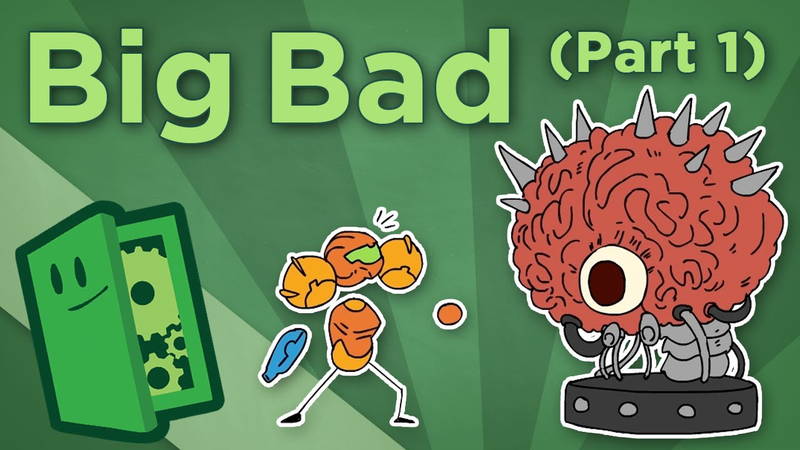
Big Bad - I: The Basics of Villains in Video Game Design - Extra Credits
Key insights
6 takeaways- 01A common design failure occurs when developers apply simple, force-of-nature mechanics archetypes to narrative-heavy contexts that require character depth.
- 02Effective game design requires distinguishing between mechanics villains, which facilitate gameplay, and narrative villains, which drive drama and immersion.
- 03The design of a mechanics villain must align with the game's overall tone to prevent distracting dissonance, such as using comical foils in light-hearted games or supernatural threats in serious titles.
- 04The gaming industry has historically demonstrated high proficiency in creating mechanics-focused antagonists, as these entities are unique to the medium and have been refined since its inception.
- 05Mechanics villains exist primarily to validate player skill through challenge and do not require psychological complexity.
- 06Mechanics villains are often positioned behind obstacles like armies or fortresses to justify progression and ensure the final confrontation feels earned.
Ask AI about this video
Transcript
Before we begin today, I've got an announcement or two. First, our wonderful artist Lilee here has decided that it's time to move on and conquer new lands. She's been working on extra credits for like 2 years now. We've loved having her on the team and we wish her the very best. And who knows, she may still pop in for an appearance from time to time. Thank you Liles for making so many episodes awesome. Of course, this left us with a bit of a void on the team. We needed another artist to help out Scott here. Well, it just so happens that we've got one and his name is are you kidding me? This is going to get confusing. I would like to welcome to the team Dan number three. This is Dan Jones. Welcome to the team, buddy. Anyway, announcements over. Let's get this episode going. Villains in video games tend to be pretty bad. Let me try that again. Villains in video games tend to be very poorly constructed. Today and next week, we're going to be talking about how to put together a decent villain for a video game. A lot of this is going to be pretty basic and there's a lot deeper one can go if one really wants to study this. I mean, smart
people have been creating great villains for centuries. But it's surprising how many games would benefit from applying even the most surface level rules of villain design. So, if your game is going to have a villain, depending on the kind of game you're making, you're generally going to have one of two types. Mechanics villains or narrative villains. Mechanics villains exist primarily for gameplay purposes. They exist to give you a reason to run, gun, jump, or stomp. They serve to precipitate the action. These are your Bowsers, your Ganons, your Dr. Wileys. Narrative villains on the other hand, are there to drive the story, to create drama, and to serve as the foil for your main character. These antagonists can be interesting, complex characters in their own right. These are your Big Bosses, your Andrew Ryans, your Delitas. Today, I want to focus on mechanics villains and how to use them. These guys don't really have to be all that complex. Functionally, they're more of final boss than a character, really. They can be comical, they can be the avatar of pure darkness, they could be inept, they could be evil geniuses. The important thing is that the player feels good about challenging them. You could often do this with contrast. Let's say your
game is a light-hearted, fun experience. In that case, you might make your villain comical and goofy, and maybe even clumsy in order to highlight the player's skill, like Dr. Robotnik, Gruntilda, King K. Rool, or Pete. Or say your game has a more serious tone. For that, maybe you want a true villain of pure evil, so that the player feels like a hero in fighting them, like the Enchantress, Chaos, Lavos, Maleficent, Tom Nook. Even your average raid boss in an MMO like World of Warcraft functions this way. When the player uses all of their mechanical prowess to overcome these villains, they should feel like within the narrative of the game that anybody with less skill than they could never overcome such a malevolent force. This is why we often resort to unknowable aliens or supernatural evils bent on humanity's destruction for this kind of mechanics villain. Your second goal when creating a mechanics villain is to make them feel as rewarding as possible to defeat. They should feel immensely powerful, so that when the player finally reaches them, you can create an intense game play scenario that requires all the mechanical skill
the player has been practicing over the course of the game. If you look at Bowser, he's bigger and more impressive than any of the Koopas scattered throughout the game, and overcoming him requires more skill from the player than almost any other enemy. Dr. Wily himself may be a weak old dude, but when you finally reach him and the fight starts, he's always in a massive attack vehicle or something, a weapon that makes him even more daunting a threat than any of his robot henchmen. Even Dracula in the Castlevania series works this way, and those games are already super hard. Finally, a good mechanics villain usually comes with some justification for why the player can't simply fight them right away and be done with it. Maybe they have an army to throw at you, or a fortress far away, or a labyrinth littered with traps, something you must overcome before you can take the fight to the villain themselves, thus justifying the rest of the game's action. I think overall that it's safe to say that we're pretty good at making villains like these. Mechanics villains are functionally somewhat unique to games, and we've been creating them for almost as long as video games have been around. What we are generally somewhat less good at is creating narrative villains. Narrative villains have vastly different requirements. Unlike the
mechanics villain type I've been describing, they usually can't just be caricatures of force of pure evil or bumbling comic relief. They aren't just there to be an end boss or to throw an army at you. They exist to make the world the player is inhabiting more immersive and believable, to provide an opposing force to the main character and create the conflict and drama of the story in doing so. This is where our industry often struggles because we have a tendency to use mechanics villains where narrative villains are needed. We'll get into that problem and talk more about the role of the narrative villain next week. Dan, thank you very much for No, no, not you, other Dan. I mean the other Oh, good grief. This is going to be a problem.
Summary
Effective video game design requires a clear distinction between two primary categories of antagonists: mechanics villains and narrative villains. Mechanics villains are functional entities designed primarily to facilitate gameplay, serving as the catalyst for player action such as jumping, shooting, or strategic combat. These characters do not require deep psychological complexity; instead, their design must align with the game’s overall tone to ensure the player remains engaged rather than distracted by tonal dissonance.
When designing a mechanics villain, the primary objective is to provide a rewarding challenge that validates the player's skill. In light-hearted games, these villains often function as comical or clumsy foils, such as Dr. Robotnik or King K. Rool, which emphasizes the player's competence. Conversely, in serious titles, mechanics villains often manifest as forces of pure evil or supernatural threats, such as raid bosses in massively multiplayer online games. These figures are typically positioned behind obstacles—such as armies, fortresses, or traps—that justify the game's progression and ensure the final confrontation feels earned.
The industry has historically demonstrated high proficiency in creating these mechanics-focused antagonists, as they are unique to the medium and have been refined since the inception of gaming. However, a common design failure occurs when developers attempt to use these simple, force-of-nature archetypes in contexts that require the nuance of a narrative villain. While mechanics villains exist to test the player's mechanical prowess, narrative villains are essential for building immersion, driving drama, and serving as a character foil. Misapplying the mechanics-first approach to narrative-heavy games often results in poorly constructed antagonists that fail to provide the necessary depth for a compelling story.
























Comments