1 free read left. Create a free account for unlimited reading + AI research.
Create free accountArticle Aldora
1 free read left. Create a free account for unlimited reading + AI research.
Create free accountArticleAldora
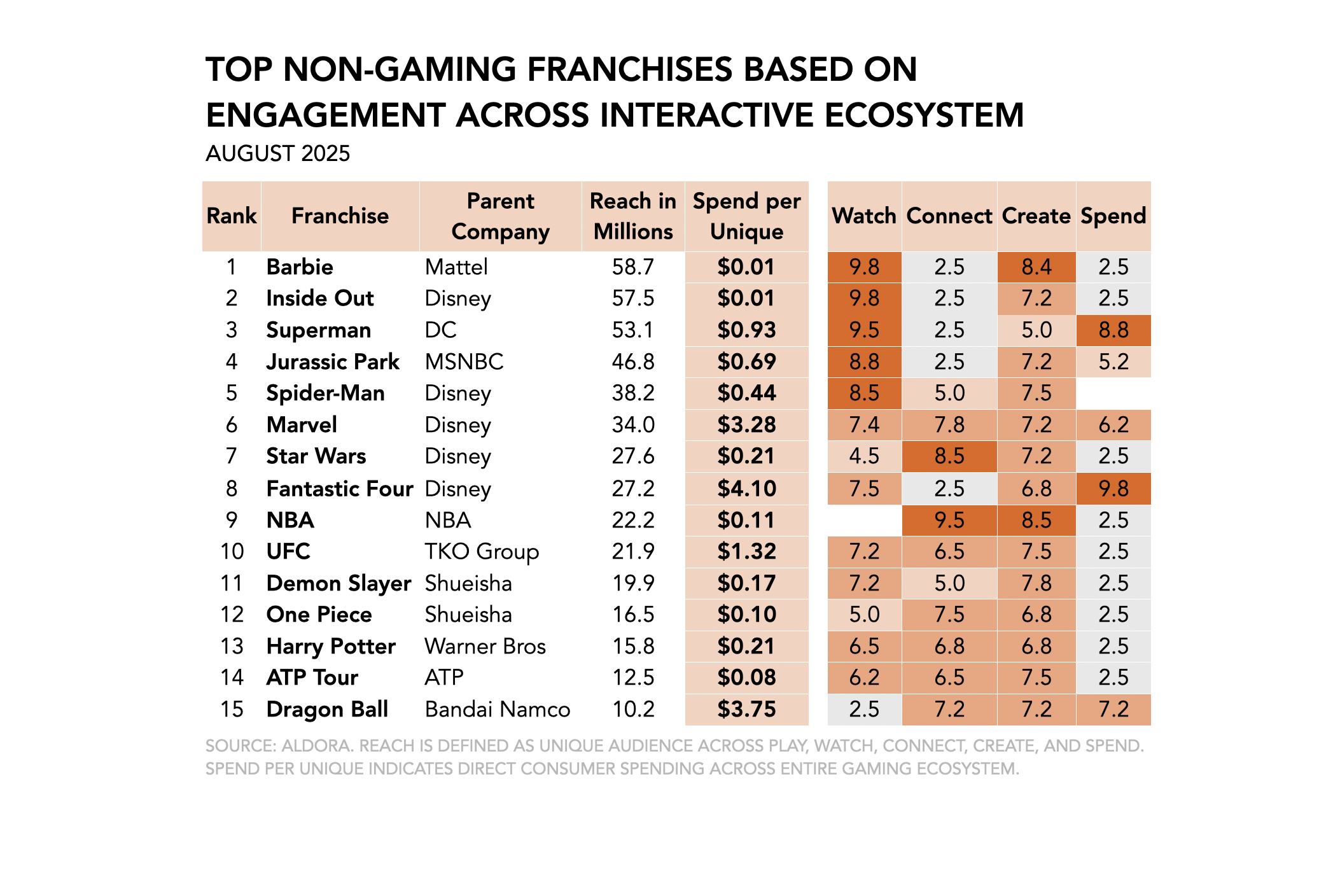
The entertainment industry is undergoing a structural shift. Top franchises function as integrated ecosystems, not isolated products, orchestrating user participation across multiple dimensions.
It's like a theme park where every ride and shop connects, rather than just a single attraction.
Key Insight. The most successful franchises in December 2025 were those that functioned as integrated ecosystems across film, gaming, merchandise, and social platforms, rather than relying on single-format content.
The January 2026 ALDORA Leaderboard identifies a structural shift in the entertainment industry, asserting that the most successful franchises are those that function as integrated, multi-channel ecosystems rather than isolated products. By analyzing performance data from December 2025, the findings demonstrate that cultural dominance is increasingly driven by the ability to orchestrate user participation across five behavioral dimensions: play, watch, connect, create, and spend. Franchises that successfully bridge these formats achieve greater durability and momentum compared to those reliant on single-format engagement or periodic release cycles.
The analysis utilizes a normalized ALDORA Score (0–100) and a Momentum Index to rank franchises based on their ability to convert attention into sustained participation. Avatar secured the top position with an ALDORA Score of 90, followed by LEGO and Five Nights at Freddy’s. These leaders exemplify the "participation-first" model, where fans migrate seamlessly between film, gaming, social, and commerce touchpoints. In contrast, legacy franchises such as Assassin’s Creed and Tomb Raider, while benefiting from IP refreshes, remain structurally constrained by their dependence on launch-driven spikes rather than consistent, ecosystem-wide engagement.
An unconventional finding highlights the role of non-traditional brands, such as Tesla, which achieved a top-ten ranking by leveraging community participation, identity signaling, and social discourse. This indicates that the competitive landscape has expanded beyond traditional media, with brands increasingly behaving like entertainment ecosystems. Ultimately, the data suggests that the primary differentiator for future success is not merely content distribution, but the capacity to design and sustain participatory loops that convert passive audiences into active, long-term contributors.
Aldora · 2026
Aldora · 2026
Aldora · 2026
Aldora · 2025
Aldora · 2025
Aldora · 2025


Aldora · 2025
Aldora · 2024
Aldora · 2024
Aldora · 2024


Aldora · 2024
Deconstructor of Fun · 2026