Updated Mar 21, 2026 by Square Enix
What can I help with?
AI-powered answers with citations from the library.
What can I help with?
AI-powered answers with citations from the library.
Financial · July 1, 2010
Published by Square Enix
Square Enix achieved record financial performance for the fiscal year ended March 31, 2010, characterized by a 41.7% increase in net sales to ¥192.3 billion and a 130% surge in operating income to ¥28.2 billion. This growth was primarily driven by a successful globalization strategy and the integration of Eidos Ltd., which expanded the company’s consolidated subsidiaries from 16 to 46. High-performing international titles, including Final Fantasy XIII, Batman: Arkham Asylum, and Just Cause 2, were instrumental in raising overseas revenue from 16.5% to 26.6% of total sales. The period marked a significant strategic pivot toward a "network-centric" business model. Management prioritized transitioning into a community platform operator, focusing on digital networks, smartphone gaming, and user-generated data over traditional physical media. To support this evolution, the company underwent a major structural reorganization into a holding company format, which included a net headcount reduction of 457 employees and the integration of amusement and software units through mergers involving Taito Corporation and Square Enix Co., Ltd. Financial results were impacted by ¥17.9 billion in extraordinary losses, largely due to the ¥12.2 billion accelerated amortization of goodwill and restructuring costs related to Taito. Despite these charges, net income rose to ¥9.5 billion. The company maintained a strong liquidity position with ¥109.7 billion in cash and equivalents, supported by the issuance of ¥35 billion in convertible bonds to manage debt redemptions. Moving forward, the strategy emphasizes expansion into the Chinese market and a commitment to stable shareholder returns, maintaining a 42.3% consolidated payout ratio while targeting future net sales of ¥160 billion.
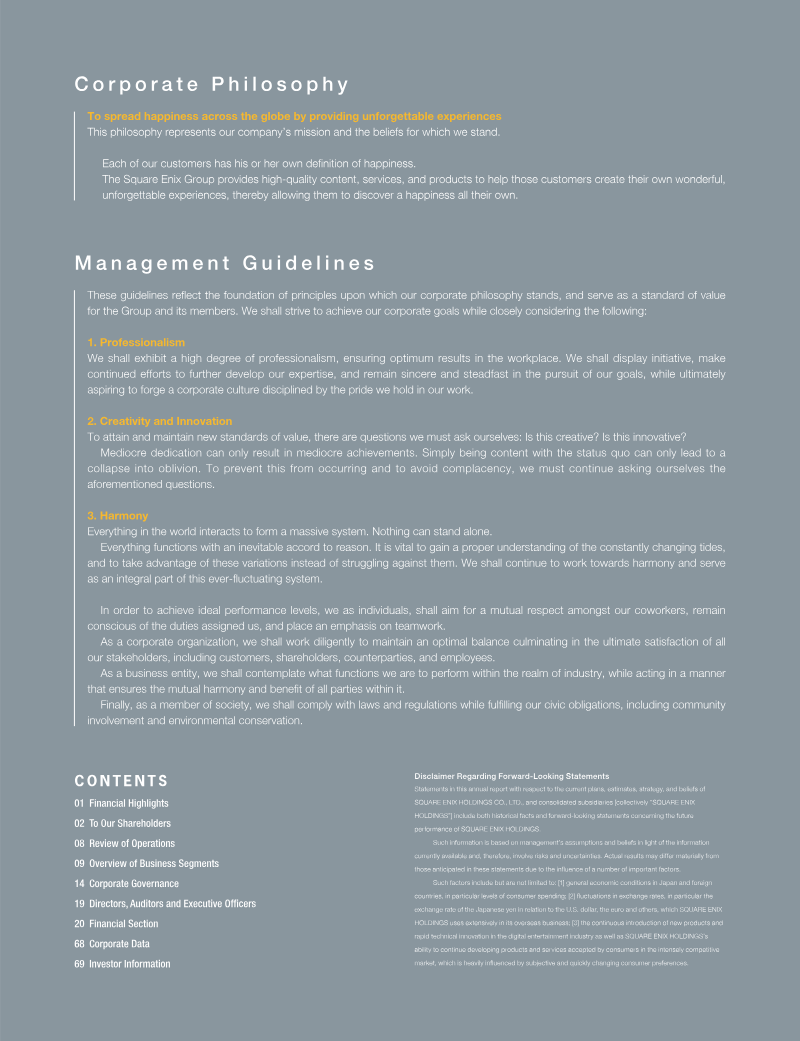
C o r p o r a t e P h i l o s o p h y To spread happiness across the globe by providing unforgettable experiences This philosophy represents our company’s mission and the beliefs for which we stand. Each of our customers has his or her own definition of happiness. The Square Enix Group provides high-quality content, services, and products to help those customers create their own wonderful, unforgettable experiences, thereby allowing them to discover a happiness all their own. M a n a g e m e n t G u i d e l i n e s These guidelines reflect the foundation of principles upon which our corporate philosophy stands, and serve as a standard of va lue for the Group and its members. We shall strive to achieve our corporate goals while closely considering the following: 1. Professionalism We shall exhibit a high degree of professionalism, ensuring optimum results in the workplace. We shall display initiative, make continued efforts to further develop our expertise, and remain sincere and steadfast in the pursuit of our goals, while ultimat ely aspiring to forge a corporate culture disciplined by the pride we hold in our work. 2. Creativity and Innovation To attain and maintain new standards of value, there are questions we must ask ourselves: Is this creative? Is this innovative? Mediocre dedication can only result in mediocre achievements. Simply being content with the status quo can only lead to a collapse into oblivion. To prevent this from occurring and to avoid complacency, we must continue asking ourselves the aforementioned questions.
s creative? Is this innovative? Mediocre dedication can only result in mediocre achievements. Simply being content with the status quo can only lead to a collapse into oblivion. To prevent this from occurring and to avoid complacency, we must continue asking ourselves the aforementioned questions. 3. Harmony Everything in the world interacts to form a massive system. Nothing can stand alone. Everything functions with an inevitable accord to reason. It is vital to gain a proper understanding of the constantly changin g tides, and to take advantage of these variations instead of struggling against them. We shall continue to work towards harmony and ser ve as an integral part of this ever-fluctuating system. In order to achieve ideal performance levels, we as individuals, shall aim for a mutual respect amongst our coworkers, remain conscious of the duties assigned us, and place an emphasis on teamwork. As a corporate organization, we shall work diligently to maintain an optimal balance culminating in the ultimate satisfaction of all our stakeholders, including customers, shareholders, counterparties, and employees. As a business entity, we shall contemplate what functions we are to perform within the realm of industry, while acting in a ma nner that ensures the mutual harmony and benefit of all parties within it. Finally, as a member of society, we shall comply with laws and regulations while fulfilling our civic obligations, including c ommunity involvement and environmental conservation.
the realm of industry, while acting in a ma nner that ensures the mutual harmony and benefit of all parties within it. Finally, as a member of society, we shall comply with laws and regulations while fulfilling our civic obligations, including c ommunity involvement and environmental conservation. CONTENTS Disclaimer Regarding Forward-Looking Statements Statements in this annual report with respect to the current plans, estimates, strategy, and beliefs of 01 Financial Highlights SQUARE ENIX HOLDINGS CO., LTD., and consolidated subsidiaries [collectively ”SQUARE ENIX 02 To Our Shareholders HOLDINGS”] include both historical facts and forward-looking statements concerning the future performance of SQUARE ENIX HOLDINGS. 08 Review of Operations Such information is based on management’s assumptions and beliefs in light of the information 09 Overview of Business Segments currently available and, therefore, involve risks and uncertainties. Actual results may differ materially from those anticipated in these statements due to the influence of a number of important factors. 14 Corporate Governance Such factors include but are not limited to: [1] general economic conditions in Japan and foreign 19 Directors‚ Auditors and Executive Officers countries, in particular levels of consumer spending; [2] fluctuations in exchange rates, in particular the exchange rate of the Japanese yen in relation to the U.S.
rs include but are not limited to: [1] general economic conditions in Japan and foreign 19 Directors‚ Auditors and Executive Officers countries, in particular levels of consumer spending; [2] fluctuations in exchange rates, in particular the exchange rate of the Japanese yen in relation to the U.S. dollar, the euro and others, which SQUARE ENIX 20 Financial Section HOLDINGS uses extensively in its overseas business; [3] the continuous introduction of new products, and 64 Corporate Data rapid technical innovation in the digital entertainment industry; and [4] SQUARE ENIX HOLDINGS’s ability to continue developing products and services accepted by consumers in the intensely competitive market, 65 Investor Information which is heavily influenced by subjective and quickly changing consumer preferences.
> **[Chart page]** This page contains visual data — view in PDF for the best experience. F i n a n c i a l H i g h l i g h t s SQUARE ENIX HOLDINGS CO.‚ LTD. and Consolidated Subsidiaries Years Ended March 31 Thousands of Millions of Yen U.S. Dollars 2006 2007 2008 2009 2010 2010 For the Year Net sales ¥ 124,473 ¥ 163,472 ¥ 147,516 ¥ 135,693 ¥ 192,257 $ 2,066,397 income Operating 15,470 25,916 21,520 12,277 28,235 303,474 income Recurring 15,547 26,241 18,864 11,261 27,822 299,039 income Net 17,076 11,619 9,196 6,333 9,509 102,206 At Year-end Total assets ¥ 213,348 ¥ 215,679 ¥ 212,134 ¥ 213,194 ¥ 270,529 $ 2,907,669 equity Total 120,993 129,461 147,034 147,318 152,680 1,641,022 Yen U.S. Dollars Per Share of Common Stock Net income ¥ 154.65 ¥ 105.06 ¥ 81.85 ¥ 55.11 ¥ 82.65 $ 0.89 Total equity 1,094.50 1,168.91 1,280.50 1,280.92 1,326.82 14.26 % Key Ratios Operating income margin 12.4% 15.9% 14.6% 9.0% 14.7% Recurring income margin 12.5 16.1 12.8 8.3 14.5 Return on equity 14.9 9.3 6.7 4.3 6.3 Equity ratio 56.7 60.0 69.3 69.1 56.4 Notes: 1. For the convenience of readers, amounts in U.S. dollars have been translated using the currency exchange rates at March 31, 2010 of ¥93.04=US$1. 2. Total equity = Common stock + Capital surplus + Retained earnings + Treasury stock + Valuation and translation adjustments Operating Income Margin/Recurring Income Margin (%) Return on Equity (%) 25 25 20 20 15 15 10 10 5 5
ing the currency exchange rates at March 31, 2010 of ¥93.04=US$1. 2. Total equity = Common stock + Capital surplus + Retained earnings + Treasury stock + Valuation and translation adjustments Operating Income Margin/Recurring Income Margin (%) Return on Equity (%) 25 25 20 20 15 15 10 10 5 5 0 0 2006 2007 2008 2009 2010 2006 2007 2008 2009 2010 Operating Income Margin Recurring Income Margin
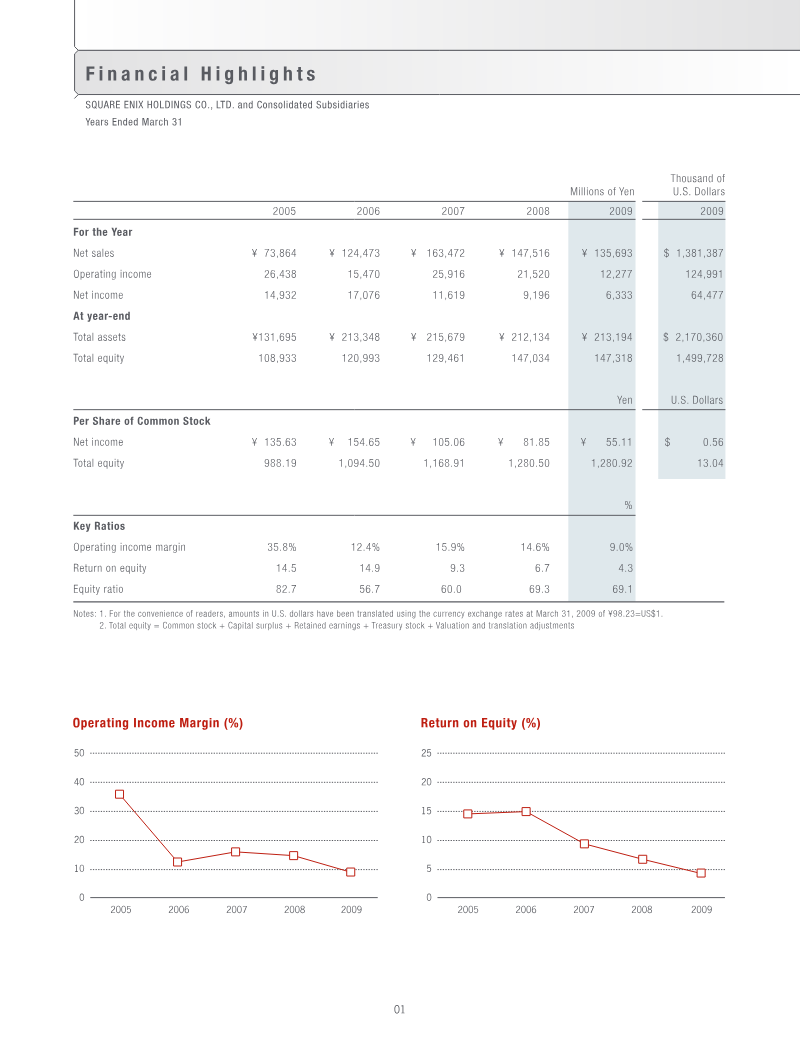
Square Enix faced a challenging fiscal year ending March 31, 2009, characterized by a global economic downturn and shifting consumer preferences. Net sales fell 8.0% to ¥135,693 million, while net income dropped 31.1% to ¥6,333 million. This decline was largely driven by a contraction in the amusement arcade segment and lower offline game sales, further exacerbated by a ¥5,368 million loss on inventory valuation and significant foreign exchange losses. Despite these headwinds, the organization maintained a strong liquidity position with ¥111.9 billion in cash and a net asset ratio of 69.1%, allowing for a consistent dividend of ¥30.00 per share. To counter domestic stagnation and a Japan-centric export model, the company underwent a major structural and strategic transformation. On October 1, 2008, it transitioned to a pure holding company structure, Square Enix Holdings Co., Ltd., to better manage its diverse gaming, mobile, and publishing operations. Central to its globalization strategy was the £84.3 million acquisition of Eidos Ltd., which integrated major Western intellectual properties like Tomb Raider and Hitman into the portfolio. This move aims to establish a truly global enterprise by leveraging Western market presence alongside traditional RPG strengths. Looking forward, management has set a 2010 net sales target of ¥180,000 million, focusing on media convergence and network-compliant entertainment. While the 2009 period saw increased capital expenditures and rising unfunded retirement obligations, the shift toward institutional and foreign investment—which rose significantly between 2004 and 2009—reflects a broadening capital base. By aligning with new Japanese accounting standards and consolidating its international footprint, the group intends to transition from a traditional publisher into a diversified global provider of digital content and community management.
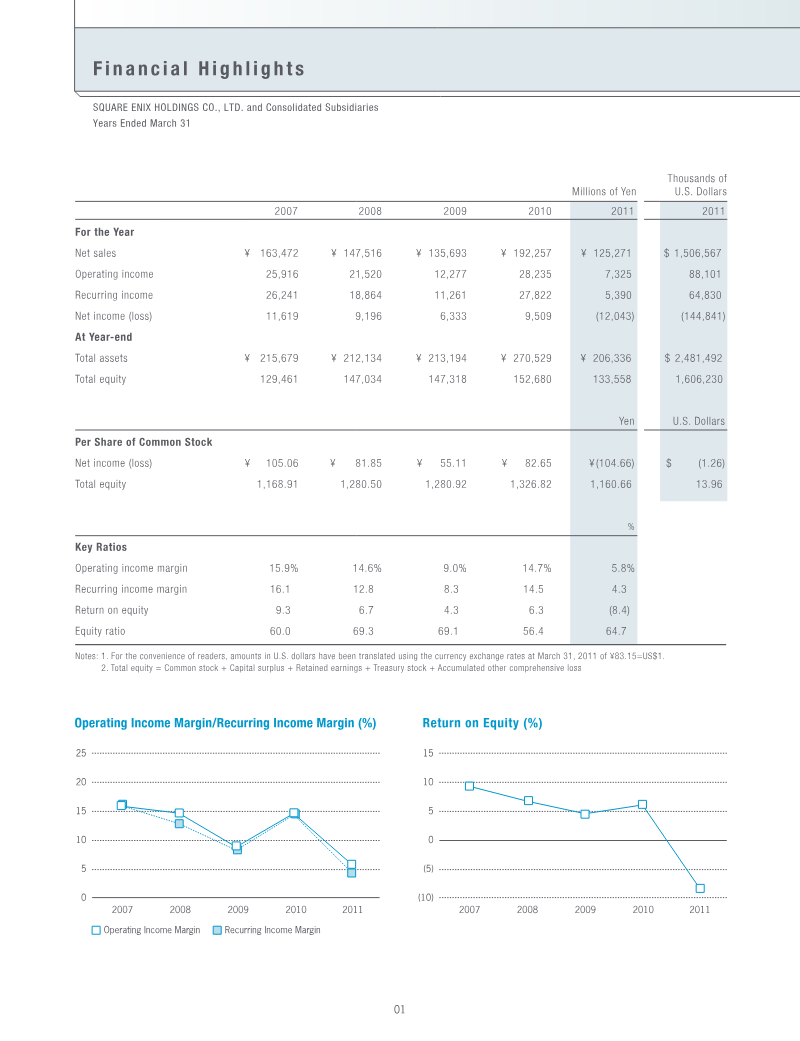
The 2011 fiscal year marked a period of significant financial contraction and strategic pivot for Square Enix, characterized by a 34.8% decline in net sales to ¥125.3 billion and a net loss of ¥12.0 billion. This downturn was primarily driven by the underperformance of major console titles, the troubled launch of Final Fantasy XIV, and a sharp decline in the merchandising segment. To stabilize the business, management executed aggressive balance sheet reassessments, including ¥8.8 billion in goodwill write-downs related to the Taito and Eidos acquisitions and ¥4.4 billion in development cancellations. Despite these losses and a ¥37 billion bond redemption, the Group maintained a solid net assets ratio of 64.7% and a cash balance of ¥109.8 billion. The primary thesis of this period is a fundamental transition from traditional, fixed-price physical media toward a "network-centric" model. This strategy responds to the rise of smartphones, browsers, and cloud gaming, which have lowered hardware barriers and necessitated a shift toward freemium and pay-as-you-go revenue streams. To support this recovery, the company is refocusing resources on approximately 10 key franchises while streamlining its corporate structure, which included the liquidation of 11 companies and the consolidation of 34 subsidiaries, most notably the integration of Eidos and Crystal Dynamics. Geographically, Japan remained the dominant market, representing 83% of total net sales, though foreign ownership of the company reached a five-year high of 27.4%. Governance reforms were also implemented to separate board oversight from operational execution and to streamline shareholder meetings. Moving forward, the Group aims to recover brand value by embracing disruptive innovation and adapting to a transforming global industry ecosystem.
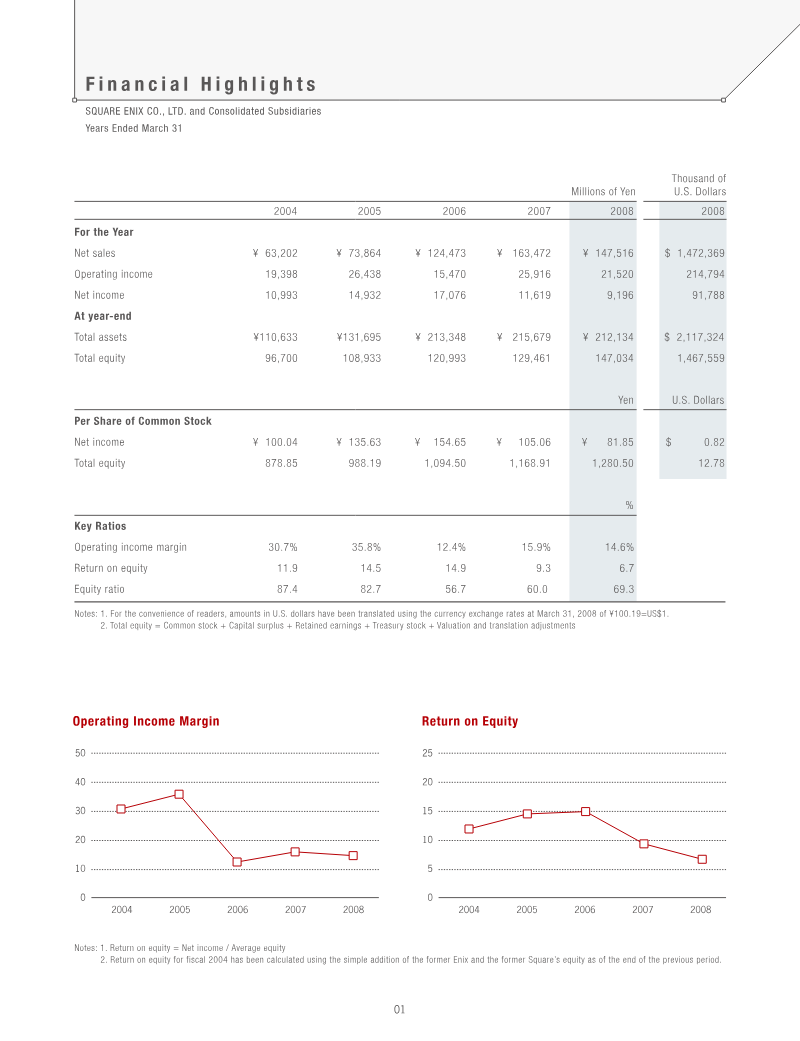
The fiscal year ended March 31, 2008, marked a period of strategic transition for Square Enix, characterized by a 9.8% decline in net sales to ¥147.5 billion and a 20.9% drop in net income to ¥9.2 billion. This downturn was primarily driven by a stagnation in the offline games segment, which saw a 19% sales decline due to a lack of major releases in North America and Europe. Despite these challenges, the company maintained a robust financial position with ¥111.5 billion in cash and equivalents, supported by the successful performance of titles like Dragon Quest IV in Japan and a significant profitability turnaround in the amusement segment. The primary thesis of this period centers on a fundamental shift from a single-console focus toward a global, multi-platform strategy. Management identified the need to overcome development bottlenecks and meet diversifying consumer preferences by expanding into online and mobile content, which posted five-year compound annual growth rates of 23.8% and 31.1%, respectively. To facilitate this evolution, the company initiated a major reorganization of development lines and prepared for a transition to a pure holding company structure, effective October 2008, to clarify accountability and enhance management flexibility for future capital alliances. Geographically, the Japanese market remained the dominant revenue source, accounting for 84.8% of total sales, while overseas contributions fell significantly. To address this imbalance, the company is prioritizing internal intellectual property and direct community engagement as media and content markets converge. While facing risks such as exchange rate fluctuations and the transition to next-generation hardware, the strategic pivot toward network-compliant entertainment and multi-functional devices aims to drive a recovery in net income for the following fiscal year.
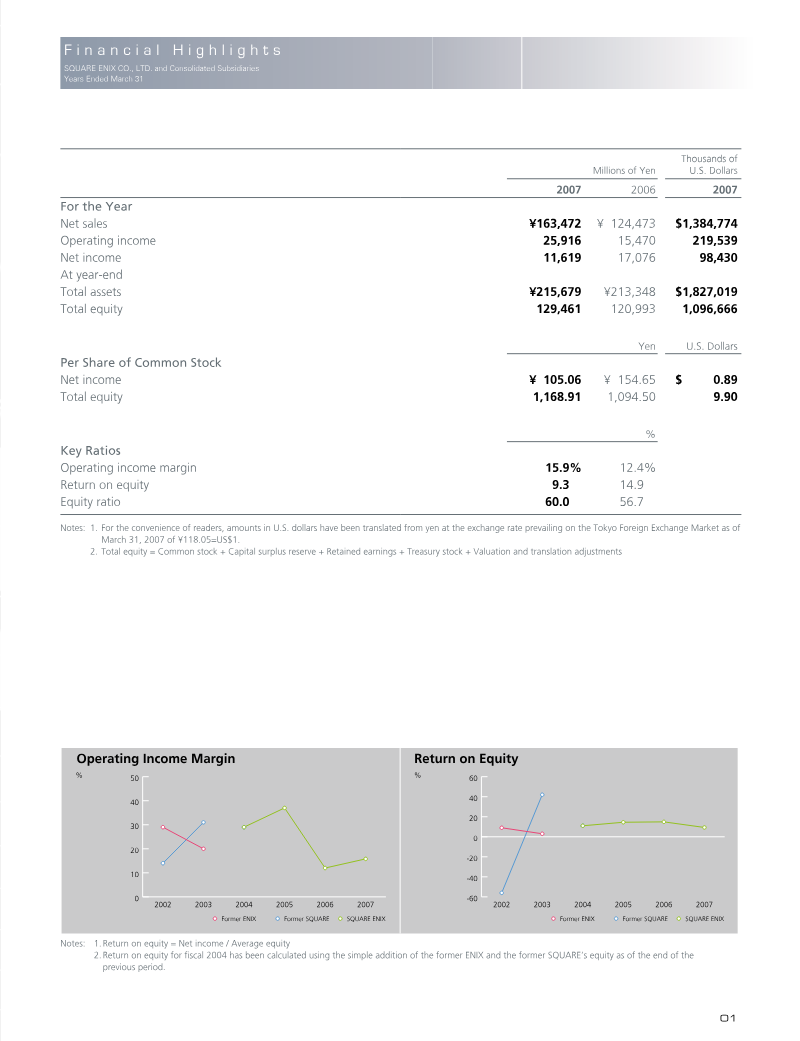
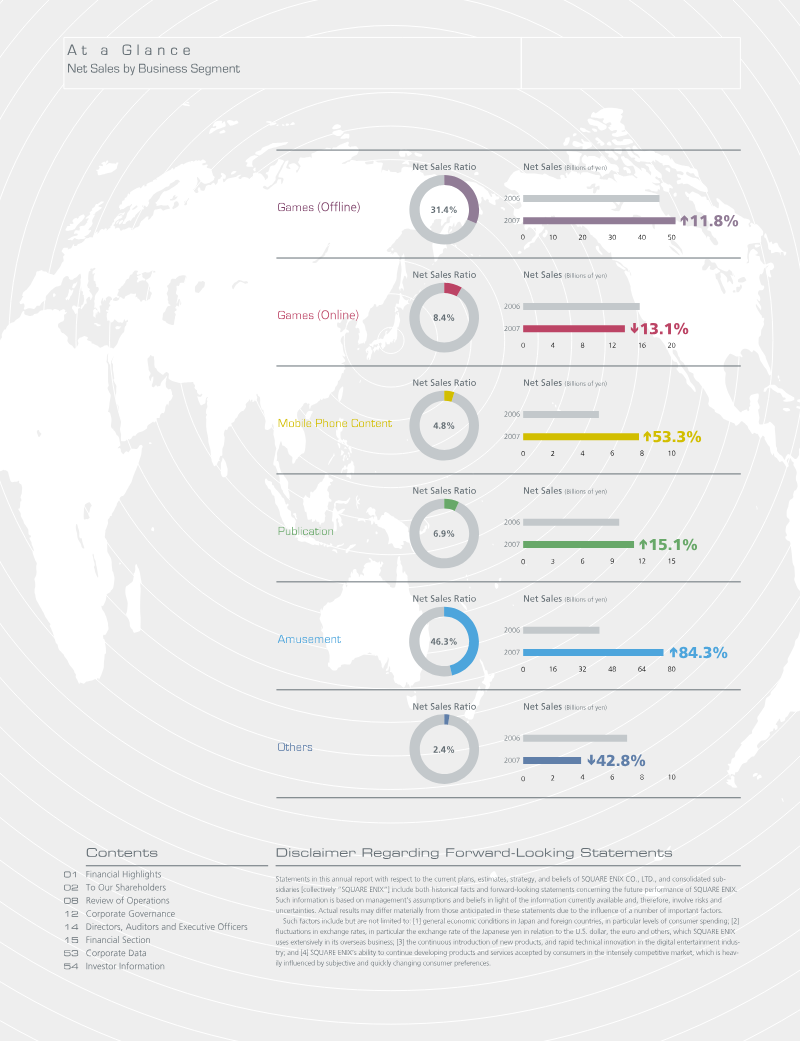
Square Enix achieved a significant financial milestone during the fiscal year ended March 31, 2007, reporting a 31.3% increase in net sales to ¥163.5 billion and a 67.5% surge in operating income. This growth was primarily driven by the consolidation of Taito Corporation and the international success of major titles such as Final Fantasy XII. Despite these gains, net income fell 32% to ¥11.6 billion due to substantial extraordinary losses totaling over ¥11 billion. These losses stemmed from a strategic restructuring of the amusement segment, which included closing unprofitable arcades and divesting Taito’s karaoke business to focus on core competencies. The company is currently navigating a transition toward becoming a global content and community provider, shifting its focus from traditional software sales to persistent network services and mobile platforms. This strategy proved successful during the console hardware transition, as handheld titles like Dragon Quest Monsters: Joker and Final Fantasy III became primary growth drivers. While Japan remains the dominant market, international operations in North America and Europe now account for 23% of total revenue. This global expansion is supported by a robust liquidity position, with cash reserves nearing ¥100 billion and a total absence of interest-bearing debt. Management has set a long-term goal to double recurring income to ¥50 billion by capitalizing on the 315% growth in mobile segment operating income and expanding established franchises. To support this evolution, the company has strengthened its corporate governance and internal controls while adopting a 30% consolidated dividend payout ratio. Despite the challenges of goodwill amortization and impairment losses related to subsidiaries like UIEvolution, Inc., the financial structure remains stable, characterized by a shift toward increased foreign share ownership and a disciplined approach to risk management and capital allocation.