Updated Mar 21, 2026 by Square Enix
Financial · July 1, 2006
Published by Square Enix
Fiscal year 2006 marked a period of aggressive structural expansion and strategic pivot for Square Enix, defined primarily by the acquisition of Taito Corporation. This consolidation drove net sales up 68.5% to ¥124.5 billion, as the company integrated Taito’s amusement and arcade operations into its traditional software portfolio. Financial performance was further bolstered by the record-setting global releases of *Final Fantasy XII* and *Kingdom Hearts II*, which shipped over 3.6 million units. However, despite record revenues, operating income fell 41.4% to ¥15.5 billion. This decline was attributed to a challenging transition in the console lifecycle, the underperformance of second-tier titles, and significant impairment hits, including a ¥3.9 billion write-down of goodwill related to the U.S. subsidiary UIEvolution. The acquisition of Taito fundamentally altered the corporate balance sheet, increasing total assets to ¥284.3 billion and necessitating the issuance of ¥50 billion in corporate bonds. While the new Amusement segment added substantial scale, it initially faced operating losses due to high investment costs and sluggish arcade sales. To mitigate these pressures, management initiated a divestment of non-core assets, such as Taito’s karaoke-on-demand business, and implemented a strategic shift toward "community management." This vision emphasizes multi-platform content delivery, network-compliant entertainment, and the application of game technology to non-entertainment sectors like education and IPTV. Geographically, Japan remained the primary revenue driver, accounting for 87% of sales, though the company noted significant growth in the Asian digital content market. The ownership structure also underwent a notable transformation, with foreign investment rising from 4.46% to 19.65% over a two-year period. Moving forward, the company aims to stabilize its expanded operations by targeting a 20% operating income ratio, focusing on cross-platform middleware development and the strengthening of global human resources to navigate the risks associated with next-generation hardware transitions.

C% C SQUARE ENIX CO., LTD, TH SQUARCCNIX www.square-enix.com/ ANNUAL REPORT 2006 PRINTED WITH S OY INK Printed in Japan
Net Sales by Business Segment Years Ended March 31 Net Sales Ratio Net Sales (Billions of yen) Games (Offline) 36.9% 2005 2006 9.5% 0 10 20 30 40 50 Net Sales Ratio Net Sales (Billions of yen) Games (Online) 12.6% 2005 2006 13.5% 0 4 8 12 16 20 Net Sales Ratio Net Sales (Billions of yen) Mobile Phone Content 4.1% 2005 2006 11.2% 0 2 4 6 8 10 Net Sales Ratio Net Sales (Billions of yen) Publication 7.8% 2005 2006 10.3% 0 3 6 9 12 15 Net Sales Ratio Net Sales (Billions of yen) Amusement 33.0% 2005 2006 0 10 20 30 40 50 Net Sales Ratio Net Sales (Billions of yen) Others 5.6% 2005 2006 162.6% 0 2 4 6 8 10 Contents Disclaimer Regarding Forward-Looking Statements Statements in this annual report with respect to the current plans, estimates, strategy, and beliefs Financial Highlights 01 of SQUARE ENIX CO., LTD., and consolidated subsidiaries [collectively ”SQUARE ENIX”] include both historical facts and forward-looking statements concerning the future performance of SQUARE ENIX. To Our Shareholders 02 Such information is based on management’s assumptions and beliefs in light of the information Review of Operations 08 currently available and, therefore, involve risks and uncertainties. Actual results may differ materially from those anticipated in these statements due to the influence of a number of important factors. Corporate Governance 12 Such factors include but are not limited to: [1] general economic conditions in Japan and foreign countries, in particular levels of consumer spending; [2] fluctuations in exchange rates, in particular the Directors, Auditors and Executive Officers 13 exchange rate of the Japanese yen in relation to the U.S.
rs include but are not limited to: [1] general economic conditions in Japan and foreign countries, in particular levels of consumer spending; [2] fluctuations in exchange rates, in particular the Directors, Auditors and Executive Officers 13 exchange rate of the Japanese yen in relation to the U.S. dollar, the euro and others, which SQUARE Financial Section 14 ENIX uses extensively in its overseas business; [3] the continuous introduction of new products, and rapid technical innovation in the digital entertainment industry; and [4] SQUARE ENIX’s ability to Corporate Data 65 continue developing products and services accepted by consumers in the intensely competitive market, which is heavily influenced by subjective and quickly changing consumer preferences. Investor Information 66
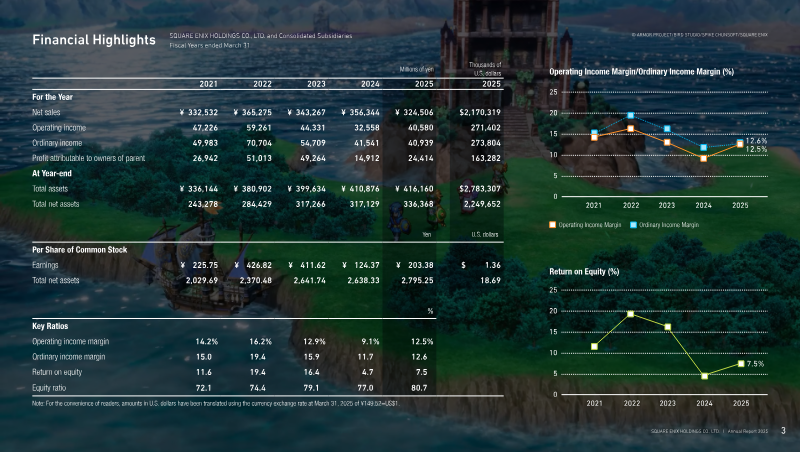
SQUARE ENIX CO., LTD. and Consolidated Subsidiaries Years Ended March 31 Thousands of Millions of Yen U.S. Dollars 2006 2005 2006 For the Year Net sales ¥124,473 ¥ 73,864 $1,059,619 Operating income 15,470 26,438 131,695 Net income 17,076 14,932 145,370 At year-end Total assets ¥213,348 ¥131,695 $1,816,198 Total shareholders’ equity 120,993 108,933 1,029,997 Yen U.S. Dollars Per Share of Common Stock Net income ¥ 154.65 ¥ 135.63 $ 1.31 Total shareholders’ equity 1,094.50 988.19 9.31 % Key Ratios Operating income margin 12.4% 35.8% Return on equity 14.9 14.5 Shareholders’ equity ratio 56.7 82.7 Notes: For the convenience of readers, amounts in U.S. dollars have been translated from yen at the exchange rate prevailing in the Tokyo foreign exchange market as of March 31, 2006 of ¥ 117.47=US $1. Operating Income Margin Return on Equity % % 50 60 40 40 30 20 20 0 10 -20 0 -40 -10 -60 2001 2002 2003 2004 2005 2006 2001 2002 2003 2004 2005 2006 Former ENIX Former SQUARE SQUARE ENIX Former ENIX Former SQUARE SQUARE ENIX Notes: 1. Return on equity = Net income / Average shareholders’ equity 2. The former ENIX did not prepare consolidated financial statements for the period in FY2000. The former ENIX figures for this period are, therefore, disclosed on a non-consolidated basis. 3. Return on equity for FY2003 has been calculated using the simple addition of the former ENIX and the former SQUARE’s shareholders’ equity as of the end of the previous period.
I<sup>am </sup> pleased to present the SQUARE ENIX annual report for fiscal 2005, ended March 31, 2006, to our shareholders and other stakeholders. In fiscal 2005, on a consolidated basis, net sales rose 68.5%, to ¥ 124,473 million, operating income declined 41.4%, to ¥15,470 million, recurring income decreased 39.9%, to ¥ 15,547 million, and net income climbed 14.3%, to ¥ 17,076 million. The operating income margin was 12.4%, and return on equity (ROE) was 14.9% in fiscal 2005. When we inaugurated SQUARE ENIX, I’ve laid out the actions to be taken as follows. The first two fiscal years were to be largely devoted to building up strength and stamina. Our primary focus for the third year —the year under review—and fourth year was to modify our physique. In addition to accomplishing structural reforms, we would work toward a significant leap forward through the completion of our new structure in fiscal 2010. In fiscal 2005, we met the challenges of a changing operating environment and the change of the industry structure by preparing a stronger than ever product lineup. FINAL FANTASY XII and KINGDOM HEARTS II became record-setting game titles in the industry during the fiscal year under review, while the release of the computer-generated imagery (CGI)-animated film FINAL FANTASY VII: Advent Children gained considerable attention in both the United States and Japan for its unprecedented success. Although our major products performed as strongly as anticipated, changes in the operating environment were even harsher than initially expected, and therefore other products were unable to mirror our major-product successes.
ention in both the United States and Japan for its unprecedented success. Although our major products performed as strongly as anticipated, changes in the operating environment were even harsher than initially expected, and therefore other products were unable to mirror our major-product successes. As a result, we were unable to avoid a decline in operating income. While committed to reassessing the current circumstances and modifying our approach, based on our firmly held philosophies, we will continue to push forward, our resolution firm, until we Net Every Yoichi Wada
Square Enix achieved a significant financial milestone during the fiscal year ended March 31, 2007, reporting a 31.3% increase in net sales to ¥163.5 billion and a 67.5% surge in operating income. This growth was primarily driven by the consolidation of Taito Corporation and the international success of major titles such as Final Fantasy XII. Despite these gains, net income fell 32% to ¥11.6 billion due to substantial extraordinary losses totaling over ¥11 billion. These losses stemmed from a strategic restructuring of the amusement segment, which included closing unprofitable arcades and divesting Taito’s karaoke business to focus on core competencies. The company is currently navigating a transition toward becoming a global content and community provider, shifting its focus from traditional software sales to persistent network services and mobile platforms. This strategy proved successful during the console hardware transition, as handheld titles like Dragon Quest Monsters: Joker and Final Fantasy III became primary growth drivers. While Japan remains the dominant market, international operations in North America and Europe now account for 23% of total revenue. This global expansion is supported by a robust liquidity position, with cash reserves nearing ¥100 billion and a total absence of interest-bearing debt. Management has set a long-term goal to double recurring income to ¥50 billion by capitalizing on the 315% growth in mobile segment operating income and expanding established franchises. To support this evolution, the company has strengthened its corporate governance and internal controls while adopting a 30% consolidated dividend payout ratio. Despite the challenges of goodwill amortization and impairment losses related to subsidiaries like UIEvolution, Inc., the financial structure remains stable, characterized by a shift toward increased foreign share ownership and a disciplined approach to risk management and capital allocation.
Fiscal 2004 marked a period of record financial performance and strategic consolidation for Square Enix following the 2003 merger of Enix and Square. Net sales rose 16.9% to ¥73.86 billion, while net income more than tripled to ¥14.93 billion. This growth was underpinned by a robust equity ratio of 82.7% and a substantial cash position of over ¥81 billion with no interest-bearing debt. While the domestic Japanese market remained the primary revenue driver, accounting for approximately 82% of total sales, the company expanded its international footprint through the establishment of Square Enix (China) and increased foreign investment, which rose to 12% of total shares. The Games (Offline) segment remained the largest revenue contributor, generating ¥41 billion behind the success of Dragon Quest VIII, which sold 3.6 million units. However, the most significant growth occurred in digital segments, with mobile phone content and online games increasing by 63.2% and 55.2% respectively. Final Fantasy XI reached a milestone of 500,000 global subscribers, validating the shift toward recurring revenue models. To support this digital evolution, the company capitalized ¥17.9 billion in software development costs and acquired UIEvolution to enhance its technical flexibility in content delivery. Management’s "Phase 2" strategy focuses on navigating the transition to next-generation consoles through a "Polymorphic Content" approach, which emphasizes cross-platform availability and economies of scope. By leveraging established intellectual properties across mobile, online, and traditional media, the company aims to mitigate risks associated with rising development costs and the volatility of the used game market. Despite a temporary revenue decline in Western markets due to a lack of major releases, the company remains positioned for growth through cross-industry alliances and the expansion of its network-based services globally.
The fiscal year ended March 31, 2008, marked a period of strategic transition for Square Enix, characterized by a 9.8% decline in net sales to ¥147.5 billion and a 20.9% drop in net income to ¥9.2 billion. This downturn was primarily driven by a stagnation in the offline games segment, which saw a 19% sales decline due to a lack of major releases in North America and Europe. Despite these challenges, the company maintained a robust financial position with ¥111.5 billion in cash and equivalents, supported by the successful performance of titles like Dragon Quest IV in Japan and a significant profitability turnaround in the amusement segment. The primary thesis of this period centers on a fundamental shift from a single-console focus toward a global, multi-platform strategy. Management identified the need to overcome development bottlenecks and meet diversifying consumer preferences by expanding into online and mobile content, which posted five-year compound annual growth rates of 23.8% and 31.1%, respectively. To facilitate this evolution, the company initiated a major reorganization of development lines and prepared for a transition to a pure holding company structure, effective October 2008, to clarify accountability and enhance management flexibility for future capital alliances. Geographically, the Japanese market remained the dominant revenue source, accounting for 84.8% of total sales, while overseas contributions fell significantly. To address this imbalance, the company is prioritizing internal intellectual property and direct community engagement as media and content markets converge. While facing risks such as exchange rate fluctuations and the transition to next-generation hardware, the strategic pivot toward network-compliant entertainment and multi-functional devices aims to drive a recovery in net income for the following fiscal year.
Square Enix achieved record financial performance for the fiscal year ended March 31, 2010, characterized by a 41.7% increase in net sales to ¥192.3 billion and a 130% surge in operating income to ¥28.2 billion. This growth was primarily driven by a successful globalization strategy and the integration of Eidos Ltd., which expanded the company’s consolidated subsidiaries from 16 to 46. High-performing international titles, including Final Fantasy XIII, Batman: Arkham Asylum, and Just Cause 2, were instrumental in raising overseas revenue from 16.5% to 26.6% of total sales. The period marked a significant strategic pivot toward a "network-centric" business model. Management prioritized transitioning into a community platform operator, focusing on digital networks, smartphone gaming, and user-generated data over traditional physical media. To support this evolution, the company underwent a major structural reorganization into a holding company format, which included a net headcount reduction of 457 employees and the integration of amusement and software units through mergers involving Taito Corporation and Square Enix Co., Ltd. Financial results were impacted by ¥17.9 billion in extraordinary losses, largely due to the ¥12.2 billion accelerated amortization of goodwill and restructuring costs related to Taito. Despite these charges, net income rose to ¥9.5 billion. The company maintained a strong liquidity position with ¥109.7 billion in cash and equivalents, supported by the issuance of ¥35 billion in convertible bonds to manage debt redemptions. Moving forward, the strategy emphasizes expansion into the Chinese market and a commitment to stable shareholder returns, maintaining a 42.3% consolidated payout ratio while targeting future net sales of ¥160 billion.