SocialPeta
Research162 documents
Documents
Article
8 Tips of Game Ad Creative
The document outlines eight actionable creative strategies for game advertising, emphasizing the importance of distinct visual and narrative elements to capture audience attention. It identifies influencer-driven live commentary, featuring popular YouTubers or user-generated content, as a high-impact method that leverages existing fan bases to boost visibility. Incorporating attractive visual themes—such as beauty-focused imagery in the UAE or cinematic elements from well-known films like Harry Potter—leverages cultural and emotional triggers to increase engagement. Highlighting core gameplay mechanics, especially in puzzle or casual titles, demonstrates how integrating game features into the ad narrative can entice potential players. Using endearing characters to narrate story arcs, as seen in tower‑defense titles, showcases the power of relatable storytelling. Dual-module layouts that juxtapose contrasting visuals create dynamic tension, while psychologically targeted content—like themes resonating with specific demographics—capitalizes on audience pain points. Finally, designing ads that build anticipation only to end abruptly taps into the desire for completion and encourages downloads. The document covers global examples, primarily from mobile gaming markets, and suggests that while innovative concepts can yield rapid success, they must be carefully planned to mitigate risk.
- Leverage influencer-driven live commentary from popular YouTubers or user-generated content to tap into existing fan bases and maximize ad visibility.
- Incorporate culturally specific visual themes, such as beauty-focused imagery in the UAE or cinematic elements from recognizable franchises like Harry Potter, to trigger emotional engagement.
- Integrate core gameplay mechanics directly into the ad narrative to clearly demonstrate the user experience, particularly for puzzle and casual game titles.
- Utilize dual-module layouts to juxtapose contrasting visuals, creating dynamic tension that captures viewer attention more effectively than static imagery.
- Implement 'cliffhanger' ad structures that build anticipation and end abruptly to trigger a psychological desire for completion, driving higher download rates.
+2
SocialPetaFeb 2023
Whitepaper191 pages
Global Mobile Game & App (Non‑Game) Marketing White Paper 2022
The global mobile landscape in 2022 was defined by a 17.5% year-on-year increase in quarterly advertisers despite a 16% decline in total creative volume. This shift indicates a transition toward more dynamic, high-frequency marketing strategies, with over 90% of advertisers launching new creatives each quarter. While North America maintained the largest advertiser base, markets in Hong Kong, Macao, and Taiwan exhibited the highest creative output per advertiser. Android remained the dominant platform for volume, often doubling the creative output of iOS, though iOS advertisers grew to represent 40% of the market by year-end.
The gaming sector experienced a notable decoupling of engagement and monetization. Genres such as strategy, simulation, and casual games saw year-over-year download growth ranging from 8% to 10%, yet simultaneously faced revenue declines between 9% and 16%. To combat rising user acquisition costs and falling revenues, developers increasingly adopted "Casual + X" strategies. This trend involved integrating hyper-casual mini-games—such as "save the dog" puzzles or line-drawing mechanics—into the marketing funnels of complex RPG and strategy titles to lower costs and broaden appeal. Hybrid-casual titles also emerged as a significant force, utilizing Roguelike mechanics and high-volume video ads to bridge the gap between traditional casual play and deeper monetization.
In the non-game sector, advertising activity peaked in the fourth quarter, driven largely by utility tools, shopping, and educational applications. Video content remained the primary medium, accounting for over 70% of creatives across most global regions. Major players like TikTok and Duolingo maintained market leadership through exceptionally high creative refresh rates, often exceeding 95% new content. Regionally, Southeast Asia and Turkey showed a heavy reliance on Android and localized "big hit" formulas, while the United States and Japan remained the primary drivers of global revenue.
Looking forward, the industry is shifting toward story-centric strategies and user-generated content to navigate a privacy-first environment. With the implementation of SKAdNetwork 4.0 and the impending Android Privacy Sandbox, marketers are moving away from granular user-level targeting in favor of Media Mix Modeling. The prevailing conclusion is that long-term lifetime value and diversified monetization models are now essential to offset rising platform costs and tightening media budgets.
- The mobile gaming sector saw a decoupling of engagement and monetization in 2022, with strategy, simulation, and casual genres experiencing 8% to 10% download growth alongside 9% to 16% revenue declines.
- To counter rising acquisition costs, developers are adopting 'Casual + X' strategies, integrating hyper-casual mini-games into complex RPG and strategy titles to broaden appeal and lower entry barriers.
- Marketing strategy shifted toward higher efficiency in 2022, characterized by a 17.5% increase in quarterly advertisers despite a 16% reduction in total creative volume.
- Android remains the dominant platform for creative volume, often doubling iOS output, though iOS advertisers captured 40% of the market share by the end of 2022.
- Market leaders like TikTok and Duolingo maintain dominance through high-frequency creative refreshes, with new content rates exceeding 95% per quarter.
+1
SocialPetaJan 2023

Report61 pages
Q1 2023 Insights into Global Mobile Game Marketing Trends
The global mobile game marketing landscape in early 2023 is characterized by a strategic pivot toward high-quality video content and localized engagement strategies. While the number of monthly active advertisers grew by 15% to over 160,000, the volume of new creative assets declined by 16%, signaling an industry-wide shift from quantity to quality. Android remains the primary platform for advertising, accounting for nearly 70% of total ad volume. Casual games continue to lead the market in both advertiser density and creative volume, though strategy and simulation genres are experiencing the most significant growth in advertiser participation.
Marketing tactics have become increasingly sophisticated to combat rising acquisition costs and shifting consumer habits. Video content now comprises over 80% of all ad creatives, frequently utilizing "mini-game" mechanics, playable ads, and "deliberate failure" tropes to drive engagement. In the strategy sector, which is projected to see a 6.42% compound annual growth rate through 2027, developers are increasingly integrating casual gameplay elements into their marketing to broaden appeal. Conversely, the RPG market has cooled, experiencing its first revenue decline of 16% in 2022, leading advertisers in this space to rely more heavily on celebrity endorsements and gacha-related incentives.
Geographic trends reveal a stark contrast in regional preferences and growth trajectories. North America maintains the highest advertiser density, while Southeast Asia and the Middle East are emerging as high-growth hubs, with Southeast Asian revenue projected to nearly double between 2020 and 2023. Regional success depends heavily on localization, such as TikTok-driven tournament content in Southeast Asia and social-integrated voice features in the Middle East. While puzzle games offer the most cost-effective advertising in the United States, the casino and simulation sectors are finding success in South America and global markets through relaxing creative themes and slots-focused advertising.
- Mobile game advertisers are shifting from quantity to quality, evidenced by a 15% increase in active advertisers to over 160,000 alongside a 16% decline in new creative asset volume.
- Video content now dominates the advertising landscape, accounting for over 80% of all ad creatives and frequently utilizing playable mechanics or 'deliberate failure' tropes to improve engagement.
- Android remains the dominant advertising platform, capturing nearly 70% of total global ad volume.
- The strategy game genre is a key growth area with a projected 6.42% compound annual growth rate through 2027, driven by the integration of casual gameplay elements into marketing.
- The RPG sector is cooling, having experienced a 16% revenue decline in 2022, forcing developers to pivot toward celebrity endorsements and gacha-based incentives.
+2
SocialPetaJan 2023

Report65 pages
Insights into Marketing Trends of Global Mobile Apps
The global mobile app marketing landscape in the first half of 2023 was defined by intense competition and a decisive shift toward dynamic content. Over 93% of the approximately 170,000 active advertisers launched new creatives during this period, with emerging markets in Africa and South Asia exhibiting the highest creative density. Android emerged as the primary platform for this activity, accounting for over 70% of total creatives. Video content has solidified its dominance, representing 45% of total ad impressions globally and reaching as high as 72% in the Middle East, while traditional static image performance continues to decline.
Sector-specific trends highlight a massive AI-driven boom in tool apps, which saw year-over-year advertiser growth exceeding 100% across all tracked regions. While entertainment and social apps continue to lead in revenue and downloads across North America and Southeast Asia, the Middle East has surfaced as a high-potential market characterized by a young demographic and high digital engagement. In contrast, the reading app sector has reached a stage of maturity, relying on high creative refresh rates and established intellectual properties to sustain market share in an increasingly crowded environment.
Technological innovation, particularly in Artificial Intelligence and Augmented Reality, is fundamentally altering user engagement. AI-integrated tools and "Social+" entertainment platforms are attracting heavy investment in Tier-1 markets, while AR is transitioning from a novelty to a core marketing medium. With over 300 million daily AR users already active on major social platforms, projections suggest that nearly 75% of the global population will be regular AR users by 2025. This shift is driven by the high visual attention and trust associated with immersive formats, which offer significantly higher receptivity compared to traditional digital advertising methods.
- Video content now accounts for 45% of global ad impressions, reaching up to 72% in the Middle East, as traditional static image performance continues to decline.
- AI-integrated tool apps experienced over 100% year-over-year advertiser growth across all tracked regions in the first half of 2023.
- Android remains the dominant marketing platform, accounting for over 70% of the total creatives launched by the 170,000 active advertisers.
- Augmented Reality is shifting from a novelty to a core medium, with projections indicating that 75% of the global population will be regular AR users by 2025.
- Over 93% of active mobile advertisers launched new creatives in the first half of 2023, with the highest creative density occurring in Africa and South Asia.
+1
SocialPetaJan 2023
Article
Global Mobile Games in November 2022: From Playfield to Battlefield
The analysis focuses on global mobile game performance in November 2022, highlighting key trends across advertising spend, revenue generation, and download growth. In advertising, the RPG “Mighty Party” dominated iOS with nearly 2,600 deduplicated creatives, emphasizing video formats and themes of relaxation and team building. “Path to Nowhere” launched its international version, deploying 1,200 video‑heavy creatives targeting the U.S., Singapore, and Canada. The casual coloring title “Fun Coloring” captured Android’s top spot with 9,100 creatives, primarily images centered on relaxation and diverse visual themes.
Revenue data show “Fate/Grand Order” leading the App Store with a 158.9 % month‑over‑month increase, driven by event‑based content and popular character re‑runs. “Lineage W” and “Genshin Impact” also posted strong gains of 90.6 % and 54.7 %, respectively, following anniversary events and new character releases. On Google Play, “Call of Duty Mobile” benefited from Neymar Jr.’s addition, achieving a 32.5 % revenue rise, while “Lineage W” and “Genshin Impact” recorded 28.8 % and 18.6 % growth, respectively.
Download figures reveal “FIFA Mobile” surged with a 60 % month‑over‑month increase after launching a Qatar mode, and Tencent’s “NIKKE” emerged as a global sensation amid overseas expansion. Other notable download leaders include the simulation “Makeover Studio,” the mini‑game “Dog Cult” within “Valor Legends,” and music casual titles such as “Piano Star.” The data collectively illustrate a November landscape where event‑driven content, high‑profile collaborations, and strategic advertising campaigns drove significant engagement across both iOS and Android platforms.
- Event-driven content and character updates drove significant revenue spikes, led by 'Fate/Grand Order' with a 158.9% month-over-month increase on the App Store.
- 'FIFA Mobile' achieved a 60% month-over-month increase in downloads following the strategic launch of a Qatar-themed game mode.
- High-profile collaborations, such as the addition of Neymar Jr. to 'Call of Duty Mobile', successfully boosted revenue by 32.5% on Google Play.
- Advertising volume remained high, with 'Fun Coloring' leading Android with 9,100 creatives and 'Mighty Party' topping iOS with nearly 2,600 deduplicated creatives.
- Major titles including 'Lineage W' and 'Genshin Impact' saw consistent cross-platform growth, with 'Lineage W' recording revenue gains of 90.6% on iOS and 28.8% on Google Play.
+4
SocialPetaDec 2022
Article
What Kind of Mobile Games Can Generate More Than $1 Billion in Revenue?
The analysis investigates the characteristics of mobile titles that have surpassed a cumulative $1 billion in revenue, drawing on data from PocketGamer and SocialPeta. It identifies nearly 60 global games that have reached this threshold, noting a shift from an initial list of 23 to the current figure. Geographic distribution shows that 37 titles generate revenue worldwide, while nine are predominantly Japanese, including popular gacha‑centric franchises such as Uma Musume Pretty Derby, Fate/Grand Order, and Puzzle & Dragons. The Japanese market alone contributed about $8.2 billion in 2022, with an average monthly spend of roughly $30 among young players.
A key finding is the dominance of 4X strategy games—nine titles in the list—and their strong performance across the United States, Japan, and China. Chinese developers account for 21 % of all titles, with seven (or fifteen if FunPlus is counted) Chinese studios producing 4X strategy games that have crossed the $1 billion mark. Other successful genres include MOBA, battle royale, card RPG, and MMORPG, often developed through collaborations between Western studios (e.g., Activision, EA, Blizzard) and Chinese partners such as Tencent and NetEase.
The report highlights the leading publishers Supercell and Playrix, each with four billion‑revenue games. Supercell’s portfolio—Clash of Clans, Hay Day, Boom Beach, and Clash Royale—reached 100 million daily active users by 2016, while Playrix’s titles (Township, Gardenscapes, Homescapes, Fishdom) combine match‑3 mechanics with construction and narrative elements. Marketing intensity is quantified by the average of 47,000 unique creatives per game; Rise of Kingdoms alone has produced over 220,000 creatives, with video ads dominating at 95 % of the mix. These insights illustrate that high‑revenue mobile games tend to be strategy or casual titles with robust, globally distributed monetization models and substantial advertising investment.
- Nearly 60 mobile games have surpassed $1 billion in cumulative revenue, with 4X strategy games emerging as the most dominant genre, accounting for nine of these titles.
- Chinese developers are a major force in the billion-dollar club, responsible for 21% of all qualifying titles and specifically dominating the 4X strategy genre through studios like FunPlus.
- High-revenue games require massive marketing scale, averaging 47,000 unique creatives per title, with video ads comprising 95% of the advertising mix for top performers like 'Rise of Kingdoms'.
- Supercell and Playrix are the leading publishers in this space, each maintaining four distinct titles that have crossed the $1 billion revenue threshold.
- The Japanese market remains a critical revenue driver, contributing $8.2 billion in 2022 with a high concentration of gacha-centric franchises like 'Fate/Grand Order' and 'Uma Musume Pretty Derby'.
+1
SocialPetaDec 2022
Article
How Did Social Media Apps Become Super Money Magnets in India?
India’s mobile‑app ecosystem is dominated by social platforms that blend entertainment, commerce and monetisation. Analysis of the top ten download‑and‑revenue apps over the past six months shows that 86 % of users reside outside major metros, driving demand for lightweight versions and multi‑language support. Instagram leads downloads with a 77 % quarterly growth, leveraging international content and YouTube‑based creatives to attract a youthful audience. ShareChat, the first Indian dialect app, tops local downloads and focuses on live‑streaming e‑commerce; its “Surprise Chest” feature and religious‑themed ads have generated 17.5 million views, reflecting strong cultural resonance.
TikTok’s ban spawned imitators such as Moj, which has secured a 10 million‑impression celebrity ad and partnered with Flipkart to embed shopping directly into the app. Video chat apps like Chamet dominate revenue, achieving a 511 % QoQ rise by offering tiered in‑app purchases and free trials that translate messages automatically, thereby lowering entry barriers. Tiki, a short‑video platform, has seen 759 % revenue growth through creator commissions and government‑aligned community events, positioning itself for future e‑commerce expansion.
Methodologically, SocialPeta’s Popular Creative Analysis Model evaluated ad performance across YouTube and social channels, while revenue metrics were sourced from app store analytics. The study covers India’s 22 official languages, a 17‑market global context, and spans the period from January to June 2024. Overall, Indian social apps succeed by combining low‑bandwidth accessibility, localized content, and monetisation pathways that integrate e‑commerce and creator incentives.
- Video chat apps like Chamet are driving massive revenue growth, recording a 511% quarter-over-quarter increase by utilizing tiered in-app purchases and automated translation tools.
- Short-video platform Tiki achieved 759% revenue growth between January and June 2024 by leveraging creator commissions and government-aligned community events.
- Instagram remains the dominant download leader in India, experiencing 77% quarterly growth by targeting youth audiences through international content and YouTube-based creative strategies.
- 86% of India’s top-performing app users reside outside major metropolitan areas, necessitating a focus on lightweight app versions and multi-language support.
- ShareChat successfully monetizes local dialects through live-streaming e-commerce, with religious-themed ads and features like 'Surprise Chest' generating 17.5 million views.
+3
SocialPetaNov 2022
Article
Global Mobile Apps in October 2022: India's Electric Bikes Demand
The October 2022 snapshot of global mobile app activity highlights a pronounced shift toward shopping, streaming, and social‑media apps during the year‑end season. In advertising, US textile retailer JOANN led with 13.5 k creatives, a 335 % quarterly jump, focusing on North America and social media channels. Hero MotoCorp’s electric‑bike app “Hero” surged to 9.3 k creatives, targeting Australia and Canada with video content that achieved 22.6 M YouTube plays. Glamour, a new‑gen video social app, concentrated on India with 19.3 k image‑based creatives across Facebook and Instagram.
Revenue growth in the App Store was driven by sports and entertainment titles: ESPN’s live NBA mock draft added 7.5 % QoQ, Disney+ benefited from a new anime release with 20 % growth, and Hulu raised subscription fees to lift revenue by 21 %. Peacock TV’s exclusive Halloween content produced a 35.1 % QoQ rise on the App Store and 25 % on Google Play, while Paramount+ increased fees for a 17.6 % gain. In download metrics, WeChat and Google saw significant quarterly increases (48.7 % and 23.5 %, respectively), while CapCut’s dual‑platform growth (46.6 % App Store, 67.7 % Google Play) reflected TikTok’s influence and a new motion‑tracing feature. In India, Normal VPN exploded with a 2632 % jump amid app bans, and Flipkart’s downloads rose 72.8 %, underscoring the country’s robust e‑commerce demand. Overall, the data underscore a global trend toward media consumption and digital commerce, with strategic pricing and content exclusivity emerging as key revenue drivers.
- Streaming services drove significant revenue growth in Q4 2022 through content exclusivity and pricing adjustments, led by Peacock TV (35.1% growth on App Store) and Hulu (21% growth via fee increases).
- India’s digital market showed extreme volatility and growth, highlighted by a 2632% surge in Normal VPN downloads following app bans and a 72.8% increase in Flipkart downloads.
- CapCut achieved massive cross-platform adoption, growing 46.6% on the App Store and 67.7% on Google Play, bolstered by TikTok integration and new motion-tracing features.
- Advertising strategies shifted toward aggressive creative volume, with JOANN increasing creatives by 335% and Hero MotoCorp generating 22.6 million YouTube plays for its electric-bike app in Australia and Canada.
- Social media and video platforms maintained high engagement, exemplified by the new app Glamour deploying 19.3k image-based creatives in India and WeChat seeing a 48.7% quarterly increase in downloads.
+4
SocialPetaNov 2022
Article
Global Mobile Apps in September: Shopping Apps Start a Shopping Spree in India
The September 2022 analysis of global non‑game mobile apps highlights a shift toward strong revenue and download growth in specific markets, notably Japan and India. Japanese app versions of TikTok and LINE saw month‑over‑month revenue increases of 65 % and 34.9 %, respectively, positioning Japan as a “new gold mine” for app monetization. In India, e‑commerce giants Flipkart and Amazon India Shop dominated downloads, with Flipkart achieving a 49.2 % MoM rise to 6.76 million downloads and Amazon India Shop growing 9.6 % to 1.22 million. Both platforms launched major sales campaigns in September, introducing features such as Flipkart’s interest‑free installment payment “Flipkart Pay Later EMI,” which drove a 120 % surge in app usage on launch day.
Revenue leaders on the App Store remained stable, while Google Play saw DAZN’s sports‑streaming revenue climb 34.7 % MoM, driven by Serie A broadcasting rights and a price increase to €29.99. Advertising activity surged across social apps; We Heart It, Bored Panda, and Pinterest each posted double‑digit percentage increases in deduplicated creatives on iOS and Android. Pinterest’s lightweight version, Pinterest Lite, posted a 245 % MoM rise in creatives, targeting entertainment and educational media. Passion and Helo also expanded creative output, with Passion focusing on Indian video content and Helo shifting its advertising focus to Latin America and Southeast Asia after a ban in India.
The report draws on App Intelligence data, covering revenue, downloads, and advertising creatives across the Apple App Store and Google Play for September 2022. It underscores a growing emphasis on localized monetization strategies, aggressive advertising in social platforms, and the continued dominance of e‑commerce apps in high‑growth markets.
- Japan is emerging as a high-growth monetization market, evidenced by TikTok and LINE achieving month-over-month revenue increases of 65% and 34.9% respectively in September 2022.
- Flipkart and Amazon India Shop dominated Indian e-commerce downloads, with Flipkart’s 49.2% MoM growth to 6.76 million downloads bolstered by a 120% surge in app usage following the launch of its 'Pay Later EMI' feature.
- DAZN saw a 34.7% MoM revenue increase on Google Play, driven by the acquisition of Serie A broadcasting rights and a subscription price hike to €29.99.
- Social platforms are aggressively scaling advertising, with Pinterest Lite recording a 245% MoM increase in deduplicated creatives while We Heart It and Bored Panda also posted double-digit growth.
- App developers are increasingly utilizing localized strategies, such as Helo shifting its advertising focus to Latin America and Southeast Asia following its ban in the Indian market.
+5
SocialPetaNov 2022
Article
Sensor Tower vs. SocialPeta: Which Is Your Best Ad Intelligence Tool
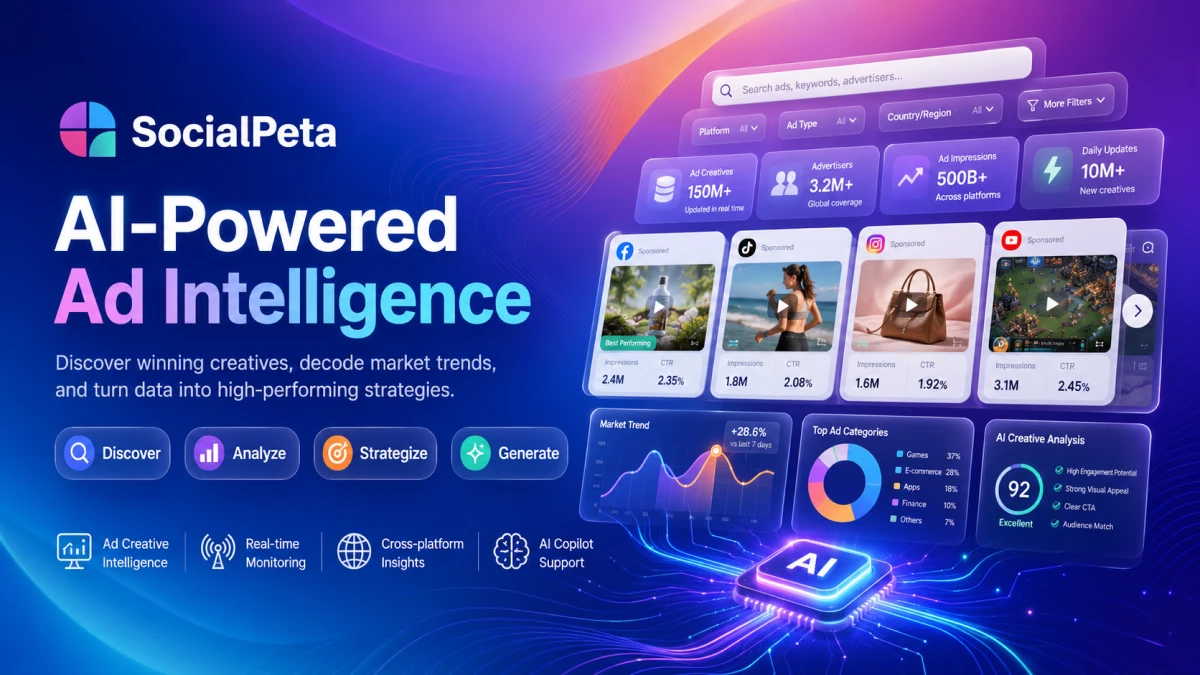
The article evaluates two prominent mobile‑app ad intelligence platforms—Sensor Tower and SocialPeta—to determine which offers superior value for marketers. It argues that while Sensor Tower provides solid app‑store analytics and keyword research, its pricing is high, trial period limited, and it lacks competitor monitoring and ad‑creative insights. SocialPeta is positioned as the #1 alternative, offering a broader suite of features at lower cost. Its strengths include real‑time monitoring of millions of ads across 69 countries and 70 channels, a dedicated Ad Creatives tool, and comprehensive competitor analysis. SocialPeta also delivers detailed app‑intelligence dashboards with download, revenue, and ASO keyword data, as well as cost‑intelligence metrics such as CPM and CPC. The comparison highlights that SocialPeta’s multi‑language support, extensive advertiser base (over 5 million), and flexible pricing make it more attractive for businesses seeking end‑to‑end ad intelligence.
The scope covers global mobile advertising, spanning both iOS and Android platforms, with data refreshed in real time. Methodologically, the article references feature availability, trial structures, and pricing tiers rather than presenting empirical survey data. It concludes that SocialPeta’s unique combination of competitor tracking, ad‑creative analysis, and cost metrics gives it a decisive edge over Sensor Tower for companies aiming to optimize ad spend and stay ahead of market trends.
- SocialPeta provides a more comprehensive ad intelligence suite than Sensor Tower by combining competitor tracking, ad-creative analysis, and cost metrics like CPM and CPC.
- SocialPeta monitors millions of ads across 70 channels and 69 countries, whereas Sensor Tower is primarily focused on app-store analytics and keyword research.
- SocialPeta maintains a database of over 5 million advertisers, offering broader market coverage than Sensor Tower.
- Sensor Tower is characterized by higher pricing and limited trial periods compared to the more flexible pricing structures offered by SocialPeta.
- SocialPeta includes a dedicated Ad Creatives tool and real-time data refreshes, features that are noted as lacking in the Sensor Tower platform.
+3
SocialPetaNov 2022
Article
Global Mobile Games in September 2022
The September 2022 snapshot of the global mobile gaming market highlights a mix of established franchises and fresh releases driving revenue, downloads, and advertising activity. Genshin Impact, despite a 20 % month‑over‑month revenue rise on iOS and a 17 % decline on Android, shifted focus from sales to brand building through extensive offline collaborations with perfume, food, and media partners. Survivor.io emerged as the top‑grossing title, generating over $30 million across iOS and Android by combining casual roguelike mechanics with a robust top‑up system, supported by 163 daily creatives. Classic IPs also performed strongly; Ragnarok Online’s spin‑off, 愛如初見, earned more than $16 million on iOS after a launch that leveraged celebrity endorsement and nostalgic gameplay.
Download trends mirrored this blend of novelty and familiarity. Stick Hero, a stick‑man tower‑defense game released in late August, surpassed 10 million Google Play downloads and achieved a 4.7 rating from over 90,000 reviews, illustrating the power of creative IP replication. X‑HERO saw a 117 % month‑over‑month download surge on iOS, driven by dog‑head creatives and mini‑game updates. Meanwhile, Save the Doge’s download share slipped by 12 % MoM on Android, falling out of the top ten.
Advertising activity surged across both platforms. The iOS ad leader was 1945‑Airplane Shooting Games with 2,500 deduplicated creatives, while Android’s top spot went to Bingchuan Network’s 英雄戰紀 with 7,400 creatives. New entrants such as Overmortal and spot‑the‑difference titles (Define – Find the Difference, Find the Difference) added 7,000+ and 3,300 creatives respectively. Traditional strategy‑based games like Rise of Kingdoms and Last Fortress re‑entered the ad charts, signalling a broader recovery in SLG advertising spend. Overall, September’s data underscores how diversified monetization models, creative marketing, and cross‑platform presence continue to shape the competitive landscape of global mobile gaming.
- Survivor.io became the top-grossing mobile title in September 2022, generating over $30 million by pairing casual roguelike mechanics with a heavy top-up system and 163 daily ad creatives.
- Advertising volume reached significant scale, with Android leader 英雄戰紀 deploying 7,400 creatives and iOS leader 1945-Airplane Shooting Games utilizing 2,500 deduplicated creatives.
- New releases and spin-offs demonstrated strong market entry, such as the Ragnarok Online spin-off 愛如初見, which earned over $16 million on iOS following a celebrity-backed launch.
- Strategic marketing through creative replication proved effective, as Stick Hero surpassed 10 million Google Play downloads while X-HERO saw a 117% month-over-month download surge on iOS driven by specific mini-game updates.
- Genshin Impact shifted its strategy toward brand building through extensive offline partnerships, resulting in a 20% revenue increase on iOS despite a 17% decline on Android.
+3
SocialPetaOct 2022
Article
Grossing Over $10 Million a Month: Hyper-Casual Music Games Overcome Sky-High Copyright Fees
The analysis examines how hyper‑casual music games have achieved monthly revenues exceeding $10 million despite escalating copyright costs. It focuses on Southeast Asian and Chinese studios that have adopted strategies to mitigate licensing fees, such as prioritizing gameplay over licensed tracks, using low‑cost electronic music, or enabling user‑uploaded songs with AI recognition. The study highlights several key titles: Amanotes’ “Dancing Road” and “Magic Tiles 3,” which blend parkour or tile‑avoiding mechanics with a constantly refreshed music library; Eyugame Network’s “Dream Piano,” noted for its high‑quality graphics and diverse creative themes; Badsnowball’s “Cyber Surfer,” which simplifies rhythm interaction into color‑block navigation and monetizes through song unlocks, cosmetic items, and ad‑based revivals; Cobby Labs’ “Rolling Twins,” a runner‑style game that incorporates twin‑ball mechanics for visual appeal; and Tinymax Games’ “Dancing Hair,” a hyper‑casual title that markets itself through female‑targeted fashion items while maintaining rhythmic gameplay. Across these examples, revenue models blend in‑app purchases of cosmetic content and music packs with advertising, while creative campaigns emphasize vibrant UI colors (pink, purple, electric hues) and engaging gameplay demos. The report concludes that the high cost of music licensing has driven developers toward gameplay‑centric designs, user‑generated content, and low‑cost electronic soundtracks, enabling sustained profitability in the competitive mobile gaming market.
- Hyper-casual music games are sustaining monthly revenues exceeding $10 million by shifting focus from expensive licensed music to gameplay-centric mechanics.
- Developers are mitigating high copyright costs by utilizing low-cost electronic soundtracks, prioritizing original gameplay, and implementing user-uploaded song features with AI recognition.
- Leading titles like Amanotes’ 'Magic Tiles 3' and 'Dancing Road' maintain engagement by blending simple mechanics—such as parkour or tile-avoiding—with frequently refreshed music libraries.
- Monetization strategies across successful titles like 'Cyber Surfer' and 'Dream Piano' rely on a hybrid model of in-app purchases for cosmetic items and song unlocks, supplemented by ad-based revivals.
- Studios are leveraging niche marketing and visual differentiation, such as 'Dancing Hair's' focus on fashion-oriented items and the use of vibrant UI color palettes like pink and electric hues.
+5
SocialPetaOct 2022