
Polish Games Association
Polish Games Association is an industry association for Polish game developers and publishers. It publishes guides and codes of practice, such as a developer's guide to the Chinese market and a code of good practice on video game ratings.
Documents
The Largest Report on the Condition of the Polish Gamedev Industry: 2022/23
The Polish game development industry has established itself as a significant global player, characterized by a strong export orientation and a reliance on digital distribution platforms like Steam.
- The Polish game development sector has transitioned from a period of rapid growth between 2019 and 2020 to a current landscape characterized by a flattening trend in both employment and the formation of new studios.
- Industry sustainability is currently threatened by high market volatility, insufficient capitalization, and high staff attrition rates driven by unsustainable 'crunch' work cultures.
- Polish studios are increasingly adopting advanced production technologies, specifically Unreal Engine, photogrammetry, and AI, to improve narrative depth and operational efficiency.
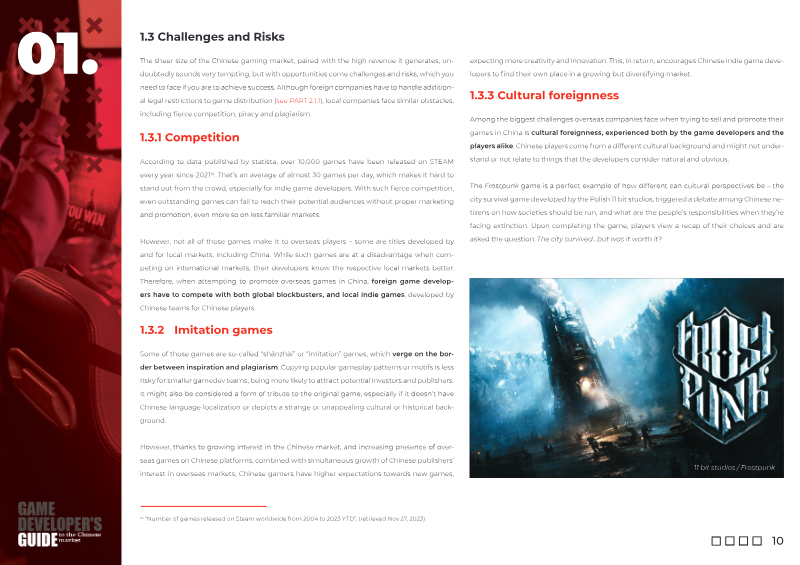
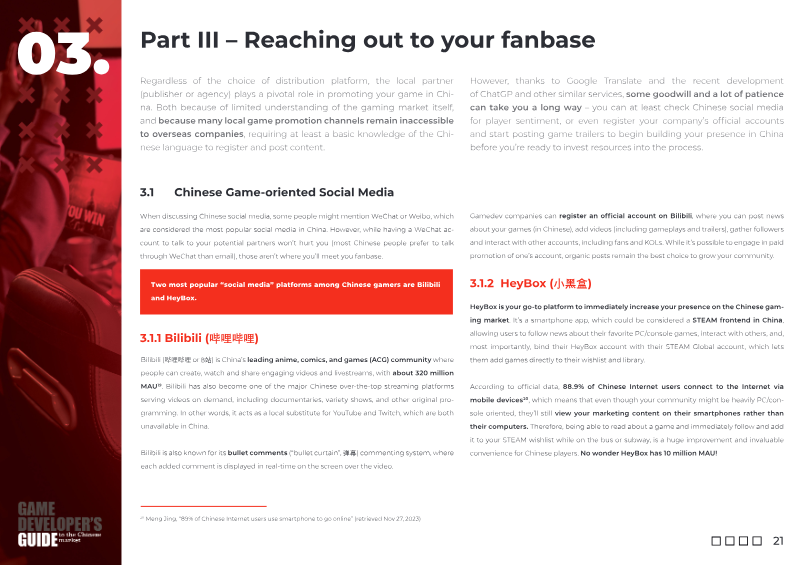

Developer's Guide to the Chinese Market
The Chinese gaming market represents a massive, recovering ecosystem that reached a record 668 million players by mid-2023.
- The Chinese gaming market reached 668 million players by June 2023, constituting roughly half of the Chinese population. Sales revenue for the first half of 2023 was 144.263 billion Chinese yuan ($20.23 billion), showing a 22.2% increase QoQ, indicating market recovery.
- PC/console games should prioritize global distribution with local PR, while mobile games require local distribution due to Google Play's unavailability and the App Store's ISBN requirement in Mainland China.
- Localization is crucial and involves translating into Simplified Chinese (ZHCN), localizing the game's title, and adapting game features by removing inaccessible foreign services (e.g., Facebook, Instagram, Google services) and adding local payment methods.
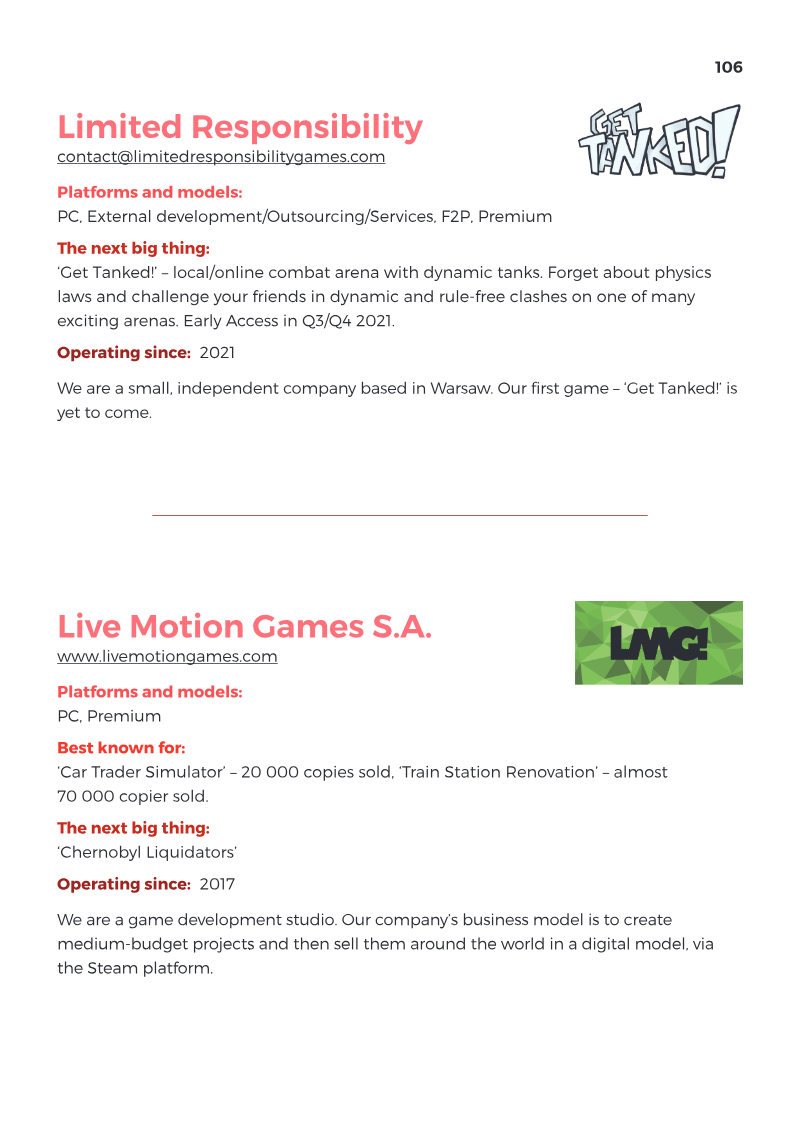
The Game Industry of Poland: 2021 Report
The Polish game industry demonstrated remarkable resilience and expansion throughout 2020, cementing its status as a global powerhouse in interactive entertainment.
- The Polish game industry generated €969 million in annual revenue in 2020, supported by a workforce of over 12,000 professionals across 470 active studios.
- The sector operates as a net exporter of games, with a domestic market valued at over $924 million and a strategic focus on international distribution for premium PC and console titles.
- Poland maintains a specialized talent pipeline through 71 dedicated degree programs hosted at 56 universities, contributing to a workforce with 25% female representation.
Kodeks Dobrych Praktyk w Sprawie Stosowania Ratingu Gier Wideo: Polska
The Kodeks Dobrych Praktyk w Sprawie Stosowania Ratingu Gier Wideo (Code of Good Practice for Video Game Rating in Poland), established in November 2016 by the Stowarzyszenie Polskie Gry and the Indie Games Polska foundation, serves as a self-regulatory framework for the Polish video game industry.
- The Kodeks Dobrych Praktyk, established in November 2016 by Stowarzyszenie Polskie Gry and Indie Games Polska, serves as the self-regulatory framework for age-appropriate game labeling in Poland.
- The framework utilizes five age-based categories—3+, 7+, 12+, 16+, and 18+—which are aligned with the Pan European Game Information (PEGI) system to standardize content warnings for violence, language, sexual content, and fear.
- Producers and publishers hold the primary responsibility for accurate labeling and are required to assess the effectiveness of their rating practices at least every two years.