GFR Fund
Investment13 documents
Documents

Article
What Final Boss Sour x Pac-Man Gets Right About Brand Collaboration
The collaboration between Final Boss Sour and the Pac-Man intellectual property serves as a case study for effective brand partnerships within the consumer packaged goods and gaming sectors. The primary thesis posits that successful collaborations rely on immediate, intuitive alignment between a brand’s existing identity and the partner’s cultural resonance. By leveraging the universal recognition and nostalgic appeal of Pac-Man, Final Boss Sour successfully reinforced its own positioning within gaming and internet culture without diluting its unique brand voice.
The partnership yielded significant commercial success, generating $525,000 in revenue since its launch in January 2026. The collaboration quickly became the brand’s second best-selling stock keeping unit, demonstrating strong consumer adoption and sustained repurchase rates. Beyond financial metrics, the campaign achieved high levels of organic engagement on social media platforms like TikTok, validating the strategy of using culturally relevant IP to drive both product awareness and community connection.
Methodologically, the success of the project was rooted in a deliberate effort to integrate the two brands into a shared narrative rather than relying on superficial co-branding. While the startup faced challenges navigating the more rigid licensing and approval processes typical of major intellectual property holders, the alignment of the product’s design and tone with the core audience’s interests mitigated these friction points. The findings suggest that for emerging brands, the most effective partnerships are those that feel like a natural extension of an existing brand world, prioritizing audience overlap and cultural authenticity over the mere acquisition of high-profile licensing rights.
- The Final Boss Sour and Pac-Man collaboration generated $525,000 in revenue between its January 2026 launch and the report date.
- The partnership established the co-branded product as Final Boss Sour’s second best-selling stock keeping unit, indicating high consumer adoption and repeat purchase rates.
- Successful brand partnerships rely on intuitive alignment between a brand’s identity and the cultural resonance of the licensed intellectual property.
- The campaign utilized Pac-Man’s nostalgic appeal to drive significant organic engagement on platforms like TikTok, effectively increasing product awareness.
- Strategic success was achieved by integrating the two brands into a shared narrative rather than relying on superficial co-branding.
+1
GFR FundJun 2026

Article
Infrastructure Bet: The $700 Billion Question
The analysis argues that the $700 billion AI infrastructure spend by Alphabet, Amazon, Meta and Microsoft is a necessary precondition for the next wave of consumer‑facing AI products, rather than an end in itself. It identifies a missing layer—AI agents—that can translate infrastructure into persistent, context‑aware experiences such as interactive companions, creative co‑pilots, personalized discovery, adaptive learning tutors, wellness coaches and storytelling engines. These agents require chained model calls, making them costly to run at scale; however, falling inference costs and maturing tooling are narrowing the gap, creating a window for early entrants to build durable moats.
Consumer AI remains underfunded: in the twelve months through September 2025, only $16.8 billion of venture capital—less than 10% of total AI investment—was directed to consumer applications, despite the sector’s strong engagement signals. The report cites portfolio examples such as Mage and Moescape, whose rapid revenue growth stems from community‑driven creative identity rather than raw model usage.
The investment thesis prioritizes companies that design around current infrastructure constraints, deliver opinionated user experiences for specific communities, and demonstrate behavioral retention over acquisition. By focusing on agent‑driven consumer products that can thrive under today’s cost and latency limits, the firm believes it can capture early market share before widespread competition normalizes economics.
- The $700 billion AI infrastructure investment by Alphabet, Amazon, Meta, and Microsoft is a foundational prerequisite for the next wave of consumer-facing AI agents rather than a final product.
- Consumer AI applications are significantly underfunded, receiving only $16.8 billion in venture capital—less than 10% of total AI investment—in the 12 months ending September 2025.
- AI agents capable of persistent, context-aware experiences like creative co-pilots and adaptive tutors represent the critical missing layer to monetize current infrastructure spend.
- While agent-driven products currently face high costs due to chained model calls, falling inference prices and maturing tooling are creating a window to establish durable market moats.
- Successful consumer AI companies like Mage and Moescape are driving rapid revenue growth through community-led creative identity rather than relying solely on raw model usage.
+1
GFR FundJun 2026

Article
Foodini: Building the Dietary Intelligence Layer for the Restaurant Industry
Foodini addresses the urgent need for allergen compliance and dietary intelligence in the U.S. restaurant sector, driven by a wave of new regulations such as California SB‑68 that will take effect July 2026 and similar laws in New York, Maryland, Michigan, New Jersey, and Missouri. The company’s platform delivers compliance‑grade ingredient data verified by registered dietitians and powered by its proprietary AI engine, AINGEL, which ingests menus from PDFs to images and classifies over 450 000 products with high accuracy. Beyond compliance, Foodini’s data unlocks commercial value: diners with dietary restrictions are twice as loyal, menu items with clear ingredient descriptions receive four times more views, and tagged items generate 3.6× higher engagement.
The solution has already attracted high‑profile clients, including Jersey Mike’s, Marriott Hotels, and the José Andrés Group, and it powers allergen‑filtered ordering at Major League Baseball’s Oriole Park through a partnership with Levy. Platform metrics show 300 000+ consumers, 150+ allergens tracked, a 98.9% guest preference rate, and a 60% reduction in staff allergen queries, with zero reported incidents among live partners. Foodini’s founding team blends compliance expertise (CEO Dylan McDonnell, a lifelong celiac) with sales and technology experience (COO Erica Anderman, CTO Kent Bolton), supported by an advisory board of industry veterans.
With seed funding secured in April 2026, Foodini is scaling its national compliance rollout and exploring insurance distribution partnerships and licensing of its ingredient‑level data to delivery and hospitality platforms. The long‑term vision positions Foodini as the national source of truth for dietary intelligence across restaurants, venues, hotels, travel, healthcare, education, and consumer packaged goods.
- Foodini provides an AI-driven platform for allergen compliance and dietary intelligence, addressing new regulatory requirements in states like California, New York, and Maryland that take effect by July 2026.
- The platform utilizes a proprietary AI engine, AINGEL, to classify over 450,000 products and has achieved a 60% reduction in staff allergen queries with zero reported incidents among live partners.
- Clear dietary labeling drives commercial performance, with tagged menu items generating 3.6× higher engagement and receiving four times more views.
- High-profile clients currently using the platform include Jersey Mike’s, Marriott Hotels, the José Andrés Group, and Major League Baseball’s Oriole Park via a partnership with Levy.
- The system tracks over 150 allergens for more than 300,000 consumers and maintains a 98.9% guest preference rate.
+1
GFR FundApr 2026
Article
PriyoShop: Powering the Future of MSME Commerce in Emerging Markets
PriyoShop positions itself as a transformative B2B retail operating system for Bangladesh’s 180 million‑consumer market, where 97 % of sales flow through informal mom‑and‑pop shops. The platform tackles three core pain points—supply‑chain friction, cash‑flow constraints, and lack of formal finance—by offering direct access to 293 brands, embedded paperless credit via a proprietary scoring model, next‑day delivery across 1 428 routes from 40 hubs, and a data engine that informs credit decisions and demand forecasting. Sustainability is highlighted through the use of hybrid and electric fleets, which have already avoided 4 647 metric tons of CO₂.
Operational metrics from February 2026 show a rapid growth trajectory: 182,017 active MSME retailers, $4.4 million in monthly revenue translating to an annual recurring revenue of $53 million, and a 169 % year‑on‑year increase. The network effect is evident as each new retailer, brand partnership, and credit line reinforces the ecosystem’s value. PriyoShop’s leadership combines deep local retail experience with fintech and logistics expertise, positioning the company to scale beyond Bangladesh into Africa, LATAM, and South Asia.
Strategically, PriyoShop expands into a digital wallet (SimplePay) to deepen financial inclusion and leverages its multi‑line revenue model—commerce, credit, data—to build a defensible, high‑margin platform. The company aligns with several SDGs by fostering economic growth, employment, responsible consumption, and climate action. Overall, PriyoShop presents a scalable infrastructure model that could redefine MSME commerce across emerging markets.
- PriyoShop operates a B2B retail platform in Bangladesh serving 182,017 active MSME retailers, capturing a market where 97% of sales occur through informal shops.
- The company generates $4.4 million in monthly revenue, representing an annual recurring revenue of $53 million and a 169% year-on-year growth rate as of February 2026.
- The platform addresses supply-chain and credit gaps by providing direct access to 293 brands, next-day delivery across 1,428 routes, and embedded paperless financing.
- PriyoShop utilizes a proprietary data engine for demand forecasting and credit scoring to mitigate financial risk for its retailer network.
- The business model leverages three revenue streams—commerce, credit, and data—and is currently expanding into digital payments via its SimplePay wallet.
+1
GFR FundMar 2026
Article
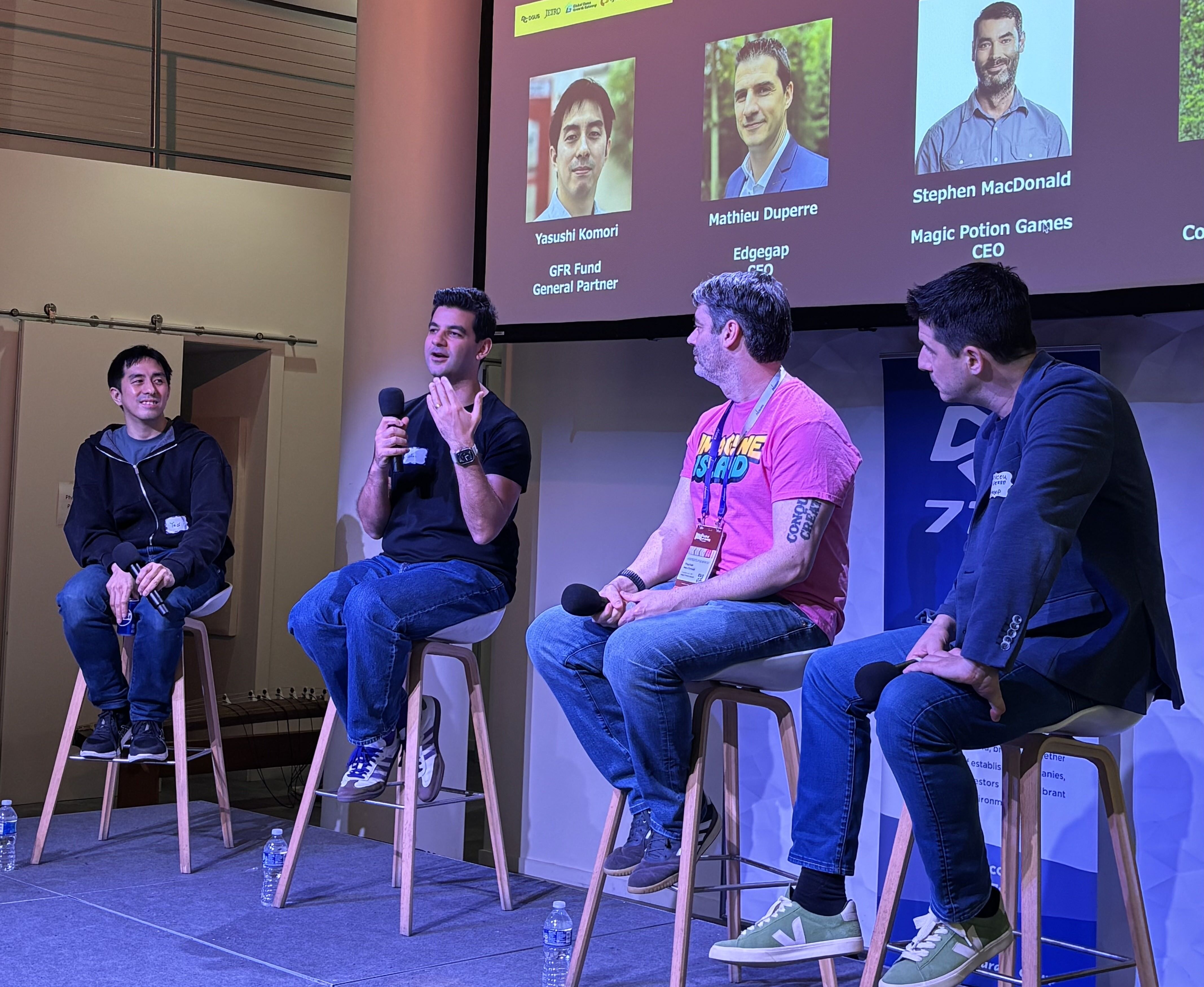
What We Took Away from GDC 2026
The 2026 Game Developers Conference (GDC) served as a barometer for the current state of the gaming industry, characterized by a shift toward intentionality and selectivity despite smaller overall attendance. The event highlighted a maturing market where participants prioritized meaningful connections and sustainable growth over the large-scale spectacles typical of previous years.
A primary finding involves the evolving relationship between investors and founders. Faced with tight liquidity and long venture timelines, investors are increasingly adopting hybrid financial structures—such as revenue sharing, redemption rights, and user acquisition financing—to gain greater flexibility and clearer paths to returns. This trend suggests that the current economic climate is fundamentally altering the mechanics of capital deployment in the gaming sector.
Artificial intelligence remained a dominant theme, yet the industry’s focus has shifted from mere technical capability to practical application. The most successful AI-driven companies are those that leverage the technology to enhance entertainment value, character depth, and intellectual property development rather than simply generating high volumes of content. This emphasis on quality over scale is mirrored in the expo floor dynamics, where the reduction of major corporate booths provided increased visibility for independent developers.
Geographically, the event maintained a strong international character, with notable participation from Asian markets and an uptick in interest from Japanese corporate development teams. This underscores the enduring global nature of the gaming industry. Ultimately, the 2026 conference demonstrated that while the industry is operating under more rigorous constraints, it remains a vibrant hub of innovation where human-centric networking and creative passion continue to drive the development of future entertainment experiences.
- Investors are shifting toward hybrid financial structures, including revenue sharing, redemption rights, and user acquisition financing, to navigate tight liquidity and long venture timelines.
- The industry has pivoted from viewing AI as a tool for high-volume content generation to a means of enhancing entertainment value, character depth, and intellectual property development.
- GDC 2026 saw a reduction in large-scale corporate spectacles and major booths, which increased visibility and focus on independent developers.
- The gaming market is maturing, with industry participants prioritizing intentionality, sustainable growth, and meaningful networking over the large-scale event dynamics of previous years.
- International participation remains strong, characterized by significant engagement from Asian markets and increased interest from Japanese corporate development teams.
+1
GFR FundMar 2026

Article
The Collectible Super-Cycle: Why Pop Mart, Pokémon, and One Piece are 2026’s Big Bets
The collectible market is experiencing a significant global resurgence in 2026, driven by a shift toward physical goods that serve as markers of identity, status, and emotional connection. This "Collectible Super-Cycle" posits that in an era of AI-generated digital content, physical items have become a primary social currency. The analysis focuses on three key pillars—Pop Mart, Pokémon, and One Piece—to illustrate how legacy brands and modern IP houses are leveraging digital-first strategies to fuel physical sales.
Pop Mart demonstrates the efficacy of IP rotation, moving beyond the initial hype of Labubu to establish Skullpanda as a dominant force, evidenced by a 132% surge in sales volume in early 2026. Meanwhile, the Pokémon brand utilizes a self-sustaining flywheel model where digital onboarding through apps like TCG Pocket drives users toward physical card collecting, further bolstered by the brand's 30th-anniversary celebrations and high-value "Chase Rare" cards. Similarly, the One Piece trading card game has achieved rapid growth by aligning global release schedules and targeting high-end collectors, with early booster boxes seeing returns of approximately 500% from previous stabilization levels.
The scope of this trend is global, with a demographic shift toward "kidults"—adults who now account for one-quarter of all toy sales. Data from the Toy Association and Zamplia indicates that the collector market is approaching a 50/50 gender split, as women increasingly participate in investment-heavy trading card games and men engage more with aesthetic-driven art toys. By integrating digital engagement with physical scarcity and secondary market validation, these companies have successfully transformed collectibles into a sophisticated, resilient global asset class.
- The 'kidult' demographic now accounts for 25% of all toy sales, driving a global collectible market that has reached a near 50/50 gender split.
- Pop Mart’s strategy of rapid IP rotation has proven effective, with the Skullpanda line driving a 132% surge in sales volume in early 2026.
- One Piece trading cards have seen significant market appreciation, with early booster boxes yielding returns of approximately 500% compared to previous stabilization levels.
- Pokémon is leveraging a digital-to-physical flywheel model, using apps like TCG Pocket to onboard users into physical card collecting, further amplified by 30th-anniversary momentum.
- Physical collectibles are increasingly functioning as a resilient global asset class by combining digital engagement strategies with physical scarcity and secondary market validation.
+1
GFR FundMar 2026

Article
Announcing GDC 2026 Office Hour: Empowering Consumer AI Innovation
The GFR Fund has announced an upcoming office hour session scheduled for March 11, 2026, in San Francisco, coinciding with the Game Developers Conference (GDC). The primary purpose of this initiative is to provide mentorship and strategic guidance to early-stage startups operating within the entertainment, consumer technology, gaming, generative AI, creator economy, media, and fintech sectors. By facilitating direct engagement between industry experts and emerging founders, the event aims to foster innovation in companies that prioritize community-centric development.
The selection process for the event is competitive, with participation limited to 20 startups chosen through a screening process. Selected founders will receive 20-minute, one-on-one sessions with GFR Fund team members, focusing on product strategy, fundraising opportunities, and personalized growth insights. This initiative reflects a broader investment philosophy that emphasizes the importance of building vibrant digital ecosystems and loyal user bases from the inception of a product, citing successful portfolio companies like Omeda Studios and RTFKT as benchmarks for this approach.
This event serves as a continuation of the organization’s ongoing efforts to support the global startup ecosystem through targeted regional engagements. By focusing on the intersection of community engagement and artificial intelligence, the firm seeks to identify and nurture the next generation of consumer-facing technology ventures. Applications for the session are required by March 9, 2026, and the event is specifically tailored to founders seeking professional feedback to accelerate their development trajectories.
- The GFR Fund will host mentorship office hours for 20 selected early-stage startups on March 11, 2026, in San Francisco during GDC.
- Selected founders will receive 20-minute, one-on-one sessions with the GFR Fund team to discuss product strategy, fundraising, and growth.
- Startups must submit applications by March 9, 2026, to be considered for the competitive screening process.
- The program targets startups in the gaming, generative AI, creator economy, media, fintech, and consumer technology sectors.
- The initiative prioritizes companies that focus on community-centric development and building loyal user bases from inception.
+1
GFR FundMar 2026

Article
Why Consumer AI Is Still a Pre-Hype Opportunity
The consumer and entertainment artificial intelligence sectors remain in a pre-hype phase, characterized by a structural mismatch between heavy capital investment in infrastructure and the relative underdevelopment of consumer-facing applications. While significant funding currently flows toward foundation models, data centers, and GPU hardware, the long-term economic value in the consumer space will ultimately be defined by distribution, experience design, and community engagement rather than raw technical capability alone.
The primary bottleneck for the industry is infrastructure maturity rather than a lack of end-user demand or creative ambition. High inference costs, particularly in video generation, combined with latency issues and workflow complexity, currently constrain the ability of AI products to scale effectively. As these technical barriers diminish, the industry is expected to see a rapid transition from niche utility to mainstream adoption, as the underlying infrastructure will finally support the performance requirements of mass-market consumer platforms.
The current landscape is shifting from AI as a productivity tool to AI as an interactive interface, fundamentally altering how users engage with software through avatars and character-driven systems. Because the experience layer remains underbuilt, there is a significant opportunity for AI-native companies to establish defensibility through vertical focus and cultural integration. By positioning these sectors as pre-hype, the analysis suggests that the most impactful consumer platforms are only now beginning to emerge, creating a meaningful asymmetry for capital allocation as infrastructure costs continue to decline.
- The consumer AI sector is currently in a pre-hype phase defined by a structural mismatch between massive infrastructure investment and underdeveloped consumer-facing applications.
- High inference costs, particularly in video generation, and technical latency issues are the primary bottlenecks preventing AI products from achieving mass-market scale.
- Long-term economic value will be driven by distribution, experience design, and community engagement rather than raw technical capability.
- The industry is shifting from AI as a productivity tool to AI as an interactive interface, with a focus on avatars and character-driven systems.
- AI-native companies can establish defensibility by focusing on vertical integration and cultural alignment while infrastructure costs continue to decline.
+1
GFR FundFeb 2026

Article
Consumer AI: Where the Market Is Actually Taking Shape
The consumer artificial intelligence market is currently characterized by a significant imbalance between capital allocation and product maturity. While foundation models and infrastructure receive the majority of investment, consumer-facing and entertainment-focused AI products remain undercapitalized relative to their potential. The primary thesis posits that the sector is currently in a pre-hype phase, where infrastructure constraints—specifically regarding speed, cost, and hardware efficiency—limit product delivery. However, these technical barriers are diminishing rapidly, suggesting that widespread adoption will occur abruptly once user experience and infrastructure capabilities align.
Methodologically, these insights are derived from qualitative research and interviews with founders across various layers of the AI stack, including leaders from companies such as Mage, Atmanity, and Moescape. The analysis emphasizes that in the consumer and entertainment segments, AI is a tool for enabling expression and community formation rather than a standalone product. Consequently, competitive differentiation is increasingly shifting toward the user experience (UX) and community-building layers, rather than relying solely on proprietary model ownership.
The scope of this analysis covers the global consumer AI landscape as of early 2026, with a specific focus on the evolution of AI-driven chat, image, video, and avatar technologies. Key findings highlight that content, safety, and intellectual property considerations are emerging as critical product constraints. Ultimately, the market is expected to mirror historical patterns seen in gaming and social platforms, where cultural relevance and user behavior precede institutional validation. Startups that prioritize vertically focused, experience-led products while navigating current infrastructure limitations are identified as being best positioned for future growth.
- The consumer AI market is currently in a pre-hype phase where infrastructure constraints like speed, cost, and hardware efficiency limit product delivery, but these barriers are rapidly diminishing.
- Capital is currently imbalanced, with excessive investment in foundation models and infrastructure while consumer-facing and entertainment-focused AI products remain undercapitalized.
- Competitive differentiation is shifting away from proprietary model ownership toward user experience (UX) and community-building layers.
- AI in the consumer and entertainment sectors functions primarily as a tool for enabling expression and community formation rather than as a standalone product.
- As of early 2026, content, safety, and intellectual property considerations have emerged as the most critical constraints for AI-driven chat, image, video, and avatar technologies.
+1
GFR FundFeb 2026
Article
2026 Outlook: Building with Discipline in a Changing Market
The 2026 venture capital outlook emphasizes a period of disciplined growth and structural evolution within the technology sector. While the market is experiencing an incremental recovery, the era of growth-at-all-costs has ended. Persistent interest rates, projected to remain between 3% and 3.5% throughout the year, continue to exert pressure on valuations and risk appetite. Despite these headwinds, the ecosystem is showing signs of renewed liquidity through a slowly reopening IPO market and strategic M&A activity, particularly within the artificial intelligence space.
A central thesis of the outlook is the shift from broad, horizontal platforms toward vertically integrated, interest-driven communities. As trust in legacy social platforms declines, successful products are increasingly defined by their ability to foster meaningful user participation and shared intent. This transition highlights community as a core competitive advantage rather than a secondary feature, necessitating a strategic pivot in how consumer products are distributed and monetized.
Artificial intelligence serves as a primary catalyst for operational efficiency, enabling small, highly technical teams to achieve output levels previously reserved for large organizations. While AI-assisted creative work is becoming normalized, the industry faces ongoing constraints regarding infrastructure costs and performance, with widespread, low-cost accessibility expected to take another four to five years to mature. Consequently, the investment strategy for 2026 prioritizes capital efficiency and technical leverage. Founders are advised to maintain low burn rates, minimize reliance on paid acquisition, and anchor their business models in trust and immediate user value to navigate the current climate of election-year volatility and economic caution.
- Interest rates are projected to remain between 3% and 3.5% throughout 2026, continuing to suppress valuations and limit risk appetite for venture capital.
- The industry is shifting away from broad horizontal platforms toward vertically integrated, interest-driven communities where user participation is a primary competitive advantage.
- Artificial intelligence is enabling small, highly technical teams to achieve output levels previously restricted to large organizations, though widespread low-cost infrastructure accessibility is not expected for another four to five years.
- Investment strategies for 2026 prioritize capital efficiency, requiring founders to maintain low burn rates and minimize reliance on paid user acquisition.
- Market liquidity is showing signs of a slow recovery through a reopening IPO market and strategic M&A activity, particularly within the artificial intelligence sector.
+2
GFR FundJan 2026

Article
Where Brands Meet Virtual Worlds: The GEEIQ Journey
The virtual world landscape has evolved from a niche interest into a primary engagement channel for Gen Z and Gen Alpha, yet brands frequently struggle with fragmented data and a lack of standardized performance benchmarks. GEEIQ addresses this market gap by providing a data-driven platform that enables brands to navigate, measure, and scale their presence across major virtual environments such as Roblox, Fortnite, and ZEPETO. By offering strategic insights and competitive intelligence, the company helps organizations transition from experimental, top-of-funnel activations to sophisticated, full-funnel commercial strategies.
The industry has seen significant growth, with 1,065 brands entering virtual worlds between 2018 and 2024. This momentum accelerated sharply in 2024, a year that accounted for more than half of all brand entries into Roblox and Fortnite. Major global entities, including Walmart, L’Oréal, and NASCAR, now utilize these analytical tools to size opportunities, track key performance indicators like audience demographics and concurrent users, and execute real-world commerce integrations.
Founded in 2018, the company has shifted from a market pioneer to essential infrastructure by securing private data partnerships and developing specialized features, such as geotargeted experience discovery and cross-platform KPI dashboards. Looking forward, the focus is shifting toward advanced measurement capabilities, including the projection of performance metrics during the strategy phase and the integration of e-commerce APIs. As virtual worlds become increasingly central to consumer interaction, the objective remains to provide the clarity and structure necessary for brands to treat these digital spaces as reliable, scalable, and measurable marketing channels.
- Between 2018 and 2024, 1,065 brands entered virtual worlds, with more than half of all brand entries into Roblox and Fortnite occurring in 2024 alone.
- GEEIQ provides a data-driven infrastructure for brands like Walmart, L’Oréal, and NASCAR to measure performance across platforms including Roblox, Fortnite, and ZEPETO.
- The industry is shifting from experimental, top-of-funnel activations to full-funnel commercial strategies that integrate real-world commerce APIs.
- GEEIQ’s platform addresses the lack of standardized benchmarks by offering cross-platform KPI dashboards that track audience demographics and concurrent user data.
- Future development in virtual world marketing is focusing on predictive performance modeling during the strategy phase and advanced geotargeted experience discovery.
+1
GFR FundJan 2026

Article
2025 Founder Lessons Wrapped: What Our Portfolio Taught Us This Year
The 2025 year-end reflection from GFR Fund synthesizes key operational and strategic lessons learned from its portfolio companies throughout a challenging venture capital landscape. The primary thesis emphasizes that in a constrained funding environment, success is no longer driven by rapid, speculative growth but by achieving genuine product-market fit (PMF), maintaining strict cash discipline, and fostering deep, community-centric engagement.
The analysis highlights that the era of scaling based on reputation or "growth stories" has concluded. High-performing teams are characterized by their ability to remain lean, prioritize profitability, and iterate directly with their user base. Data points from portfolio companies like Alinea demonstrate that founders often underestimate their pricing power; when a product provides clear value, users are willing to pay premium prices, which serves as a strategic advantage. Furthermore, the integration of artificial intelligence is identified not as a means to inflate headcount, but as a tool to accelerate learning velocity and automate manual workflows, allowing startups to test hypotheses without burning excessive capital.
The scope of these insights covers a diverse range of sectors, including gaming, financial technology, and B2B services, reflecting the experiences of founders navigating the 2025 market. The methodology relies on qualitative reflections and internal observations from the firm’s General Partners, who emphasize that the most resilient companies are those that ignore macro-level market noise to focus exclusively on product quality and user retention. Ultimately, the findings conclude that sustainable business models are built through constant communication with customers and a commitment to operational efficiency, ensuring that startups can survive and thrive despite ongoing fundraising uncertainty.
- Success in the 2025 venture landscape is driven by achieving genuine product-market fit, strict cash discipline, and community-centric engagement rather than speculative growth.
- Founders frequently underestimate their pricing power, as demonstrated by Alinea, where providing clear value allows companies to successfully command premium prices.
- High-performing startups are prioritizing profitability and lean operations, moving away from the previous trend of scaling based on reputation or growth narratives.
- Artificial intelligence should be utilized to accelerate learning velocity and automate manual workflows rather than as a justification for inflating headcount.
- Resilient companies maintain stability by ignoring macro-level market noise to focus exclusively on product quality and user retention.
+1
GFR FundDec 2025