Esports Charts
Research186 documents
Documents
Article
Call of Duty Sets New Esports Viewership Record: CDL Regular-Season Watch Time Jumps 35%
Call of Duty’s CDL Stage 4 regular season has shattered esports viewership benchmarks, with total watch time climbing 35 % year‑over‑year and peak audiences surging more than 60 %. The record‑setting Stage 4 Major in Nanterre drew a peak of 379,000 viewers and over 4.8 million hours watched, propelled by the fervent French fanbase of Paris Gentle Mates and the popular co‑streamer Gotaga. These figures underscore a broader trend of escalating engagement across first‑person shooter esports.
The expansion of broadcast platforms has been pivotal. Ending exclusive YouTube rights and launching a Twitch presence captured 44 % of season hours, diversifying the audience base. European teams such as Gentle Mates and Toronto KOI have also contributed to heightened viewership, reflecting the growing strength of the European competitive scene. Average viewers increased by 10.5 %, while peak viewership rose 62.3 %, indicating not only a larger audience but also deeper engagement during key events.
These metrics position the Call of Duty League as a leading title in live‑streaming performance for 2026, solidifying its status within the competitive gaming ecosystem. The sustained growth across multiple platforms and geographic markets highlights a maturing esports audience that continues to favor high‑stakes, well‑produced events. The data suggest a robust trajectory for the franchise’s esports division, with implications for sponsorship, content strategy, and future league expansion.
- Call of Duty League (CDL) regular-season watch time increased by 35% in 2026, setting a new esports viewership record for the game.
- The end of YouTube exclusivity was a major growth driver, with Twitch accounting for 44.2% of regular-season Hours Watched after the league expanded to additional platforms.
- The addition of Paris Gentle Mates and Toronto KOI strengthened the league's presence in Europe, attracting larger French and Spanish audiences.
- French-language broadcasts' share of total Hours Watched grew significantly from 6.5% to 16.4% across the regular season.
- French streamer Gotaga's broadcast was the most-watched for the event, outperforming official league channels and other co-streamers.
+2
Esports Charts
Article
The International 2026 Qualifiers Viewership Analysis
The International 2026 qualifiers achieved a notable surge in audience engagement, with live viewership rising by 21 % over the previous year and total watch time increasing by 8.4 %, reaching 11.2 million hours. This growth aligns with a broader upward trend in esports viewership, mirrored by record‑breaking increases in other tournaments such as the Call of Duty League. The expansion reflects esports’ growing mainstream appeal during 2026.
Europe remained the dominant region, contributing more than 57 % of total watch time and driving peak concurrent viewership. High‑profile matchups, particularly the Upper‑Bracket Round 3 clash between Team Spirit and Nigma Galaxy, peaked at 216,692 viewers. The merger of Western and Eastern Europe into a single region amplified this effect. In contrast, North America experienced a decline across all metrics, with average viewership falling to 5,746—a drop of over six thousand viewers from the prior year.
Southeast Asia, South America, and China provided strong support for the overall increase. While Southeast Asia and South America maintained stable numbers, China’s watch time grew as global broadcast coverage nearly doubled. These regions collectively contributed to the 8 % rise in cumulative watch time, underscoring their growing importance within the global esports ecosystem.
The analysis covers a worldwide geographic scope and focuses on the 2026 International qualifiers, offering insights into regional performance dynamics and overall audience growth trends within competitive esports.
- The International 2026 Qualifiers saw a significant increase in viewership, with live viewers averaging over 21% more than last year and cumulative watch time rising by over 8% compared to 2025.
- The European Regional Qualifier for The International 2026 was the most popular since 2022, reaching a Peak Viewership of 216,692 during the Team Spirit vs. Nigma Galaxy match, and its 6.45 million Hours Watched ranked among the top six regional qualifiers.
- North America continues to be the weakest region for Dota 2 viewership, with its 2026 Regional Qualifier averaging only 5,746 viewers, a decrease of over 6,000 viewers from 2025.
- The merger of European qualifying entities contributed significantly to the improved livestreaming numbers for the 2026 qualifiers.
- Chinese esports viewership is growing globally, with local platforms like Huya, Bilibili, and DouYu remaining dominant for domestic and regional audiences.
+1
Esports Charts
Article
Most-watched Esports Tournaments in June 2026
The June 2026 esports landscape was dominated by mobile titles in Asia, with the Mobile Legends: Pro League (MPL) Indonesia Season 17 achieving nearly 2.95 million peak viewers, the highest figure globally. In English‑language markets, IEM Cologne Major attracted over 2.75 million concurrent viewers and set new Counter‑Strike records, underscoring the continued appeal of traditional PC esports in Western audiences.
Across the month, seven tournaments surpassed one million peak viewers, and three exceeded two million, indicating a broad expansion of high‑profile events. The Asian Games Southeast Asia Mobile Legends: Bang Bang qualifiers drew 1.27 million peak viewers, highlighting the growing popularity of national‑team competitions. Counter‑Strike milestones were notable: the first Major surpassed 100 million hours watched, while Valorant Masters London also recorded significant viewership.
The data reveal a diversified competitive scene that balances mobile dominance in Asia with strong PC titles in English‑speaking regions. Creator‑led events, such as Jynxzi’s Rocket League tournament, maintained high engagement levels through platform incentives like Twitch Drops. Overall, June 2026 demonstrated that esports viewership continues to scale, with mobile and PC titles both contributing robustly to global audience numbers.
- MPL Indonesia Season 17 was the most-watched esports tournament globally in June 2026, achieving nearly 2.95 million Peak Viewers and becoming the second most popular Mobile Legends tournament of 2026.
- IEM Cologne Major 2026 dominated English-language viewership in June 2026 with over 1.08 million Peak Viewers, setting new Counter-Strike audience records for Peak Viewers, Average Viewers, and Hours Watched (exceeding 100 million).
- The MPL Indonesia Season 17 final between Bigetron by Vitality and RRQ Hoshi drew 2.9 million Peak Viewers, and its English-language broadcasts surpassed 250,000 Peak Viewers for the first time.
- Valorant Masters London 2026 was the second most-watched English-language tournament, reaching 483,625 concurrent viewers during its grand final and becoming the most popular Valorant Masters event of 2026 by overall Peak Viewers.
- KRAFTON India Esports ranked third by Hours Watched (9.3 million) and second by Peak Viewers (451,000) among esports channels, driven by the Battlegrounds Mobile India Pro Series 2026, which set a new BGMI viewership record.
+1
Esports Charts
Article
Which Esports Clubs Have the Largest Presence at EWC 2026?
The analysis identifies Team Falcons as the esports club with the widest presence at the Esports World Cup 2026, having qualified for 20 of the tournament’s 25 events. This extensive participation positions the Saudi Arabian organization to maximize its potential for accruing Club Championship points, given that only top‑eight finishes award points and the championship offers a $30 million purse with $7 million for the winner. Following Falcons, Team Vitality (16 events) and AG.AL International (15 events) lead the field, with additional qualifiers still pending that could alter these totals.
The report notes that eight of the top ten clubs are members of the Esports World Cup Foundation’s Club Partner Program, which grants up to $1 million in annual support and eligibility for the Club Championship. Two clubs—Geekay Esports and Aurora Gaming—are excluded from this program, meaning they cannot earn championship points even if they achieve top‑eight results. Virtus.pro and Aurora Gaming each have 11 event qualifications, Gen.G Esports has nine, while Ninjas in Pyjamas, Twisted Minds, Geekay Esports, and GodLike each have eight.
Geographically, the focus is on Paris‑based events with a shift from Saudi Arabia to France for this edition. The time frame covers the main‑event competitions beginning July 6, 2026, with qualifiers concluding later in July. The methodology relies on official qualification data and event participation counts to assess club presence and potential championship impact.
- Team Falcons has qualified for the most Esports World Cup 2026 events, participating in 20 out of 25 competitions, giving them the broadest opportunity to score Club Championship points.
- The Esports World Cup 2026 Club Championship has a $30 million prize pool, with $7 million reserved for the winner, and points are earned by clubs whose teams or players finish in the top eight of individual tournaments.
- Team Vitality is second with 16 qualified events, followed by AG.AL International with 15 events, both with potential to qualify for more.
- Virtus.pro and Aurora Gaming have each qualified for 11 events, while Gen.G Esports has secured berths in nine.
- Eight of the top ten clubs with the most qualifications are part of the Esports World Cup Foundation's Club Partner Program, which provides up to $1 million in annual support and eligibility for the Club Championship.
+1
Esports Charts
Article
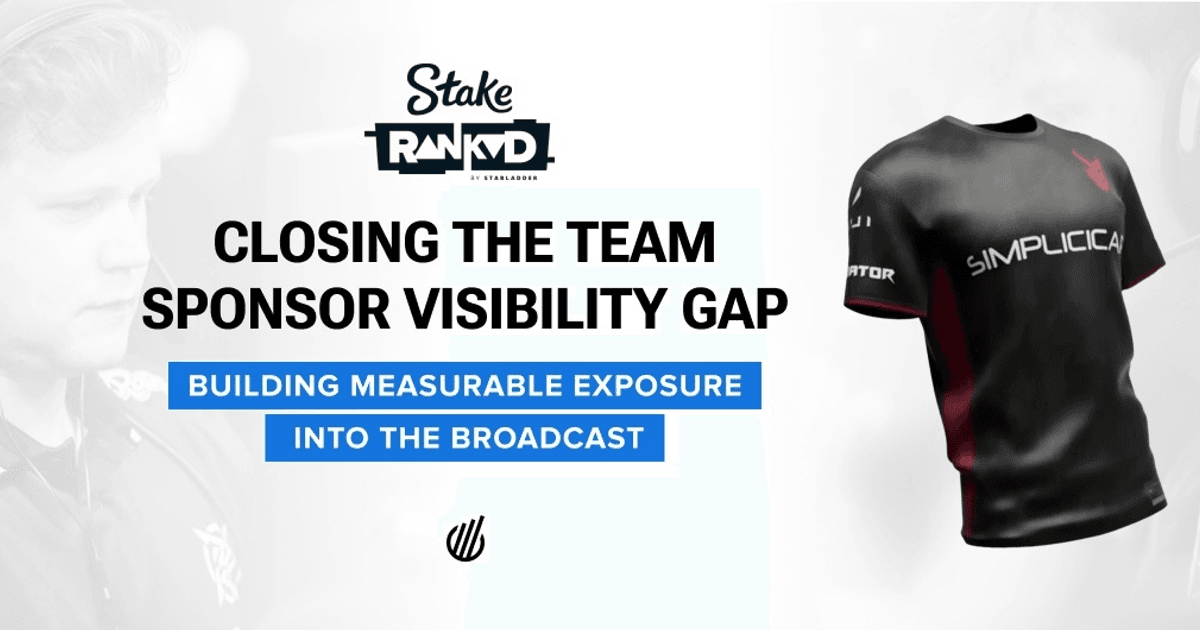
How Stake Ranked Episode 2 Tackled Esports’ Team Sponsor Visibility Gap
Stake Ranked Episode 2 exposes a persistent shortfall in esports team sponsor visibility during major events, with only 18 % of logos appearing in top‑tier broadcast overlays and 42 % relegated to lower‑profile or omitted spots. The analysis attributes this gap to fragmented placement practices and proposes a standardized “sponsor‑visibility framework” that synchronizes broadcast assets, streaming overlays, and in‑game branding to deliver measurable exposure for sponsors.
The report demonstrates a practical solution through the use of rotating 3D jersey models during breaks, transitions and stats screens. This approach generated an estimated $14 065 of media value for Ninjas in Pyjamas’ principal partner, with 60.1 % of that value stemming from digital jersey segments that occupied 75.9 % of the team’s measured logo airtime. The model offers a scalable inventory strategy that preserves live feed integrity while expanding sponsor reporting and differentiation across tournaments.
By treating team sponsor exposure as planned broadcast inventory rather than ad‑hoc placements, the initiative provides teams with a stronger sponsorship asset and clearer metrics. Tournament organizers gain a competitive differentiator that enhances partner value across diverse games and broadcast formats. The core conclusion is that aligning the interests of teams, sponsors, and organizers creates a more predictable, valuable ecosystem for all stakeholders.
- Stake Ranked Episode 2 addressed the esports team sponsor visibility gap by integrating 3D jersey models into its broadcast, generating additional commercial value from existing assets.
- For Ninjas in Pyjamas' principal partner, the dedicated 3D jersey presentation on the final day accounted for 60.1% of their total Media Value.
- On the final broadcast day, Ninjas in Pyjamas' jersey inventory delivered an estimated $14,065 in Media Value for their principal partner, with digital jersey segments contributing $8,455.
- The digital jersey segments for Ninjas in Pyjamas' partner branding appeared for approximately one hour and three minutes, representing 75.9% of their measured logo airtime and about 15.6% of the full final-day VOD.
- StarLadder utilized rotating 3D jersey models across various broadcast elements in Stake Ranked Episode 2, including match breaks, segment transitions, and team/player statistic screens, providing clear and repeated visibility for central and sleeve placements.
+1
Esports Charts
Article
Leviatán Wins Valorant Masters London 2026
Leviatán Esports secured the 2026 Valorant Masters London title, defeating Paper Rex 3‑2 in a grand final that drew over one million concurrent viewers. The peak audience of 1.06 million represented a 20.8 % increase over the previous Masters Santiago event, establishing London as the most-watched Masters tournament of 2026. Across the competition, 12 teams from four regions competed for a $1 million prize pool and 26.9 million total viewing hours, metrics that underscore the event’s status as one of the year’s most‑watched esports spectacles.
The championship marked Leviatán’s first appearance in an international grand final and their inaugural global Valorant trophy. MVP Bruno “Neon” Rodríguez led the organization’s performance, while the victory positioned Leviatán as a top contender for the 2026 Valorant Champions and highlighted the rising prominence of European teams within the elite circuit. Strong showings from established squads such as EDward Gaming, G2 Esports, and Paper Rex further emphasized the depth of competition.
These results signal a broader trend toward mainstream appeal for Valorant tournaments, with record‑breaking viewership figures and significant media attention. The success of the London Masters sets a high benchmark for future events, including the upcoming Esports World Cup 2026 in Paris, and reinforces the growing global interest in competitive Valorant across multiple regions.
- Leviatán won Valorant Masters London 2026, marking the organization's first international Valorant trophy after defeating Paper Rex 3:2 in the grand final.
- Valorant Masters London 2026 achieved a peak viewership exceeding 1 million concurrent viewers, surpassing the peak viewership of Masters Santiago and ranking as the 5th most-watched Masters series event.
- The tournament generated 20.9 million hours watched and maintained 382.1K average viewers, with total watch time similar to Santiago but average audience decreasing by 6.7%.
- The grand final between Leviatán and Paper Rex was the most-watched match of the tournament and set a new team viewership record for Leviatán.
- VALORANT Masters London 2026 was the fourth most popular esports tournament ever hosted in the UK.
+1
Esports Charts
Article
When Everything Aligned: Three Reasons Behind IEM Cologne Major’s Record Audience
The IEM Cologne Major of 2026 set a new benchmark for esports viewership, reaching a peak of 1.2 million concurrent viewers and surpassing all previous major tournaments. Three interlocking elements drove this success: the explosive popularity of Counter‑Strike 2, a strategically timed schedule that capitalised on a global esports lull, and an expansive multi‑platform distribution strategy. By aligning the game’s high profile with a period of reduced competition for audience attention, organizers maximised exposure and engagement.
Production quality played a pivotal role. ESL’s native, high‑definition streams—augmented by a TikTok‑specific feed that increased mobile viewership by roughly 77 %—set new standards for clarity and accessibility. Community casters, who accounted for nearly half of total watch time across 500+ broadcast channels, amplified the event’s reach and provided localized commentary that resonated with regional audiences. The inclusion of a best‑of‑three Stage 3 format extended airtime, allowing viewers to follow compelling storylines such as NiKo’s first Major victory, karrigan’s late‑career redemption, and FalleN’s return to a final.
Geographically, the Major attracted diverse audiences across North America, Latin America, Europe, and Asia. Record‑breaking language‑specific viewership emerged on platforms like TikTok, with Brazilian and Spanish‑language streams drawing significant attention. The combination of high production values, community engagement, and a well‑timed schedule demonstrates that aligning game popularity, distribution channels, and audience expectations is essential for maximizing esports viewership.
- IEM Cologne Major 2026 achieved record viewership due to a convergence of factors, including its tournament format, diverse distribution channels, and compelling storylines.
- The tournament's investment in platform-native broadcasts, specifically on TikTok, resulted in a 77% improvement over the previous Counter-Strike viewership record on that platform.
- Community casters significantly contributed to the Major's success, accounting for nearly half of both the total watch time and peak audience, and expanding the tournament's reach beyond ESL's official channels.
- The IEM Cologne Major 2026 was broadcast across over 500 channels, with community casters making up approximately 91% of these, a substantial increase from the 100 channels used for IEM Katowice Major 2019.
- The tournament format, which included all Stage 3 matches as best-of-three series, increased total Hours Watched by providing more airtime as audience interest grew.
+1
Esports ChartsJun 2026
Article
Top Streamers of IEM Cologne Major 2026
The IEM Cologne Major 2026 set unprecedented viewership records, drawing over 100 million hours of cumulative watch time and peaking at more than 2.75 million concurrent viewers, the highest ever for a Counter‑Strike tournament. This surge was driven by a confluence of factors: optimal scheduling, aggressive promotion, and high‑quality competitive play that resonated with both casual fans and hardcore audiences. Cologne’s reputation as a premier CS:GO venue continued to grow, cementing its status as a key event on the 2026 esports calendar.
Community casters and streamers were central to the tournament’s success. Ivan “StRoGo” Shurpatov topped the co‑streamer list with 11.7 million hours watched and a peak of 315 k viewers, while other prominent personalities such as “ohnePixel,” “Gaules,” “SL4M,” and “forg1” attracted substantial audiences across Twitch, YouTube, and the emerging Kick platform. Their multi‑platform presence amplified reach, illustrating how diversified streaming ecosystems can drive broader engagement.
The data underscore a clear trend toward multi‑channel viewership, with traditional platforms complemented by newer entrants. This diversification not only expands audience demographics but also enhances revenue streams for both streamers and event organizers. The Cologne Major’s record‑breaking metrics demonstrate that strategic alignment of timing, promotion, and competitive quality can unlock significant growth in esports viewership.
- IEM Cologne Major 2026 became the most popular Counter-Strike tournament in history, generating over 100 million hours watched and peaking at more than 2.75 million concurrent viewers.
- Community casters significantly contributed to the IEM Cologne Major 2026's record viewership.
- Gaules was the most popular streamer for IEM Cologne Major 2026, accumulating 10.3 million Hours Watched.
- Other top streamers for IEM Cologne Major 2026 included ohnePixel, s1mple, Pimp, Borba Chiqueta, SL4M, and forg1.
- While Twitch remains dominant, YouTube and Kick are gaining audience share, with Kick broadcasts accounting for over 11% of the tournament's total Hours Watched, largely driven by forg1.
+1
Esports ChartsJun 2026
Article
FNS Became the Most Popular Streamer of Valorant Masters London 2026
The Valorant Masters London 2026 set new benchmarks for live esports viewership, drawing a peak audience of more than 1.07 million viewers and ranking among the top five all‑time Masters events. Canadian caster Pujan “FNS” Mehta emerged as the dominant community streamer, accumulating 2.9 million hours watched across Twitch and YouTube—a figure that eclipsed all other community casters except the official VALORANT Champions Tour channel. FNS’s performance was highlighted by consistently high engagement metrics, positioning him at the top of popularity charts throughout the tournament.
Leviatán secured victory in the London Masters, adding to the event’s prestige and contributing to the overall surge in viewership. The caster lineup showcased global diversity, with prominent figures such as Mixwell, Sacy, WtcN, and TcK10 also attracting significant audiences. Despite the absence of specific numerical data in some sections, the consensus across reports confirms FNS’s supremacy in streaming metrics and underscores his influence on audience retention during the event.
The 2026 Masters’ success reflects broader trends in esports consumption, where community casters play a pivotal role in driving engagement. The record‑setting viewership figures and FNS’s exceptional streaming hours illustrate the growing importance of individual personalities in shaping tournament narratives. These insights suggest that future Masters events may increasingly rely on high‑profile casters to maximize audience reach and sustain the sport’s expanding global fanbase.
- FNS was the most popular streamer for Valorant Masters London 2026, generating 1.1 million Hours Watched across his Twitch and YouTube channels.
- FNS's Hours Watched were only surpassed by the official VALORANT Champions Tour YouTube channel during the event.
- FNS also led community casters in peak concurrent viewership, with his Twitch channel reaching 87,460 peak viewers, exceeding the official VALORANT Twitch channel.
- The main VALORANT Champions Tour YouTube channel was the only broadcast to have a larger audience than FNS's Twitch channel.
- Other top community casters for Valorant Masters London 2026 included Mixwell, Sacy, WtcN, and TcK10.
+3
Esports ChartsJun 2026
Article
BMPS 2026 Sets New BGMI Viewership Record
The 2026 Battlegrounds Mobile India Pro Series (BMPS) established a new benchmark for competitive viewership in the BGMI ecosystem, with a peak audience of 1.2 million viewers during its final match and an overall tournament reach of 3.4 million across all broadcast streams. This surge was largely propelled by GodLike Esports’ dramatic last‑to‑first comeback, which not only secured the Grand Finals victory but also attracted a record 12.7 million cumulative viewing hours and drew over 12,000 in‑person attendees.
Comparative data shows the series surpassed its previous peak of 577,685 viewers by 26.1 %, reaching nearly 730,000 during the closing broadcast. The event’s success underscores BGMI’s expanding competitive footprint in India and its growing appeal to both live audiences and online viewers. The tournament also secured a berth for GodLike Esports at the PUBG Mobile World Cup 2026, highlighting the series’ role as a qualifying platform for global competition.
Geographically, the viewership figures reflect a predominantly Indian audience with growing international interest, as evidenced by the substantial total viewer count. The time frame covers the full 2026 season, marking it as BGMI’s strongest competitive year to date. Overall, the data confirms a significant upward trajectory in live viewership and engagement for BGMI’s esports offerings.
- The Battlegrounds Mobile India Pro Series (BMPS) 2026 set a new viewership record for BGMI, reaching nearly 730,000 Peak Viewers.
- GodLike Esports won the BMPS 2026 championship after a last-to-first comeback from their initial last-place standing in the Grand Finals.
- BMPS 2026's peak viewership of nearly 730,000 surpassed the previous record held by the Battlegrounds Mobile India Series 2026 by 26.1%.
- The BMPS 2026 also exceeded the 537,849 Peak Viewers recorded by the Launch Party BATTLEGROUNDS MOBILE INDIA in July 2021, indicating the growing strength of BGMI esports.
- BMPS 2026 accumulated 12.7 million Hours Watched, making it the second most-watched BGMI event by total watch time.
+2
Esports ChartsJun 2026
Article
Asian Games SEA MLBB Qualifiers: 2026 Popularity Analysis
The 2026 Asian Games Southeast Asian Mobile Legends: Bang Bang qualifiers have risen to the top‑ten most popular esports events worldwide, eclipsing traditional titles such as Mid‑Season Invitational and PUBG Nations Cup. Viewership figures demonstrate a 35 % jump over prior SEA qualifiers, with concurrent audiences exceeding ten million and peak numbers surpassing one million across major streaming platforms. This surge underscores a growing regional appetite for mobile esports and positions the qualifiers as a pivotal revenue source in 2026.
The competition’s structure featured a Malaysia‑vs‑Indonesia showdown that drew the highest viewership, while the Philippines dominated the standings with a 6:1 record. Their performance secured the first of five regional berths for the main Games event in Tokoname, Japan. Other prominent teams—Team Liquid PH, Alter Ego, and Vigor Apex—contributed to a highly competitive field that attracted sustained audience interest.
Geographically, the analysis focuses exclusively on Southeast Asia, with data collected from 2026 events across the region. The time frame spans the entire qualification period leading up to the Games, capturing both peak and average viewership metrics. The findings reveal a clear upward trajectory in mobile esports engagement, suggesting that the SEA qualifiers are not only a marquee event for fans but also an increasingly influential platform for sponsors and broadcasters in the Asian esports ecosystem.
- The Asian Games SEA MLBB Qualifiers for 2026 ranked as the tenth most popular esports tournament of 2026 so far, achieving a Peak Viewership of 1,278,586.
- The peak audience for the qualifiers occurred during the match between Malaysia and Indonesia, which garnered over 1.27 million concurrent viewers.
- This event is the fourth Mobile Legends: Bang Bang (MLBB) tournament to enter the top ten most popular esports events of 2026, highlighting the game's significant viewership.
- The qualifiers surpassed major international tournaments like PGL Astana 2026 and IEM Rio 2026 (Counter-Strike), and VALORANT Masters London 2026 in terms of Peak Viewers.
- The Philippines national team, primarily composed of Team Liquid PH players, dominated the qualifiers with a 6:1 series record and a 13:3 map score, securing first place.
+1
Esports ChartsJun 2026
Article
IEM Cologne 2026: Most-Watched Counter-Strike Tournament
IEM Cologne Major 2026 established a new benchmark for Counter‑Strike viewership, eclipsing two million live viewers and becoming the most‑watched CS2 event to date. Peak concurrent audiences surpassed 1.5 million, while cumulative viewership across all streams exceeded two million, underscoring the tournament’s broad broadcast reach. The event also set a record for total hours watched, with 76.2 million viewing hours—over 100 000 more than the previous record held by BLAST.tv Austin Major 2025. This surge was largely attributable to the first‑ever best‑of‑three format in Stage 3, which extended match durations and increased broadcast time. Strong regional audiences, particularly Russian‑ and Spanish‑language streams, further amplified engagement.
The record viewership figures highlight the growing mainstream appeal of PC esports and demonstrate how platform‑native broadcasts can drive audience growth. TikTok Live played a pivotal role, accounting for a significant share of the total viewership and illustrating the platform’s expanding influence within esports. The Cologne Major’s success places it at the top of the all‑time CS2 viewership list, with the three most recent majors now occupying the first three positions in hours watched.
Geographically, the event attracted a global audience with notable spikes from Russian and Spanish‑speaking regions. The time period covered the 2026 Major cycle, encompassing all stages of competition and associated streaming content. The findings confirm that innovative tournament formats, coupled with strategic platform partnerships, can substantially elevate viewership metrics in the competitive gaming landscape.
- IEM Cologne 2026 became the most-watched CS2 event in history, reaching over 2 million cumulative viewers and a peak concurrent audience of 1.5 million.
- The tournament set a new record of 76.2 million total hours watched, surpassing the previous benchmark held by the 2025 BLAST.tv Austin Major by over 100,000 hours.
- The introduction of a best-of-three format in Stage 3 significantly increased broadcast duration, acting as a primary driver for the record-breaking viewership totals.
- TikTok Live emerged as a critical platform for esports distribution, accounting for a significant share of the total audience and demonstrating its growing influence in the sector.
- The three most recent majors now hold the top three positions for all-time CS2 viewership, indicating a sustained upward trend in the mainstream appeal of PC esports.
+2
Esports ChartsJun 2026